
Encounters · No. 15 – This was written before Kusama’s passing, and originally scheduled for a November release. Due to current events, we have moved things around. You can read her obituary here.
Infinity, One Dot at a Time
Yayoi Kusama has been covering every surface she can reach with dots and nets and flowers for over seventy years. She does it to survive. The fact that it became one of the most visited art practices in the world is, from her perspective, beside the point.
By Bergotte
When Yayoi Kusama was ten years old, growing up in Matsumoto in the Japanese alps, the flowers in her mother’s garden began to speak to her. The tablecloth spoke too. The ceiling. The floor. The dots on a flower’s petals multiplied until they covered everything in her field of vision, and her own body began to dissolve into the pattern, and the boundary between herself and the world collapsed entirely. This was not a pleasant experience. It was a terrifying one. The only thing that stopped the terror was to sit down and draw what she was seeing — to put the hallucination on paper, to surround it with lines, to make it visible and external and therefore, in some partial and provisional sense, manageable. She has been doing this ever since. She is ninety-five years old. She has not stopped.
Kusama is now, by most measures, the most visited living artist in the world. Her Infinity Mirror Rooms — mirrored chambers filled with hanging lights or pumpkins or polka-dotted forms, the reflections multiplying endlessly in every direction — generate queues that stretch around city blocks and social media content that circulates in volumes that dwarf anything any other contemporary artist produces. She is commercially successful on a scale that most artists do not approach. She is also, and has been for nearly fifty years, a voluntary resident of a psychiatric institution in Tokyo, checking herself in at night and going to her studio each morning to work. She does not present these facts as contradictory. She presents them as aspects of the same truth: that the making is the survival, that the dots and the nets and the flowers are not a style or a brand but a lifelong act of self-preservation, and that the institution is where she keeps herself safe enough to continue.
The making is the survival. The dots and the nets and the flowers are not a style or a brand but a lifelong act of self-preservation. She does it because without it she is not sure she would still be here.
Matsumoto, Then New York
Kusama was born in 1929 into a prosperous but deeply unhappy family in Matsumoto. Her father was serially unfaithful; her mother, consumed by resentment, sent the child to spy on him and report back. The household was a system of recruited suffering, and Kusama’s response to it was to retreat into the world of hallucination and drawing that the flowers in the garden had opened to her. She painted obsessively throughout her childhood and adolescence, producing work that her mother found incomprehensible and her father found irrelevant and that was, by any serious assessment, extraordinary — dense, compulsive, covered in nets and dots and organic forms that seemed to generate themselves endlessly across the surface of the paper.
She wrote to Georgia O’Keeffe in 1958, before she had left Japan, asking for advice about whether to come to America. O’Keeffe wrote back. Kusama arrived in New York in 1957 — having burned most of her childhood work before leaving, a gesture both of rupture and of fury — and entered the New York art world at one of its most volatile moments: Abstract Expressionism giving way to Pop, Minimalism emerging, Happenings beginning, the entire established order of what art was and who got to make it under pressure from every direction.
She thrived in this environment and was systematically overlooked by it simultaneously. She was making large-scale net paintings — canvases covered from edge to edge in obsessively repeated loop strokes, the surface built up over weeks into a dense, shimmering field — that preceded and in some respects exceeded the Minimalist work being celebrated around her. She was staging performances and happenings — body painting events, anti-war protests, public acts of radical visibility — that prefigured the performance art of the following decade. She was doing all of this as a Japanese woman in an art world that had limited interest in either of those categories, and she was doing it while managing the hallucinations and the obsessive-compulsive symptoms that had followed her from Matsumoto and that she addressed, daily, by working.
The Nets
The net paintings — Infinity Net, the series she began in 1958 and has never entirely stopped — are among the most physically demanding works in the history of painting. Each canvas is covered with an unbroken sequence of small, repeated arcs of paint, each arc applied individually with a loaded brush, the whole surface built up over days or weeks in a process that requires a quality of sustained, repetitive attention that approaches the inhuman. Kusama has described painting them as a form of meditation, as a form of punishment, as a form of prayer, as a form of therapy. She has described entering a trance state while painting them. She has described the physical pain — her arm, her back, the accumulated strain of years of this kind of work — as simply the cost of the making, a cost she has always been willing to pay because the alternative, which is to stop, is not available to her.
The nets, seen from a distance, look like the surface of a body of water, or like the texture of skin, or like the visual static that precedes a migraine — a field of uniform marks that the eye cannot resolve into a focal point, that offers nowhere to rest, that produces a slight unease even in viewers who do not know that the unease is the point. They are, technically, abstract paintings. They are also, in the most direct and literal sense, documents of obsession: the record of a mind that cannot stop repeating, that finds in repetition the only available relief from the images that would otherwise overwhelm it.
The nets are documents of obsession: the record of a mind that cannot stop repeating, that finds in repetition the only available relief from the images that would otherwise overwhelm it.
The Rooms
The Infinity Mirror Rooms began in 1965 with Infinity Mirror Room — Phalli’s Field, a floor-to-ceiling mirrored room filled with soft fabric phallic protrusions covered in red polka dots, the mirrors multiplying them into apparent endlessness. The work was many things at once: a response to the sexual anxiety that had followed Kusama from her childhood, a confrontation with the obsessive image given a literal infinity of repetitions, a participatory environment in which the viewer entered the hallucination rather than viewing it from outside. It was also, in 1965, completely unlike anything else being made in New York, and it received the response that truly original work reliably receives from its moment: incomprehension, dismissal, and then, much later, retrospective recognition that it had been right all along.
The mirror rooms have multiplied and evolved over sixty years — there are now dozens of them, each constructed around a different obsessive image, each offering the visitor the experience of standing inside an apparently infinite space. The queues they generate have become a subject of critical anxiety: too popular, too photogenic, too easily consumed as Instagram content, the depth of the work obscured by the pleasure of the surface. The anxiety is not entirely misplaced. The mirror rooms are genuinely beautiful and the beauty is genuinely available without any knowledge of what drives it. But the knowledge changes the experience. To stand inside the Souls of Millions of Light Years Away room, surrounded by points of light multiplying into apparent infinity in every direction, knowing that the infinity is a literal image of the hallucination that has accompanied Kusama since she was ten years old in her mother’s garden — knowing that she built this room to let other people stand inside what she cannot escape — is to have a different and more vertiginous experience than the photograph can convey.
Obliteration
There is a recurring concept in Kusama’s work and writing that she calls self-obliteration: the dissolution of the individual self into the pattern, the surrender of the boundary between the person and the world, the disappearance of the ego into the infinite repetition of the dot. She presents this, depending on the interview and the mood, as terrifying or as liberating or as both simultaneously, which is probably the most honest account. The hallucinations she has experienced since childhood are a form of involuntary self-obliteration — the self overwhelmed, the boundary collapsed, the person dissolved into the field of marks. Her art is a form of voluntary self-obliteration — the same dissolution pursued deliberately, on her own terms, under conditions she controls. The difference between the two is the difference between drowning and swimming: the same water, a completely different relationship to it.
Agnes Martin went into the desert to become quiet enough to paint. Kusama has spent ninety-five years covering every surface she can reach because the covering is the only thing that keeps the silence at bay. Both of them are painting the same territory — the territory beyond the self, the place where the individual boundary dissolves — but they are approaching it from opposite directions and with opposite temperaments, and the works they have made are as different as two things that are fundamentally about the same truth can be. Martin’s canvases are pale and still. Kusama’s are loud, relentless, polka-dotted, pumpkin-orange, sequinned, reflected into infinity. Both of them are trying to survive.
Agnes Martin went into the desert to become quiet enough to paint. Kusama has spent ninety-five years covering every surface she can reach because the covering is the only thing that keeps the silence at bay.
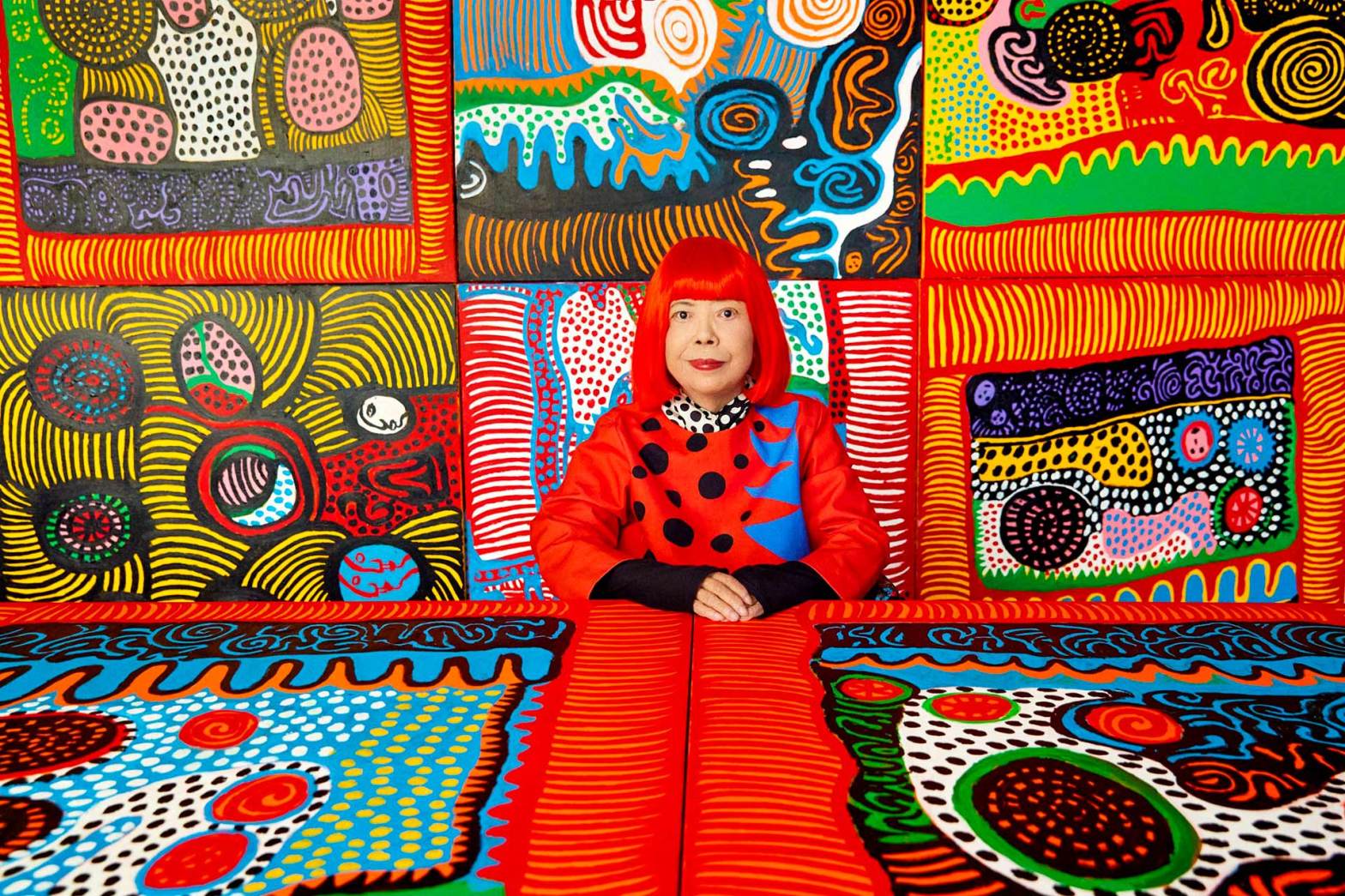
She wears polka dots. Her hair — dyed, in recent decades, a vivid red — echoes the colours of her work. She is photographed constantly, has been photographed constantly for sixty years, and she looks in photographs the way her paintings look: entirely herself, immediately recognisable, slightly too much for the space she is in. She goes to her studio every morning. She covers the surface. She has said that she will work until she dies, not because she is ambitious but because she does not have the option of stopping. The dots accumulate. The nets extend across the canvas. The infinity of the mirror room reaches in every direction from the point where she stands, which is the only point from which she has ever been able to see it clearly.
Works referenced: Infinity Net series (1958–ongoing); Infinity Mirror Room — Phalli’s Field (1965); Aggregation: One Thousand Boats Show (1963); Souls of Millions of Light Years Away (2013); All the Eternal Love I Have for the Pumpkins (2016). Yayoi Kusama, Infinity Net: The Autobiography of Yayoi Kusama (Tate Publishing, 2011). This essay is part of an ongoing series, Encounters, on artists whose practice cannot be easily categorised.
Discover more from My World of Interiors
Subscribe to get the latest posts sent to your email.

