
Obituary
He Painted Palestine from the Ground Up — Literally
Sliman Mansour, 1947–2026. When the occupation cut off his art supplies, he turned to the earth beneath his feet. What he made from mud and henna and olive wood became the visual language of a people.
By Bergotte · August 28, 2026
Sliman Mansour · born 1947, Birzeit, Palestine · died August 24, 2026, Jerusalem · aged 79
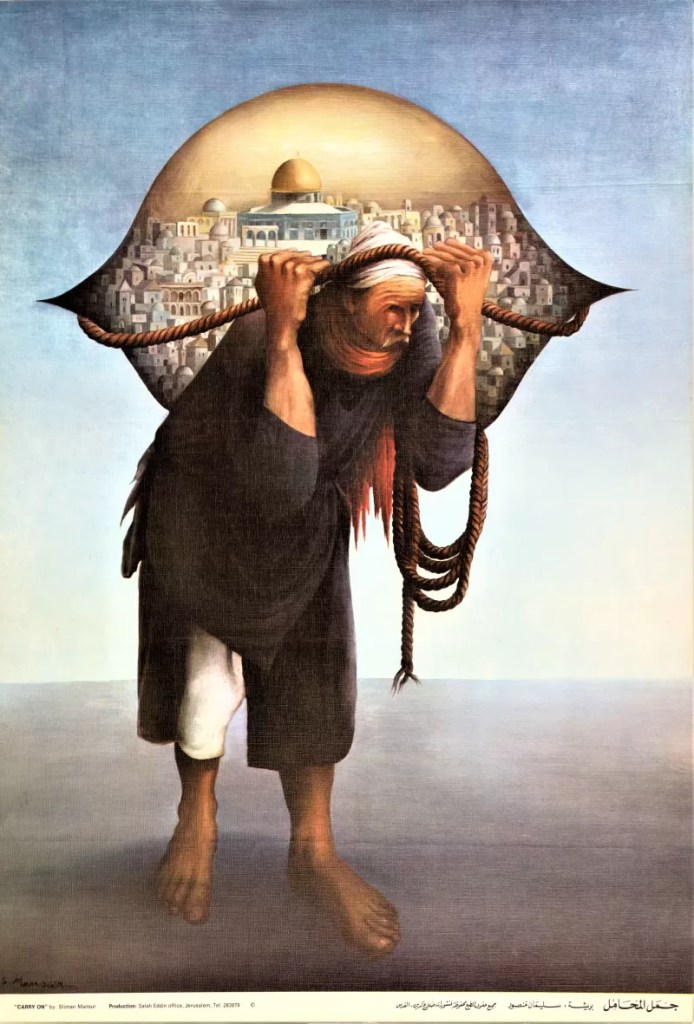
There is an image known everywhere in the Arab world and almost nowhere else, though it deserves to be everywhere. An elderly man, bent almost double under the weight of what he carries — a bundle on his back that resolves, on close inspection, into the skyline of Jerusalem: the Dome of the Rock, the minarets, the old city walls, the whole accumulated weight of a city that is also a people’s claim to existence, borne on the back of a single exhausted figure who is still walking. Still going. Still carrying it. The painting is called Camel of Hardship, or sometimes Camel of Burdens, and Sliman Mansour painted it in 1973, and it became one of the most reproduced images in Palestinian visual culture — on posters, on postcards, on the walls of homes and offices across the Palestinian diaspora, wherever people needed a single image to carry the whole of what they meant when they said the word Palestine.
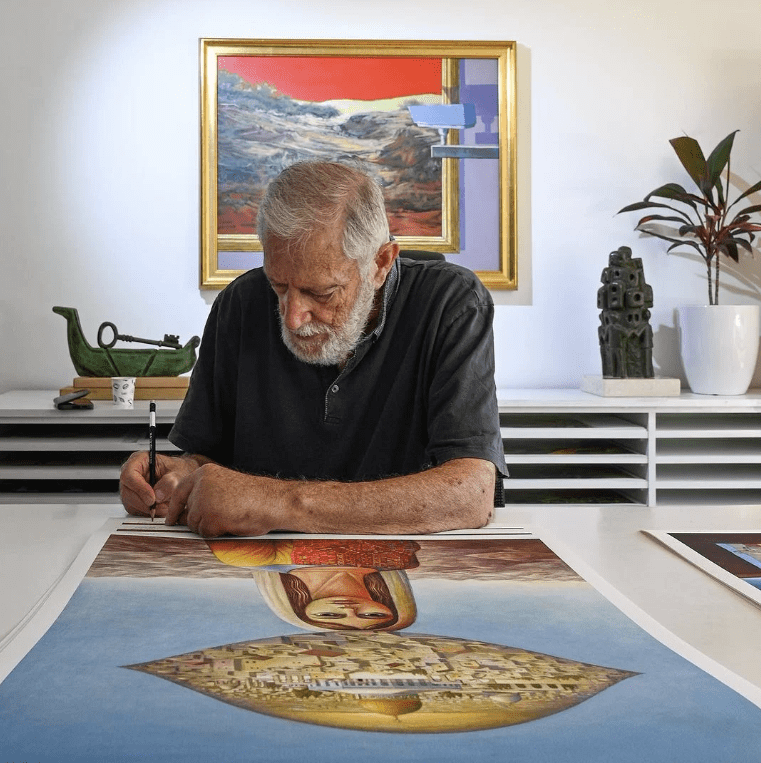
Mansour died on August 24, 2026, in Jerusalem, at the age of seventy-nine. The announcement was made by his family on his verified Instagram account, following a post days earlier that he was in critical condition. He had suffered a stroke in 2021 and had spent his final years in declining health, but he reflected, near the end, that he tried to work daily, to go to the studio, to do something there. The doing of something was, for Mansour, never separable from the act of bearing witness. He bore witness for more than fifty years. The work he left is the testimony.
An elderly man bent almost double under the weight of Jerusalem on his back. Still walking. Still carrying it. The image became one of the most reproduced in Palestinian visual culture — wherever people needed a single image to carry the whole of what they meant when they said the word Palestine.
Birzeit, Then Bezalel, Then the Land
Mansour was born in 1947 in Birzeit, Palestine — one year before the Nakba, the catastrophe of 1948 in which more than seven hundred thousand Palestinians were displaced. He grew up in a landscape already altered by events he was too young to remember but old enough to inherit. He studied fine art at the Bezalel Art Academy in Jerusalem — the art school established under the British Mandate, in which a Palestinian student learned the grammar of Western studio painting while living under the specific conditions of Palestinian life. The tension between those two things — the universal language of art and the particular reality of where and who he was — would govern everything he subsequently made.
His visual language drew deeply from the region’s ancient civilisations — Canaanite, Pharaonic and Assyrian — as well as Islamic and Arab art, particularly calligraphy and geometric motifs. At the same time, his upbringing in Birzeit anchored his work in the everyday life of Palestinian villages: the landscape, peasants, traditional homes and clothing. He was not making folklore. He was insisting, with great formal intelligence, that this specificity — these faces, these olive groves, these women in embroidered dresses, this particular quality of Levantine light on stone — was as worthy of serious pictorial attention as any subject the Western tradition had considered significant. He was making this argument at a moment when the people he was painting were being systematically told that they did not exist.
The Boycott and the Mud
The decision that defined the second half of Mansour’s career was made not in a studio but in a political moment. During the First Intifada, which began in 1987, Mansour co-founded the New Visions collective with Vera Tamari, Tayseer Barakat and Nabil Anani. The artists boycotted Israeli art supplies and turned to materials found locally — mud, henna, coffee, tea, straw, leather, found pottery shards and natural dyes. The boycott was an act of solidarity with the wider civil disobedience of the Intifada, a refusal to participate in the economic structures of the occupation even in the most intimate act of making.
What Mansour discovered in the mud was not a limitation but a revelation. Mud — the basis for human life in many cultures and religions as well as an actual piece of Palestinian land — became a tool of choice for Mansour. His childhood memories shaped the choice: he had worked with his grandmother when she was building beehives and ovens with mud, and that memory inspired him. The material was not exotic. It was the material of daily life, of ancestral practice, of the earth itself — which was, for a Palestinian artist working under occupation, precisely the point. To paint with the earth of Palestine was to make the connection between the artwork and the land it depicted not metaphorical but literal, physical, undeniable.
To paint with the earth of Palestine was to make the connection between the artwork and the land it depicted not metaphorical but literal, physical, undeniable.
He layered and moulded the mud on wooden structures, allowing the material to crack as it dried. The resulting figures carried a sense of fragility and time passing, while the earth itself tied the work physically to Palestine. The cracking was not a flaw but a feature: the map of Palestine drawn in mud that fractures and fragments as it dries — as in his 1996 work Shrinking Object — was the condition of Palestine made visible in the medium that carried it. The material performed the meaning. Mansour continued using mud as a medium even after the end of the First Intifada in 1993, seeing it as a potent medium to explore the Palestinian experience.
Sumud
Mansour’s art moved beyond simple aesthetic expression to become a symbol of Sumud — an Arabic concept meaning steadfastness or perseverance. The word describes a quality that is neither optimism nor resignation but something harder and more specific: the refusal to be moved, the commitment to remaining in place and continuing to exist and continuing to make, regardless of the forces arranged against it. It is the quality of the old man carrying Jerusalem on his back. He is not celebrating. He is not despairing. He is still walking.
Mansour embodied Sumud not as a political programme but as a daily practice. He was a founding member of the League of Palestinian Artists and led it from 1986 to 1990. He organised, he taught, he built the institutional infrastructure of Palestinian art in conditions that were designed to make such infrastructure impossible. When Israeli military orders prohibited the display of the Palestinian flag’s four colours together in the occupied territories, Palestinian artists found ways to keep the colours present in their work — through the watermelon, whose red, green, black and white interior replicated the flag’s palette. An Israeli officer is said to have told artists that even if they painted a watermelon, it would be confiscated. They painted the watermelon anyway. Mansour was among them.
When Israeli military orders prohibited the Palestinian flag’s colours, artists painted the watermelon. An officer said even that would be confiscated. They painted it anyway. Mansour was among them.
What the Work Contains
A complete account of Mansour’s work would require a book, and the book deserves to be written. The paintings of women in traditional Palestinian embroidered dress — not as ethnographic subjects but as individuals, as presences, as people whose specific humanity the painting insists on. The landscapes of olive groves and stone terraces, painted with the attention of someone who knows that these particular trees and these particular stones are contested territory, that the act of depicting them is an act of claiming them. The mud works, in which the earth carries the weight of everything that cannot be said in the conventional language of oil on canvas. The late works using olive wood and natural foliage, extending the commitment to Palestinian materials into new formal territory.
His works are held in international public and private collections, including the Guggenheim Abu Dhabi, Mathaf: Arab Museum of Modern Art in Doha, the Barjeel Art Foundation in Sharjah, Darat Al Funun in Amman, and the Institut du Monde Arabe in Paris. He received the Grand Nile Prize at the Cairo Biennial in 1998, the Palestine Prize for the Visual Arts, the UNESCO Sharjah Prize for Arab Culture in 2019, and the Necip Fazıl Award in 2025. The recognition came, as it tends to come for artists working outside the established centres of the art world, later than the work deserved. Mansour navigated all of this without compromising the essential thing, which was the work, which was the witness, which was the mud.
What Remains
The old man is still walking. He is still carrying Jerusalem on his back, in the image that Mansour made in 1973 and that has been carried, in turn, on the backs of everyone who has reproduced it and pinned it to a wall and kept it — as evidence, as consolation, as a reminder that the weight can be borne even when the weight is everything.
Mansour spent fifty-three years making the visual language of Palestinian identity at a time when that identity was under systematic assault. He made it from the earth of Palestine, from the mud and the henna and the olive wood and the natural dyes that the land provided when everything else had been cut off. He made it with the patience and the stubbornness of someone who understood that the act of making was itself a form of remaining — that to paint, every day, was to insist on the same thing that the old man carrying Jerusalem insists on: that you are here, that you were here, that the weight will be carried, that the walking will continue.
He was seventy-nine years old. The mud is still in the work. The work is still in the world.
Sliman Mansour (1947–2026). Born in Birzeit, Palestine. Studied at the Bezalel Art Academy, Jerusalem. Co-founder of the New Visions collective (1987) and the League of Palestinian Artists. Works held at Mathaf: Arab Museum of Modern Art, Doha; Guggenheim Abu Dhabi; Barjeel Art Foundation, Sharjah; Darat Al Funun, Amman; Institut du Monde Arabe, Paris; and international private collections. Awards include the Grand Nile Prize, Cairo Biennial (1998); Palestine Prize for the Visual Arts (1998); UNESCO Sharjah Prize for Arab Culture (2019); Necip Fazıl Award (2025).
Discover more from My World of Interiors
Subscribe to get the latest posts sent to your email.

