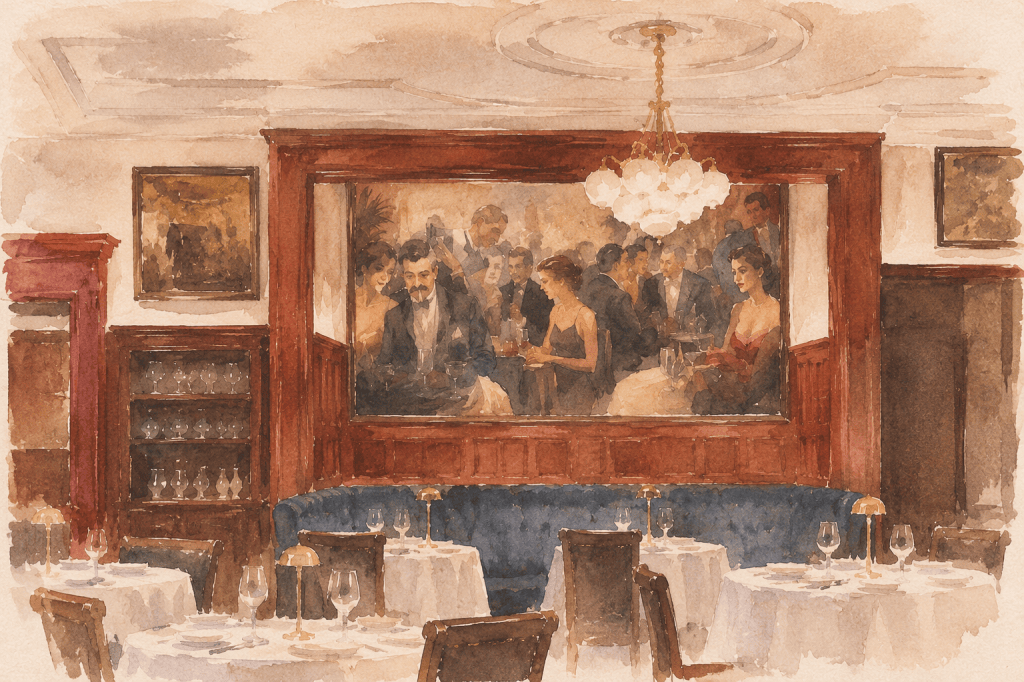
From a Swiss brothers’ pastry shop to the dining rooms of Gilded Age Manhattan, the history of Delmonico’s tells us something about how New York learned to eat, entertain and conduct its social affairs.
The two marble columns framing the entrance to Delmonico’s on Beaver Street are older than the building itself. They were salvaged from its nineteenth-century predecessor and incorporated into the present restaurant when it was constructed in 1891. According to a longstanding story, they originally came from Pompeii, although their provenance has never been conclusively established. By the late nineteenth century, regular customers were apparently touching them for good luck.
It is an appropriate detail for a restaurant whose history has accumulated almost as much mythology as its menu.
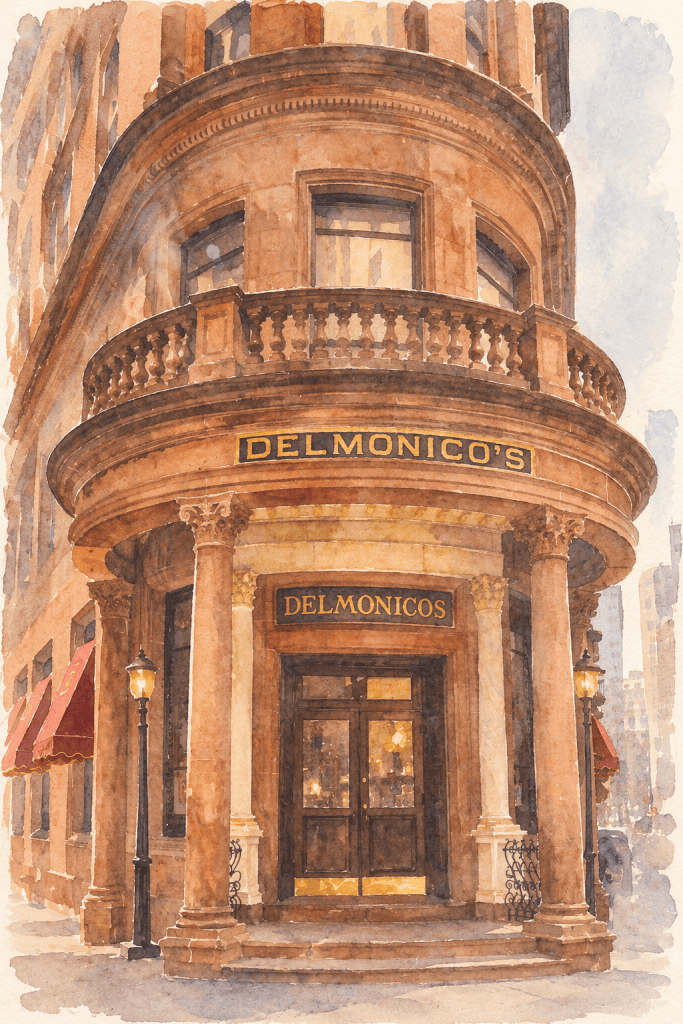
Delmonico’s began in 1827, when two brothers from the Swiss canton of Ticino, Giovanni and Pietro Delmonico, opened a small establishment at 23 William Street in Lower Manhattan. Giovanni had previously worked as a sea captain and wine merchant; Pietro was a trained confectioner. Together, they introduced a style of European hospitality that was relatively unfamiliar in the young American republic.
Their original business sold pastries, confectionery, coffee, chocolate and wine. Service was attentive, ingredients carefully selected, and customers could sit at individual tables. The brothers’ approach attracted a prosperous clientele, particularly among the merchants and financiers working nearby.
In 1831, they expanded into an adjoining property at 25 William Street, opening a French-style restaurant where customers could select individually priced dishes rather than accept a fixed meal. This was an important departure from the communal dining arrangements familiar in many American hotels and taverns.
An eleven-page menu from 1838, preserved by the Museum of the City of New York, illustrates the scale of the brothers’ ambitions. Printed in French and English, with prices expressed in shillings and pence, it offered an extensive selection of soups, fish, meats, vegetables, pastries and wines. The brothers had recognised a market for European restaurant culture among New Yorkers who increasingly expected choice, privacy and attentive service.
The business survived the Great Fire of 1835, which destroyed its William Street restaurant, and in 1837 opened a larger establishment at the triangular intersection of Beaver, William and South William Streets. The new Greek Revival building became known as the Citadel, a reference to its distinctive rounded corner. It stood within walking distance of the Stock Exchange, among the merchants, bankers and brokers who formed much of its clientele.
Under the direction of their nephew Lorenzo Delmonico, who assumed management in 1848, the family developed an increasingly elaborate operation. Private dining rooms accommodated discreet gatherings, while the kitchens prepared banquets and catered entertainments elsewhere in the city.
Delmonico’s also followed the movement of fashionable society northwards, opening establishments around Union Square, Madison Square and eventually Fifth Avenue. At different points, the family operated several restaurants simultaneously.
By the second half of the nineteenth century, dining at Delmonico’s had become an established social ritual among New York’s wealthy families, visiting dignitaries and literary figures.
The kitchen contributed considerably to its reputation. In 1862, the French chef Charles Ranhofer joined the establishment, bringing an extraordinary command of classical cuisine and a willingness to develop dishes for an American clientele.
His substantial cookbook, The Epicurean, published in 1894, contains recipes, service instructions and menus reflecting decades of work at Delmonico’s.
Among its recipes is Alaska, Florida, an elaborate dessert combining sponge cake, apricot preserve, banana and vanilla ice cream, and meringue briefly browned in a hot oven. It is an early documented version of what became known as Baked Alaska, although similar preparations existed before Ranhofer’s recipe.
Delmonico’s is also closely associated with Lobster Newburg, Delmonico Potatoes and the famous Delmonico Steak. Eggs Benedict is frequently included among its inventions, although the dish’s precise origins remain disputed.
The restaurant’s culinary reputation has encouraged some questionable historical claims. One particularly persistent example concerns a supposed Delmonico’s menu from 1834, frequently cited as the earliest printed restaurant menu in America.
In a 2008 study published in Gastronomica, food historians Ellen F. Steinberg and Jack H. Prost investigated the document and concluded that it originated from an unrelated, inexpensive establishment called Small Delmonico’s, operating at 494 Pearl Street during the late 1880s.
The genuine historical menus are interesting enough without such embellishments. An 1899 menu from Beaver Street, preserved by the New York Public Library, documents the continuing importance of French culinary terminology and individually priced dishes. The menus also provide a record of the elaborate dinners through which professional associations, businesses and social organisations conducted their affairs.
Delmonico’s occupied an equally interesting position in the changing social conventions of nineteenth-century America.
In April 1868, the New York Press Club organised a dinner in honour of Charles Dickens at Delmonico’s uptown establishment on Fifth Avenue. Women journalists, including Jane Cunningham Croly, were initially refused tickets despite their professional standing. A subsequent conditional invitation failed to resolve the dispute.
Croly, who wrote under the name Jennie June, helped establish Sorosis, an organisation for professional women. Its members soon began holding meetings and luncheons at Delmonico’s.
The episode is sometimes incorporated into claims that the restaurant pioneered unrestricted dining for women. The reality was considerably more complicated. Delmonico’s accommodated organised women’s gatherings while continuing to enforce restrictions on unescorted female customers. Women were generally excluded from dining alone until the 1880s, and initially their independent access was limited to lunchtime.
Even Ranhofer’s cookbook reflects these distinctions. His instructions for composing a dinner menu specify that an occasion including women should feature lighter, more decorative dishes and an attractive dessert, while an exclusively male dinner should be shorter and more substantial.
The distinction between the two menus reveals the assumptions governing polite society, even within an establishment celebrated for its sophistication.
The restaurant’s architecture offers an equally revealing record of the period.
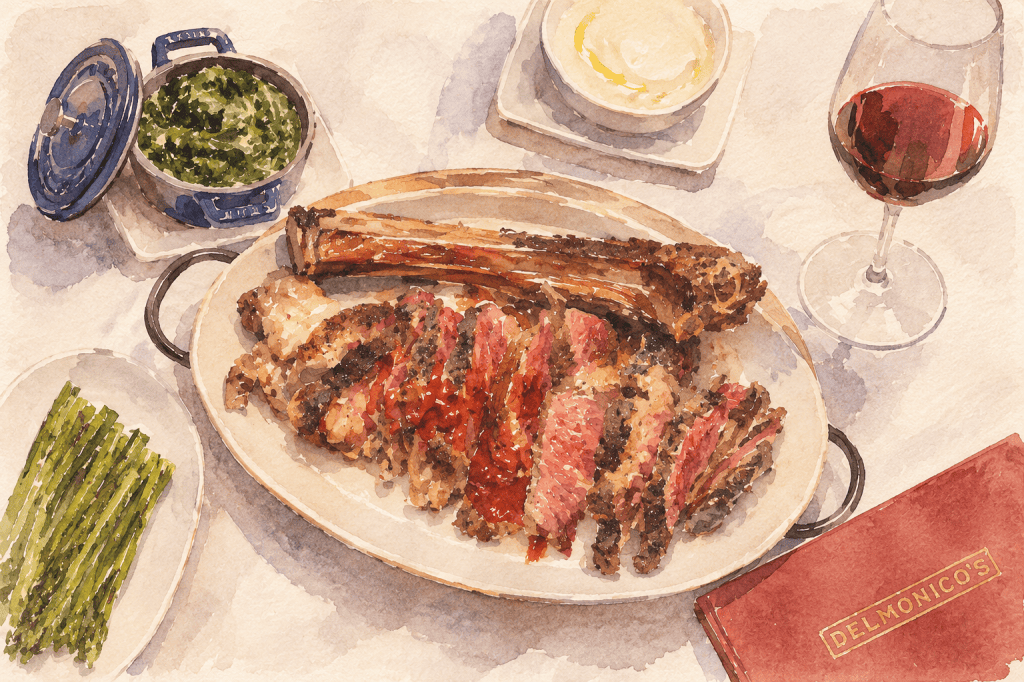
The present building at 56 Beaver Street was designed by James Brown Lord, as documented by the New York City Landmarks Preservation Commission, and completed in 1891. An eight-storey Renaissance Revival structure, it occupies an awkwardly shaped site with a rounded corner entrance, monumental arches, terracotta ornament and a combination of brownstone and orange brick.
Lord’s design retained elements from the earlier restaurant, including the entrance columns and part of its marble cornice, while giving the establishment a considerably larger presence in the expanding financial district.
The arrangement of the interior was particularly interesting. The ground floor accommodated the restaurant and café, the second floor contained private dining rooms, including rooms designated for ladies, and the kitchen occupied the eighth floor. The intervening floors were let as offices.
The building was constructed with an iron-and-steel frame at a reported cost of $360,000 and opened on 7 July 1891. Its commercial arrangement reflected the rapid expansion of Lower Manhattan, where the growing demand for office accommodation had made land increasingly valuable.
The Delmonico family understood these conditions. They could enlarge the restaurant while deriving rental income from a substantial portion of the property.
It was a practical response to the economics of an increasingly expensive city, particularly for a business whose reputation depended upon costly ingredients, elaborate service and an extensive staff.
The original family enterprise eventually declined amid rising operating costs, disagreements among its owners and the economic consequences of the First World War.
In November 1917, following wartime restrictions and the sale of the building, Delmonico’s ceased operating at Beaver Street. Its remaining uptown establishment continued for several years before closing in 1923, affected by Prohibition and rising property values.
The name nevertheless survived. In 1934, restaurateur Oscar Tucci established Oscar’s Oldelmonico Restaurant in the Beaver Street building, subsequently operating under the Delmonico’s name. It began a succession of later incarnations that kept the restaurant’s reputation alive long after the original family business had disappeared.
After another closure in 2020, Delmonico’s reopened in September 2023, once again serving dishes associated with its nineteenth-century history.
The contemporary restaurant is therefore a revival rather than an uninterrupted continuation of the original family enterprise.
What remains most clearly from that earlier period is the building itself. Its entrance preserves architectural fragments from the restaurant erected after the Great Fire, while the upper storeys reflect the commercial calculations of the family that replaced it in 1891.
The Delmonicos’ decision to construct offices above their dining rooms gave the restaurant a lasting place in the financial district’s streetscape. That unusual combination of hospitality and real estate remains visible at the corner of Beaver and South William Streets today.


