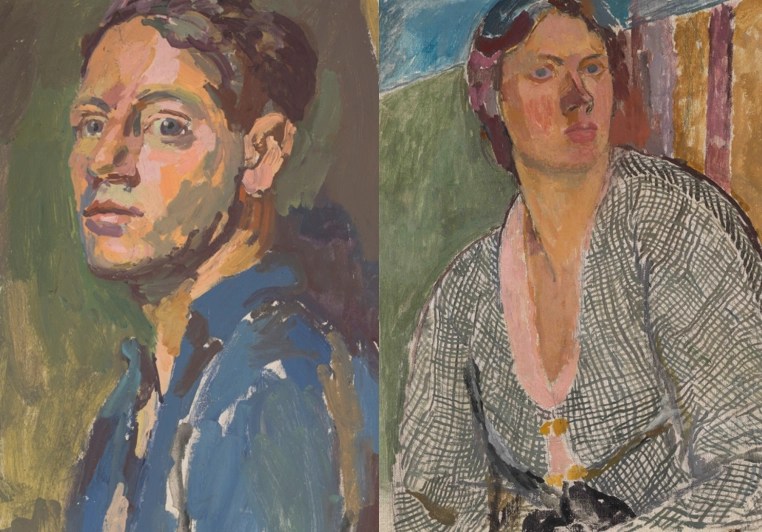
An exhibition at Tate Britain brings together more than 300 works by the two Bloomsbury artists, including paintings, furniture, ceramics and a reconstruction of their studio at Charleston, the Sussex farmhouse that became the centre of their shared artistic life.
In 1914, Vanessa Bell and Duncan Grant painted the same mantelpiece at 46 Gordon Square, the London house that had become a meeting place for the Bloomsbury Group. Bell’s Still Life on Corner of a Mantelpiece approaches the arrangement from below, reducing its carved mouldings to rectangular shapes and the objects above them to broad passages of colour. Grant’s The Mantelpiece retains more of the architectural detail, while introducing pieces of coloured and marbled paper, cut and pasted onto the board before being painted over. Working side by side, the two artists arrived at markedly different interpretations of the same domestic scene.
Both works feature in Vanessa Bell & Duncan Grant: Inside Bloomsbury, which opened at Tate Britain on 12 November 2026. Organised in collaboration with Charleston, the exhibition brings together more than 300 works spanning their five-decade artistic partnership. Its most unusual undertaking is the relocation and reconstruction of the artists’ studio from Charleston, the Sussex farmhouse where they lived and worked for much of their lives.
Bell (1879–1961), the elder sister of Virginia Woolf, trained at the Royal Academy Schools, where she studied under John Singer Sargent. Grant (1885–1978) studied in Paris, encountering French painting at first hand. Their artistic development coincided with a significant change in British attitudes towards modern art, particularly following Roger Fry’s 1910 exhibition Manet and the Post-Impressionists at London’s Grafton Galleries.
The encounter with Cézanne, Gauguin, Van Gogh and other European artists encouraged both painters to reconsider the relationship between representation and form. Bell’s Studland Beach, painted around 1912, remains among her most accomplished early works. Figures gathered on the Dorset shore are reduced to compact silhouettes against broad areas of sand, sea and sky. The composition is almost motionless, its effect dependent on the placement of shapes and the careful balance of colour. Her Abstract Painting of 1914 would take these experiments further, becoming one of the earliest wholly abstract works produced in Britain.
Grant’s Group at Asheham (1913), depicting members of their circle, belongs to the same period of experimentation. His handling of paint was generally more impulsive than Bell’s, whose strongest compositions often display considerable restraint. Seen together, their work makes clear that Bloomsbury modernism accommodated distinct artistic approaches, even among painters who shared studios and materials.
Their experiments soon extended beyond the canvas. In 1913, Bell and Grant joined Fry as co-directors of the Omega Workshops, established at 33 Fitzroy Square in London. The enterprise employed artists to design and decorate furniture, textiles, ceramics and other household objects, applying the formal experiments of Post-Impressionist painting to the domestic interior. Work was produced anonymously, marked only with the Greek letter Ω, reflecting Fry’s belief that an object’s value should not depend on the reputation of its maker.
The workshops offered a practical means of earning money while experimenting with decorative design. Painted chairs, patterned fabrics and ceramic objects carried the same simplified forms and unconventional colour combinations that appeared in Bell and Grant’s paintings. Many of the ideas developed there would find a more permanent setting at Charleston.
Bell and Grant moved to Charleston in 1916 with Bell’s sons, Julian and Quentin, and Grant’s lover, the writer David Garnett. The move was partly dictated by the First World War: Grant and Garnett were conscientious objectors who undertook agricultural work.
The seventeenth-century farmhouse gradually became one of Britain’s most distinctive artist-made interiors. Bell and Grant painted doors, fireplaces, walls and furniture, incorporating their designs alongside pictures, textiles, ceramics and objects collected over many years. Decoration was often spontaneous, responding to the existing architecture and the practical demands of the household. Charleston was never conceived as a completed decorative scheme. After the war, the family returned to London and travelled extensively, continuing to use the Sussex house principally during the summer months until the outbreak of the Second World War.
The familiar image of Charleston as a place of artistic freedom deserves some qualification. The household also employed a nurse, a housemaid and a cook, whose labour supported its unconventional arrangements. Nor were those arrangements without personal consequences. Bell remained married to the critic Clive Bell, although their marriage had developed into a friendship. Her relationship with Grant, who continued to have relationships with men, became a lasting domestic and artistic partnership. Their daughter Angelica, born in 1918, grew up believing Clive Bell was her father and learned the truth at eighteen.
The personal closeness between Bell and Grant did not always benefit their painting. By 1921, Bell had become concerned that their work was growing too similar. During a stay near Saint-Tropez, they agreed to paint in separate rooms and to avoid looking at one another’s work until it was finished. Bell’s Interior with a Table, painted that year, shows the view through French windows towards the Provençal landscape, its warm terracotta and muted greens considerably removed from the sharper experiments of 1914. The decision to work independently allowed both artists to develop their painting without the constant influence of the other.
Their decorative work, meanwhile, continued through a series of commissions. Bell designed book jackets and illustrations for Virginia Woolf, while Grant undertook murals and other large-scale decorative projects. Among their most ambitious collaborations was the Famous Women Dinner Service, commissioned by Kenneth and Jane Clark in 1932 and completed two years later.
The fifty hand-painted Wedgwood plates depict women drawn from literature, history and contemporary culture, including Jane Austen, Sappho and Cleopatra, alongside portraits of Bell and Grant themselves. Arranged into categories of writers, queens, beauties and performers, the service gave historical and cultural figures a place within the conventions of formal dining. Kenneth Clark later recalled his surprise at receiving a series of painted portraits rather than the more conventional decorative service he had anticipated.
The commission is particularly revealing of Bell and Grant’s approach. Each plate was treated as a small painting, with its own subject and composition, while remaining part of a functional dinner service. Their interest in the decorative arts had never required them to abandon the individual painted image.
The exhibition also includes rarely seen erotic drawings by Grant, whose depictions of male sexuality introduce an aspect of his work largely absent from the familiar Bloomsbury interiors. Produced in a period when sexual relationships between men were criminalised in Britain, these works offer a different perspective on an artist whose public reputation has often been shaped by portraits, landscapes and domestic decoration.
Bell and Grant’s importance within British modernism remains open to critical debate. Their early experiments were indebted to developments in French painting, and much of their later work returned to more conventional representational subjects. Yet their sustained engagement with decorative art deserves attention in its own right. Through the Omega Workshops, their commissions and the continuing decoration of Charleston, they developed an approach in which painting could occupy almost any available surface.
The reconstruction of their Charleston studio is therefore especially significant. The room, which they shared until 1939, has been relocated to Tate Britain while conservation work is undertaken at the farmhouse. Its contents provide a material account of their working lives, bringing together the furnishings and objects among which their paintings were made.
There is a difference between encountering these objects in a museum and seeing them within the rooms for which they were created or collected. At Charleston, painted furniture and ceramics belong to an arrangement shaped by decades of use. At Tate Britain, they can be examined individually, alongside the paintings and drawings from which so much of their decorative language developed. The reconstructed studio allows something of that original relationship to remain visible, even within the formal setting of a gallery.
Vanessa Bell & Duncan Grant: Inside Bloomsbury is at Tate Britain, London, from 12 November 2026 to 11 April 2027. Curated by Thomas Kennedy and Eliza Spindel, the exhibition is organised in collaboration with Charleston.
Cover image: (left to right) Duncan Grant, Duncan Grant Self-Portrait [of Duncan Grant] c.1920 (detail). Private Collection © Estate of Duncan Grant. Vanessa Bell Self Portrait c.1915. Yale Center for British Art, Paul Mellon Fund. Courtesy of Tate Org.

