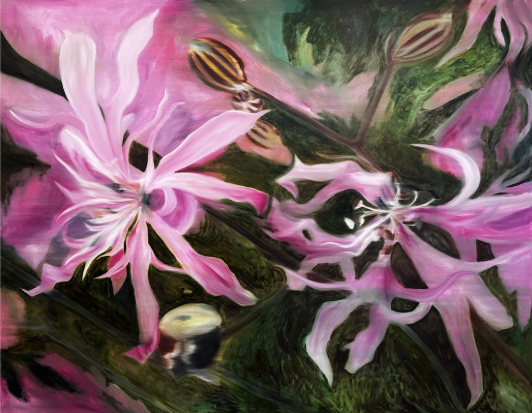
Frederik Nystrup-Larsen examines our diminishing familiarity with the natural world, while photographer Fryd Frydendahl turns her attention to the imagery of American consumer culture. Both exhibitions open on 20 November at V1 Gallery and Eighteen in Copenhagen.
One of Frederik Nystrup-Larsen’s new paintings is titled Skovviol / Early Dog-Violet (2026). The name identifies a particular woodland flower, one of countless plant species that tend to disappear into the general greenery of a landscape. For several years, the Copenhagen-based artist has been interested in how we recognise plants, how we learn their names and why so many remain unfamiliar.
His exhibition, Mother Tongues, opens at V1 Gallery on 20 November. That same evening, the gallery’s neighbouring exhibition space, Eighteen, presents Happy Meal: An American Side Quest by photographer Fryd Frydendahl, whose new work investigates the everyday imagery of the United States, from fast-food restaurants and casinos to superheroes and consumer packaging.
Frederik Nystrup-Larsen: Mother Tongues
Born in 1992, Frederik Nystrup-Larsen studied at the Royal Danish Academy of Fine Arts’ School of Design before completing an MA in Sculpture at London’s Royal College of Art in 2020. His practice encompasses sculpture, painting and installation, often incorporating objects and materials associated with ordinary domestic life.
His recent work has increasingly concentrated on plant blindness, a term introduced in 1999 by the American biology educators James Wandersee and Elisabeth Schussler to describe the human tendency to overlook plants and underestimate their ecological importance.
The phenomenon has since become an established subject of research, although some scientists now favour the term plant awareness disparity, partly because of the ableist implications of the original terminology. Studies have found that people frequently pay greater attention to animals than to plants, even when both are equally visible.
Nystrup-Larsen explored this tendency in Stolen Motifs, Vol. 1, presented at Eighteen in 2024. The exhibition consisted of floral paintings that deliberately embraced decoration, a function sometimes treated with suspicion in contemporary art.
In his accompanying statement, Nystrup-Larsen described decoration as a potentially useful form of propaganda. His suggestion was that the repeated presence of flowers in everyday surroundings might encourage greater attention to the plants themselves. It was a deliberately uncomplicated proposition, pursued through a familiar subject in painting.
The following year, his installation Ivy Fence, presented during CHART in Tivoli, covered a pentagonal glass pavilion with aluminium ivy. The artificial climbing plant complicated the distinction between living vegetation and its decorative imitation.
In 2026, he developed the idea further with CPH Flora, five permanent works commissioned for Copenhagen Airport.
The series depicts plants growing on the airport’s own grounds, particularly in the neglected areas between buildings, asphalt and grass. Nystrup-Larsen painted them on discarded aluminium baseplates from aircraft cargo containers, retaining the scratches and marks left by their previous use.
The project brought the airport’s immediate ecology into its terminals, where passengers are generally more concerned with destinations elsewhere. The choice of material also connected the paintings directly to the infrastructure surrounding the plants.
Mother Tongues develops these interests through language.
The exhibition takes its title partly from the artist’s experience of watching his young son begin to acquire speech. As children learn words, they gradually become capable of distinguishing and identifying things that previously had no individual names.
The exhibition also refers to Ursula K. Le Guin’s The Word for World Is Forest, first published in 1972 and issued as a standalone book in 1976.
In Le Guin’s science-fiction novella, the inhabitants of a forested planet use the same word for their world and its forests. Human colonists, interested in exploiting the planet’s timber, approach the landscape through a radically different set of priorities. The story explores colonial violence and the consequences of treating a living environment primarily as an economic resource.
Nystrup-Larsen’s connection between language and environmental awareness is interesting, although the relationship is less straightforward than the exhibition’s premise might suggest. Knowing the names of plants does not necessarily produce a commitment to protecting them. Environmental destruction involves decisions about land use, agriculture and economic priorities that extend well beyond individual awareness.
His paintings operate on a smaller, more immediate level. By presenting particular species as subjects worthy of sustained attention, he encourages viewers to distinguish between the plants that ordinarily form the background of their surroundings.
Fryd Frydendahl: Happy Meal
At Eighteen, Fryd Frydendahl approaches a very different landscape.
Born in Hvide Sande in 1984, Frydendahl studied at Copenhagen’s Fatamorgana School of Photography and New York’s International Center of Photography. She lived in the United States between 2008 and 2020 and continues to work between Denmark and New York.
Her new exhibition, Happy Meal: An American Side Quest, examines a country whose commercial imagery has become familiar across much of the world.
The subjects include distressed denim, gold-coloured credit cards, amusement parks, fast-food packaging, police officers, superheroes and casinos decorated with imitation Greek interiors.
Frydendahl draws on several photographic approaches, including personal snapshots, street photography, staged reconstructions and images resembling forensic documentation. The exhibition also includes sculptural objects developed from photographic motifs and a new video work.
The variety of methods reflects a longstanding interest in how photographic images influence our understanding of their subjects.
An important early example is Nephews, published as a book and exhibited at V1 Gallery in 2017.
The project began after Frydendahl’s older sister died during childbirth, leaving behind two sons. Frydendahl started photographing her nephews while studying at Fatamorgana, and the work developed over approximately a decade.
The resulting photographs record the boys growing up and their changing relationship with their aunt. The project was also collaborative: the subjects participated in the making of images that gradually became part of their shared family history.
Frydendahl pursued a different investigation in Oddly Satisfying, exhibited at Viborg Kunsthal in 2022 and subsequently at Eighteen in 2023.
The series responded to the online phenomenon of videos showing repetitive or visually gratifying activities, such as slicing materials into precise shapes or pouring glossy substances over surfaces.
Frydendahl photographed her interpretations using an analogue large-format camera. At Viborg Kunsthal, the pictures were presented behind sandblasted glass that restricted the visible image to an area approximately the size of a smartphone screen.
It was a particularly effective decision. Images derived from a digital culture of effortless consumption became physical objects requiring the viewer to approach them closely. Their surfaces retained small imperfections that would ordinarily be eliminated from commercial imagery.
Happy Meal continues Frydendahl’s interest in familiar images and the expectations they create.
Its American subjects are especially suited to this approach. The imitation Greek interiors of a Las Vegas-style casino, for example, already involve an elaborate act of visual construction. Classical architecture becomes a commercial fantasy, reproduced to suggest luxury and spectacle within an environment designed for gambling.
Frydendahl’s photographic treatment introduces another layer of selection and interpretation.
The exhibition’s title is equally suggestive. Happy Meal immediately recalls the carefully packaged pleasures of American fast-food culture, in which familiar images and recognisable branding accompany the products themselves.
Frydendahl’s longstanding relationship with the United States gives her a personal perspective on this material, informed by years spent living and working there. The exhibition brings together imagery associated with entertainment, consumption, religion and national mythology, without requiring these subjects to form a single account of American society.
In 2024, Frydendahl received the New Carlsberg Foundation’s Artist Grant, recognising a photographic practice that has developed considerably since her earliest documentary work.
Happy Meal is her fourth solo exhibition with V1 Gallery.
Exhibition information
Frederik Nystrup-Larsen — Mother Tongues
V1 Gallery
Slagtehusgade 44D, Copenhagen
20 November 2026 – 23 January 2027
Exhibition details — V1 Gallery
Fryd Frydendahl — Happy Meal: An American Side Quest
Eighteen
Slagtehusgade 18, Copenhagen
20 November 2026 – 23 January 2027
Exhibition details — Eighteen / V1 Gallery
Opening reception: Friday, 20 November 2026, 4–9 pm, at both galleries.
Opening hours: Tuesday–Friday, 11 am–5 pm; Saturday, 11 am–3 pm.
Cover image: Frederik Nystrup-Larsen, courtesy of V1 Gallery

