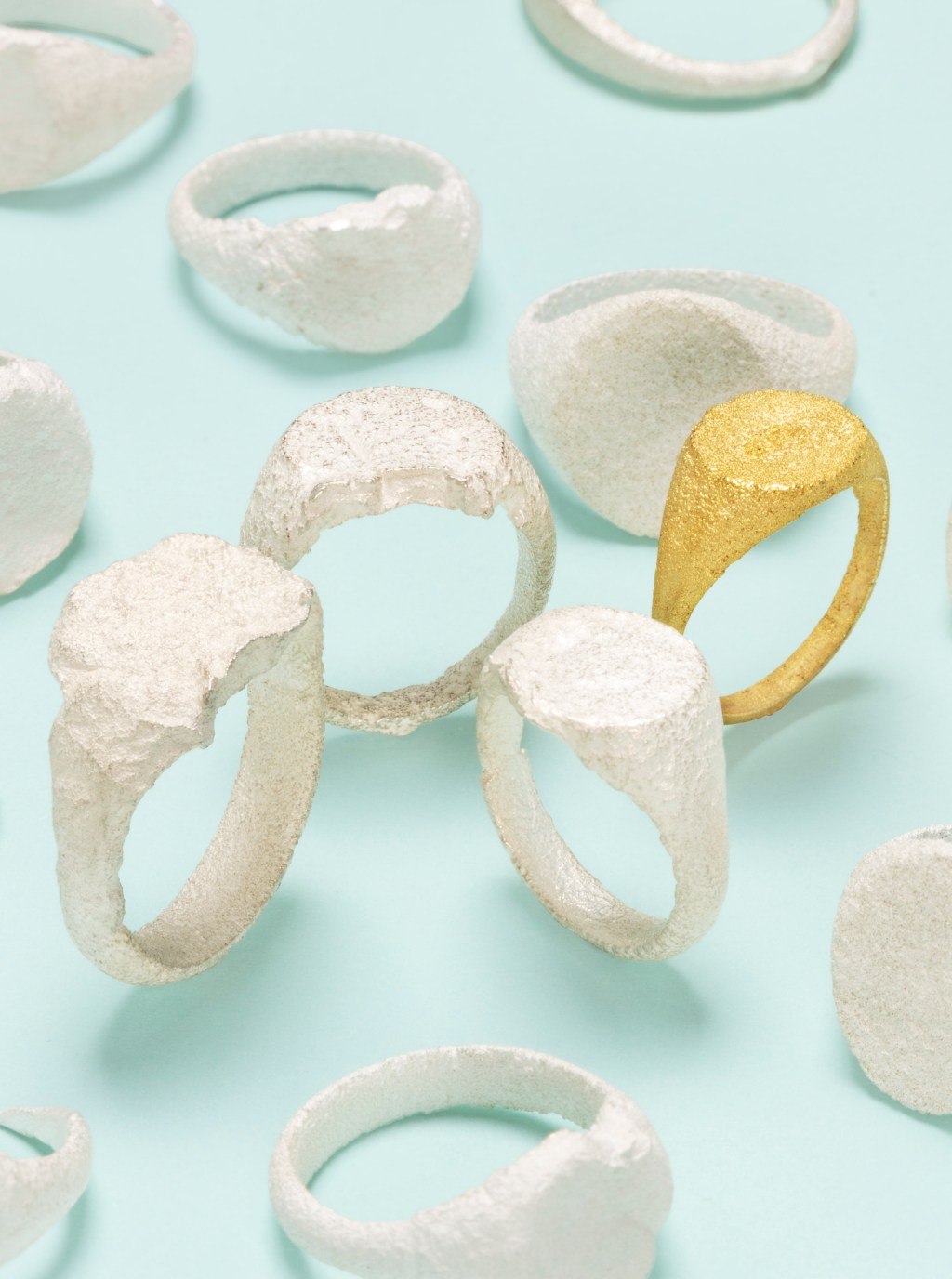
At Designmuseum Danmark, more than 150 works trace the Danish goldsmith’s investigations into craftsmanship, material value and the peculiar relationship between jewellery and its wearer.
The signet rings in Kim Buck’s Opblæst (Puffed Up) series appear to have been inflated. Their swollen forms, rounded edges and puckered seams suggest something made from soft plastic. In the brightly coloured versions from 2012, powder-coated fine silver resembles the material of inflatable toys. The effect is deliberately misleading: beneath their playful appearance lies considerable technical ingenuity.
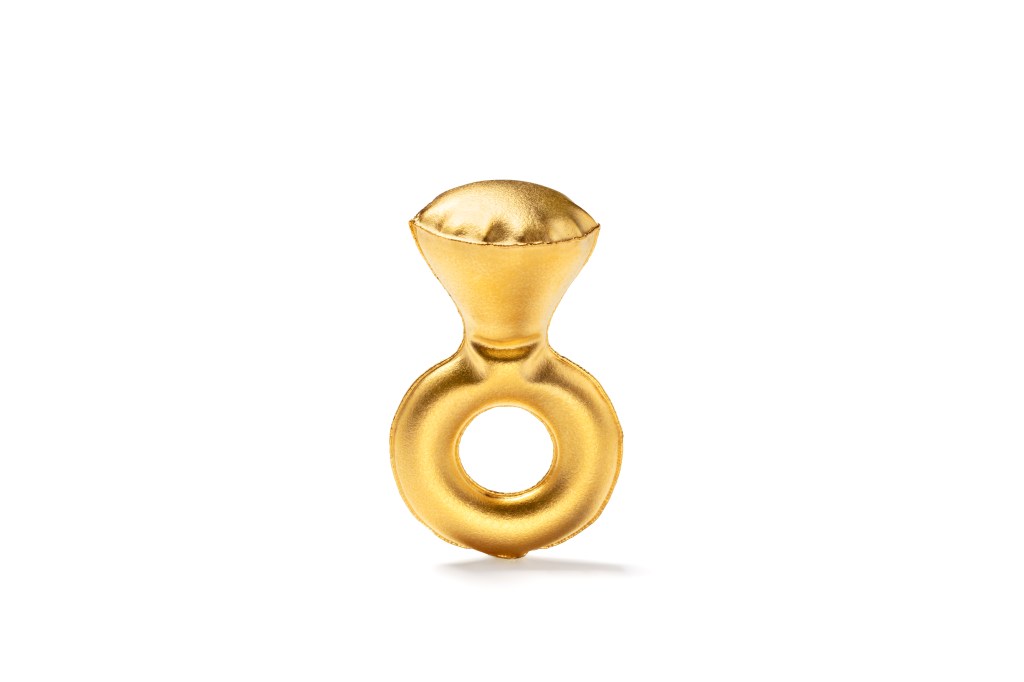
The signet ring has traditionally been associated with ancestry, ownership and social standing. Buck has taken this rather self-important object and given it the proportions of a small balloon. The Danish word opblæst describes something inflated, but also a person with an exaggerated opinion of themselves. The rings are a joke about vanity, executed with exceptional seriousness.
The joke continues after the rings have been sold. Buck has described how they acquire dents and scratches through everyday wear, gradually becoming less inflated and more modest in appearance. Their changing surfaces are part of what interests him.
This longstanding fascination with the meaning and value of jewellery is the subject of LABORATORIUM: Kim Buck at Designmuseum Danmark, which opened on 13 November 2026. Bringing together more than 150 works spanning over four decades, alongside new pieces made for the occasion, it is the most extensive presentation of his work to date.
Video: LABORATORIUM: Kim Buck – by Birgitte / Myworldofinteriors.com
Photography: Dorte Krogh, except Elsker, elsker ikke (2007), photographed by Anders Sune Berg. Images courtesy of Designmuseum Danmark.
Born in Odense in 1957, Buck grew up in Thisted, in northern Denmark, where his father operated a metalworking business specialising in aluminium. The workshop stood beside the family home, and Buck spent much of his childhood surrounded by machinery and materials.
He began training as a goldsmith in the late 1970s, qualifying in 1982. Much of his apprenticeship was devoted to repairing jewellery, an experience that provided an education in how people actually use and value their possessions. Rings arrived worn or damaged after years of contact with their owners. Their significance could rarely be established by examining their materials alone.
Between 1983 and 1985, Buck continued his education at Guldsmedehøjskolen, during a period of considerable experimentation in contemporary jewellery. Aluminium, rubber, steel and plastic challenged the profession’s traditional dependence on precious metals. For Buck, who had grown up handling industrial materials, these experiments were a natural extension of what he already knew.
His subsequent career has combined traditional goldsmithing with increasingly conceptual investigations into the conventions of his profession. He has designed commercially, including for Georg Jensen, while developing an independent artistic practice. His work has entered international collections, including the Victoria and Albert Museum in London and the Museum of Arts and Design in New York.
Throughout these activities, Buck has remained emphatic about his professional identity. As he explained in a conversation published by Formkraft in June 2026, he consistently calls himself a goldsmith. Everything he makes begins with the craft, and he insists upon being able to produce his own work.
One of the most revealing examples of his approach is Kopi (Copy, 2007), which developed from an encounter with a damaged family ring.
The ring had belonged to a customer’s grandparents. Its opal was damaged, and the gold band had become so worn that it had broken. Nevertheless, family members continued to carry it as a good-luck charm, taking it with them to examinations, birthdays and visits to the dentist.
Buck was struck by the discrepancy between the ring’s physical condition and its importance to the family. He received permission to make an exact copy, which he subsequently exhibited alongside the original.
The newly made ring restored the appearance of a functional piece of jewellery. The original, with its damaged stone and broken band, remained the object to which the family attached its feelings. Replication could reproduce its appearance, but had no means of transferring its history.
The episode helped redirect Buck’s attention towards what happens to jewellery after it leaves the workshop. The maker may determine its form and materials, but its subsequent significance develops beyond his control.
This concern runs through works that initially appear light-hearted.
In Perleplade (Pearl Plate, 2007), 169 cultured pearls are combined with polyamide and 18-karat gold. The title refers to the familiar children’s activity of arranging plastic beads on a pegboard. Buck brings the language of an inexpensive childhood pastime into an object made with materials associated with luxury jewellery.
The choice of pearls is particularly apt. Their regularity and lustre give the work an appearance of refinement, while its construction recalls a craft activity that requires patience rather than specialist training. The difference in status between the two forms of making is precisely what makes the combination interesting.
Language is equally important to Buck’s practice. Familiar sayings, popular expressions and established jewellery motifs frequently become the starting points for new works.
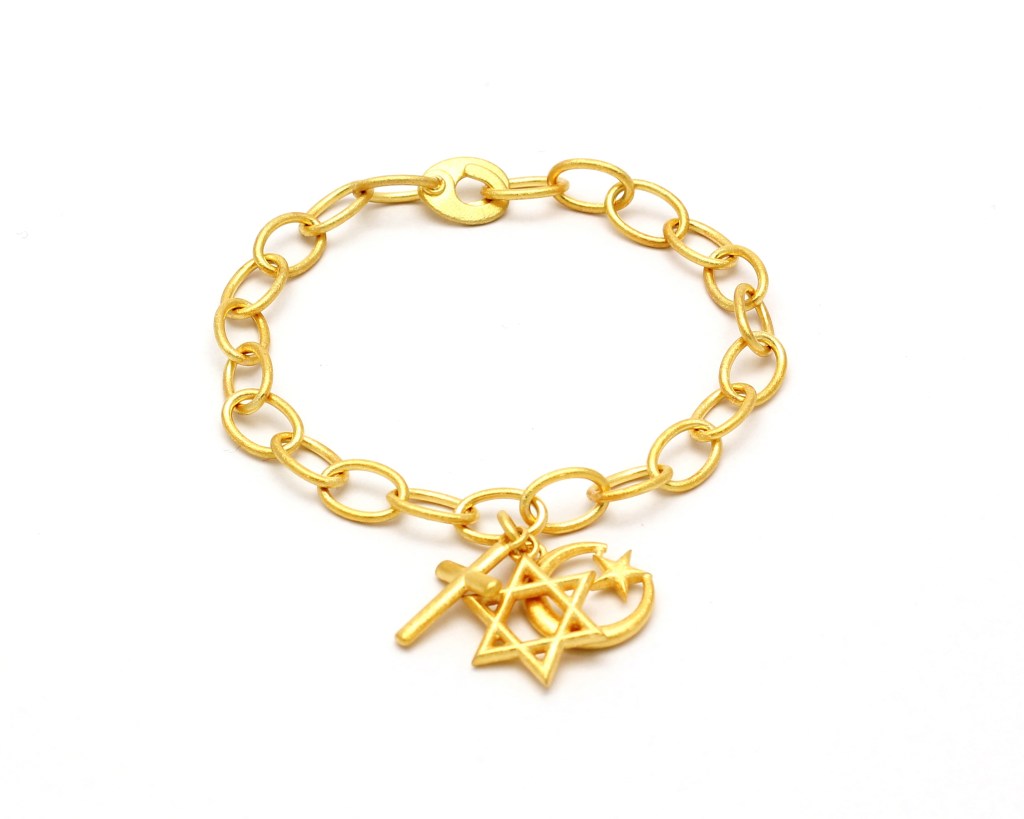
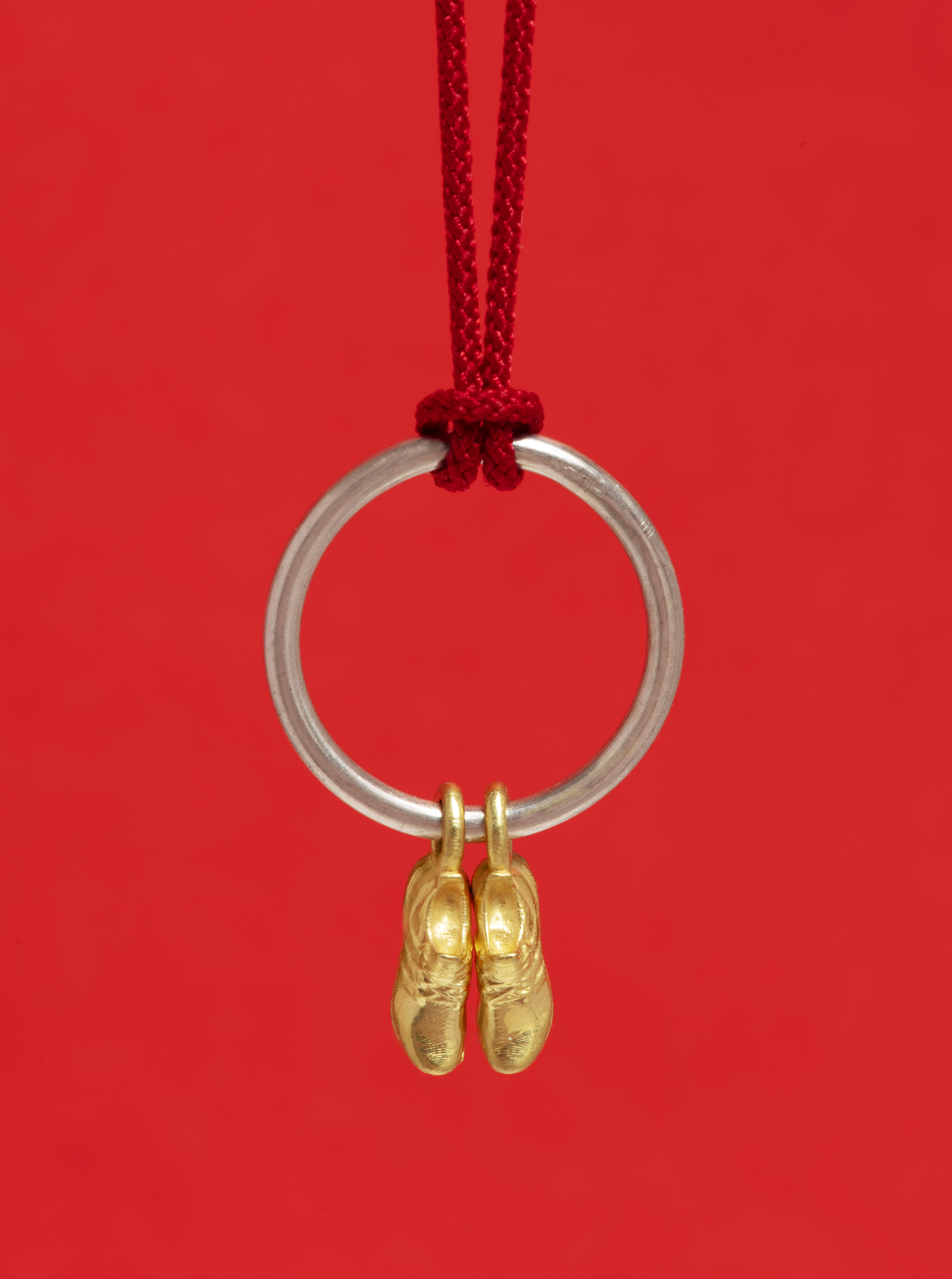
In Tro, håb og kærlighed (Faith, Hope and Love, 2005), he revisits the traditional Christian jewellery symbols of the cross, anchor and heart. He retains the cross but replaces the other two emblems with the Star of David and the Islamic crescent.
The three symbols, executed as charms in 18-karat gold and presented in a red case, propose a shared language of religious tolerance. The title is taken from the Christian tradition, while the objects broaden its customary symbolism to encompass Judaism and Islam.
Elsewhere, Buck’s attention turns towards the conventions of Danish jewellery itself.
The marguerite brooch has occupied a distinctive place in Danish decorative culture since the 1940s. Associated with Princess Margrethe, later Queen Margrethe II, the white enamel flower became an enduring emblem of respectable taste and national affection. Its familiar design remains part of the Georg Jensen Daisy collection.
Buck began experimenting with the motif in 2003, producing a series of altered daisies. By 2007, he had progressed from creating his own interpretations to working directly with existing Georg Jensen brooches.
In Elsker, elsker ikke (Loves Me, Loves Me Not, 2007), he used the original brooches as readymades, manipulating their forms and adding his own maker’s mark alongside that of Georg Jensen. Some petals became detached during the process, leaving incomplete flowers and separate pieces.
The title invokes the childhood ritual of removing petals to discover whether one’s affections are returned. Yet there was another ambiguity involved.
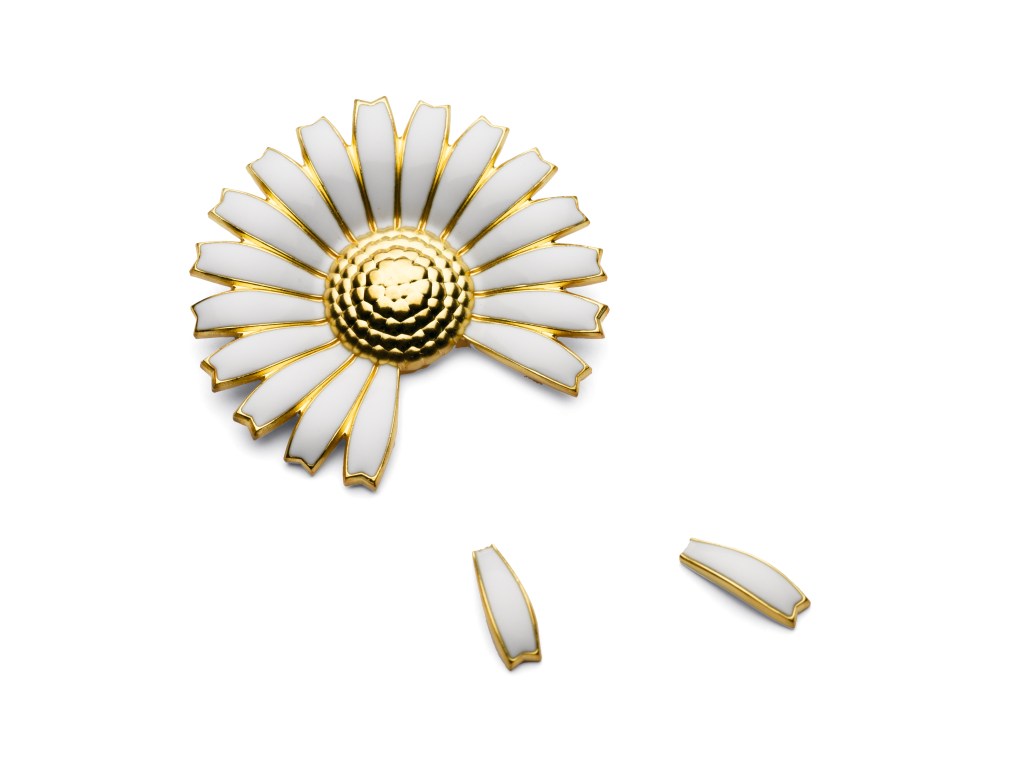
As the art historian Jorunn Veiteberg documented in her 2007 study of Buck, the work also reflected his complicated feelings towards Georg Jensen, a company for which he had previously designed.
The intervention is unusually pointed. Buck had worked within the commercial organisation whose emblem he was now altering. By placing his own mark beside the manufacturer’s, he made authorship itself part of the work. The familiar flower became a means of examining the distinction between a commercial design and an individual artistic statement.
Such works reveal a tension within contemporary jewellery. An object may criticise the conventions of luxury while remaining desirable, rare and expensive. Its workmanship and association with a recognised artist may even increase its commercial appeal.
Buck’s jewellery does not escape this contradiction. His technical skill is one of the reasons collectors seek out his work, including pieces that question the values of the jewellery market. His irreverence towards established symbols coexists with a serious commitment to their making.
One of the new works presented in the exhibition, MAMMON (2026), makes this relationship particularly explicit.
It consists of a five-gram bar of 24-karat gold bearing the stamped word MAMMON, the biblical term associated with wealth and material possessions.
The gold bar is an object whose value can be calculated with unusual precision. Its weight and purity are the principal characteristics by which it is traded. Buck leaves this economic identity intact and adds a word that introduces a moral judgement about the pursuit of wealth.
There is something deliberately uncomfortable about the result. Gold becomes the material through which a goldsmith questions the importance attached to gold, while the completed work remains an object made from a precious commodity.
The contrast with Kopi is revealing. In one, the value of the material can be measured almost exactly. In the other, the object’s damaged condition has little bearing on its importance to the people who possess it. Both belong to the same investigation, conducted through very different means.
Buck’s interest in these questions has been explored at length by Veiteberg, most recently in her 2021 book The Real Thing: Jewellery and Objects by Kim Buck. His career offers an extended examination of the assumptions surrounding jewellery, from the meaning of precious materials to the authority of familiar religious and national symbols.
The Designmuseum exhibition forms the fifth instalment of its LABORATORIUM series, which examines the working processes of contemporary designers and craftspeople. The format is well suited to Buck, whose ideas frequently emerge through attempts to develop unfamiliar techniques.
He has described how he sometimes begins with a title and searches for a way to make it tangible. At other times, an experiment with a material produces a form whose meaning only becomes apparent afterwards. He rarely relies on elaborate preliminary drawings, preferring to work directly with materials.
In a 2018 interview with Art Jewelry Forum, Buck explained that he considers almost all his jewellery suitable for wearing. This conviction places his work in an interesting position within the museum, where objects intended for physical contact are necessarily separated from their owners.
The Opblæst rings offer a particularly good illustration of what may be lost under those conditions. In a display case, their swollen surfaces remain intact, inviting admiration for the skill required to make them. On the hand, they begin to change.
Buck has spent decades considering the significance of this ordinary process. He makes the ring, but cannot determine who will wear it, how it will be treated or what personal associations it may eventually acquire. The dents and scratches that accumulate through use are additions that no amount of technical precision in the workshop could have supplied.
All photography by Dorte Krogh. Courtesy of Designmuseum Danmark.
LABORATORIUM: Kim Buck is at Designmuseum Danmark, Copenhagen, from 13 November 2026 to 9 May 2027.
Cover image: Dorthe Krogh courtesy of Designmuseum Danmark

