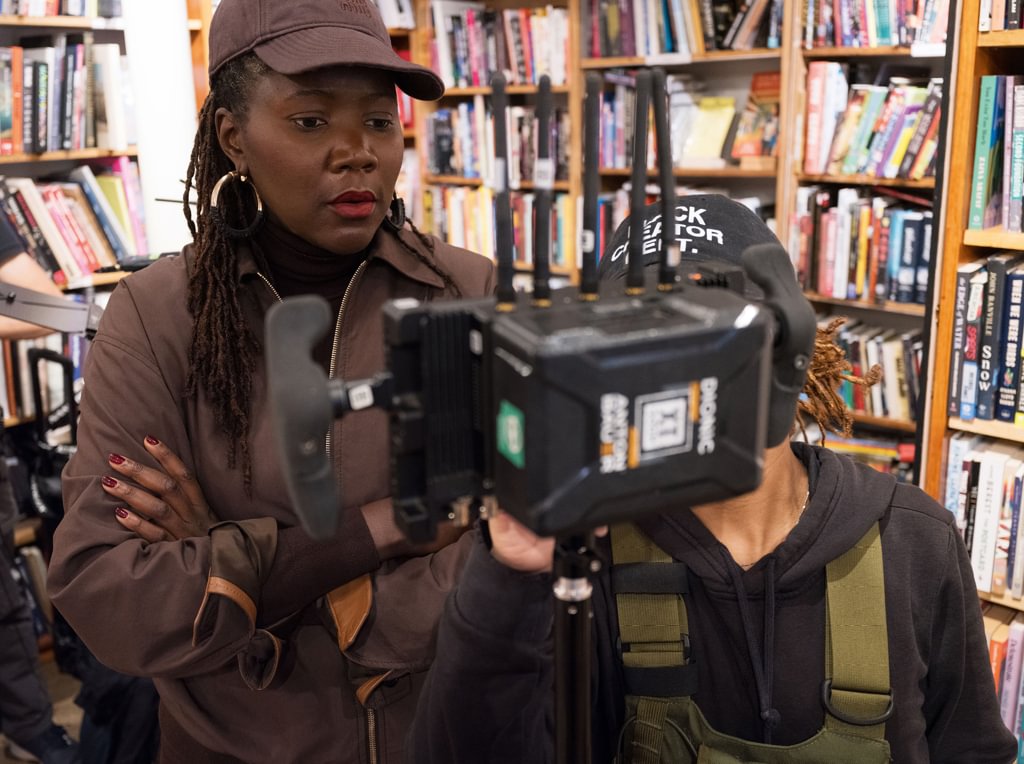
At Art Basel Paris 2026, French filmmaker Alice Diop brought together photography, cinema, sculpture, literature and performance in an extraordinary examination of Black female creativity. Presented by Miu Miu, Geste de Consolation proposed that confronting the violence of art history might also create the possibility of repair.
Between 21 and 25 October 2026, the great concrete halls of Paris’s Palais d’Iéna became the setting for an unusually personal exhibition. Conceived by French filmmaker Alice Diop at the invitation of Miuccia Prada, Geste de Consolation brought together women whose work had profoundly influenced Diop’s understanding of herself, her history and her artistic practice.
Presented by Miu Miu as part of Art Basel Paris’s public programme, the exhibition marked Diop’s first venture into curating. Its title, Gesture of Consolation, suggested something more complex than comfort. Diop wanted to confront the historical representations of Black women that have shaped Western culture, while creating a space in which those women could determine how they wished to be seen.
The project involved some of the most significant contemporary artists working across the African diaspora, including Zanele Muholi, Simone Leigh, Nadia Beugré and Angel Bat Dawid.
Rather than assemble their work into a conventional exhibition, Diop organised the experience as a sequence of encounters, borrowing the narrative principles of cinema to move visitors through four interconnected spaces.
From Cinema to the Politics of Representation
Born in 1979 to Senegalese parents and raised in the Parisian suburb of Aulnay-sous-Bois, Alice Diop established her reputation through documentary filmmaking.
Her films examine the social and psychological experiences of people frequently absent from dominant accounts of French national identity. Nous (We, 2021) follows the communities living along a suburban railway line outside Paris, while Saint Omer (2022), her first narrative feature, reconstructs the trial of a French-Senegalese woman accused of killing her infant daughter.
Saint Omer, awarded the Silver Lion Grand Jury Prize at Venice, established Diop as one of the most intellectually distinctive filmmakers of her generation. Its achievement lies in the tension between the public judgement of a woman and the intimate histories that remain inaccessible to those judging her.
The concerns of Geste de Consolation were already present.
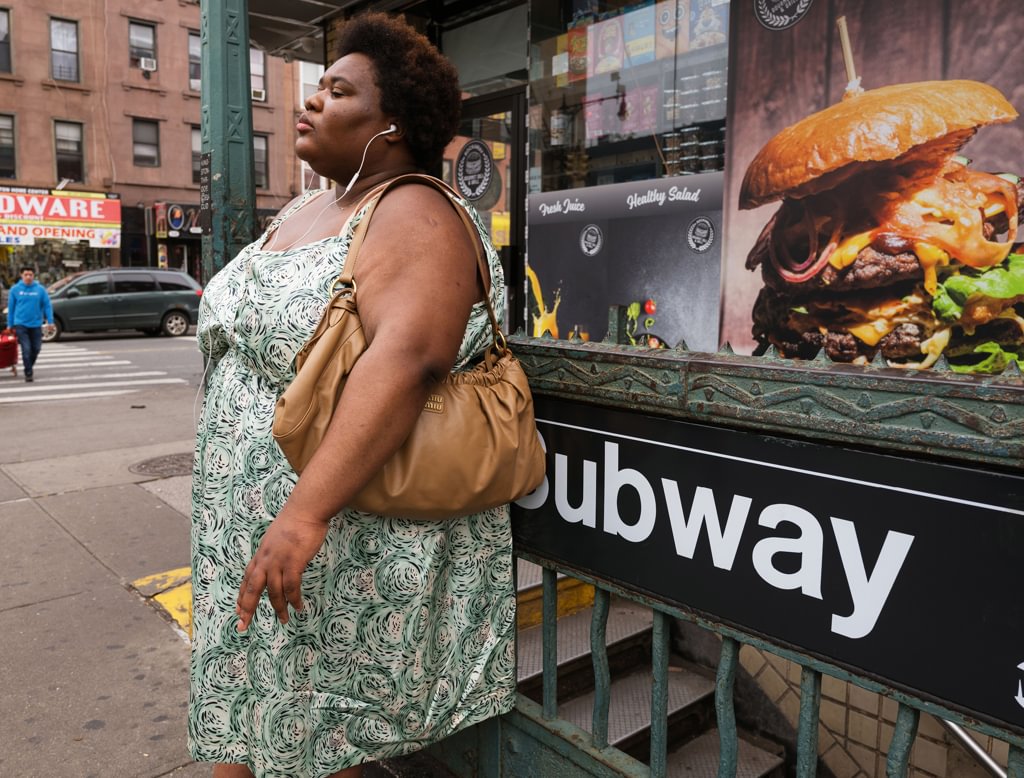
In 2025, Diop directed Fragments for Venus, the thirtieth film in Miu Miu’s Women’s Tales series. Inspired partly by American poet Robin Coste Lewis’s Voyage of the Sable Venus, the film follows a Black woman studying paintings in a museum while another walks through Brooklyn, encountering Black women whose presence challenges the limited representations of the past.
The film’s central question concerns the authority of images. Who creates them, who classifies their subjects, and how do those representations continue to influence the lives of the people depicted?
The 2026 exhibition expanded this investigation into physical space.
Four Rooms, Four Ways of Seeing
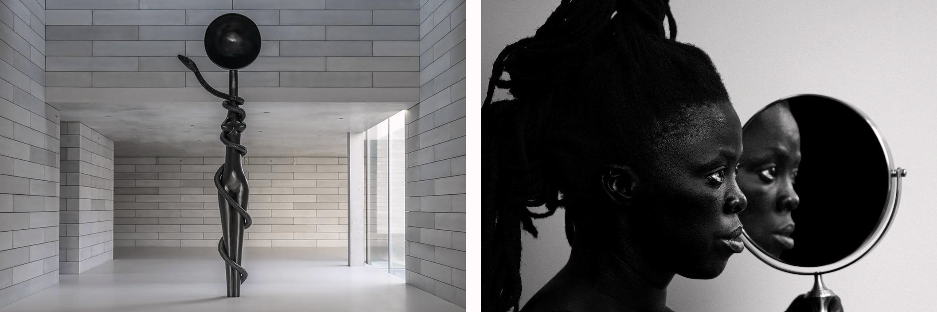
Visitors first encountered a photograph by South African artist and visual activist Zanele Muholi.
Muholi’s celebrated self-portraits deliberately confront the conventions of ethnographic photography, reclaiming control over the depiction of the Black body. The choice provided a particularly meaningful introduction to an exhibition concerned with looking and being looked at.
Beyond the photograph, Diop presented a two-screen video installation combining historical film material with images that had shaped her own cinematic imagination.
Much of the archival footage originated in colonial-era ethnographic and so-called scientific expeditions. These films frequently recorded African women as specimens or objects of observation, their identities subordinated to the supposed authority of the camera.
By returning to these images, Diop exposed the power relationships embedded within the history of moving pictures.
The following space offered a striking change of atmosphere.
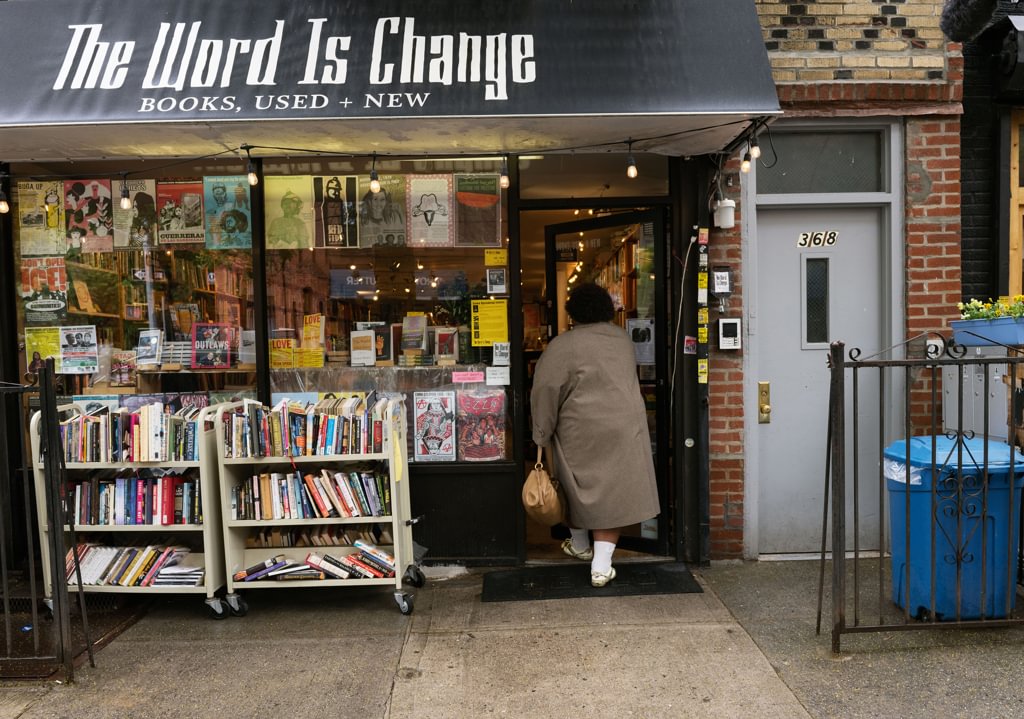
Called Chambre à soi — A Room of One’s Own, after Virginia Woolf’s influential essay — it contained a public library furnished with richly coloured carpets incorporating designs by Mary Lee Bendolph, the distinguished American quiltmaker associated with Gee’s Bend, Alabama.
Here, Diop’s intellectual life became the subject of the exhibition. Books by Audre Lorde, Zadie Smith, Virginia Woolf, Marguerite Duras and other writers occupied a space conceived for reading, reflection and conversation.
The inclusion of Bendolph was particularly significant. The quilts of Gee’s Bend emerged from a tradition in which African American women transformed the domestic necessity of sewing into an extraordinarily inventive visual language, much of it developed outside established art institutions.
In the setting of the Palais d’Iéna, the textile designs introduced a material history of Black female creativity that was both intimate and monumental.
The exhibition then opened into an arena for readings, dance and music. Texts by Zora Neale Hurston, June Jordan, Audre Lorde, Marie NDiaye and Zadie Smith were performed aloud, alongside an adaptation of Ivorian choreographer Nadia Beugré’s Prophétique.
Chicago musician Angel Bat Dawid and her ensemble, Sistazz of the Nitty-Gritty, brought improvisation and collective musical expression into the space.
The movement from archival image to literature, performance and music was deliberate. Diop was developing an alternative to the passive consumption of images, allowing voices and bodies to occupy the space on their own terms.
The Monumental Presence of Simone Leigh
The exhibition culminated with Simone Leigh’s Sentinel (Mami Wata) (2020–21).
Standing nearly five metres tall, the bronze depicts an elongated female figure encircled by a serpent, referencing the powerful water spirit Mami Wata, whose imagery has developed across West Africa and its diasporas.
Leigh’s artistic practice has consistently examined the representation of Black women through sculpture, architecture and the material traditions of African and African American cultures.
Her figures possess an extraordinary physical authority. Rather than reproduce the historical objectification of Black women, they claim an imposing presence that does not depend upon the spectator’s approval.
For Diop, Leigh’s work represented the possibility of something restorative. The encounter with the sculpture offered an alternative to the disturbing images presented at the beginning of the exhibition.
The visitor moved from a visual history in which Black women were repeatedly denied agency towards a monumental figure whose power and significance existed entirely on her own terms.
The progression was neither accidental nor simply theatrical. It gave the exhibition its intellectual structure.
The Architecture of Consolation
The setting added a further dimension to the experience.
The Palais d’Iéna, designed by Auguste Perret and completed in 1939, is among the most accomplished examples of French concrete modernism. Its monumental columns and rigorous proportions provide an architecture associated with institutional authority.
It is also familiar as the location of Miu Miu’s fashion shows.
Diop transformed this setting through an arrangement that alternated between enclosure and openness, individual reflection and collective participation.
The domestic warmth of the library contrasted with the severity of the surrounding architecture. The performance arena made spectators visible to one another, while Leigh’s sculpture introduced a final encounter with an image that seemed to resist ordinary observation.
Diop’s use of space recalled cinematic editing. Each room altered the meaning of what had preceded it; the significance of the exhibition emerged through the visitor’s movement between them.
This is an important distinction from conventional exhibition design, where individual works can often be approached in almost any order. Here, the sequence itself became part of the argument.
Beyond the Fashion Exhibition
Miu Miu’s involvement belongs to a broader programme of cultural commissions initiated under Miuccia Prada. The house became an official partner of Art Basel Paris’s public programme in 2024, presenting Goshka Macuga’s Tales & Tellers, followed by Helen Marten’s 30 Blizzards in 2025.
Such collaborations inevitably raise questions about the relationship between luxury brands and cultural institutions. They also create opportunities for artists to work with resources, spaces and audiences that might otherwise remain inaccessible.
What made Diop’s contribution distinctive was the degree to which the project retained the intellectual concerns of her existing practice.
The exhibition did not simply celebrate Black female creativity as a fashionable cultural subject. It examined the historical circumstances in which that creativity has developed, the ways it has been excluded from institutional recognition, and the artistic forms through which women have challenged those exclusions.
Its argument was ultimately about the difference between representation and agency.
For centuries, Black women have appeared in Western art as figures interpreted through the desires, assumptions and authority of others. Diop’s exhibition considered what becomes possible when those women participate in constructing the images and narratives through which they are understood.
In 2026, when museums and cultural institutions continue to reconsider the omissions and inherited hierarchies of their collections, that question remains urgent.
Geste de Consolation suggested that confronting historical violence need not mean allowing it to determine every subsequent image. Art can preserve difficult histories while also making room for imagination, intellectual freedom and forms of beauty that emerge from the people whose experiences it represents.

