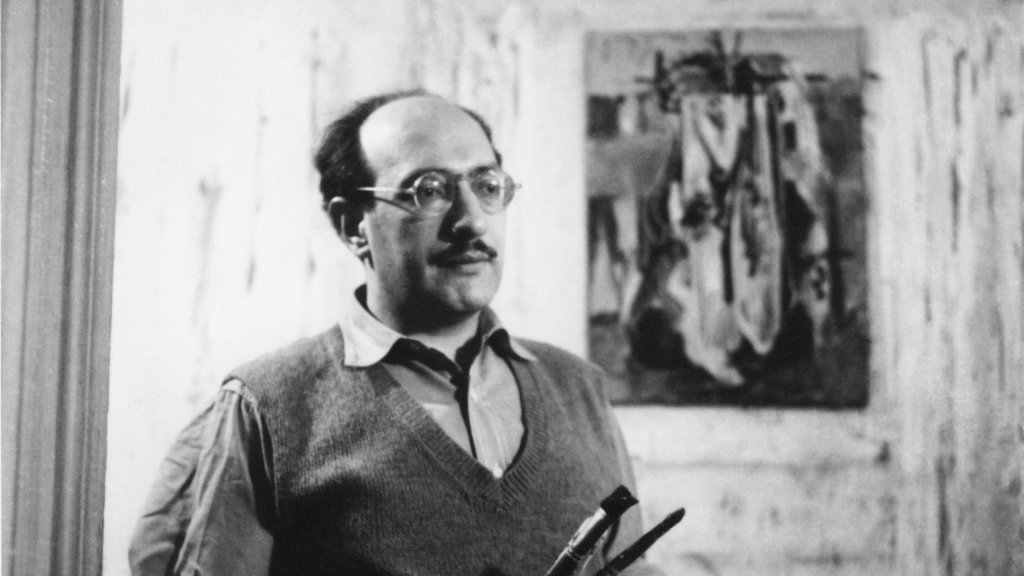
The Tragedy of Colour
Mark Rothko spent thirty years insisting that his paintings were not about colour. They were about tragedy, ecstasy, and doom. He was right, and the insistence cost him everything.
There are instructions for how to look at a Rothko. You are supposed to stand close — much closer than you think, closer than the instinct for comfortable viewing distance suggests, close enough that the canvas fills your peripheral vision and the edges of it disappear. You are supposed to stay for a while. You are supposed, ideally, to be alone, or as close to alone as a museum allows. Under these conditions something happens that is difficult to describe and that Rothko spent much of his working life trying to describe and that the descriptions have never quite captured: the colour begins to move. The rectangles of pigment, which from a distance look flat and static, reveal at close range a surface that breathes — layers of translucent paint built up and scraped back, the colours beneath showing through the colours on top, the whole surface vibrating with a quality of light that seems to come from inside the canvas rather than from any external source.
People cry in front of Rothko paintings. This is documented, discussed, occasionally disputed. The Rothko Chapel in Houston — a non-denominational chapel containing fourteen large paintings made specifically for it, in near-black purples and maroons, completed in 1971 — is one of the places where people cry most reliably, and most people who cry there are not people who expected to cry there, and many of them cannot subsequently explain why. Rothko would not have been surprised. He would have been gratified, though he would not have said so. He would have said instead, in one of the formulations he returned to across decades of interviews and lectures and late-night arguments with other painters, that he was interested in expressing basic human emotions — tragedy, ecstasy, doom — and that anyone who was moved by his paintings was having the same religious experience he had when he made them. He said this often enough that people eventually believed him. He was right, and being right about it did not make him happy.
The colour begins to move. The rectangles of pigment reveal at close range a surface that breathes — layers of translucent paint built up and scraped back, the whole surface vibrating with a quality of light that seems to come from inside the canvas.
Dvinsk to New York
Marcus Rothkowitz was born in 1903 in Dvinsk, in the Russian Empire — now Daugavpils, in Latvia — the youngest of four children in a Jewish family of sufficient education and sufficient anxiety about the future of Jews in Russia that his father emigrated to America in 1910 and sent for the family two years later. Marcus was ten when he arrived in Portland, Oregon. His father died within months of the family’s reunion. The childhood, from this point forward, was conducted in a condition of precariousness — financial, social, linguistic — that left marks on the adult that the adult’s success never entirely erased.
He went to Yale on a scholarship, found it cold and exclusionary, left after two years, and arrived in New York in 1923 without a plan. He took drawing classes at the Art Students League, began painting, began calling himself Mark Rothko — the name change in 1940, the American name for the American career, though also an erasure of the Latvian-Jewish boy from Dvinsk who had arrived at ten with no English and a dead father. He painted for two decades before he found what he was looking for, working through Expressionism and Surrealism and mythology and biomorphic abstraction, producing work that was serious and accomplished and that he later largely disowned. He was looking for something he could not yet name. When he found it, around 1949, he recognised it immediately.
The Luminous Rectangles
What he found were the rectangles: two or three soft-edged blocks of colour, stacked vertically on a large canvas, separated by thin bands of ground or of contrasting colour, hovering slightly above the bottom of the picture plane and slightly below the top, neither touching the edges nor entirely free of them. The format is so simple that it takes an act of will to understand how radical it was — how completely it stripped away everything that painting had traditionally offered as justification for itself: the subject, the narrative, the illusion of space, the demonstration of technical virtuosity, the legible human figure. What remained was colour and scale and the relationship between them, and Rothko trusted these things to do work that painting had never previously asked colour and scale to do alone.
The trust was not naive. Rothko was one of the most intellectually serious painters of the New York School, a reader of Nietzsche and Kierkegaard and the Greek tragedians, a man who had thought hard about what art was for and what it owed its audience. His 1958 lecture at the Pratt Institute — delivered without notes, in the manner of a man saying things he has been thinking about for a long time — is one of the essential documents of twentieth-century art: a sustained argument that the abstract painting he and his contemporaries were making was not a retreat from emotion but an advance toward it, not a renunciation of the human but the most direct possible route to the human, because it stripped away everything that allowed the viewer to remain at a comfortable critical distance and left them with nothing but the experience itself.
He was emphatic, in this lecture and in many others, that his paintings were not about colour. He said this repeatedly and with some irritation, because the critical vocabulary of the period kept reaching for colour — the beauty of the colour, the harmony of the colour, the sophistication of the colour — and the colour was not, for Rothko, the point. The colour was the vehicle. What it was carrying was the thing that mattered, and what it was carrying was tragedy, ecstasy, doom: the fundamental emotional conditions of human existence, addressed directly, without the mediation of narrative or symbol or recognisable form.
He was emphatic that his paintings were not about colour. The colour was the vehicle. What it was carrying was tragedy, ecstasy, doom — the fundamental emotional conditions of human existence, addressed without mediation.
The Seagram Murals
In 1958, Rothko accepted a commission from the Four Seasons restaurant in the Seagram Building in New York — a commission of almost unlimited budget and prestige, the most expensive and architecturally significant restaurant in the city, designed by Philip Johnson, the kind of place where the right people ate the right lunches at the right tables. He accepted it, took the money, went to Europe on the strength of it, stood in the entrance hall of the Medici Library in Florence and understood, with sudden clarity, what he wanted the paintings to do: he wanted them to make the diners in the Seagram restaurant feel what the architecture of the Medici Library made him feel — trapped. Imprisoned. Oppressed by the weight of grandeur. He wanted the paintings to ruin their appetite.
He worked on the murals for nearly two years, producing a series of large canvases in dark maroons and blacks, the rectangles more compressed than usual, the colour heavy and enclosing, the mood deliberately sepulchral. Then, at a dinner at the Four Seasons, he looked at the room and the people in it and understood that whatever he put on those walls would become part of the decor — would be absorbed into the atmosphere of expensive pleasure, would be looked at by people ordering lobster, would serve the restaurant rather than confront it. He withdrew from the commission, returned the advance, and kept the paintings.
The Seagram Murals are now split between the Tate Modern in London, the National Gallery of Art in Washington, and the Kawamura Memorial DIC Museum of Art in Japan. The Tate Modern has a dedicated room for its portion of the series — a long, low room lit to Rothko’s specifications, the canvases hung at the height he specified, the colour of the walls the colour he specified. It is one of the finest rooms in any art museum in the world. People stand in it for a long time. Some of them cry. The restaurant is still there, still serving lobster, the walls hung with other things.
The Chapel
The commission that consumed the last years of his life came from John and Dominique de Menil, the Houston philanthropists who wanted to build a non-denominational chapel and asked Rothko to create the environment for it. He worked on the fourteen paintings from 1964 until 1967, the most sustained single project of his career. The canvases are enormous and very dark: near-black on near-black, the rectangles barely distinguishable from the grounds, the colour reduced to its lowest possible temperature. They are not decorative. They are not comfortable. They are the most extreme statement of Rothko’s conviction that painting could carry the weight of the sacred — could create in a room a condition of the spirit that had previously required architecture and ritual and theology.
The Rothko Chapel opened in 1971, fourteen months after his death. He did not see it finished. He had struggled with depression for years, had separated from his wife, had suffered an aortic aneurysm in 1968 that left him with restricted physical capacity and an enforced lightness of palette — the dark canvases were too physically demanding to make after the aneurysm, and the late works, made in acrylics on paper, are in greys and blacks and browns, the colour drained away. On the morning of February 25, 1970, his assistant found him on the floor of his studio. He had taken an overdose of barbiturates and cut his arms with a razor. He was sixty-six.
The Chapel paintings are the most extreme statement of Rothko’s conviction that painting could carry the weight of the sacred — could create in a room a condition of the spirit that had previously required architecture and ritual and theology.
The Painting and the Painter
There is a tension in Rothko’s career that the paintings themselves do not contain but that every account of his life eventually arrives at: the gap between the transcendence the work offers and the suffering of the man who made it. The paintings propose an experience of the luminous, the expansive, the emotionally clarifying. The painter was depressive, difficult, prone to grandiosity and paranoia, convinced by the end of his life that his work was being misunderstood, that the colour was still what people were seeing, that the tragedy and the doom were going unheard. The irony is precise and somewhat cruel: he spent thirty years making work that caused strangers to weep, and wept himself, mostly alone.
But the tension is not quite the contradiction it appears. Rothko was not offering the viewer an emotion he himself possessed. He was offering the viewer an encounter with emotions that terrified him — with the tragedy and the doom that he could approach only through the oblique and disciplined medium of the rectangle and the colour field, because to approach them directly was to be overwhelmed by them. The paintings are not transcendent despite the darkness of the man who made them. They are transcendent because of it — because they were made by someone who knew exactly what he was painting about, who had lived inside those emotions for sixty-six years, and who had found the one form that could hold them without being destroyed by them.
Stand close. Let the edges disappear. Wait. The colour will begin to move, and what moves inside it is not colour at all.
Works referenced: the Seagram Murals (1958–59, now divided between Tate Modern, London; National Gallery of Art, Washington; Kawamura Memorial DIC Museum, Japan); the Harvard Murals (1962); the Rothko Chapel, Houston (1964–67, opened 1971). Mark Rothko, lecture at the Pratt Institute (1958). See also James E. B. Breslin, Mark Rothko: A Biography (University of Chicago Press, 1993). This essay is part of an ongoing series, Encounters, on artists whose practice cannot be easily categorised.

