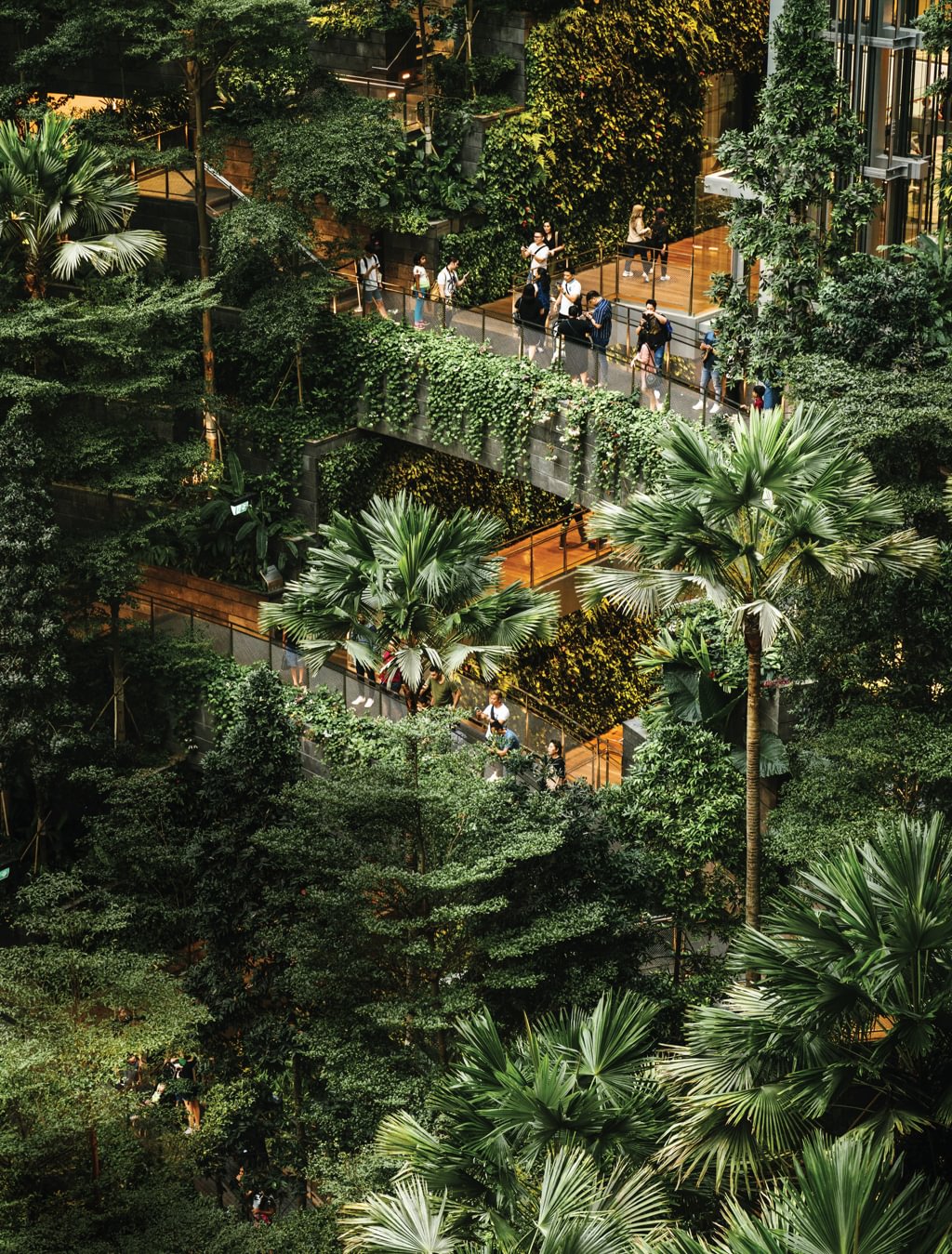
An indoor rainforest in Singapore, traditional Korean architecture in Seoul, a Roman museum in Istanbul and a working brewery in Munich. The world’s best airports have become increasingly ambitious destinations in their own right, bringing together architecture, culture and hospitality in places once designed primarily to move passengers from one aircraft to another. The 2026 Skytrax World Airport Awards place Singapore Changi first, but the rest of the top ten reveal some equally interesting approaches to the experience of travel.
1. Singapore Changi Airport, Singapore
There are impressive airports, and then there is Singapore Changi, where an enormous indoor waterfall descends through a tropical forest beneath a glass roof. The airport has won Skytrax’s World’s Best Airport title fourteen times, including in 2026, when it also received awards for dining and immigration services.
Its most remarkable attraction is Jewel Changi Airport, a 135,700-square-metre development designed by architect Moshe Safdie and opened in 2019.
The structure is based upon a torus, a geometric form resembling a ring, with a vast glass-and-steel roof enclosing the Shiseido Forest Valley. Thousands of trees, palms and shrubs surround the extraordinary HSBC Rain Vortex, a waterfall dropping forty metres through the centre of the building.
The landscape was designed to be experienced from several levels, with elevated walkways, gardens, restaurants and shops arranged around the central forest. Water collected through the roof is recirculated, helping sustain the planting while contributing to the building’s environmental systems.
Safdie conceived Jewel as a public gathering place as well as an airport facility, and its ambition reflects Singapore’s longstanding interest in integrating vegetation with contemporary urban architecture.
Elsewhere, Changi has a Butterfly Garden in Terminal 3, home to more than a thousand tropical butterflies, and the remarkable Dreamscape in Terminal 2, where twenty thousand plants are displayed beneath a digital sky that responds to the weather outside.
Jewel is particularly worth planning around. It is located outside the airport’s secure transit area, so connecting passengers must meet Singapore’s entry requirements before visiting. The waterfall operates daily from 10am until 10pm, with evening light-and-music performances.
Explore Jewel’s attractions and visitor information.
2. Incheon International Airport, Seoul, South Korea
Seoul’s Incheon International Airport takes second place and wins the 2026 award for the World’s Most Family-Friendly Airport.
Its particular strength is the integration of Korean cultural heritage into a contemporary transport environment. The airport’s Korean Cultural Street incorporates architectural forms inspired by traditional tiled-roof houses and pavilions, while dedicated cultural centres provide opportunities to discover Korean crafts and participate in free cultural activities.
Digital installations, performances and exhibitions complement the experience. The result is an airport that introduces visitors to aspects of Korean identity before they have even reached Seoul.
3. Tokyo Haneda Airport, Japan
Ranked third, Tokyo Haneda also wins World’s Cleanest Major Airport, World’s Best Domestic Airport and recognition for its accessible facilities.
Haneda is unusually convenient for Tokyo, but its cultural attractions are equally interesting. In Terminal 3, Edo Ko-ji recreates the atmosphere of an Edo-period street, with traditional shopfronts and restaurants serving sushi, soba and other Japanese specialities.
A reproduction of the historic Nihonbashi bridge connects visitors to a shopping area inspired by the commercial culture of old Tokyo. The airport also has observation decks overlooking the runways and Tokyo Bay.
4. Hong Kong International Airport, Hong Kong
Hong Kong International Airport rises to fourth place, with its security services receiving particular recognition.
One of its most interesting architectural additions is the Sky Bridge, opened in 2022. Measuring 200 metres long and standing 28 metres above an aircraft taxiway, the enclosed pedestrian bridge connects Terminal 1 with its satellite concourse.
Its glazed sections allow passengers to watch enormous aircraft moving beneath their feet. The structure also eliminates the need for some apron bus transfers, combining an improvement in passenger movement with an unusual architectural experience.
5. Narita International Airport, Tokyo, Japan
Japan’s second representative in the top five, Narita, receives the award for World’s Best Airport Staff.
Narita has made considerable efforts to introduce international passengers to Japanese culture through exhibitions, performances and traditional craft activities. Its Japanese cultural programme includes rotating experiences involving traditional crafts, seasonal customs and contemporary interpretations of Japanese design.
The airport also houses art installations and exhibitions distributed throughout its terminals. It is a particularly rewarding place for travellers interested in the relationship between Japanese hospitality and cultural presentation.
6. Paris Charles de Gaulle Airport, France
Ranked sixth and the highest-placed European airport, Paris Charles de Gaulle has gradually developed a more sophisticated cultural identity.
The airport’s Espace Musées, situated in Terminal 2E’s Hall M, hosts exhibitions in collaboration with French museums. Its 2026 presentation, Paris–Rome, explores the relationship between the two capitals through works from the Musée Carnavalet.
For travellers departing through the relevant terminal, it offers the rather wonderful possibility of visiting a museum exhibition between security and boarding. The airport also contains some interesting late-twentieth-century architecture, particularly the circular Terminal 1 designed by Paul Andreu.
7. Rome Fiumicino Airport, Italy
Rome Fiumicino comes seventh and is named Southern Europe’s best airport.
Its location offers a fascinating historical connection: the airport occupies land close to the ancient Roman harbour complex of Portus. During construction work between 1958 and 1965, archaeologists discovered the remains of several Roman vessels.
Five of these are preserved at the nearby Museum of the Roman Ships, which includes cargo boats and a fishing vessel dating from antiquity.
Although the museum is outside the airport rather than within the terminals, it is an extraordinary reminder that this part of the Italian coastline has functioned as a gateway to Rome for nearly two thousand years.
8. Istanbul Airport, Türkiye
Istanbul Airport rises to eighth place, reflecting its development into one of the world’s major international connecting hubs.
Its most unusual cultural attraction is the Istanbul Airport Museum, opened in 2020 within the international departures area.
The museum brings together archaeological and historical objects from collections across Türkiye, introducing visitors to the civilisations of Anatolia through sculpture, decorative art and other artefacts.
Its first exhibition included hundreds of objects drawn from twenty-nine museums. With approximately 1,000 square metres of exhibition space, it is an ambitious undertaking for an airport museum. Access is for eligible passengers beyond passport control, and admission is charged separately.
9. Munich Airport, Germany
Ninth-placed Munich Airport demonstrates how regional culture can become an important part of airport hospitality. It also won the 2026 award for Best Airport Staff in Europe.
Its most distinctive attraction is Airbräu, established in 1999 and recognised as the world’s first airport brewery.
The restaurant brews its own beer according to Bavaria’s historic purity law, with copper brewing equipment visible inside and a beer garden offering traditional regional food.
It is an amusing but thoughtful expression of local identity: a fully functioning Bavarian brewery within one of Europe’s major international airports.
10. Vancouver International Airport, Canada
Completing the top ten is Vancouver International Airport, whose extensive programme of Indigenous art gives the terminal a cultural character unlike many international airports.
The centrepiece is The Spirit of Haida Gwaii: The Jade Canoe, an immense bronze sculpture by Haida artist Bill Reid, installed in the international terminal.
Its canoe is crowded with figures drawn from Haida stories and oral traditions. The work occupies a prominent position before security, introducing travellers to the cultural heritage of the Pacific Northwest.
The airport’s art programme is complemented by businesses celebrating Indigenous culture, including the Lattimer Gallery and Salmon n’ Bannock On The Fly, a restaurant specialising in Indigenous Canadian cuisine.
The Airport as a Destination
These airports suggest how extensively the idea of airport design has changed. The terminal is no longer understood simply as infrastructure for processing passengers. It can also function as a civic space, a cultural exhibition venue, a shopping destination or, in Singapore’s case, an extraordinary piece of landscape architecture.
There are practical limits to this ambition. An excellent airport must still move passengers efficiently, provide clear information and make the difficult business of international travel as straightforward as possible. A remarkable waterfall is little consolation to someone who has missed a connection.
But the best examples demonstrate that operational efficiency and cultural imagination need not be incompatible.
Skytrax’s 2026 rankings are based on passenger assessments of airport services and facilities, rather than an architectural competition. Other surveys produce different results: Condé Nast Traveller’s 2026 Readers’ Choice Awards placed Istanbul first and Singapore second.
What makes Changi so compelling, however, is its broader architectural proposition. Safdie’s Jewel demonstrates that an airport can become part of the cultural and social life of a city, attracting people who have no intention of boarding an aircraft.
For an industry traditionally concerned with departures and arrivals, that represents a fascinating change of direction.
For our companion piece on the world’s best airlines – CLICK HERE
Explore the Rankings
Skytrax — World’s Top Ten Airports 2026
The official passenger-voted results, announced on 18 March 2026.
Skytrax — Complete 2026 World Airport Awards
Individual awards for dining, cleanliness, staff, accessibility, airport hotels and regional performance.
Condé Nast Traveller — Best Airports in the World 2026
An alternative international readers’ survey, published in October 2026.
Jewel Changi Airport — Architecture by Safdie Architects
Architectural drawings, photographs and an explanation of the engineering behind Singapore’s extraordinary airport landmark.
