An ambitious New York retrospective revisits the artist’s fascination with seeing, copying and the complicated question of who owns an image.
In 1963, Roy Lichtenstein painted a small, confrontational picture of a comic-book villain. Beneath a heavy black fringe and sharply angled eyebrows, a pair of eyes stare directly at the viewer. An enormous speech balloon demands to know what the viewer knows about his image duplicator. The painting, Image Duplicator, was a mischievous form of self-portrait. Lichtenstein had achieved sudden notoriety by transferring existing illustrations into the language of fine art, and the accusation that he was merely copying other people’s pictures was already familiar.
The joke became particularly pointed when Life magazine profiled him in January 1964 under the headline Is He the Worst Artist in the U.S.? Lichtenstein, whose work would become among the most recognisable of the twentieth century, understood the controversy surrounding his methods remarkably well.
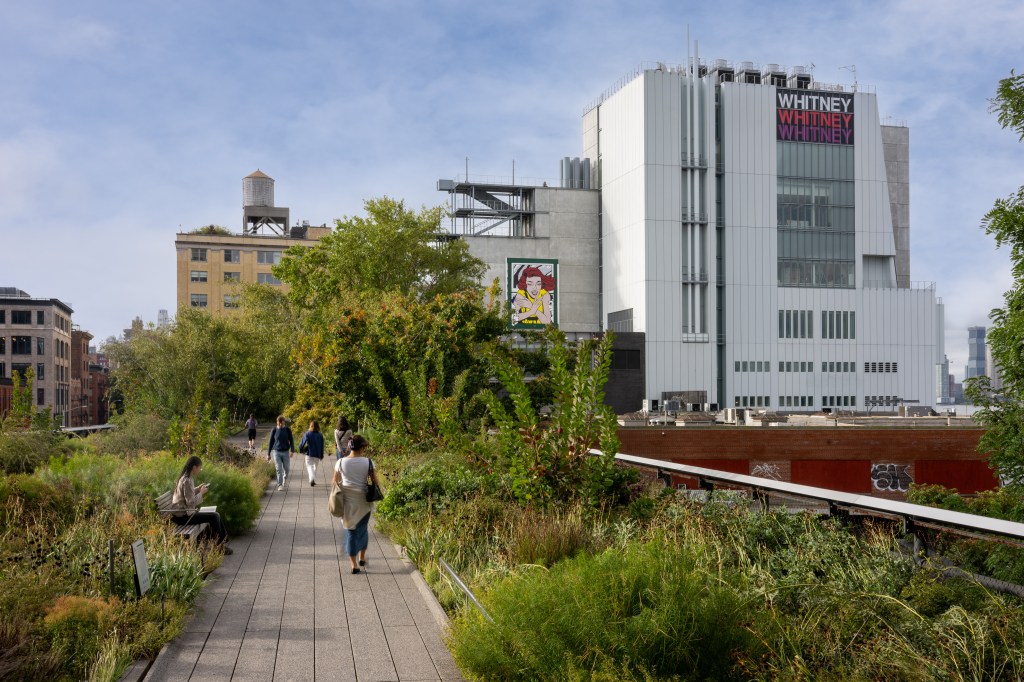
That controversy provides a useful entry into Roy Lichtenstein: Like New, the major retrospective currently occupying the fifth floor of the Whitney Museum of American Art in New York. Organised by curator Meg Onli and artist Alex Da Corte, with more than 130 works spanning the 1940s to the 1990s, it is the first New York retrospective devoted to Lichtenstein since the Guggenheim’s exhibition of 1993.
The curators have looked beyond the comic-book paintings that established his reputation to examine the intellectual foundations of his practice. Their research returns repeatedly to questions of perception, visual memory and the construction of images.
Learning to Look
Lichtenstein entered Ohio State University in 1940, where he encountered the artist and teacher Hoyt L. Sherman. Sherman’s experimental teaching methods departed dramatically from conventional drawing instruction. In a darkened classroom known as the Flash Lab, students were shown objects or projected images for extremely brief periods and then asked to draw what they remembered.
The exercises required students to register an entire visual composition rather than build an image gradually from observed details. Lichtenstein later credited Sherman with teaching him how to look, and the significance of that education is central to the Whitney’s interpretation of his subsequent career.
Da Corte has created a short film, Drawing by Seeing (2026), which reconstructs aspects of Sherman’s teaching through theatrical sets and practical effects. Historical material from Ohio State University provides a documentary counterpoint.
The connection between these early experiments and Lichtenstein’s mature paintings is persuasive. His images depend upon economical visual decisions: the weight of a black contour, the distribution of colour, the placement of a repeated pattern. Their apparent simplicity conceals a sophisticated understanding of how the eye recognises and organises information.
A New Kind of Painting
The exhibition reunites all eight works from Lichtenstein’s first one-person exhibition of Pop-style paintings at Leo Castelli Gallery, held between 10 February and 3 March 1962. Reconstructing their original presentation gives these early paintings something they have largely lost through decades of reproduction: a sense of the circumstances in which they first appeared.
In the New York art world of the early 1960s, Abstract Expressionism still held considerable authority. Painting was associated with gesture, individual expression and the visible record of an artist’s physical engagement with the canvas.
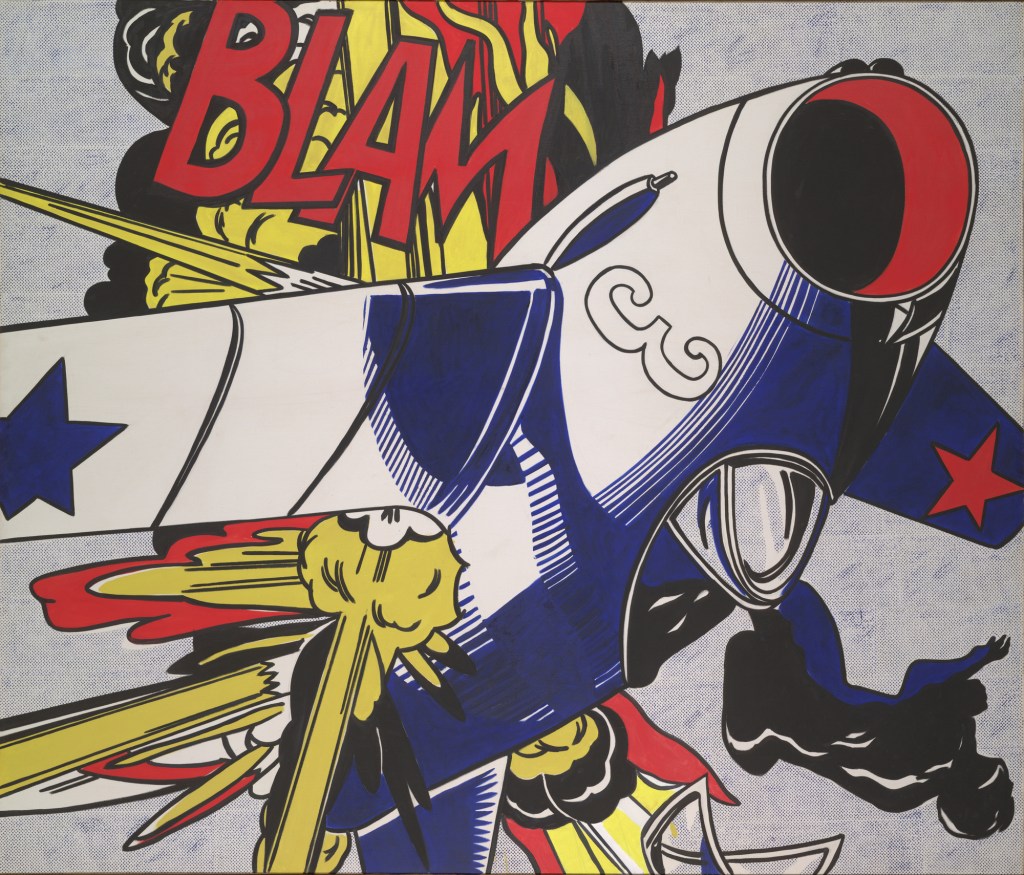
Lichtenstein’s pictures offered an altogether different proposition. Images derived from advertising, domestic products and comics appeared in flattened compositions with emphatic outlines and fields of simulated commercial printing dots. They looked industrially produced, although they were painstakingly made by hand.
His working process involved far more than straightforward enlargement. Source images were selected, redrawn, cropped and reorganised. Contours were adjusted, colours reconsidered and compositions transferred to canvas. He developed perforated screens through which he applied paint to produce the regular dots associated with commercial printing.
The distinction matters. Lichtenstein was not simply enlarging pictures; he was examining what happened when an existing image was translated into another medium, scale and cultural setting.
Yet the argument that transformation establishes artistic originality has never entirely settled the matter of the people who created his source material.
The Whitney addresses this history through original comic illustrations and works concerned with the circulation of images. One particularly revealing example involves William Overgard’s Steve Roper newspaper strip of 6 August 1961. Lichtenstein isolated its final panel for I Can See the Whole Room! … And There’s Nobody in It! (1961). When Overgard subsequently encountered the painting in a magazine, he wrote to Time questioning the relationship between his original drawing and its celebrated successor.
The episode remains instructive because both artists’ contributions are identifiable. Lichtenstein made substantial decisions about presentation and composition, while the underlying imagery originated in another artist’s work.
Comic-book artists and historians have continued to question the imbalance of recognition and reward. Research by David Barsalou, documented in the 2023 film Whaam! Blam! Roy Lichtenstein and the Art of Appropriation, has traced hundreds of Lichtenstein’s images to earlier comic illustrations. The controversy includes objections from artists whose work became the foundation for celebrated paintings without comparable recognition for their own contributions.
These concerns do not exhaust what can be said about Lichtenstein’s paintings. Their formal intelligence and the unresolved ethical questions surrounding their production belong to the same history.
Lichtenstein’s imagery soon became the subject of further appropriation. Richard Pettibone, Sturtevant and later Louise Lawler explored the implications of reproducing work that was already concerned with reproduction. Their presence in the Whitney exhibition demonstrates how rapidly an artistic challenge to originality could itself become an established artistic language.
Beyond the Comic Strip
Some of the exhibition’s most revealing works concern subjects considerably removed from popular illustration.
In Little Big Painting (1965), a monumental painted brushstroke becomes the subject of the picture. Its extravagant curves, hard outlines and simulated printing dots transform the supposedly spontaneous gesture of Abstract Expressionism into something deliberately composed.
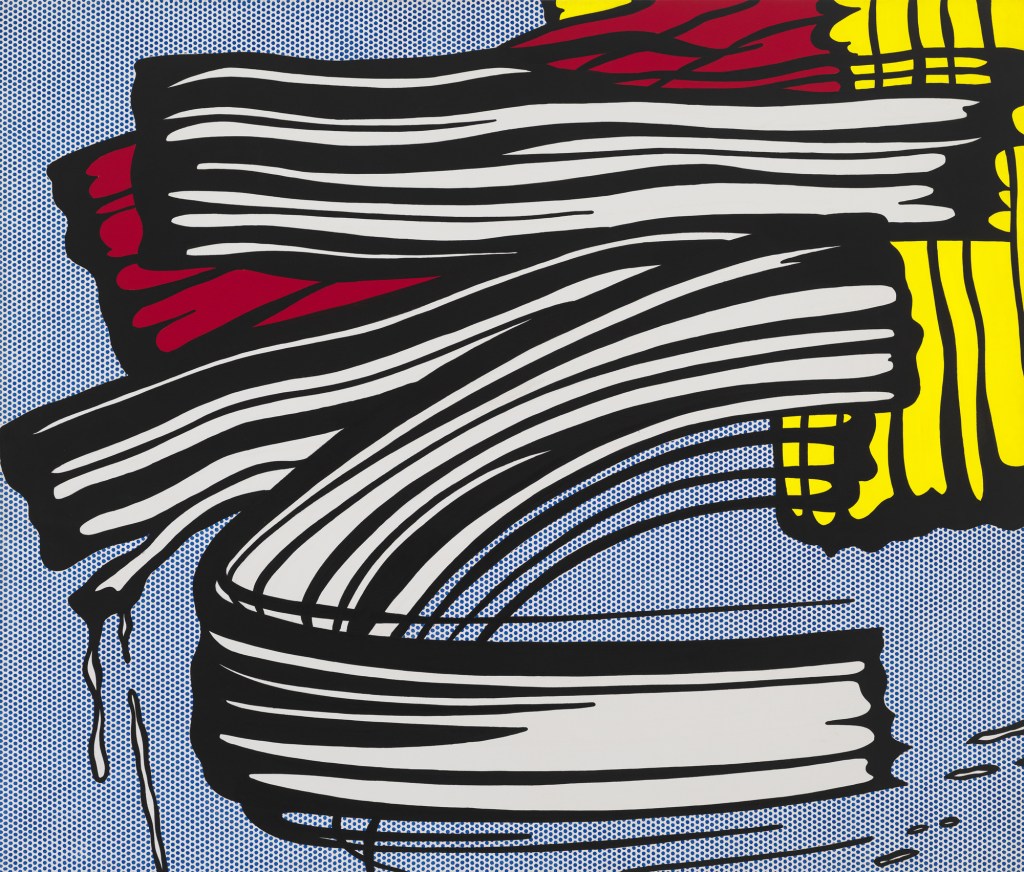
The painting offers a particularly sharp commentary on the relationship between artistic expression and its representation. A mark that once stood as evidence of the painter’s physical presence has become an image of such a mark.
Lichtenstein’s Mirror paintings, begun in 1969, develop a different problem. Constructed from curved bands, patterned surfaces and calculated highlights, they depict objects whose defining characteristic is their ability to reflect. Yet these painted mirrors return no reflection of the viewer or the room.
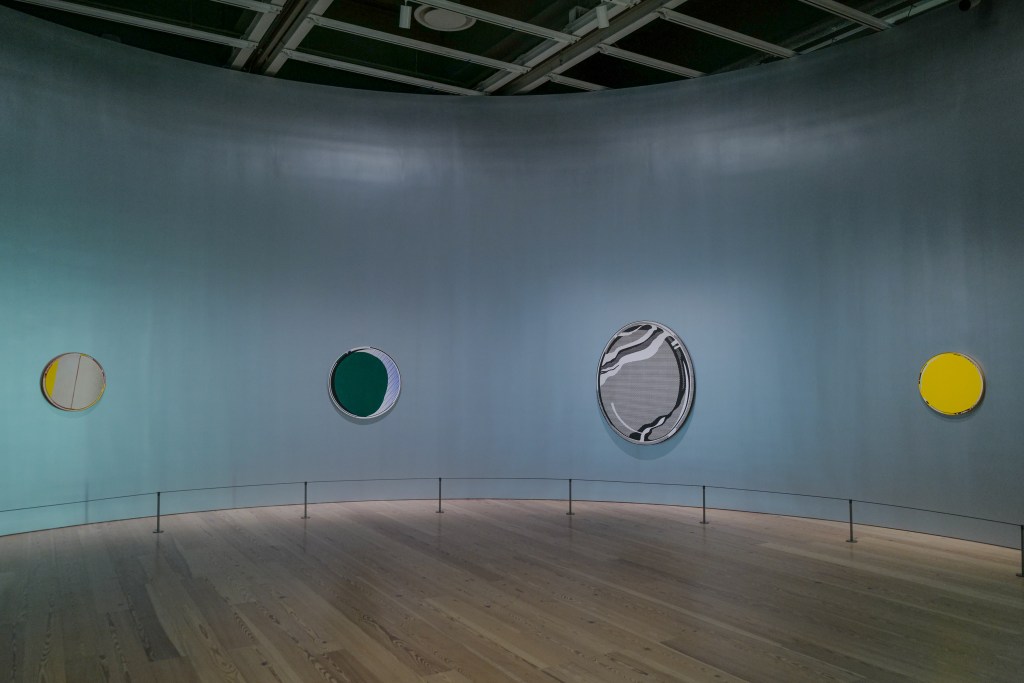
Artwork © Estate of Roy Lichtenstein. Photograph by Jason Lowrie/BFA.com
Their origins were unexpectedly ordinary. Lichtenstein had noticed illustrated mirror advertisements in shops along the Bowery and became interested in the graphic conventions used to represent reflective glass. He subsequently photographed actual mirrors to study the behaviour of light before translating those observations into painting.
Recognition depends upon a surprisingly small collection of visual signals. Remove the physical properties of the object, and the image can still persuade us that we know what we are seeing.
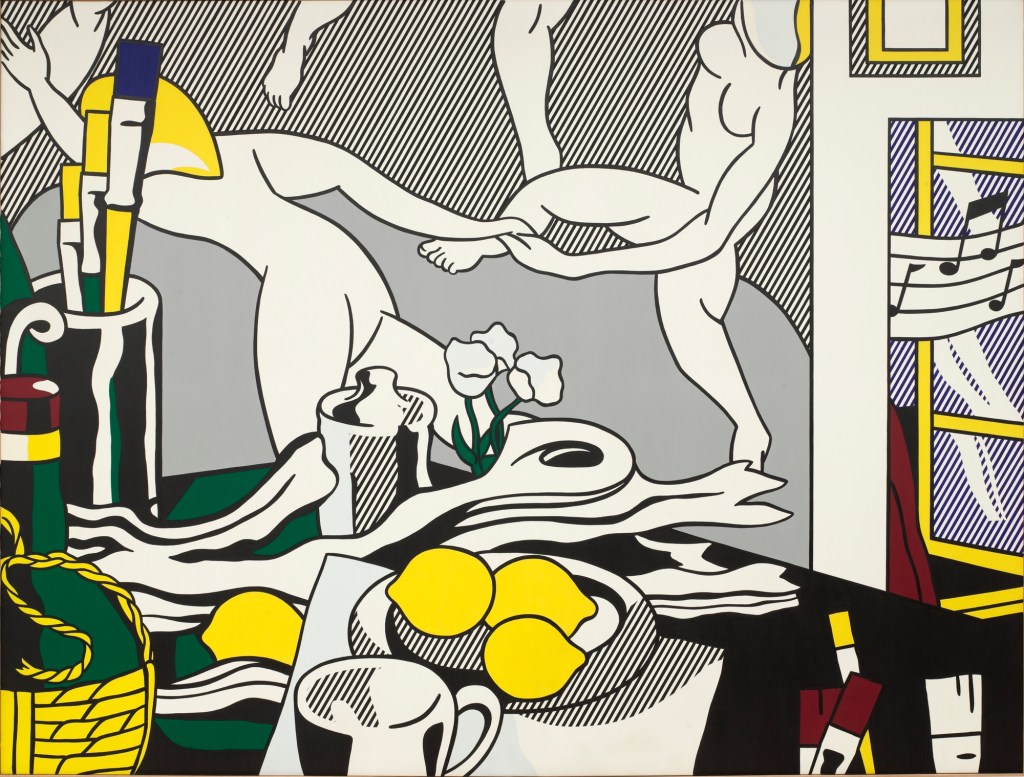
In the Artist’s Studio paintings of the 1970s, Lichtenstein returned to art history more explicitly. Inspired partly by Henri Matisse’s The Red Studio (1911), these imagined interiors gather paintings, decorative motifs and fragments from his earlier work into newly organised environments.
Artist’s Studio “The Dance” (1974) is especially revealing. Pictures become objects within other pictures, and the painted room functions simultaneously as an interior and a record of the artist’s changing visual vocabulary. The result is a self-conscious examination of how artworks acquire new meanings through their placement and repetition.
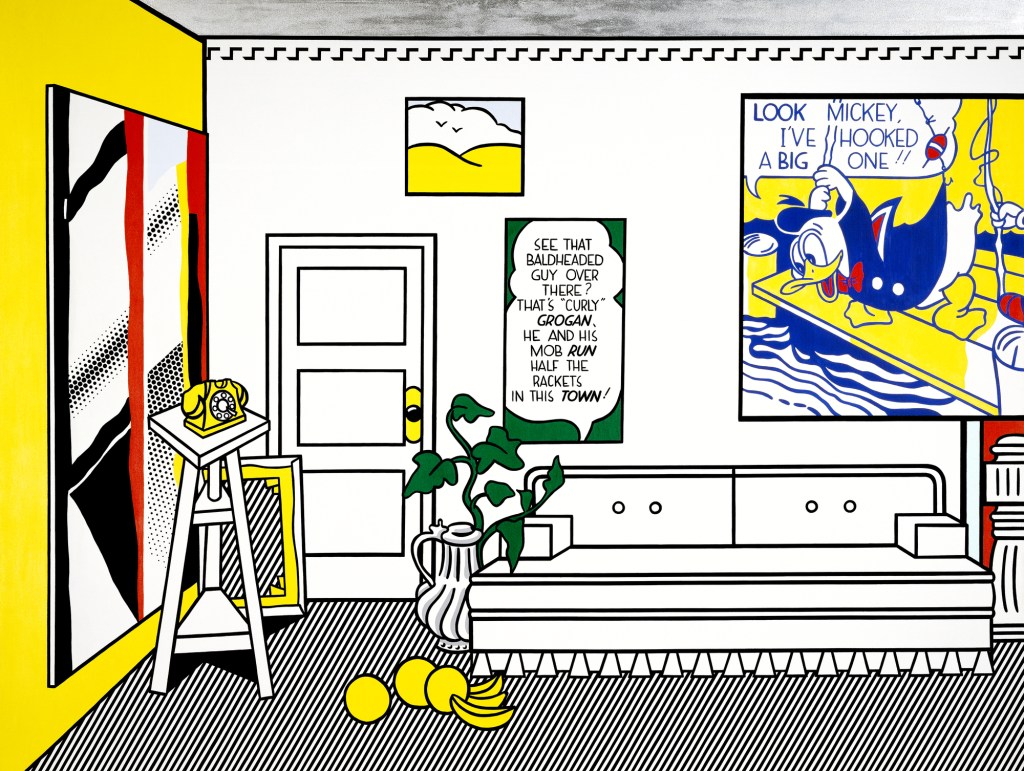
Such works also complicate the familiar identification of Lichtenstein with Pop Art. His continuing engagement with Picasso, Monet, Matisse and the conventions of modernist painting suggests an artist whose interests extended well beyond the commercial imagery that initially made him famous.
The Whitney gives considerable space to these later investigations, while four reconstructed murals return Lichtenstein’s imagery to an architectural scale. Among them is the nearly 96-foot-long Greene Street Mural (1983), recreated by Colossal Media, and an outdoor version of New York World’s Fair Mural (Girl in Window) (1963/2026), realised by Da Corte’s studio.
The original murals belonged to particular places and circumstances. Their contemporary recreations preserve their designs while changing their locations and relationship to the public. The museum has, in effect, extended the artist’s methods into the presentation of his own work.
Critical responses to this approach have differed considerably. John Yau, writing for Hyperallergic, finds the exhibition’s playful interventions distracting and questions whether Lichtenstein’s later work sustained the critical force of his early paintings. Hilton Als, in The New Yorker, offers a more appreciative reading, particularly of the artist’s wit and his treatment of gender stereotypes.
The disagreement is useful. Lichtenstein’s images can appear endlessly inventive or disconcertingly self-repeating, depending upon which works are examined and how much significance one attributes to their transformations.
Like New makes a convincing case for taking his visual thinking seriously. It also demonstrates why the history of his sources must remain part of that discussion. Lichtenstein understood that a picture changes when it is copied, enlarged, repainted or placed somewhere else. What the Whitney’s retrospective allows us to examine, across six decades of work, is how carefully he controlled those changes—and how much of the original image remained.
Cover image: Roy Lichtenstein, Artist’s Studio “The Dance”, 1974. Acrylic, oil, graphite pencil on canvas, 98 1/8 × 1283/4in. (249.2 × 327 cm). The Museum of Modern Art,New York. Gift of Mr. and Mrs. S. I. Newhouse, Jr. ©Estate of Roy Lichtenstein/DACS 2026 © The Museum of Modern Art/Licensed by SCALA / Art Resource, NY
Roy Lichtenstein: Like New
Whitney Museum of American Art, New York
11 October 2026 – 10 May 2027
