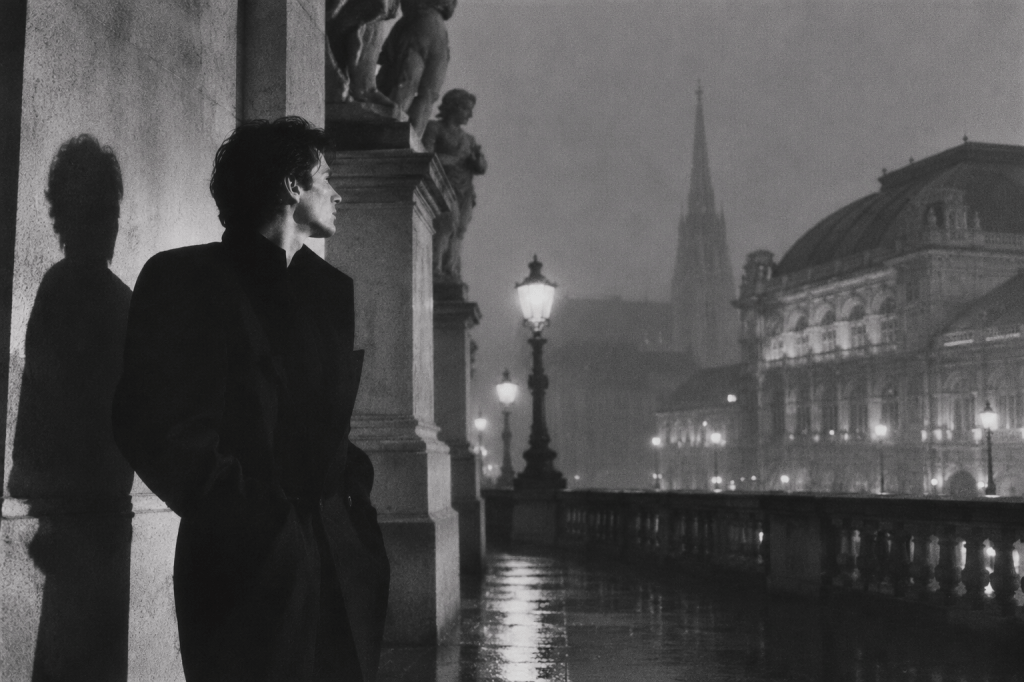
From its cinematic beginnings in 1981 to Bret Easton Ellis’s The Shards, Ultravox’s most celebrated recording has become an enduring cultural reference. For Generation X, it remains a particularly potent reminder of the decade in which we came of age.
In Bret Easton Ellis’s 2023 novel The Shards, the young narrator sits in his BMW convertible, looking towards a former girlfriend. His car radio is tuned to an Eighties station, and Ultravox’s “Vienna” is playing. It is a characteristically precise musical reference from a writer whose fiction has long been inseparable from the popular culture surrounding his characters.
The novel returns to Los Angeles in 1981, reconstructing the privileged adolescence of a fictionalised Bret Easton Ellis against a background of sexual anxiety, obsession and escalating violence. Music runs through its pages, providing an exact chronology of early-1980s tastes and social life. Duran Duran, Blondie, the Human League and numerous less familiar performers populate a world where the choice of record can seem as revealing as the choice of clothes.
“Vienna” is a recurring presence, its extraordinary melancholy well suited to Ellis’s preoccupation with emotional detachment.
When Ryan Murphy’s television adaptation premiered in August 2026, the song was retained in the opening episode. For a new generation of viewers, the familiar synthesisers and Midge Ure’s voice became an introduction to the uneasy atmosphere of Ellis’s Los Angeles.
For those of us who grew up with the record, the effect is rather different. The opening notes of “Vienna” belong to a musical landscape we remember particularly well, when synthesisers still sounded futuristic and pop musicians could achieve enormous commercial success while dressed as vaguely sinister characters from European cinema.
Released as a single in January 1981, the recording has retained an unusually prominent place in popular culture. Its subsequent appearances in fiction and television reveal how much can be done with a song whose principal emotional statement is so spectacularly unconvincing.
A Most Unlikely Pop Hit
The story begins with a band whose commercial prospects were far from promising.
Ultravox had emerged during the second half of the 1970s, initially fronted by John Foxx. Their early music occupied an intriguing position between art rock, punk and the developing electronic sound of the period. Their third album, Systems of Romance (1978), produced by the German musician Conny Plank, demonstrated considerable artistic ambition but failed to deliver the commercial breakthrough their record company wanted.
Dropped by Island Records and subsequently losing Foxx, the remaining members — Billy Currie, Chris Cross and Warren Cann — faced an uncertain future.
The arrival of Scottish musician Midge Ure in 1979 transformed the group. Ure had played with Slik and the Rich Kids, as well as working with drummer Rusty Egan on the electronic project Visage. His interest in melody complemented the experimental instincts of the surviving Ultravox musicians.
The renewed partnership produced the album Vienna, released in July 1980, with Plank once again involved as producer.
The title track was unlike almost anything else competing for attention on British radio.
Its foundations lay in a rhythm devised by drummer Warren Cann using a Roland CR-78 drum machine. Around this, the musicians constructed an arrangement combining synthesisers, grand piano and a richly expressive viola passage by Currie.
In a 2017 interview with The Guardian, Currie recalled the influence of late-Romantic composers, particularly Grieg, Elgar and Max Reger. His classical training contributed to the song’s elaborate instrumental structure, while the electronic rhythm gave the recording its unmistakably modern character.
The arrangement is unusually spacious. Its opening pulse establishes a restrained, almost mechanical atmosphere before the piano introduces the principal harmonic movement. Ure begins singing with a measured intensity, allowing the tension to increase gradually.
The middle section introduces a sudden expansion of musical scale, with Currie’s string playing becoming increasingly impassioned. The recording then retreats into its earlier restraint before building towards the final vocal climax.
One of its more unusual musical decisions concerns the relationship between the vocal melody and the chords beneath it. As Ure’s voice rises, the harmony moves downwards. He discussed this in an April 2026 interview with MusicRadar, explaining how the unconventional movement helped distinguish the recording from more straightforward pop arrangements.
The song’s dramatic effect depends on these changes in intensity and on a willingness to let the instrumental passages develop. There is no rush towards the next chorus.
Ure also recalled just how unlikely a commercial proposition the song had appeared. Its duration, slow tempo and classical influences hardly suggested an obvious hit single.
Chrysalis Records was reluctant to release it and wanted a shorter version. The band refused to compromise, believing that removing a section would damage the composition.
Their instincts proved correct.
Released on 9 January 1981, “Vienna” reached number two in the British singles chart and remained there for four consecutive weeks.
For the first week, it was prevented from reaching number one by John Lennon’s “Woman”, released following his murder in December 1980. For the remaining three weeks, its principal obstacle was Joe Dolce’s novelty song “Shaddap You Face”.
The outcome remains one of the more entertaining episodes in British chart history.
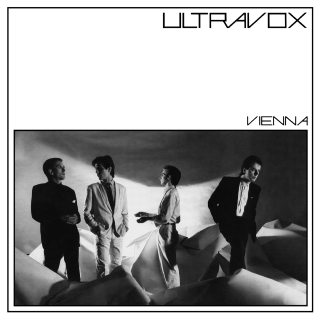
On one side stood an elaborate composition incorporating electronic experimentation, classical music and European romanticism. On the other was a comedy record performed in a caricatured Italian accent.
The British record-buying public preferred Joe Dolce.
The result became so firmly embedded in pop folklore that, in January 2013, BBC Radio 2 listeners voted “Vienna” Britain’s favourite single never to reach number one.
It was an honorary victory, thirty-two years after the original disappointment.
The Vienna That Never Was
The song’s title suggests a cultural history considerably more elaborate than its actual inspiration.
Vienna was the city of Gustav Klimt, Egon Schiele and the Secession movement, where artists and architects had challenged established artistic conventions during the final decades of the Habsburg Empire. It was also the city of Freud, Mahler and Schönberg, a centre of intellectual and musical experimentation whose achievements profoundly influenced twentieth-century European culture.
The Austrian capital possessed an additional cinematic association through Carol Reed’s The Third Man (1949), with its shadowy streets, damaged buildings and atmosphere of post-war intrigue.
These references seemed entirely appropriate to Ultravox’s dramatic recording, and the British music press was happy to explore them.
There was, however, a problem. Midge Ure had never visited Vienna when he wrote the song.
In a 2020 retrospective published by Electronic Sound, Ure admitted that he had encouraged journalists to believe the song was connected with Klimt and the Vienna Secession.
The actual inspiration was an imaginary holiday romance.
His explanation was wonderfully straightforward. Someone travels to an unfamiliar and beautiful city, meets another person, experiences an intense romantic connection and imagines that the relationship will continue. Eventually, the experience recedes into the past.
The fashionable British music press of the period apparently preferred Gustav Klimt to a holiday romance.
Ure later acknowledged that discussing the Secessionists seemed considerably more impressive than talking about the feelings associated with a brief relationship.
The invented intellectual background is amusing, but it also reveals something about the cultural expectations surrounding British popular music at the beginning of the 1980s. Musical ambition was increasingly associated with artistic seriousness. References to European modernism could lend sophistication to material whose emotional origins were relatively ordinary.
Yet the imagined setting was an inspired choice.
Vienna’s reputation for faded imperial grandeur offered an atmospheric backdrop to romantic disappointment. Ure understood the appeal of the city’s decaying elegance, even before experiencing it himself.
The song’s central declaration, “This means nothing to me”, contains its most interesting emotional contradiction.
Ure sings the words with such intensity that the listener has little reason to believe him. The elaborate arrangement continues to insist upon the significance of an experience the lyrics attempt to dismiss.
It is an effective expression of a familiar human impulse: trying to persuade oneself that something has ceased to matter when it plainly has not.
That contradiction would subsequently prove particularly useful to filmmakers and television directors.
A Film for a Movie That Didn’t Exist
The accompanying music video, directed by Russell Mulcahy, considerably expanded the song’s cultural identity.
Filmed predominantly in black and white, it presents Ultravox within a world of shadowy architecture, mysterious encounters and carefully arranged cinematic compositions. Monumental interiors, dramatic lighting and elegant clothing create an atmosphere reminiscent of European film noir.
The Austrian capital itself appears, although much of the production was filmed in London.
Covent Garden and the former Kilburn Gaumont Theatre provided locations that could suggest the old European city without requiring an expensive foreign production.
Ure’s wardrobe was similarly economical. He later recalled acquiring most of the clothing from second-hand shops, although he invested in a Burberry raincoat that he had always wanted. The result looked considerably more expensive than it was.
Mulcahy’s visual approach was especially important. Rather than simply filming the musicians performing, he constructed a loosely connected sequence of cinematic images. Characters appear to inhabit a mysterious narrative that the viewer is never fully permitted to understand.
The director’s ambitions were recognised by his contemporaries.
In the 2022 documentary Music Videos That Shaped the 80s, Gary Kemp of Spandau Ballet recalled the impact of seeing the “Vienna” video. The musicians appeared as characters within a film, suggesting possibilities that went far beyond conventional promotional performances.
It was an important development in the visual presentation of pop music. The film appeared before MTV began broadcasting in August 1981, at a moment when the promotional video was becoming an increasingly ambitious medium.
British performers were experimenting with theatrical presentation, fashion and historical references. The New Romantic scene, associated with London’s Blitz nightclub and figures such as Steve Strange, provided one context for this development. David Bowie’s earlier experiments with visual identity were another important influence.
“Vienna” was distinctive because its imagery seemed so closely integrated with its music.
Ure later described the band’s ambition to create recordings that could accompany films which did not yet exist.
The relationship between the song and its video proved sufficiently influential that later television productions would sometimes refer to both.
In the opening episode of the BBC’s Ashes to Ashes (2008), police psychologist Alex Drake awakens aboard a boat in 1981 while “Vienna” plays. The staging recalls the party sequence in Mulcahy’s video, making the reference as much visual as musical.
It is an affectionate recreation of a moment that audiences familiar with the original recording could recognise immediately.
The Soundtrack to Other People’s Lives
The song has appeared in a remarkably varied collection of television programmes, often serving purposes considerably more complicated than simple Eighties nostalgia.
Its use in The Crown is particularly subtle. In the fourth season’s 2020 episode “Fairytale”, the young Diana Spencer awakens to “Vienna” playing on her alarm-clock radio.
The placement is an effective piece of musical commentary. Diana is approaching a marriage that the audience already knows will prove deeply unhappy. The song accompanies a period of increasing isolation at Buckingham Palace, allowing its melancholy refrain to suggest the emotional disappointment awaiting her.
An even more interesting use occurs in the third season of The Americans, the espionage drama set during the Cold War.
In the 2015 episode “I Am Abassin Zadran”, Elizabeth Jennings turns up “Vienna” on the radio to conceal a sensitive conversation with her daughter Paige. The music performs a practical function within the scene, masking their voices, while its emotional content provides another layer of interpretation.
The characters’ difficulty expressing or acknowledging their feelings gives the choice particular resonance.
In the first season of Yellowjackets, released in 2021, “Vienna” appears twice. Its first use accompanies the discovery of Travis’s body by Natalie and Misty. The song returns in the season finale, connecting the adult characters’ troubled present with the traumatic relationships of their adolescence.
In the second appearance, the narrative moves between the past, when Travis declares his love for Natalie, and the present, when she is confronting the circumstances of his death. The song’s insistence that feelings have disappeared acquires a particularly painful irony.
The repetition is significant. The recording becomes associated with experiences that have persisted across decades despite the characters’ efforts to move beyond them.
These examples demonstrate the song’s adaptability, although it would be excessive to claim that it carries a single, fixed meaning. Its mixture of restraint and extravagance can serve different dramatic purposes.
And sometimes its cultural function is simply to provide a joke.
In the 1996 Father Ted episode “A Song for Europe”, Ted recalls that a former seminarian, Father Benny Cake, recorded an immensely successful pop single under a pseudonym. The record, he explains to Dougal, was “Vienna”.
The fictional single supposedly reached number one in Britain, something the real Ultravox recording famously failed to achieve.
It is an absurd little aside that depends on the song’s established place in British popular culture. Few records receive a more unexpected tribute.
Bret Easton Ellis and the Art of Feeling Nothing
Of all the subsequent appearances, Bret Easton Ellis’s use of “Vienna” is perhaps the richest.
Ellis has always treated popular music as an important component of his fictional worlds. In Less Than Zero and American Psycho, references to specific records, performers and musical tastes help establish character, social status and the often disturbing emotional distance between people.
His writing is exceptionally attentive to the commercial surfaces of American life. Fashion labels, expensive cars, restaurants, records and consumer objects are described with a precision that can become unsettling.
In The Shards, music contributes to the reconstruction of a particular moment in Los Angeles.
The novel’s teenage characters inhabit a privileged environment in which appearances are carefully maintained. Their relationships are complicated by jealousy, sexual uncertainty and a reluctance to confront uncomfortable truths.
The narrator is especially preoccupied with concealing aspects of himself while attempting to interpret the behaviour of others.
“Vienna” seems particularly well chosen for this environment.
Its most memorable lyric insists upon emotional indifference, while the music communicates an almost overwhelming intensity of feeling. The contradiction resembles the distance between the composed exteriors of Ellis’s characters and their considerably less stable private experiences.
It would be speculative to claim that Ellis selected the song specifically for this reason. What can be said is that its musical and lyrical qualities work unusually well within his fictional world.
The 2026 television adaptation gave the record a prominent position within its reconstruction of early-1980s Los Angeles.
In a September interview with Rolling Stone, music supervisor Amanda Krieg Thomas explained that the production team had received a playlist of approximately 200 songs referenced in Ellis’s novel.
“Vienna” was among the recordings considered essential.
Its inclusion also demonstrates how differently the same piece of music can operate across generations. For Ellis, it belongs to the soundtrack of an adolescence reconstructed through fiction. For audiences who remember 1981, the record carries associations formed during their own youth. For younger viewers, it may be an entirely new discovery.
In an August 2026 interview with British GQ, actor Igby Rigney, who plays the young Ellis, explained that he had discovered “Vienna” through the television production.
His reaction was enthusiastic. He called it a “slammin’ song”, adding that he had listened to it repeatedly while learning the lyrics in case he was required to sing along during filming.
It was a delightful example of a recording reaching somebody who had no first-hand experience of the era in which it was created.
The Generation That Remembers
For Generation X listeners, “Vienna” belongs to a particularly fertile period of British popular music.
The early 1980s produced an extraordinary range of electronic recordings, from the sparse experiments of the Human League and Orchestral Manoeuvres in the Dark to the more elaborate compositions of Ultravox and Japan.
These artists approached synthesisers from different musical backgrounds. Some were inspired by German electronic experimentation, others by punk, art rock or the possibilities of dance music. The resulting recordings sounded radically different from much of what had dominated the previous decade.
The arrival of electronic instruments also encouraged a new relationship between sound and visual presentation. Record sleeves, clothing, photography and promotional films became important parts of how music was encountered and understood.
For listeners who were young at the time, these associations remain vivid.
The first years of music television, the theatrical fashions, the peculiar hairstyles and the excitement of hearing unfamiliar electronic textures on mainstream radio all belong to the experience of discovering popular music during that period.
“Vienna” retains many of these associations, particularly for audiences in Britain and parts of Europe, where Ultravox enjoyed their greatest commercial success.
There is also an element of affectionate amusement involved in returning to the record today.
The dramatic coats, the solemn expressions, the suggestion of obscure European intrigue and Ure’s extraordinary commitment to the final chorus all belong unmistakably to their moment.
Yet the recording withstands a degree of gentle ridicule that might overwhelm a lesser song.
Its arrangement remains inventive, the contrast between electronic precision and classical expression is effective, and the vocal performance possesses a conviction that prevents the theatricality from becoming entirely absurd.
Nostalgia certainly contributes to the pleasure of hearing it again. But the song’s musical construction also rewards repeated listening, which helps explain why it continues to appeal beyond its original audience.
Its appearance in The Shards is especially appropriate in this respect. Ellis’s fictional world is reconstructed through the music its characters listen to, yet the audience encountering the 2026 adaptation has a very different relationship with those recordings.
For older viewers, the soundtrack may recall familiar records, fashions and places. Younger viewers are encountering the same material without those personal associations.
The distinction is nicely illustrated by Rigney’s enthusiasm for “Vienna”. The actor had to learn the lyrics for a scene set in 1981, a time before he was born. He listened to the recording over and over again in preparation.
By the time filming was complete, he told GQ, he still hadn’t grown tired of it.
Cover image: My World of Interiors
