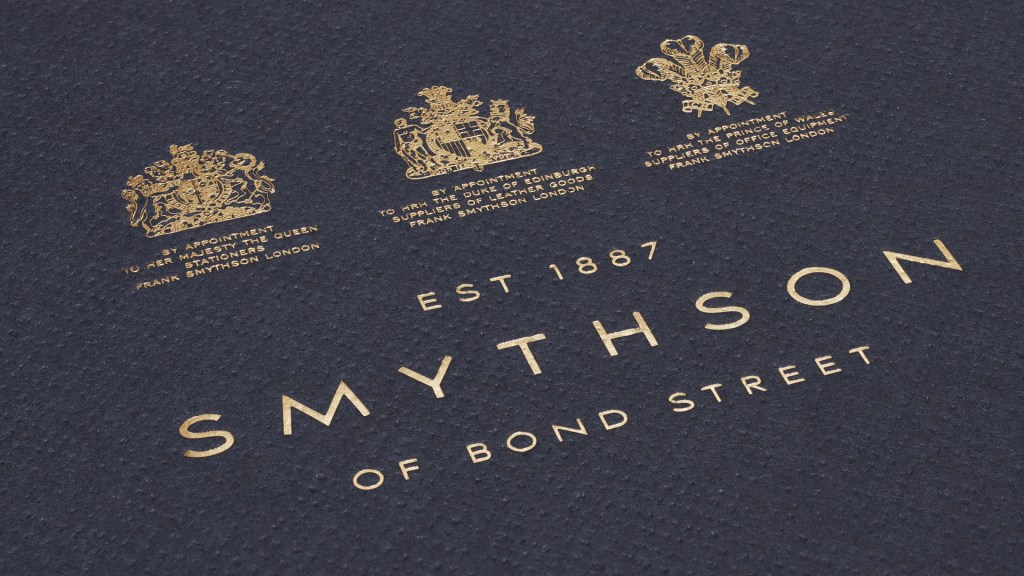
There is something pleasingly defiant about an exceptionally beautiful sheet of writing paper. At a time when correspondence is increasingly instantaneous and disposable, Smythson continues to make a persuasive case for the physical pleasures of handwriting, engraving and carefully considered design. Founded on London’s Bond Street in 1887, the company has evolved from a fashionable stationer into an international luxury house, while preserving some of the techniques that made its reputation.
When Frank Smythson opened his shop in 1887, he advertised stationery and luxury accessories to an affluent London clientele. The business quickly acquired prestigious customers, including Queen Victoria, for whose residences Smythson supplied correspondence paper.
Its success reflected an age in which personal stationery communicated social identity. Paper quality, engraving, monograms and the arrangement of an address were all understood as expressions of taste, while the conventions of letter-writing formed an important part of private and professional life.
Smythson’s most enduring innovation arrived in 1908 with the introduction of the Panama diary. Designed to fit into a gentleman’s jacket pocket without disrupting its shape, it combined a flexible leather binding with exceptionally lightweight paper. The company described it as the Panama hat of books, borrowing the association with fashionable travel.
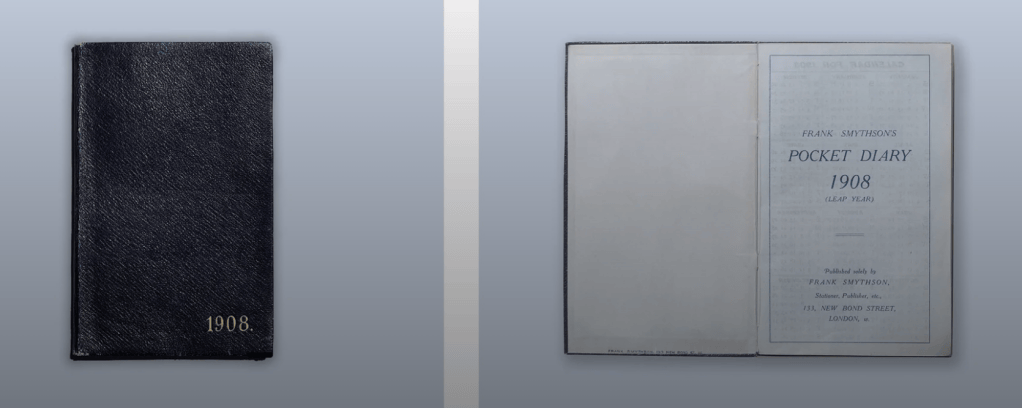
The distinctive pale-blue Featherweight paper subsequently became one of Smythson’s signatures. According to company lore, the colour originated when ink was accidentally spilled into paper pulp during manufacture. Whether entirely accurate or embellished through repetition, the story has become part of the brand’s identity.
The technical achievement is more important than the anecdote. Smythson’s thin, opaque paper allows substantial quantities of writing to be accommodated within remarkably slim notebooks and diaries, while the leather covers provide flexibility and durability.
The same concern with material and proportion continues in the company’s bespoke stationery service.
Customers can select paper stocks, typefaces, ink colours, borders, motifs and envelope finishes before receiving a digital proof for approval. Once confirmed, the design is transferred to a copper printing plate and engraved stationery is produced using traditional processes at the company’s workshop in Wiltshire.
The results are especially appealing for correspondence cards, business stationery and formal invitations, where the relationship between lettering, paper and empty space determines the character of the finished object.
Personalisation at this level is quite different from adding initials to an existing product. It involves an understanding of typography and composition, allowing relatively modest details to transform an otherwise ordinary piece of stationery.
The company has also continued developing its relationship with fashion and contemporary design.
For its 2027 Fashion Diary, launched in 2026, Smythson collaborated with Grace Coddington, the celebrated former creative director of American Vogue. Her illustrated edition celebrates the diary’s thirtieth anniversary, featuring whimsical drawings and personal recommendations for the world’s major fashion capitals.
The collaboration is particularly appropriate. Coddington’s work has always emphasised the importance of imagination within the highly organised machinery of fashion publishing. Her illustrations bring a playful visual intelligence to an object whose purpose remains fundamentally practical.
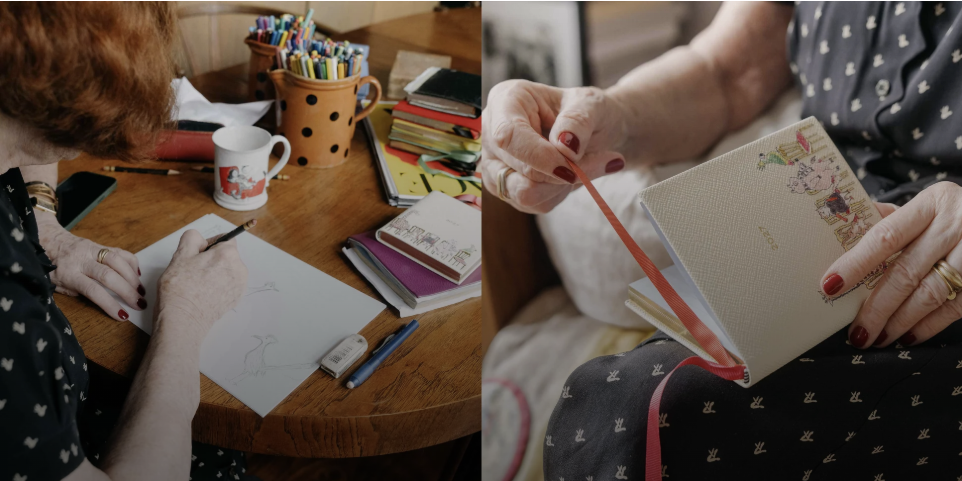
Image courtesy of smythson.com
In October 2026, Smythson opened a new flagship at 575 Madison Avenue, New York, introducing its first bespoke stationery salon outside London.
The timing is interesting. Although digital communication has transformed the practical necessity of handwritten correspondence, physical stationery has acquired a new significance as a deliberate and unusually personal form of communication.
A beautifully engraved invitation or handwritten letter asks for something increasingly scarce: the recipient’s undivided attention.
Smythson’s enduring appeal lies in the understanding that design can elevate the smallest daily rituals, whether recording an appointment, sending a note or writing something worth keeping.
Explore: The Smythson story · Bespoke stationery · Grace Coddington collaboration
Visit: 141–142 Sloane Street, London SW1X 9AY, or 575 Madison Avenue, New York.
All images courtesy of Smythson
