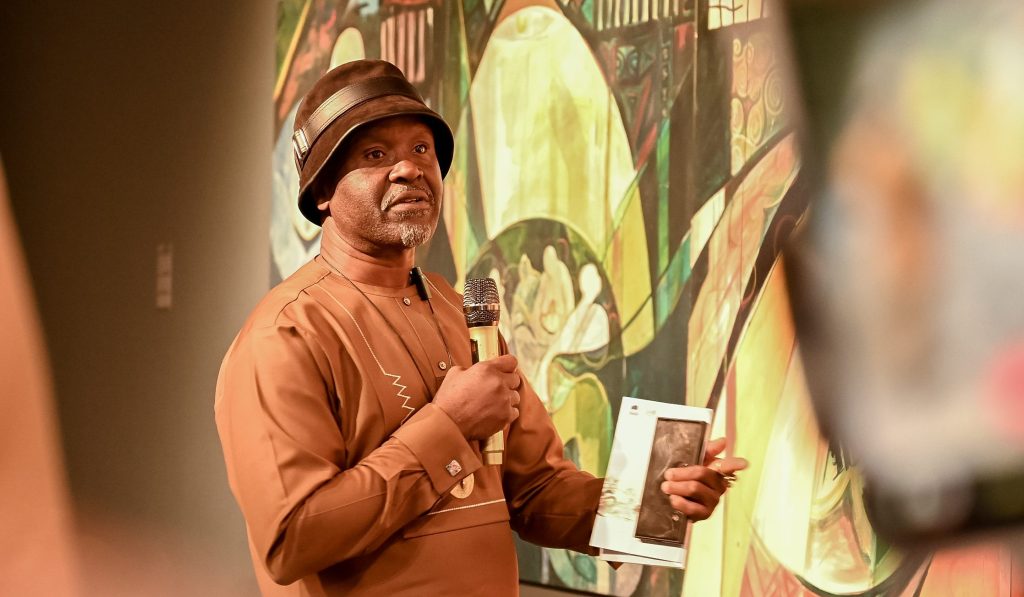
More than 100 works spanning over three decades of artistic practice have been brought together at the Yemisi Shyllon Museum of Art in Lagos for Freedom Bird, a major exhibition devoted to Professor Chika Okeke-Agulu. Best known internationally for his influential scholarship on African art and Nigerian modernism, Professor Okeke-Agulu has maintained an active artistic practice throughout his academic career. The exhibition, curated by Iheanyi Onwuegbucha, with Sandra Mbanefo-Obiago as associate curator, offers an opportunity to examine that practice on its own terms.
Presented in collaboration with SMO Contemporary Art, the exhibition encompasses painting, drawing, sculpture and archival material. Its six thematic sections trace the artist’s development against the political and cultural circumstances of postcolonial Nigeria, his subsequent departure for Europe and the United States, and the personal relationships that have informed his work.
Among the works on view is Freedom Bird II (2024), a four-panel composition in which charcoal gathers in dense, looping coils before gradually giving way to a brightly coloured bird against an almost empty white ground. The movement across the panels suggests a passage towards freedom, although traces of the earlier turbulence remain. The bird occupies only a small part of the composition, while the drawing’s earlier density remains visible across the adjoining sheets.
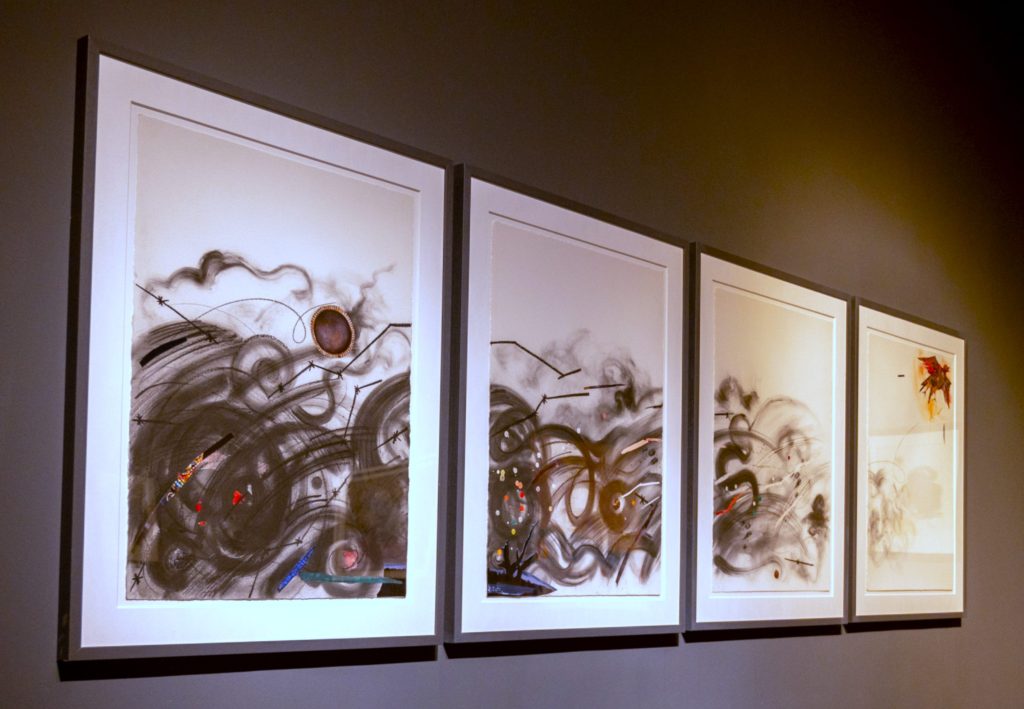
Charcoal, watercolour and collage · 56 × 75.8 cm
© Yemisi Shyllon Museum of Art, Pan-Atlantic University
The work offers a compelling introduction to an artist whose paintings, drawings and sculptures have developed in close relationship with Nigeria’s political and cultural history.
Internationally, Professor Okeke-Agulu is particularly well known as a historian of African art. He holds the Robert Schirmer Professorship of Art and Archaeology and African American Studies at Princeton University, and his scholarship has helped establish a fuller understanding of Nigerian modernism. Yet he has repeatedly maintained that he considers himself an artist first. In a Princeton interview, he explained that he continues to practise as an artist and seeks out the company of artists and writers wherever he travels.
That distinction matters to the history presented in Lagos. His artistic practice was established before his academic career took its present shape, and the circumstances of its development help explain the urgency of both.
Learning to See at Nsukka
Born in Umuahia in southeastern Nigeria, Professor Okeke-Agulu spent his earliest years amid the Nigerian Civil War of 1967–70. His artistic education began unusually. Having studied science at school, he initially taught himself to paint using instructional books bought in a local market. When he applied to the University of Nigeria, Nsukka, in 1985, he assembled a portfolio using improvised asbestos-board supports. According to Princeton’s biographical account, he performed so well in the entrance examination that the portfolio was never examined.
At Nsukka, he studied sculpture and subsequently completed an MFA in painting. His teachers included the Ghanaian sculptor El Anatsui and the Nigerian painter Obiora Udechukwu, both central figures in an exceptionally productive artistic environment.
The Nsukka School developed from an important reconsideration of Nigerian modernism. Uche Okeke, whose teaching helped establish its direction after the civil war, encouraged artists to investigate indigenous visual systems alongside contemporary methods of artistic expression. Particularly influential was uli, the tradition of body and wall painting historically practised by Igbo women, distinguished by expressive lines, economical forms and a sensitivity to the relationship between marks and empty space.
Professor Okeke-Agulu’s generation inherited this approach without treating it as a fixed style. Drawing became a field of experimentation, capable of carrying political commentary, complex imagery and personal experience.
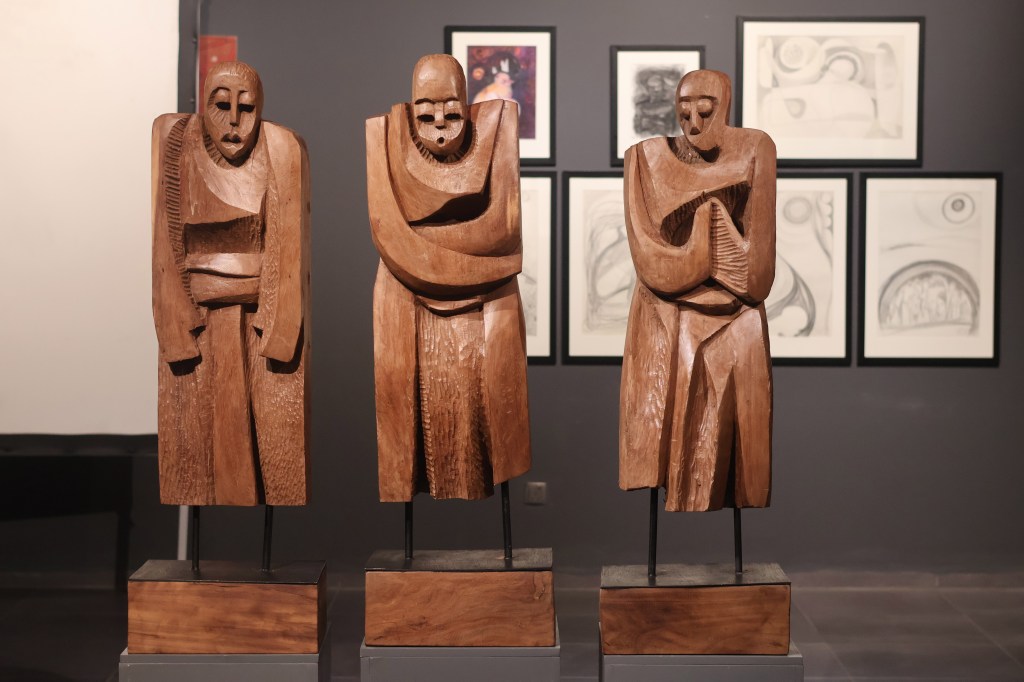
His early sculpture demonstrates a related interest in formal economy. Ancestors (1989–90) consists of three elongated wooden figures with deeply recessed facial features and arms held close to their bodies. Their surfaces retain visible carving marks, while the figures’ upright forms preserve something of the original timber. The sculptures are strikingly restrained, relying upon the arrangement of a few substantial volumes rather than anatomical detail.
© Yemisi Shyllon Museum of Art, Pan-Atlantic University
He also belonged to the Aka Circle of Exhibiting Artists, founded in Enugu in 1985 by Anatsui and Udechukwu. As Onwuegbucha explains in a recent scholarly essay published on MoMA’s research platform, Aka was primarily a professional exhibiting association rather than an artistic movement committed to a unified style. Its members organised exhibitions, pooled resources and maintained an independent artistic community during a period of considerable economic and political difficulty.
This distinction between Nsukka and Aka is significant. The former encouraged a particular intellectual and aesthetic engagement with indigenous visual traditions; the latter offered artists the practical means to sustain their individual practices.
Pictures of a Country in Crisis
At more than eight metres wide, Tyranny and Democracy (1994) is among the exhibition’s most imposing works. Seven painted panels form a continuous composition, their arrangements of figures and geometric shapes connected by sweeping curves and angular divisions.
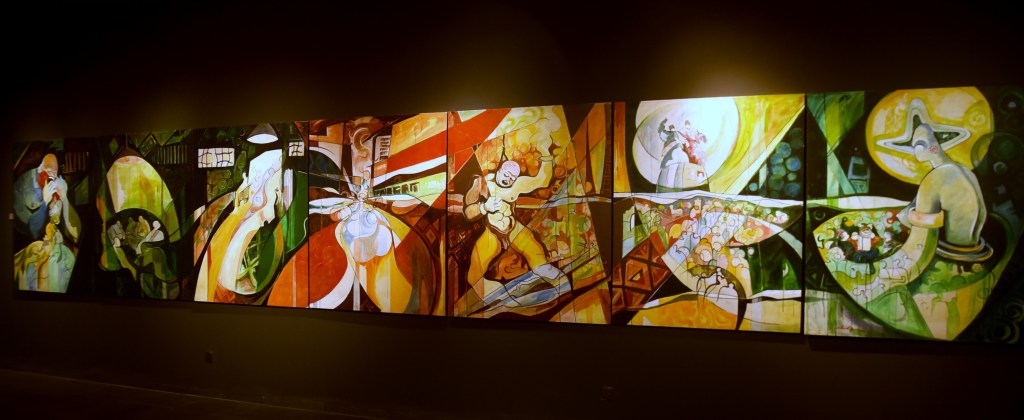
Acrylic on canvas · 152.5 × 853.5 cm (seven panels)
© Yemisi Shyllon Museum of Art, Pan-Atlantic University
The painting moves between passages of vivid yellow, red and green, interrupted by darker areas in which figures appear compressed or threatened. Several forms are immediately recognisable as human, while others emerge only gradually from the overlapping shapes. Large circular elements provide points of visual concentration, but the painting resists a single, easily followed narrative.
According to the exhibition’s curatorial guide, Professor Okeke-Agulu draws upon Igbo cosmology and folklore, including the tyrannical figure Anukili and the earth goddess Ana, to examine the struggle between authoritarian power and democratic aspiration. The references situate the work within his own cultural and intellectual environment. Its composition, however, is considerably less straightforward than a symbolic confrontation between opposing figures.
Across the seven panels, the pictorial space repeatedly opens and closes. Figures occupy the same visual field as patterns and abstract passages, while the continuous arrangement encourages the viewer to read the painting as a succession of related episodes. Its scale allows the artist to sustain several simultaneous events without establishing a definitive hierarchy among them.
The painting emerged during a particularly difficult period in Nigeria. The presidential election of June 1993 had been annulled by the military government, and General Sani Abacha subsequently consolidated authoritarian rule. Political repression and economic hardship profoundly affected universities and cultural life.
Professor Okeke-Agulu had already begun responding to these circumstances. His first solo exhibition, Whirlwinds Across the Nation, took place in 1992. Drawings associated with that period examine student protests, police violence and political unrest in Lagos.
The subsequent Biafra Series (1995) returns to an earlier national catastrophe through a markedly different visual language. In the painting reproduced for the exhibition, a solitary, elongated figure stands against a densely worked red and orange field. Above it, a large circular area contains small signs and schematic forms, while diagonal divisions and curving lines disturb the surrounding space.
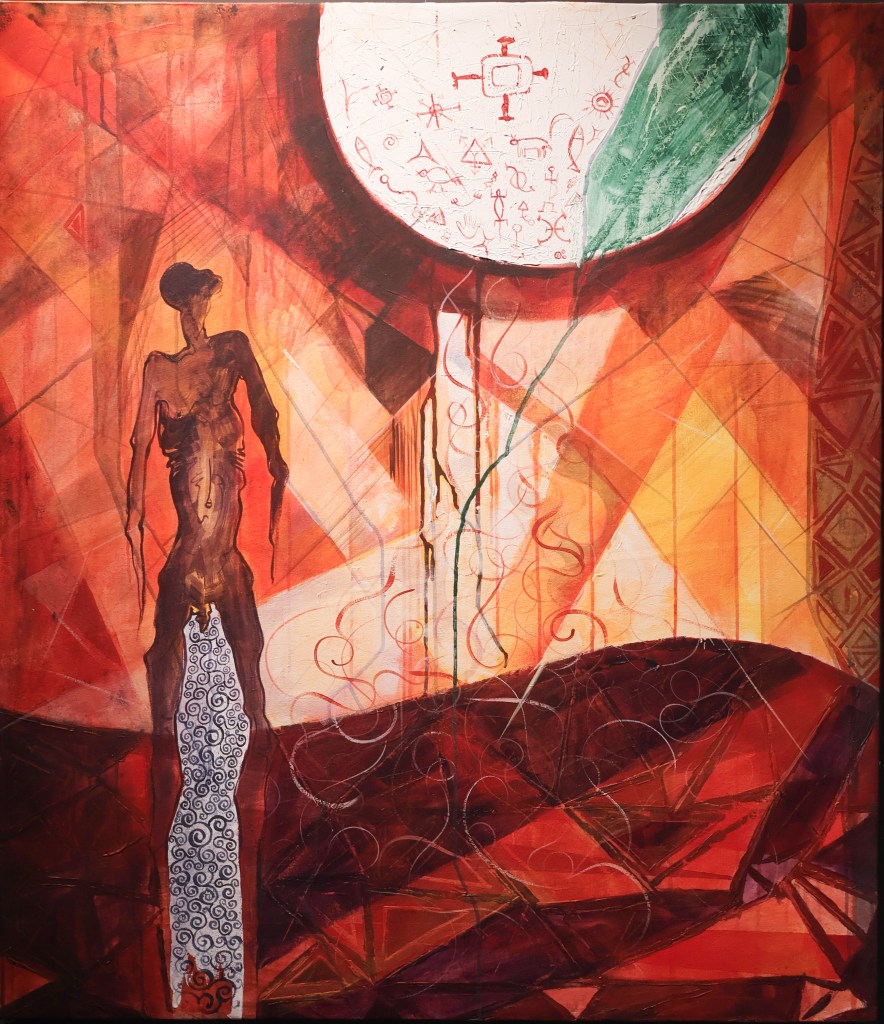
Acrylic on canvas · 118 × 101 cm
© Yemisi Shyllon Museum of Art, Pan-Atlantic University
The figure is recognisably human but resists conventional portraiture. Its dark body contrasts with a narrow patterned section extending towards the bottom of the canvas. There is no literal depiction of battle. Instead, the work assembles symbols, bodily forms and shifting pictorial planes into an unsettling image.
Other works address the persecution of political dissenters, including the execution of environmental activist Ken Saro-Wiwa in 1995.
These paintings and drawings are particularly compelling when considered as artistic investigations rather than illustrations of historical events. Changes in medium and composition are themselves significant. In some drawings, fine pencil lines establish a fragile figure; elsewhere, charcoal is rubbed into the paper until the image becomes almost entirely absorbed into darkness.
The Prison Garden works, begun in the late 1990s, use these qualities to explore confinement. Dense charcoal forms evoke enclosure, while occasional organic shapes emerge from the surrounding marks. The suggestion of vegetation provides a counterpoint to the oppressive spaces without resolving their tension.
A later group of drawings, the Jos Series (2001), has a different and immediate historical context. During the communal violence in Jos that year, Professor Okeke-Agulu lost belongings and artworks. The drawings register the instability associated with those events through blurred forms, concentrated charcoal and passages of colour.
The Experience of Departure
By the mid-1990s, political repression had begun to alter Professor Okeke-Agulu’s life directly. During a confrontation between the military government and university staff in 1996, he was among thirteen academics at Nsukka who refused to sign a government-imposed undertaking. Eight of the dissenting lecturers were subsequently arrested and charged with serious offences. He eventually left Nigeria to pursue further study in the United States.
He had already travelled to London for an artist residency in 1995. Works from that visit examine the experience of arriving in an unfamiliar city. In London Underground (1995), a network of intersecting lines and dark architectural forms crosses a warm, densely coloured surface.
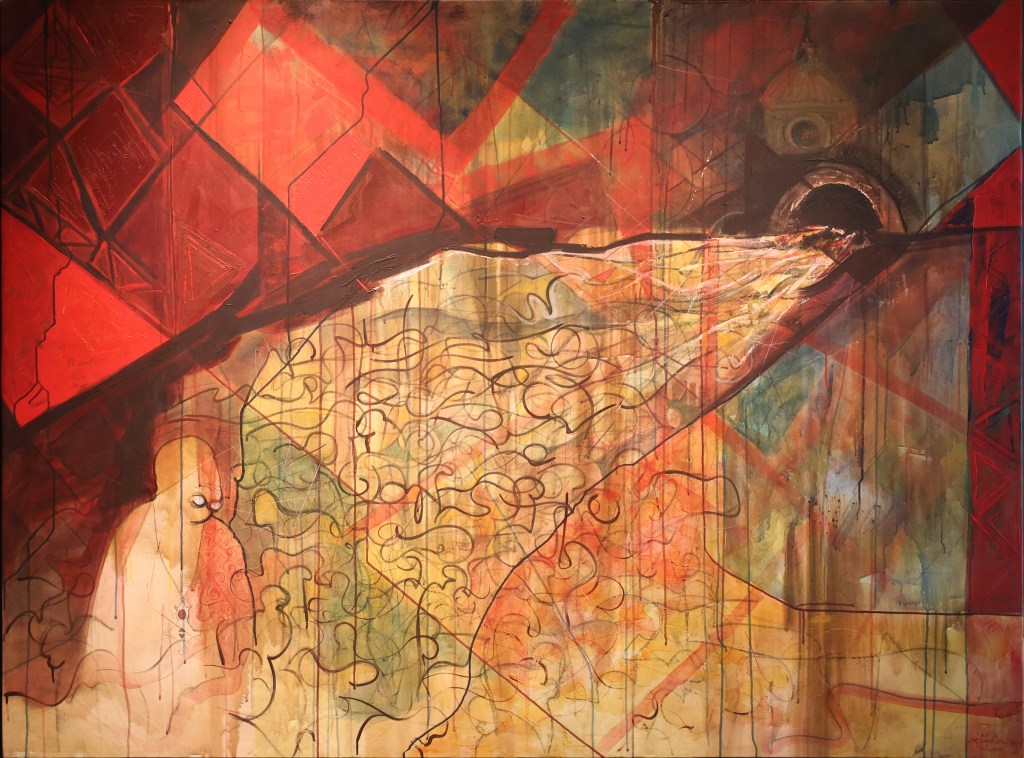
Acrylic on canvas · 140 × 186 cm
© Yemisi Shyllon Museum of Art, Pan-Atlantic University
The painting gives little sense of London as a recognisable urban landscape. A large diagonal structure cuts through the composition, while smaller architectural details appear partly obscured by overlapping marks. The resulting space is difficult to navigate visually, an effect consistent with the artist’s interest in the disorientation of unfamiliar surroundings.
His move to the United States in 1997 brought further challenges. While studying in Florida, he faced financial difficulties and the prospect of homelessness. The subsequent Map Series approaches geography through fragmented surfaces and diagrammatic arrangements, exploring the experience of movement between places.
These works also connect with an important personal history. The exhibition includes pieces concerned with Professor Okeke-Agulu’s relationship with Marcia Kure, herself an accomplished Nigerian artist trained at Nsukka. Their separation during the political upheavals of the 1990s, their eventual reunion and their artistic collaboration form the basis of the exhibition’s final section, Love.
The inclusion of Kure’s work gives this part of the exhibition particular interest. Their relationship belongs to a shared artistic environment in which both developed independent practices, and the collaborative works place their personal circumstances within a continuing exchange of artistic ideas.
The Artist and the Historian
Professor Okeke-Agulu’s academic career developed from interests already present in his work as an artist, critic and curator. His research into Nigerian modernism eventually produced Postcolonial Modernism: Art and Decolonization in Twentieth-Century Nigeria, published by Duke University Press in 2015.
The book reconstructs the artistic and intellectual networks through which Nigerian artists developed modern practices during the decades surrounding independence. It challenges accounts of modernism that assign European artistic developments a universal authority, examining instead the specific conditions in which Nigerian artists negotiated questions of artistic autonomy, cultural inheritance and political change.
Alongside Okwui Enwezor and Salah Hassan, he also helped develop Nka: Journal of Contemporary African Art, providing a forum for criticism and scholarship at a time when modern African artists remained seriously underrepresented in international art-historical literature.
There is an interesting consequence to this history. Professor Okeke-Agulu spent decades researching, documenting and curating the work of other artists, while his own paintings and drawings received comparatively little sustained scholarly attention. The Lagos exhibition begins to address that imbalance.
It also reveals the breadth of his artistic development. The assertive figuration of Tyranny and Democracy, the heavily worked charcoal surfaces of Prison Garden and the open compositions of Freedom Bird II belong to different stages of a continuing investigation. Their political associations are important, but the formal differences between them are equally revealing.
Returning to Freedom Bird II, one notices how much of the composition depends upon what the artist leaves untouched. The bird occupies a relatively small area of the final panel. Most of the surrounding paper remains white, while the denser marks are concentrated further to the left.
The work retains a connection to the linear experiments of the Nsukka years, although its means are now considerably more economical. The survey makes that development visible across drawings, paintings and sculpture, bringing into focus an artistic career that has remained active alongside one of the most influential scholarly contributions to modern African art history.
Exhibition Information
Chika Okeke-Agulu: Freedom Bird
1 November 2026 – 31 January 2027
Yemisi Shyllon Museum of Art, Pan-Atlantic University, Ibeju-Lekki, Lagos, Nigeria.
Curated by Iheanyi Onwuegbucha, with Sandra Mbanefo-Obiago as associate curator.
Presented in collaboration with SMO Contemporary Art.
Cover image: Professor Chika Okeke-Agulu at Freedom Bird
Artist-led tour at the VIP exhibition opening, 8 November 2026
© Yemisi Shyllon Museum of Art, Pan-Atlantic University
