From colonial photographic archives to the imagined underwater civilisation of Drexciya, Ayana V. Jackson has spent more than two decades examining how images shape our understanding of history. As From the Deep opens in Vancouver, her work reveals an artist whose research extends far beyond the photographic frame.
In When the Spirit of Kalundo Comes So Does Kianda, American artist Ayana V. Jackson appears against a black background, wearing a metallic gown with enormous structured skirts and translucent sleeves. A crown of branching silver rods rises above her head, while a rigid band conceals her eyes. The garment suggests ceremonial dress, although its materials and elaborate construction belong to no recognisable historical period. The figure inhabits a world that Jackson has invented.
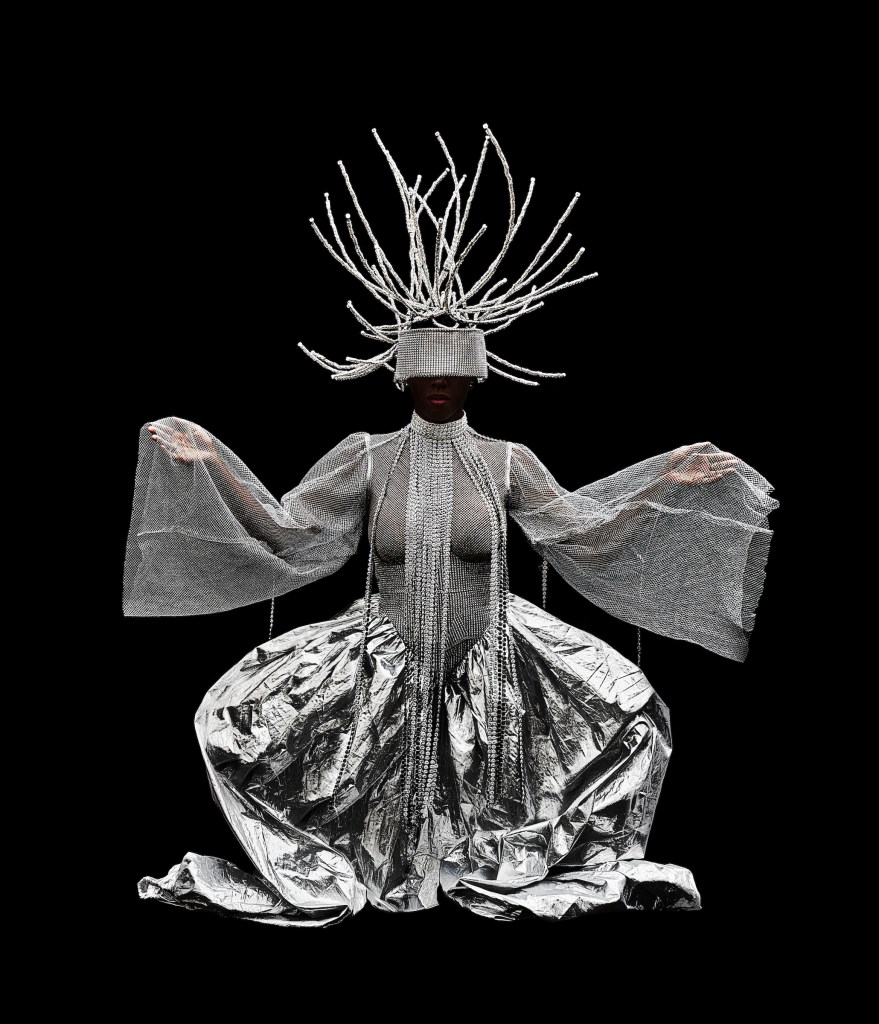
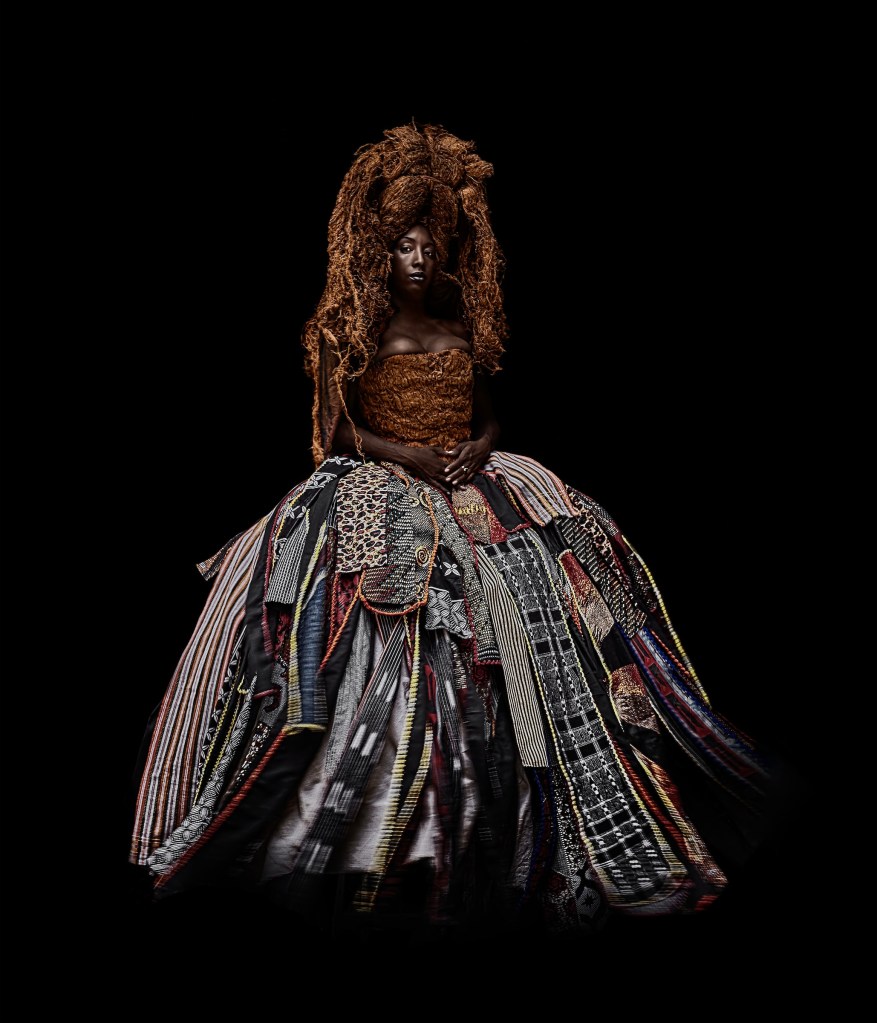
She is one of the inhabitants of Drexciya, an imaginary civilisation beneath the Atlantic Ocean. Jackson has developed its appearance through photography, costume and film, drawing upon African spiritual traditions and the mythology created by two Detroit electronic musicians during the 1990s.
Her exhibition, From the Deep: In the Wake of Drexciya with Ayana V. Jackson, opened at the Museum of Anthropology at the University of British Columbia on 19 November 2026. First presented at the Smithsonian’s National Museum of African Art in Washington in 2023, it brings together photographs, sculptural costumes, animation and underwater film.
It is an ambitious undertaking for an artist whose earlier work was rooted in documentary photography. Yet the connection becomes apparent when considered alongside her longstanding examination of historical images, particularly the ways Black women have been represented by photographers working within colonial societies.
From Documentary Photography to the Colonial Archive
Born in East Orange, New Jersey, in 1977, Ayana V. Jackson studied sociology at Spelman College in Atlanta, developing an interest in the African diaspora and its histories in Latin America and the Caribbean.
Between 2003 and 2005, she collaborated with writer and filmmaker Marco Villalobos on African by Legacy, Mexican by Birth, a documentary project examining Afro-Mexican communities and their place within Mexican society.
The work explored questions of racial classification and cultural citizenship, including the limited recognition historically afforded to African-descended populations in Mexico. It also prompted Jackson to consider the relationship between photographers and the people they photograph. Even when documentary images are produced with sympathetic intentions, their subjects have limited control over how the resulting pictures are interpreted.
Jackson eventually began examining the photographic archive itself.
In Archival Impulse (2013), she reconstructed images from the late nineteenth and early twentieth centuries, drawing upon photographs taken during European colonial expansion in Africa and the Americas.
Her sources included the South African Duggan-Cronin collection and photographs documenting ethnographic exhibitions in Europe, where people from colonised societies were displayed before paying audiences.
Such images were often presented as objective records. Their compositions, however, reflected the assumptions of the societies that commissioned them. Photographers determined how their subjects stood, dressed and looked towards the camera. The resulting pictures became part of an enormous visual record through which European audiences encountered and classified people living under colonial rule.
Jackson responded by placing herself within these compositions.
She adopted historical poses and costumes, performing roles originally occupied by people whose circumstances differed profoundly from her own. In the process, she assumed control over the photograph’s construction, occupying the positions of subject, performer and author.
The series takes its name from art historian Hal Foster’s writing on the archival impulse. Jackson also drew upon scholarship by Susan Sontag, Elizabeth Edwards, Okwui Enwezor and Tamar Garb, whose work has examined photography’s relationship to historical knowledge and representation.
Her approach places considerable importance on the act of performance. The historical image becomes a set of instructions that Jackson can examine by physically reconstructing it.
A similar concern informs Dear Sarah (2016), a series of seven portraits inspired by the life of Sarah Forbes Bonetta, the Yoruba girl who became associated with Queen Victoria’s court during the nineteenth century.
Jackson approaches Bonetta through the different names and identities recorded during her life. Photographs titled Aina, Sarah and S. Bonetta examine how a historical individual could be understood through the circumstances in which her likeness was preserved.
The series is particularly interesting because Bonetta survives in the photographic record partly through her connection to the British royal household. Her portraits provide evidence of her appearance, clothing and social presentation, but they offer a necessarily incomplete account of her experiences.
Jackson’s reconstructions draw attention to that distinction. A photograph may preserve considerable visual information while revealing surprisingly little about the person who appears within it.
In a July 2026 interview with Rebecca Amsellem, Jackson emphasised that her work is concerned with dismantling racial and gender stereotypes. She distinguishes these from identity itself, explaining that her interest lies in understanding how restrictive assumptions develop and become embedded in visual culture.
It is an important distinction. Her photographs do not claim to recover lost historical experiences. They examine the conventions through which certain interpretations of those experiences have come to seem natural.
The World of Drexciya
Jackson’s interest in historical representation acquired an unexpected dimension when she encountered Drexciya, the Detroit electronic music project developed by James Stinson and Gerald Donald.
During the 1990s, the musicians constructed an elaborate fictional world around their recordings. Tracks such as Bubble Metropolis, Wavejumper and Deep Sea Dweller suggested underwater settlements, unfamiliar technologies and an aquatic population existing beyond human observation.
Drexciya’s mythology received its clearest explanation in the sleeve notes accompanying the 1997 compilation The Quest.
The fictional civilisation was said to have descended from the unborn children of pregnant African women who were thrown overboard, or jumped from ships, during the transatlantic slave trade. In this imagined account, the children survived beneath the Atlantic, developed the ability to breathe underwater and eventually established their own society.
The premise belongs to speculative fiction, but its origins are inseparable from the historical violence of the Middle Passage.
Stinson and Donald cultivated considerable anonymity. Their imaginary world developed primarily through music, album artwork and fragments of narrative, leaving listeners to construct much of its appearance for themselves.
Jackson encountered Drexciya through Afrofuturist artist and thinker Ingrid LaFleur. The mythology interested her partly because of what its creators had left unexplained.
How had the children survived their mothers’ deaths? What spiritual traditions might have accompanied them into the ocean?
Jackson drew upon African and Afro-Atlantic cosmologies, imagining that water spirits had assisted the women and acted as midwives to their children.
Her fictional society incorporates figures associated with Yemoja, Oshun, Mami Wata and other spiritual traditions. These belong to different cultural and religious histories, and Jackson brings selected elements of them into a deliberately constructed mythology.
The resulting civilisation places women and spiritual authority at its centre, developing a markedly different emphasis from Drexciya’s original technological and sometimes militaristic universe.
Before proceeding with the exhibition, Jackson contacted Gerald Donald, the surviving member of Drexciya, and received his support.
The Clothing of an Imagined Civilisation
Jackson began developing the visual world of Drexciya through her earlier Take Me to the Water project, presented at Mariane Ibrahim Gallery in Chicago in 2019.
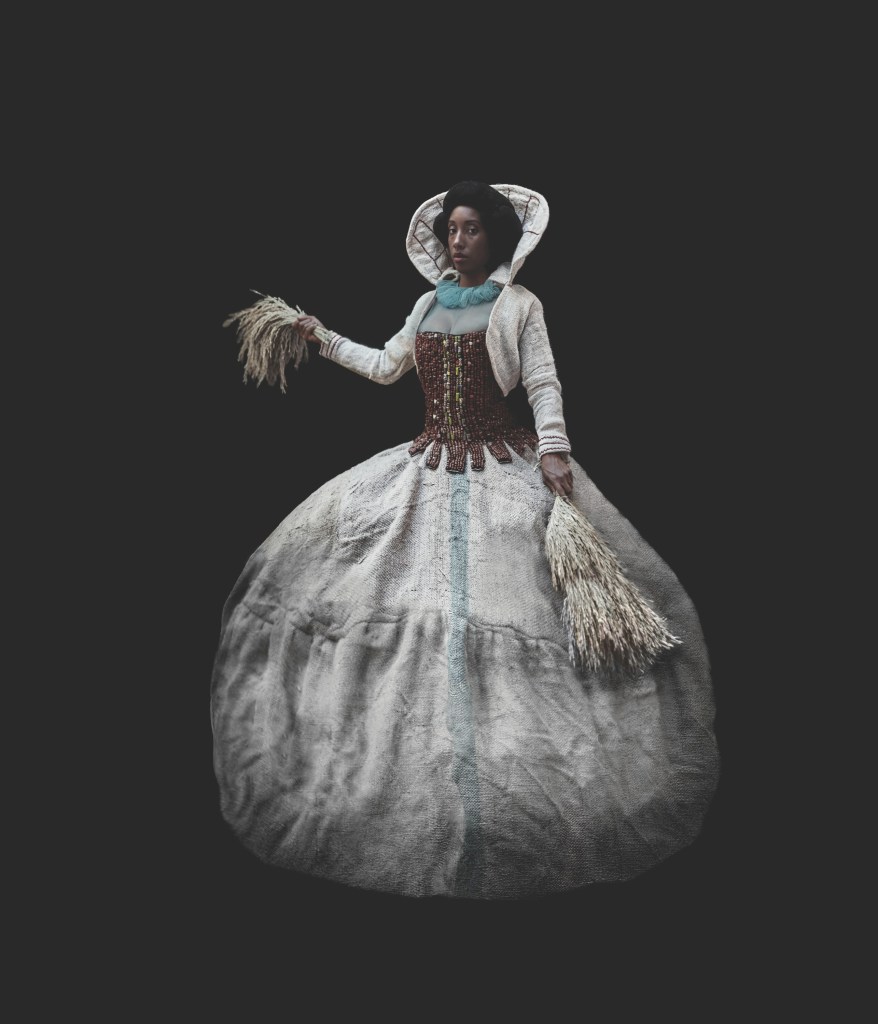
Working with designers including Rama Diaw of Senegal, Mwambi Wassaki of Angola and Olabanji “Cheddar” Arowoshola, who works between Nigeria and Ghana, she created elaborate costumes informed by historical dress and materials associated with maritime environments. Trinidadian designer Robert Young also contributed to the wider exhibition project.
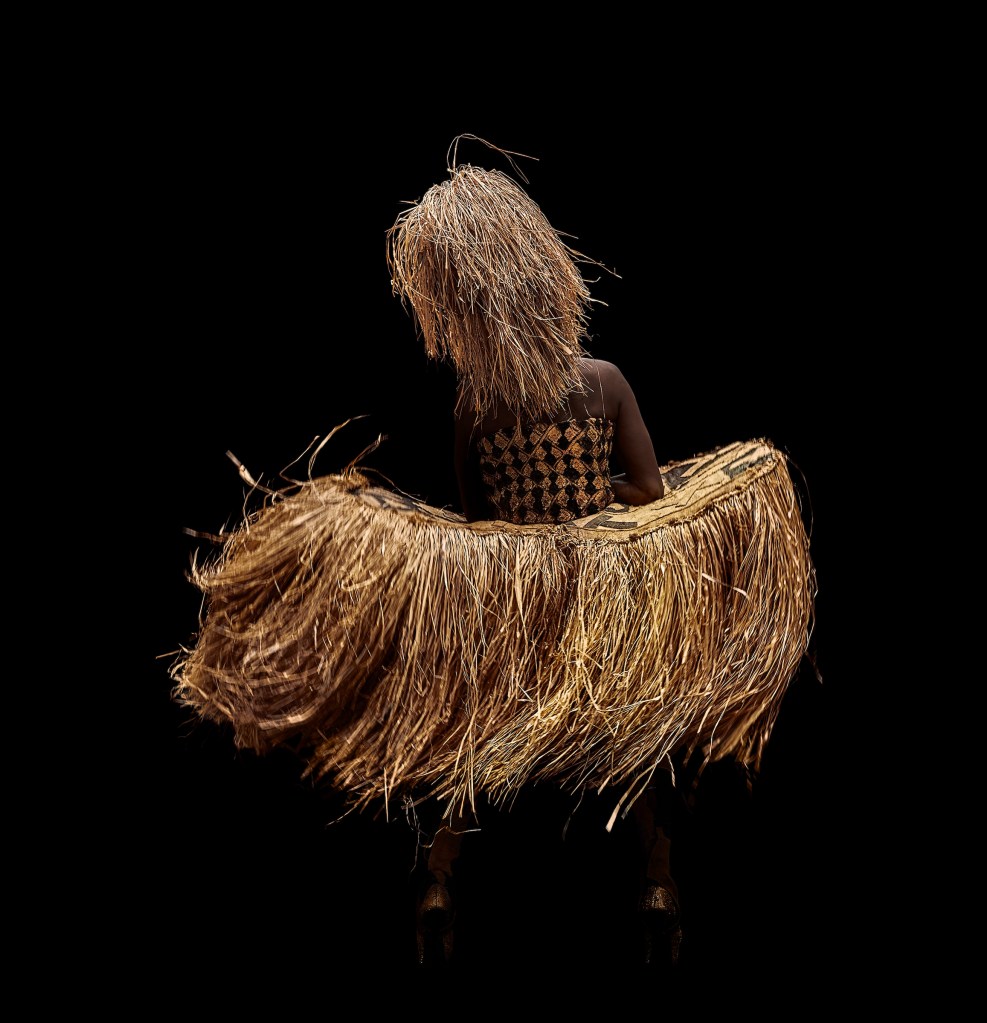
The garments incorporate fishing nets, shells, plastic footwear, metal utensils and other objects that might conceivably reach an underwater settlement.
In The Rupture Was the Story (2019), Jackson reclines against a dark background, wearing a bodice constructed from silver spoons and a skirt assembled from discarded plastic flip-flops. The metallic surfaces catch the light, while the inexpensive footwear forms an unexpectedly elaborate garment.
The arrangement recalls the carefully staged informality of aristocratic portraiture, although its materials belong unmistakably to contemporary industrial production.
Jackson and her collaborators researched clothing associated with African societies and European courts from the sixteenth century onwards. Such references are significant in an imagined civilisation whose origins coincide with the expansion of transatlantic slavery.
European court portraiture employed elaborate dress to communicate wealth, rank and authority. Jackson draws upon aspects of this visual language while replacing its familiar fabrics and ornaments with objects associated with trade, consumption and marine debris.
The costumes suggest a society that has developed its own forms of ceremony from materials discarded or transported by another world.
Other works emerged from stories Jackson encountered during her research.
In Some People Have Spiritual Eyes (2020), she wears a garment incorporating Ghanaian banknotes. The photograph developed from a story told by her aunt in Ghana about fishermen who believed that people traded with inhabitants of an underwater world.
In a 2023 interview with The Guardian, Jackson recalled discussing the belief with a fisherman. He explained that although he had never witnessed such an encounter, others believed they had seen these mysterious traders.
The anecdote reveals something characteristic of Jackson’s working method. Her imaginary civilisation has been constructed through historical research and contemporary conversations, with particular attention to the places and traditions informing its mythology.
The clothes themselves are central to this process. They establish the inhabitants’ appearance and suggest the forms of material knowledge that their civilisation might possess.
Beneath the Surface
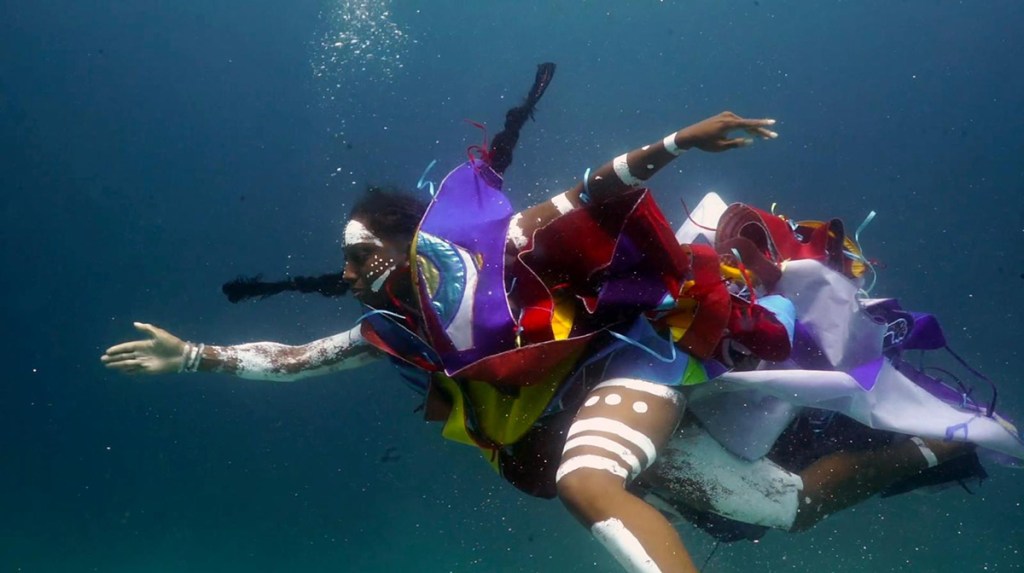
For the moving-image installation Journey of the Deep Sea Dweller: Who Among Us Has Killed an Albatross, Jackson decided to enter the underwater environment herself.
She initially experimented with filming while diving in Senegal, Angola and Ghana. Dissatisfied with footage recorded near the surface, she undertook further training in Trinidad and Tobago, where she spent several months during pandemic travel restrictions.
She eventually qualified as a highly trained diver before travelling to South Africa to film with cinematographer Eran Tahor and a professional underwater team.
Some sequences were recorded at depths of approximately 90 feet, with Jackson performing while holding her breath. The costumes complicated an already demanding undertaking, restricting her movements and limiting individual passages to twenty or thirty seconds.
The resulting film places Jackson among marine environments, performing the movements of a fictional underwater inhabitant.
The exhibition’s soundscape was developed specifically for Jackson’s project, drawing inspiration from Drexciya rather than using the duo’s original recordings. The Smithsonian presentation also incorporated passages from Robert Hayden’s poem Middle Passage and Alexis Pauline Gumbs’s Undrowned: Black Feminist Lessons from Marine Mammals.
The film required Jackson to extend her established method of photographic performance into an unfamiliar physical environment.
Her earlier photographs reconstructed historical poses within the controlled conditions of a studio. Underwater, the weight of the costume and the resistance of the surrounding water became part of the performance.
The work also introduces a different relationship between artist and subject. Jackson’s fictional inhabitants possess the ability to breathe underwater, whereas the person performing them must repeatedly return to the surface.
The distinction remains visible beneath the technical accomplishment of the film. Jackson is constructing a fictional existence through an entirely human physical undertaking.
of the artist and Mariane Ibrahim
The Horsewomen of History
Jackson’s more recent work extends her interest in historical representation into another longstanding artistic convention: the equestrian portrait.
In You Forgot to See Me Coming, begun in 2023 and presented at the Rencontres d’Arles photography festival in 2026, she inhabits historical figures associated with horses, travel and political independence.
They include Mary Fields, the African American stagecoach driver known as Stagecoach Mary; Selika Lazevski, a Black equestrian photographed in nineteenth-century Paris; and figures associated with the Mexican Revolution, including Amelio Robles and the Adelitas.
The series draws upon the familiar appearance of mounted figures in European and American portraiture, military painting and public monuments.
For centuries, the horse has been associated with political power, military authority and social distinction. Jackson examines this tradition through people whose achievements have rarely been represented within its established visual conventions.
In To Be Black and Female in the Spanish South-West (in the Style of Selika Lazevski) (2023), Jackson rides sidesaddle through a pale, misty landscape. Her posture and historical clothing evoke nineteenth-century equestrian photography, while her presence recalls the Black women whose lives rarely entered the canonical images of the period.
Once again, Jackson undertook the physical training required to perform the role.
Having learned to dive for From the Deep, she learned to ride sidesaddle for the equestrian photographs.
In her 2026 conversation with Rebecca Amsellem, Jackson described viewers questioning whether some of these images had been generated using artificial intelligence. She acknowledged that the photographs employed digital manipulation, but observed that people seemed particularly doubtful about the possibility of her actually riding the horses.
Their questions concerned the apparent improbability of the scene rather than the skills needed to produce it.
For an artist who has spent much of her career examining how images reinforce stereotypes, the reaction was revealing. Jackson had reconstructed a historical visual convention with considerable attention to costume and physical performance, yet some viewers struggled to accept her presence within it.
The Figure in the Photograph
The Vancouver presentation of From the Deep brings together much of what Jackson has developed over the past two decades. Its elaborate costumes, historical references and demanding performances emerge from a practice founded on close attention to how photographs are constructed and interpreted.
There is a difficulty inherent in the exhibition’s central mythology. The imagined survival of children lost during the Middle Passage creates an elaborate civilisation from a history of enormous human suffering. The fiction cannot recover those lives or alter the circumstances of their deaths.
Jackson’s photographs nevertheless give the imaginary descendants a material culture, spiritual traditions and the means to represent themselves. The historical catastrophe remains part of the story, even as the artist develops possibilities that lie beyond the surviving record.
Her broader work has consistently investigated the distance between the appearance of a photograph and the circumstances that produced it.
In Archival Impulse, she reconstructed the conventions of colonial photography. In Dear Sarah, she examined the representation of a woman whose life has been interpreted through several historical identities. In From the Deep, she has developed portraits of people who exist entirely through artistic invention.
The equestrian photographs return to historical individuals, but the underlying concern remains recognisable.
Jackson has described her recent riding pictures as counter-monuments, drawing attention to the limited range of people traditionally represented in positions of authority.
Their construction is as carefully considered as the elaborate costumes of Drexciya. Each image requires historical research, practical preparation and a conscious decision about how its subject should appear.
The questions viewers have asked about the authenticity of her riding photographs suggest why Jackson remains interested in these conventions. The images may be constructed, but so are many of the assumptions brought to them.
From the Deep: In the Wake of Drexciya with Ayana V. Jackson
19 November 2026 – 29 March 2027
Museum of Anthropology, University of British Columbia, Vancouver, Canada.
Originally curated by Karen E. Milbourne for the Smithsonian’s National Museum of African Art. International tour organised by International Arts & Artists.
Exhibition information and visiting details
Cover image: Ayana V. Jackson, Journey of the Deep Sea Dweller, 2019. Video Still

