The Canadian-born American painter spent much of her career pursuing an ideal she knew could never be realised. Her grids and pale bands of colour reveal an unusually complex relationship between discipline, perception and the human hand.
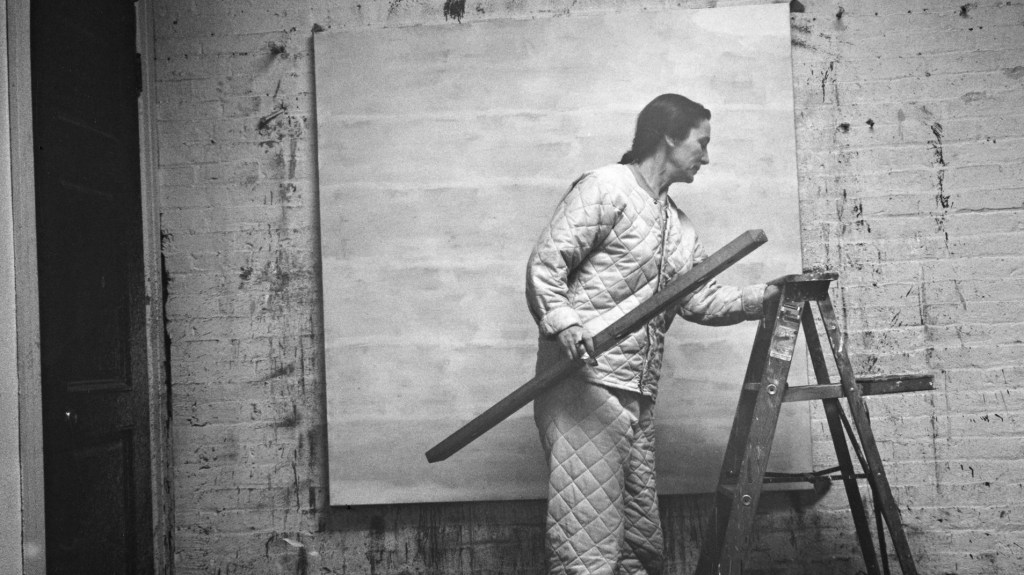
An eighteen-inch ruler was one of Agnes Martin’s essential working tools. When drawing a horizontal line across a canvas five feet wide, she moved the ruler in successive stages, following the surface as it yielded slightly beneath the pencil. The resulting line could never be mathematically straight. In Untitled #5 (1994), eleven bands of white, blue and peach are separated by graphite lines that waver almost imperceptibly and stop before reaching the edges of the canvas. The divisions appear regular from a distance. Close examination reveals a succession of small adjustments made by hand.
Martin understood this discrepancy between an ideal form and its physical execution. In a 1989 interview with Suzan Campbell for the Smithsonian Institution’s Archives of American Art, she described perfection as impossible to achieve and pointed out that even the two hands of a human body are different. Repetition in nature, she argued, never produces exact duplication.
This presents a useful starting point for understanding an artist whose work is frequently described in terms of serenity, harmony and spiritual transcendence. Martin (1912–2004) devoted decades to the repetition of apparently simple geometric arrangements, yet the paintings continually reveal the physical circumstances of their making. The square never entirely suppresses the irregularity of the line. Colour does not settle into uniformity. Even the pale surfaces that appear almost empty contain subtle differences in density and texture.
Martin’s pursuit of perfection was concerned with an ideal that existed in the mind, beyond the limitations of material things. Painting offered a means of approaching that experience, although the painted object could never fully contain it. Her measured compositions therefore hold an unresolved tension between the precision of their design and the necessarily imperfect process of execution.
Martin arrived at this restricted visual language gradually. Born in Macklin, Saskatchewan, in 1912, she moved to the United States in 1932, studied art education and eventually established herself in Taos, New Mexico. Her paintings of the 1940s and 1950s included landscapes, biomorphic forms and experiments with Surrealist automatism. She was already in her forties when the New York dealer Betty Parsons encouraged her to move to Manhattan in 1957.
Martin settled at Coenties Slip, a former waterfront district where an unusually productive artistic community occupied inexpensive lofts. Her neighbours included Ellsworth Kelly, Robert Indiana, Jack Youngerman and the textile artist Lenore Tawney. The artists worked in different media and pursued markedly different interests, but shared an environment in which established ideas about painting, sculpture and artistic materials were being challenged.
The importance of Coenties Slip complicates the familiar account of Martin as an isolated visionary. She developed her mature style within a closely connected artistic community, at a moment when the assumptions of Abstract Expressionism were being reconsidered. Kelly’s hard-edged compositions, Tawney’s woven structures and the experiments of other artists around her formed part of the artistic environment in which Martin’s own thinking developed. Her subsequent withdrawal from New York has sometimes obscured the importance of these relationships.
By 1960 she had begun working with the grid that would become her defining visual structure. Paintings such as White Flower (1960) and The Islands (1961) established the six-foot square as a recurring format. The combination of delicate pencil marks, restrained colour and repeated divisions allowed Martin to dispense with recognisable objects while retaining considerable variation within a tightly controlled composition.
The grid already possessed a substantial history in twentieth-century abstraction. It could suggest rational organisation, the rejection of illusionistic space or a painting concerned primarily with its own structure. Martin employed it to explore experiences that were difficult to describe in visual terms. She spoke of innocence, happiness and beauty, concepts that she believed could be conveyed through arrangements of lines and colour without referring to identifiable objects.
In The Tree (1964), now in the Museum of Modern Art, hundreds of graphite lines cross an off-white canvas. They form narrow vertical rectangles, some containing additional lines, which collectively produce twenty-four alternating horizontal bands. The painting has an extraordinary density of information, although its restrained appearance can initially suggest the opposite. Its delicacy comes from the accumulation of marks.
Martin associated the origin of her grid with the innocence of trees. This was a revealing description of her method. She did not intend The Tree to resemble its subject, even in heavily abstracted form. The grid represented an experience she associated with innocence. Whether the viewer arrives at anything resembling that experience is another matter. The title offers an indication of Martin’s intentions, but provides little assistance in deciphering the image itself.
Her insistence that paintings could communicate states of feeling without representing their causes distinguished her from the more impersonal interpretations of geometric abstraction. Martin was included in exhibitions associated with Optical art, Hard Edge painting and Minimalism during the 1960s. Yet she considered herself an Abstract Expressionist, identifying with that movement’s belief in the emotional possibilities of painting. The classification was philosophical rather than stylistic. She had little interest in the dramatic brushwork through which Abstract Expressionism is most often recognised.
This distinction is particularly apparent in Friendship (1963), one of the most unusual paintings in Martin’s career. She covered an underlayer of oil paint with gold leaf and scored a grid into its surface by hand, exposing the darker ground beneath. Measuring just over six feet square, it combines the familiar arrangement of fine lines with a material whose historical associations include religious painting, luxury and ceremonial objects.
The gold changes the experience of the grid. Light catches the scored surface, drawing attention to its material presence. The marks interrupt the metallic field, producing minute differences in reflection and tone. The painting is difficult to reconcile with the idea that Martin’s achievement depended simply upon eliminating visual incident. Its richness comes from what happens to a comparatively simple structure when the surface itself becomes active.
The same attention to material difference remained fundamental to her later paintings. Their economy is deceptive. Encountered in reproduction, a Martin canvas can resemble a composition of mechanically even lines. At its original scale, the graphite catches the grain of the surface, the divisions reveal slight irregularities, and barely distinguishable passages of colour begin to separate from one another. The scale of the work matters because the painting must be apprehended both as a complete arrangement and as a surface marked by individual decisions.
Martin’s career was interrupted in 1967, when she left New York and stopped painting. Her final canvas before this withdrawal, Tundra (1967), is among her most radically reduced compositions. Two horizontal graphite lines and one vertical line divide an off-white canvas into six large rectangles. The intricate grids of the preceding years have almost disappeared. What remains is a small number of divisions, each given considerable space.
It would be tempting to read Tundra as an artistic farewell or a prediction of the silence that followed. Such interpretations risk imposing a retrospective narrative on a painting whose formal development was already underway. Other works from 1967 had begun to abandon the densely repeated grid in favour of larger divisions and horizontal bands. These experiments would eventually inform Martin’s paintings of the 1970s.
The circumstances of her departure were complicated. Martin faced the loss of her studio to redevelopment, experienced the death of her friend Ad Reinhardt and struggled with serious mental-health difficulties. She later offered different accounts of her decision to leave. Following a period of travel, she settled in a remote part of New Mexico, where she spent several years away from painting.
There is a persistent tendency to turn Martin’s biography into a spiritual parable: the solitary woman in the desert, liberated from worldly concerns, producing paintings of absolute tranquillity. The image overlooks the demanding practical circumstances of her life and the artistic relationships that had helped shape her career. It also risks making the paintings seem like illustrations of a pre-existing philosophy.
Martin herself contributed to this public image. In 1973, while she was still absent from painting, two published texts helped shape how her work was understood. The Untroubled Mind, included in the catalogue accompanying her retrospective at the Institute of Contemporary Art in Philadelphia, brought together Martin’s spoken and written statements as transcribed and recounted by Ann Wilson. It addressed innocence, inspiration and the possibility of escaping the limitations of the ego. Reflections, published in Artforum that April, was transcribed by Lizzie Borden from an interview with Martin. In it, Martin connected artistic perfection with the cultivation of an inner life.
These writings have frequently encouraged interpretations of Martin through Taoism, Zen Buddhism and other spiritual traditions. Her engagement with such ideas was serious, although her personal philosophy cannot be treated as a systematic account of any one tradition. She also drew upon her own conception of classicism, finding affinities between her work and ancient Egyptian, Greek, Chinese and Coptic art. What interested her was the possibility that an artwork could make perceptible an ideal conceived in the mind.
Her statements can be uncompromising. She sometimes wrote as though the experience of beauty were universal and as though the artist’s intentions could be communicated with unusual certainty. The paintings themselves are less prescriptive. Their effects depend upon conditions that Martin could never entirely control: the light in which they are seen, the distance from which they are approached and the concentration of the observer. The experience she sought to communicate remains open to interpretation.
During her absence from painting, Martin produced On a Clear Day (1973), a portfolio of thirty screenprints. The series explores different arrangements of parallel lines and grids within square formats. The clarity of the printed medium distinguishes these works from the fragile graphite surfaces of her earlier canvases, while the variations between them retain her interest in repetition and proportional change. The portfolio marked her return to artistic production before she resumed painting in 1974.
The new canvases introduced a significant development. In Untitled #3 (1974), six vertical rectangles of pale red and blue stand against a white ground, separated by narrow divisions and outlined in graphite. Colour, previously subordinate to the grid in many of her mature New York paintings, became a more prominent organising element. Over the following years, these vertical arrangements gave way to the horizontal stripes that would dominate much of her later work.
Martin’s interest in the emotional effects of repeated forms also found expression outside painting. In 1976 she completed Gabriel, a seventy-eight-minute film following a young boy through landscapes that include the Pacific coast, rivers and mountains. The film contains sustained observations of flowers, trees and water, accompanied at intervals by Glenn Gould’s 1955 recording of Bach’s Goldberg Variations.
Gabriel is an intriguing exception to Martin’s insistence upon non-representation. Its natural imagery is explicit, yet its attention to landscape and its musical accompaniment pursue experiences she associated with her abstract paintings. The film makes visible some of the natural forms that remained absent from her canvases. The connection with Bach is particularly suggestive. The capacity of a repeated structure to accommodate variation had occupied Martin for years, and music offered another means of investigating how formal relationships might produce emotional responses.
That principle reached an unusually ambitious scale in The Islands I–XII (1979), now in the Whitney Museum of American Art. The work consists of twelve canvases, each six feet square, conceived as a single composition and exhibited in a fixed sequence. White and off-white horizontal bars are separated by fine lines or narrow bands. Their number, placement and relative dimensions change from one canvas to the next.
The apparent sameness of the twelve paintings gradually gives way to an awareness of difference. One arrangement establishes an expectation that another modifies. A division that appears substantial on one canvas becomes comparatively narrow on the next. The first painting contains five white bars separated by four narrow off-white bands; the second reorganises the relationship between the pale areas and their graphite divisions. Across the complete work, Martin created a sequence whose individual components remain closely related without becoming identical.
This is an important distinction in assessing Martin’s originality. Repetition is frequently understood as a way of removing individual decisions from the making of a painting. In her work, repetition allowed increasingly subtle decisions to become significant. The restricted vocabulary made small differences perceptible. Colour, spacing and the pressure of a pencil could carry an expressive weight that might be overwhelmed in a more elaborate composition.
During the 1990s, Martin reduced the dimensions of her canvases from six feet to five feet square as the larger format became difficult to manage physically. The change brought a different sense of scale to paintings such as Untitled #5. Its horizontal colour bands remain carefully organised, but the final graphite lines, applied over the acrylic paint, preserve the slight disturbances of the hand. Drawing becomes the finishing gesture, remaining visible on the surface of the painting.
In her later years, Martin also returned to titles that made the emotional concerns of her painting more explicit. The six-part work With My Back to the World (1997) consists of canvases arranged in pale bands of blue, yellow, orange and red, their proportions and sequences varying across the group.
The title recalls ideas Martin had expressed decades earlier about the artist’s separation from the ordinary demands of the world. Yet the paintings are remarkably open in their colour relationships. Their gentle variations make sustained looking rewarding without dictating what that experience should mean. The work also demonstrates how much Martin’s visual language had changed since the dense graphite grids of the 1960s, despite her continuing commitment to the square.
Martin repeatedly expressed the desire to make paintings about happiness and beauty. These statements can sound disarmingly direct, especially in an artistic culture that often treats such ambitions with suspicion. Her conception of happiness concerned a state of awareness distinct from passing personal emotion. It belonged to an ideal realm that, in her understanding, could be approached through art without ever being fully reproduced.
The difficulty is that her paintings cannot guarantee the experiences she wanted them to evoke. A viewer may find stillness, pleasure or frustration in the same arrangement of lines. The subtlety of the work does not ensure agreement with the artist’s philosophy. Indeed, the paintings become more interesting when their physical properties are allowed to complicate her assertions about perfection.
Returning to the graphite lines of Untitled #5, the discrepancy between intention and execution is particularly revealing. Martin could determine the dimensions of the canvas, calculate the spacing of its bands and choose the degree of colour saturation. She could make repeated attempts to approach the geometric arrangement she had conceived. Yet a line drawn across a textured canvas would inevitably register the movement of the hand.
The measured order of the composition remains intact, while the marks themselves retain evidence of the process by which it was made. Martin’s ideal of perfection survives in the painting as a principle of organisation, even as the material surface demonstrates its impossibility. Her achievement was to sustain that tension across decades of work, finding increasingly subtle possibilities within an artistic vocabulary she had chosen to limit.

