Opening on 20 November, the festival’s 23rd edition brings international filmmakers to Morocco, with particular attention to emerging directors from Africa and the Arab world.
In Rami Kodeih’s new film Furies, two Lebanese sisters plan a bank robbery to recover their own savings. Their accounts have been frozen during Lebanon’s financial collapse, and one sister urgently needs surgery. The premise turns an economic catastrophe into a heist thriller, with the sisters attempting to retrieve money that legally belongs to them.
The film is among thirteen features competing for the Étoile d’Or at the Marrakech International Film Festival, which opens today, 20 November, and continues until 28 November 2026. Now in its 23rd edition, the festival presents films from 39 countries, combining major international productions with work by emerging filmmakers.
Founded in 2001, with its first edition held in 2002, Marrakech has established a particular role within the international festival calendar. Its competition is reserved for first and second features, while its professional programmes support filmmakers from Morocco, Africa and the Arab world. This year’s selection offers a useful picture of the range of contemporary filmmaking across these regions.
New Voices in International Cinema
Several competition films address historical and social circumstances through closely observed personal stories.
In Cairo Shadows, brothers Rani and Salem Massalha return to Cairo in 2009, when the Egyptian government’s response to the swine flu pandemic threatened the livelihoods of the Zabbaleen, the city’s traditional waste collectors and recyclers. Pigs played an important role in their system of processing organic waste, and the government’s decision to slaughter them had lasting economic consequences.
The film follows a young man returning to his family in Manshiyet Nasser, where an inherited pig farm draws him back into the community. By placing its story within this particular episode of Egyptian history, Cairo Shadows connects an individual family’s circumstances to a larger account of urban labour and government intervention.
Rwandan director Marie-Clémentine Dusabejambo’s Ben’imana examines the difficult aftermath of the 1994 genocide against the Tutsi. Set in 2012, it follows a survivor involved in local reconciliation efforts whose convictions are tested by events within her own family. Dusabejambo’s debut feature won the Caméra d’Or at Cannes earlier this year.
Cameroonian filmmaker Auguste Bernard Kouemo Yanghu’s House of the Wind considers the consequences of migration through a mother trying to maintain relationships with children who have left for Europe. Meanwhile, Moroccan-Italian director Yassine Marco Marroccu’s Alkebulan takes a considerably different direction, using adventure and historical mystery in a story connecting the Sahara with Italy.
The selection makes room for established genres alongside intimate social dramas. This variety is one of the more encouraging features of the programme: filmmakers are approaching their subjects through distinct cinematic traditions, without being confined to a particular expectation of what African or Arab cinema should look like.
Arab Cinema Across Genres
Beyond the competition, the Horizons section includes several films from Arab filmmakers whose work deserves wider international attention.
Yemeni-Scottish director Sara Ishaq’s The Station is set in war-torn Yemen, where a woman operates a petrol station exclusively for women. No men, weapons or politics are permitted. When her younger brother faces recruitment into the fighting, she seeks help from an estranged sister.
Ishaq was previously nominated for an Academy Award for her documentary short Karama Has No Walls, which examined the violence surrounding Yemen’s 2011 uprising. The Station, her first fiction feature, had its premiere at Cannes Critics’ Week in 2026.
Egyptian filmmaker Mohammed Hammad’s Safe Exit approaches political violence through psychological suspense. A young security guard in Cairo, traumatised by witnessing his father’s murder by extremists targeting Coptic Christians in Libya, finds himself forced to conceal a wanted terrorist in the building where he works.
These premises make clear how widely Arab filmmakers are working across cinematic forms. The heist thriller, psychological drama and dystopian narrative provide different ways of examining economic hardship, violence and the pressures placed on individuals.
Moroccan Cinema and the Story of Leila Alaoui
Among the festival’s Moroccan-related presentations is Leila et la nuit, directed by Brazilian filmmaker Fellipe Barbosa and co-directed by Othman Zine. Inspired by the life of French-Moroccan photographer Leila Alaoui, the film follows a family in Marrakech after learning that their daughter has been gravely injured while working in Burkina Faso.
Alaoui died in January 2016, aged 33, following a terrorist attack in Ouagadougou, where she had been working on a photographic assignment for Amnesty International.
Her artistic legacy deserves attention in its own right. Alaoui was known for portraits that combined documentary observation with carefully controlled lighting and composition. Her work examined migration and the social realities of communities across the Mediterranean, while maintaining a strong interest in the individuality of her subjects.
Rather than constructing a conventional artist biography, Leila et la nuit approaches the circumstances surrounding her death through her family’s experience. The film features Roschdy Zem and Marina Foïs and receives its world premiere in Marrakech.
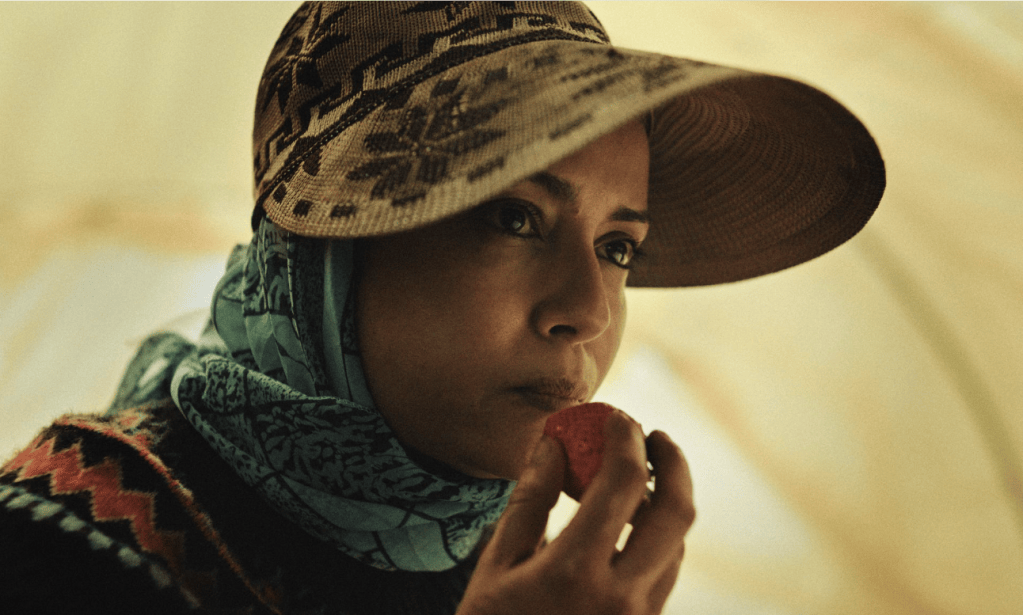
Another notable Moroccan contribution is Strawberries (La Más Dulce), directed by Laïla Marrakchi. Two Moroccan women travel to southern Spain for seasonal work harvesting strawberries, hoping to earn money for their families. Their experiences expose them to exploitation and abuse within an agricultural labour system dependent on migrant workers.
Marrakchi first attracted international attention with Marock (2005), which examined the lives of privileged young people in Casablanca and their conflicts with established social expectations. Strawberries turns towards a very different part of Moroccan society, exploring the economic relationships connecting Morocco and southern Europe.
The festival’s Moroccan Panorama also includes films by Tala Hadid and Mohamed Mouftakir, while Moroccan productions appear throughout the wider selection.
International Guests and Conversations
The festival opens with Jesse Eisenberg’s The Debut, starring Julianne Moore. Other screenings include new work by James Gray, Luca Guadagnino, Ryusuke Hamaguchi, Cristian Mungiu and Hirokazu Kore-eda.
The Conversations programme brings filmmakers and performers into public discussions about their careers and working methods. This year’s participants include Monica Bellucci, Xavier Dolan, John Turturro, James Gray and Moroccan director Laïla Marrakchi.
Tributes honour Jeff Goldblum, John Turturro and Moroccan musician and actor Younès Mégri, whose career began in popular music before extending into cinema. His inclusion acknowledges a figure whose work is closely associated with Morocco’s cultural history.
Marion Cotillard chairs the international jury, which includes Tunisian director Kaouther Ben Hania, Senegalese-French filmmaker Ramata-Toulaye Sy, Moroccan director Saïd Hamich Benlarbi, British director Andrew Haigh and Danish actor Claes Bang.
Supporting Films Before They Reach the Screen
One of Marrakech’s most consequential initiatives operates outside the public screening programme.
Established in 2018, the Atlas Workshops provide development and post-production support for filmmakers from Morocco, Africa and the Arab world. The programme helps directors and producers work with experienced international professionals and establish relationships that can assist their projects through financing, production and distribution.
For 2026, thirty projects and films from fourteen countries have been selected from 410 submissions. The participating countries include Algeria, Egypt, Ethiopia, Lebanon, Libya, Palestine, Rwanda, Senegal, Sudan, Syria and Tunisia, alongside Morocco, Cabo Verde and Jordan.
The results can be traced through individual productions. Laïla Marrakchi’s Strawberries first received Atlas development support in 2021, returned for post-production assistance in 2025 and is now screening at the festival as a completed feature. Other Atlas-supported films have subsequently appeared at Cannes and major international festivals.
Marrakech has expanded this infrastructure through Atlas Press, which supports film criticism and journalism in Morocco, and Atlas Distribution, which seeks to improve the circulation of Moroccan, African and Arab films.
These efforts address practical difficulties facing independent filmmakers. Access to international financing, experienced producers and distribution networks can determine whether a project is completed and where it can eventually be seen. Support for critics is equally relevant in countries where a developing film culture needs sustained public discussion alongside production.
The festival’s international guests attract attention, but the progress of films such as Strawberries offers a more substantial measure of what Marrakech has built. Five years after its first appearance in the Atlas Workshops, Marrakchi’s film returns to the city with an international festival premiere already behind it and a Moroccan audience waiting to see it.
The 23rd Marrakech International Film Festival takes place from 20 to 28 November 2026. The official festival programme provides details of screenings, venues and events.
Cover image: Still from Strawberries (La Más Dulce), directed by Laïla Marrakchi, 2026. Courtesy of Unifrance.

