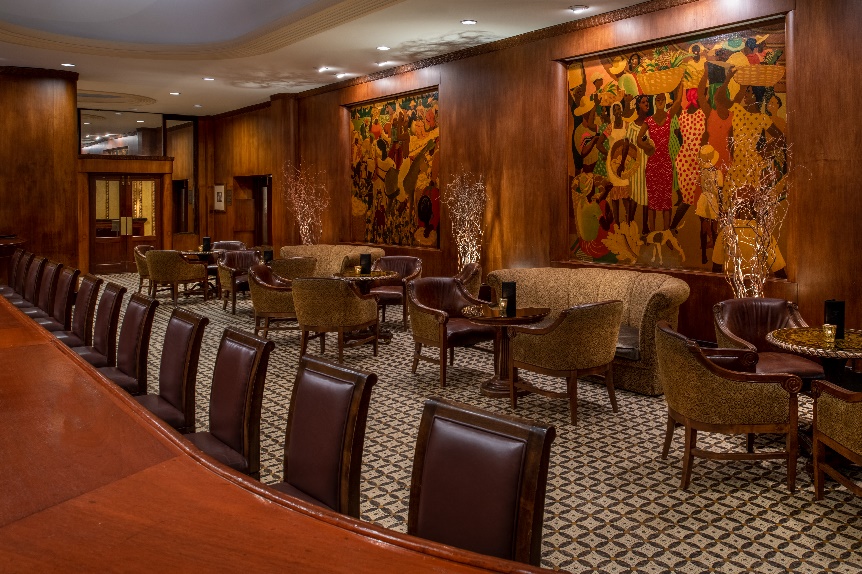
Inside New Orleans’ magnificent Roosevelt Hotel is a bar where the walls are panelled in African walnut, the cocktails have nineteenth-century pedigrees and the paintings deserve almost as much attention as the drinks. The Sazerac Bar is among America’s most evocative drinking establishments, with a history involving politicians, artists and a group of determined women who changed its rules in 1949.
A New Orleans Institution
Enter The Roosevelt New Orleans from Roosevelt Way, and the grandeur begins before you reach the bar. The hotel’s famous lobby, with its marble floors, gilded decoration and chandeliers, recalls the period when a fashionable hotel was as much a centre of civic and social life as somewhere to spend the night. Beyond it lies The Sazerac Bar, an intimate Art Deco room whose polished woodwork, leather armchairs and patterned flooring have changed remarkably little in character since the 1930s.
The building itself opened in 1893 as the Grunewald Hotel, established by Bavarian immigrant Louis Grunewald. It expanded considerably in 1908 and acquired the Roosevelt name in 1923. During the following decades, its Blue Room became one of the city’s celebrated entertainment venues, hosting performers including Louis Armstrong, Ella Fitzgerald and Frank Sinatra.
The Roosevelt’s architectural history reflects the changing ambitions of New Orleans, but its bar preserves a particularly distinctive period of American hospitality. With an African walnut counter, deep leather seating and softly illuminated bottles, it feels like a place designed for extended conversations rather than hurried drinking.
The room’s most significant decoration is a series of four murals completed in 1938 by Paul Ninas, a New Orleans artist associated with the development of modernist painting in Louisiana.
Ninas, who had worked for the Federal Art Project during the New Deal, developed a figurative language influenced by European modernism, particularly Picasso. His murals depict scenes of Louisiana life through flattened forms, vivid colour and rhythmic compositions. Their subjects bring the energy of the streets into an otherwise restrained hotel interior.
The contrast is delightful. In a room characterised by expensive woodwork and genteel hospitality, the paintings introduce the movement, music and social life of the city outside. They also make the bar a small but significant destination for anyone interested in twentieth-century American decorative art.
A Cocktail with a Complicated Past
The drink that gives the bar its name predates the present establishment by almost a century.
The Sazerac emerged during the nineteenth century from New Orleans’ distinctive mixture of French drinking traditions and American cocktail culture. Its history is associated with Antoine Amédée Peychaud, whose aromatic bitters became an essential ingredient, and the Sazerac Coffee House in the French Quarter, where the drink acquired its enduring identity.
Early versions featured French cognac, later replaced by American rye whiskey. Absinthe became another important ingredient, subsequently giving way to Herbsaint after absinthe was prohibited in the United States.
The contemporary version is deceptively simple: rye whiskey, sugar, Peychaud’s Bitters and an absinthe or Herbsaint rinse, finished with lemon peel. The ingredients are stirred with ice, but the finished cocktail is served without it.
Its origins have accumulated considerable mythology, including the claim that it was the world’s first cocktail. Historians dispute that distinction, but its importance to New Orleans is unquestionable. In 2008, Louisiana officially recognised the Sazerac as the city’s signature cocktail.
The Sazerac Bar itself operated at a separate address on Carondelet Street before the name moved to the Roosevelt in 1949. The hotel already possessed an established bar and Ninas’ murals, giving the newly installed institution an impressive historical setting.
Today, the cocktail menu includes the traditional rye Sazerac, a cognac variation and the elaborate Ramos Gin Fizz, another New Orleans invention. Created by Henry C. Ramos in 1888, the latter combines gin, citrus, cream, egg white and orange blossom water in a famously demanding preparation.
Louisiana politician Huey P. Long was particularly fond of the drink, and his association with the Roosevelt has become part of the hotel’s folklore.
The Women Who Took Their Seats
For all its cultivated elegance, the Sazerac Bar once enforced a rule that now seems extraordinary: women were generally excluded, apart from Mardi Gras Day.
The restriction reflected a broader culture in which prestigious hotel bars and drinking establishments were frequently treated as exclusively male spaces. Businessmen and politicians could socialise freely, while women were expected to observe different conventions.
That changed in September 1949, when the establishment began admitting women regularly.
On 26 September, a large gathering of women entered the bar, filling it with fashionable hats, dresses and considerable enthusiasm. Photographs from the occasion show an establishment suddenly transformed by an audience it had previously excluded.
The event became known as the Storming of the Sazerac, an episode that has since acquired an affectionate place in the city’s social history.
Its annual anniversary celebration, revived most recently in September 2026, recreates the occasion with vintage fashion, music and, naturally, cocktails. Beneath the festivities lies a revealing reminder that even the most apparently civilised institutions once maintained rules governing who was entitled to participate in public life.
The bar has survived other changes. The hotel became the Fairmont in 1965, suffered serious damage during Hurricane Katrina in 2005 and reopened as The Roosevelt in 2009 following an extensive restoration.
Its surviving murals, woodwork and familiar drinks now provide a continuity that is increasingly unusual in American hospitality.
For visitors, the appeal extends beyond nostalgia. The Sazerac Bar is a beautiful room with genuine artistic and social history, where a cocktail provides an unusually enjoyable introduction to the development of New Orleans itself.
It also illustrates something essential about the city: traditions acquire their value through continued use, adaptation and occasional challenges to the rules.
There are certainly less expensive places to order a whiskey cocktail. Few, however, offer quite so much to contemplate while drinking it.
Visit The Sazerac Bar
The Sazerac Bar at The Roosevelt New Orleans
130 Roosevelt Way, New Orleans, Louisiana 70112, USA
Opening hours: Sunday–Thursday, 11am–midnight; Friday–Saturday, 11am–1am.
What to order: The traditional Sazerac, currently listed at $22, or a Ramos Gin Fizz, listed at $26. Prices and hours are subject to change.
For a fuller exploration of the city, its architecture, restaurants, music and neighbourhoods, read our companion travel feature, New Orleans: The City That Invented Itself.
Further Exploration
An excellent introduction to the painter behind the Sazerac Bar’s distinctive murals.
The History of the Sazerac — The Sazerac House
A history of the cocktail’s French and New Orleans origins. The Sazerac House also operates a visitor attraction in the city devoted to cocktail history.
Storming the Sazerac — St. Charles Avenue
The fascinating story of the women who entered the bar in September 1949, changing one of the city’s longstanding social conventions.

