Cortina d’Ampezzo, and why the most beautiful ski resort in the world is not primarily about the skiing
There is a moment, arriving in Cortina d’Ampezzo for the first time, when the car rounds a bend on the approach from the south and the valley opens and the Dolomites appear in their entirety — the Tofane to the northwest, the Cinque Torri to the southwest, the Cristallo to the northeast, and Sorapis rising beyond them, all of it in the specific pink limestone that UNESCO designated a World Heritage Site in 2009 and that turns the colour of embers at dawn and dusk in a way that photographers have been attempting to document since the invention of photography and have never adequately captured. It is an arrival that requires a moment of stillness, and most people give it one, and then they drive into town and discover that the town is also extraordinary, and the problem of choosing where to begin becomes the pleasantest problem Cortina creates.
Cortina is Italy’s most famous ski resort, which means it is constantly compared to the resorts of France and Switzerland on the metrics of terrain extent, vertical drop, and snow reliability, and it consistently loses those comparisons, and none of that matters. The French resorts are vast and efficient and impersonal in the specific way of places that have been engineered rather than grown. Cortina grew — from a farming valley in the Ampezzo basin into a resort town over the course of a century, and it retains, under the glamour and the Olympic legacy and the boutiques on Corso Italia, the quality of a place that has a life of its own independent of the visitors who arrive each winter. The Ampezzani — the people who have been here for generations, who speak their own Ladin dialect, who regard the mountains around them as home rather than backdrop — are still here, and their presence gives Cortina a density of character that the purpose-built French stations cannot manufacture.
The skiing is genuinely beautiful. It is not, if you are being precise about it, the skiing of Verbier or Val d’Isère — 120 kilometres of piste, mostly intermediate, with the kind of scenery that makes you ski more slowly than the terrain requires because stopping to look is preferable to not looking. But the mountains around Cortina are among the most dramatically beautiful terrain in the Alps, and the experience of skiing them — the pink towers rising vertically from the snow, the views opening and closing as you traverse the ridges, the specific quality of light in the Ampezzo basin on a clear December morning — is unlike anything available anywhere else in the world.
The Olympics: context and consequence
Cortina has hosted the Winter Olympics twice. The first time was 1956 — the Games that established the resort’s international reputation and produced the infrastructure of lifts and facilities that defined its skiing for the following decades. The second time was February 2026, when the Milano Cortina Games brought the women’s alpine ski events back to the Tofane slopes, the same mountain that hosted them seventy years before. The sliding events — bobsleigh, luge, skeleton — were also held here, in a newly rebuilt track that is now among the fastest in the world.
The Olympic legacy for the visitor arriving in the 2026-27 season is significant. The infrastructure investment ahead of the Games — new lifts, renovated facilities, the rebuilt sliding track, significant investment in hotels and restaurants — has elevated the resort’s physical quality considerably without changing its fundamental character. The Tofane runs, where the Olympic downhill courses are set, are now maintained to the standard of World Cup racing. The hotel scene, which was already strong, has been transformed by a wave of new and renovated properties of which the most significant is the Ancora.
A practical note: the Games themselves took place in February 2026, meaning the Olympic period of peak demand has already passed. For visitors planning the 2026-27 season, Cortina returns to its normal rhythm — which is to say, a resort that is busy at Christmas and February half-term and pleasantly uncrowded in the weeks between.
Where to stay: Hotel Ancora Cortina
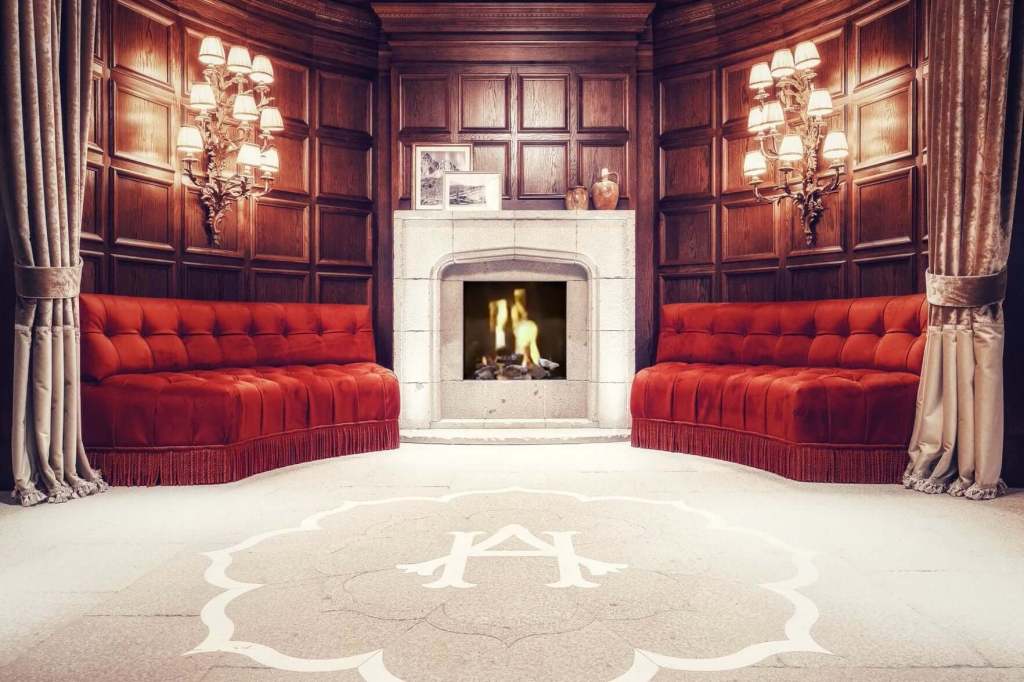
The Ancora has been on Corso Italia since 1826 — two hundred years of continuous hospitality in the most visible location in Cortina, the pedestrianised boulevard where the town takes its evening passeggiata and where the mountain light is most theatrical in the early morning and late afternoon. It is the symbolic address of the resort. It is also, since its reopening in June 2025, the most interesting hotel in the Dolomites.
The renovation was led by Renzo Rosso — founder of Diesel and the OTB Group (Maison Margiela, Marni, Jil Sander, Viktor & Rolf), a man who grew up in the Veneto region and has been clear about his relationship to Cortina: “for me, it is the most beautiful mountain resort in the world.” The interior design was entrusted to Vicky Charles, former design director at Soho House and founder of Charles & Co, who has spoken about approaching the Ancora as a restoration project rather than a renovation — treating the existing wooden work, painted ceilings, and alpine decorative motifs as material to be worked with rather than cleared away.
The result is 38 rooms — each facing the Dolomites, each with its own character, furnished with bespoke pieces crafted by Molteni&C, the Italian furniture maker whose built-in woodwork runs throughout the property. Natural materials: wood and stone, warm earthy tones, the rich textures of the alpine tradition translated into a contemporary register without losing either the warmth or the history. The Brave Club in the basement is the hotel’s nightlife soul. The terrace on Corso Italia is where the Dolomites are best watched as the light changes in the evening.
Hotel Ancora Cortina — Corso Italia 69, 32043 Cortina d’Ampezzo (BL).
For something further from the centre and closer to the slopes, Hotel de Len is the considered alternative — a contemporary alpine property with a strong sustainability focus, excellent spa, and the specific quality of a hotel that has been built around a point of view rather than a service catalogue.
The skiing: three areas, one valley
Cortina’s skiing is divided across three separate areas, connected by ski bus rather than by lifts — a fact that surprises visitors expecting the seamless interconnected terrain of the large French domains, and that is either an inconvenience or an opportunity depending on how you hold it. The opportunity is that each area has its own character, and spending a day in each is a different experience.
Tofane is the largest and highest area, reaching 2,932 metres at Ra Valles — Cortina’s highest skiing, with the 360-degree view over the surrounding peaks that constitutes the most dramatic vantage point in the resort. The Olympic Women’s Downhill runs here, steep and technical and not for the faint-hearted, but the area also contains long, sweeping intermediate runs through the upper valley that are among the most satisfying cruising terrain in the Alps. The gondola from the town centre makes it the most accessible.
Faloria-Cristallo, to the north, is the quieter area — less visited, with the specific reward of the Cristallo massif rising above you and the runs through the forests below it providing the most sheltered skiing when the weather turns. The expert skier who wants to avoid the social scene of the main area in the mornings will find this the preferred option.
Lagazuoi-Cinque Torri-Giau, to the southwest, is the most scenically extraordinary of the three — the Cinque Torri, five isolated limestone towers rising from the snow like the ruins of a civilisation that never existed, provide a backdrop to skiing that is simply unavailable anywhere else. The Lagazuoi cable car reaches 2,778 metres and serves a long, wide run down toward Armentarola that is one of the great ski descents in the Alps for intermediate skiers: not technically demanding, spectacularly beautiful, about eight kilometres of continuous descent through changing terrain with the Dolomites performing their various acts around you.
The Dolomiti Superski pass connects Cortina to eleven other ski areas in the region, including the Sella Ronda — the circular circuit around the Sella massif that passes through four valleys and constitutes one of the great ski touring routes in Europe. The full circuit covers roughly 40 kilometres of marked piste and takes a full day; the correct approach is to allocate one day during the trip and return with a standard Cortina day.
http://www.dolomitisuperski.com
The Dolomites beyond skiing
Cortina argues, correctly, that it is worth visiting in winter even if you do not ski. The valley’s snowshoeing and winter hiking trails — maintained specifically for non-skiers — reach areas of the surrounding mountains that the ski lifts do not, and the experience of moving through the Dolomites on foot in deep winter, in the specific silence that heavy snow creates, is different from and in some respects better than skiing through it. The Cinque Torri, in particular, can be reached on foot from the Bai de Dones area, and the walk through the snow to stand at the base of the towers in winter light is one of those experiences that people who have done it describe in terms usually reserved for religious experiences.
The ice rink on the Olympic stadium — one of the finest natural ice rinks in Europe, set in the valley floor with the mountains rising on all sides — is open for public skating and is the correct way to spend a Cortina afternoon when the legs are tired and the mountain is doing what it does in the low sun of a December afternoon.
And the Corso Italia itself, in winter, is one of the great pedestrian streets in the Alps — not because of what is on it, though the shops are excellent and the terraces are warm, but because of what it looks out at. The mountains at either end of the street, closing off the valley in both directions, are always present, always changing, and constitute the most sustained visual experience available in any ski resort in the world.
Where to eat
The food culture of Cortina draws from two traditions: the alpine cuisine of the Veneto and the South Tyrol, built on dairy, cured meats, game, polenta, and the mountain herbs that grow on the surrounding slopes; and the more ambitious Italian cooking that the resort’s international profile has attracted. The intersection of the two produces a table that is simultaneously rooted and refined, and the best restaurants here are among the finest mountain dining in Europe.
El Brite de Larieto — or SanBrite as it is also known — holds both a Michelin star and a Michelin Green Star for its sustainable approach, and earns both. It sits in a small larch forest on the road toward the Tre Croci pass, surrounded by the Dolomites and next door to the working farm that supplies almost everything on the menu. The butter arrives first — pale, silky, extraordinary, made from the dairy’s own animals — and sets the tone for a meal in which the farm is not a concept but a physical fact. The charcuterie, the cheeses, the herbs, the berries: all from here, all treated with the intelligence of a kitchen that understands that this quality of ingredient is the argument and the technique is in service of it. Book weeks ahead. One of the finest restaurants in the Italian Alps.
Tivoli, with its Michelin star and its panoramic terrace above the town, is the address for the evening when you want both the culinary ambition and the theatrical setting. Chef Graziano Prest has been here since 2002, producing a menu that moves between the alpine tradition and the seafood that arrives daily from the markets at Venice and Chioggia — an unusual combination that works because Prest understands the logic of both. The two window tables, which look out over Cortina and the mountains beyond, should be specifically requested at booking.
http://www.ristorantetivolicortina.it
For the mountain lunch that Cortina does better than anywhere: the rifugi — the mountain huts accessible by ski or on foot — are the correct address. Rifugio Dibona on the Tofane, Rifugio Faloria, and Malga Ra Stua in the valley behind Fiames all offer the Ampezzano version of the mountain lunch: local cheeses, polenta, cured meats, the specific comfort of a room full of steam and conversation and the particular pleasure of eating well at altitude after a morning of cold air and exertion.
The calendar: when to go
The ski season at Cortina runs from early December through late April, with the December opening depending on snowfall and the spring skiing on the upper glaciers extending the season considerably. The following periods define the resort’s rhythm:
Christmas and New Year (December 20 – January 6): the most festive and the most expensive. The Corso Italia is decorated. The restaurants are at their fullest. The mountains are reliably snowy. Book everything months ahead.
January: the best skiing period. The crowds thin after Epiphany; the snow is typically excellent; the prices ease considerably. This is the week that serious skiers choose — the resort at its most functional and least performative.
February: the school holiday period brings a second peak. The World Cup races on the Tofane, which have been a fixture since the 1950s, provide spectacle and atmosphere.
March and April: spring skiing, longer days, the Dolomites in the specific quality of light that comes when the snow is still deep and the sun is already approaching summer angles. The most underrated season in the Alps.
The essentials
Stay
Hotel Ancora Cortina — Corso Italia 69, 32043 Cortina d’Ampezzo. Renzo Rosso; Vicky Charles; the historic address. Book directly.
http://www.ancoracortina.com
Hotel de Len — Via del Castello 21, 32043 Cortina d’Ampezzo. Contemporary; sustainable; spa; away from the centre.
http://www.hoteldelen.com
Eat
El Brite de Larieto — Località Larieto, Strada per Passo Tre Croci, Cortina d’Ampezzo. Michelin star and Green Star. The farm is next door. Book weeks ahead.
http://www.elbrite.com
Tivoli — Via Lacedel 34, 32043 Cortina d’Ampezzo. Michelin star; panoramic terrace; request the window table.
http://www.ristorantetivolicortina.it
Ski
Three areas: Tofane (largest; Olympic runs; highest terrain), Faloria-Cristallo (quieter; forested), Lagazuoi-Cinque Torri (most scenic; Sellaronda access).
Dolomiti Superski pass covers Cortina and 11 connected areas including the Sella Ronda.
http://www.dolomitisuperski.com
Cortina ski school (Scuola Sci Cortina) — the oldest ski school in Italy; founded 1932.
http://www.scuolascicortina.it
When to go
January for the best combination of snow, manageable crowds, and value. Christmas for the atmosphere. March for the light.
Getting there
Fly to Venice Marco Polo (VCE) — approximately 2 hours’ drive via the A27 motorway and then the SS51 through the Cadore valley. The drive through the Cadore is itself part of the experience and should not be shortened by alternative routing. Fly to Innsbruck as an alternative — slightly closer in some conditions, and an airport that handles ski traffic with particular efficiency.
Cortina Express runs a direct coach from Venice airport. Journey time approximately 2 hours 30 minutes.
http://www.cortinaexpress.it

