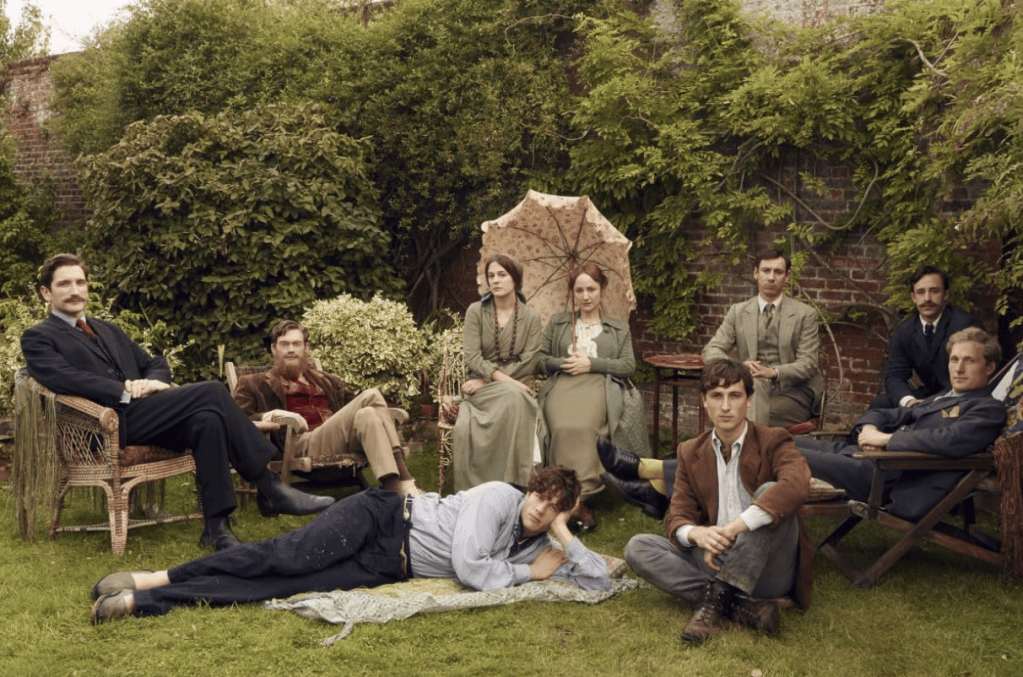
In the final episode of the BBC’s Life in Squares (2015), Vanessa Bell tells her daughter Angelica that the man she has always believed to be her father, Clive Bell, is not her father at all. Her biological father is Duncan Grant, the painter who has lived alongside her mother for much of her childhood. Angelica, played by Lucy Boynton, receives the news with a long, disbelieving look. According to screenwriter Amanda Coe, the scene was filmed in the garden room at Charleston, where the conversation had actually taken place.
It is one of the most revealing moments in a television drama about people whose lives have so often been presented as an enviable experiment in artistic and sexual freedom. For Angelica, the arrangements that allowed her parents to live unconventionally had also required years of deception. Her reaction makes visible something that tends to disappear beneath Bloomsbury’s considerable mythology: the emotional consequences of a freedom that was not always experienced equally by everyone involved.
Written by Amanda Coe and directed by Simon Kaijser, Life in Squares was broadcast on BBC Two in three episodes between July and August 2015. It follows the Bloomsbury Group from the early years of the twentieth century through to Virginia Woolf’s death in 1941. Its principal characters are the sisters Vanessa Bell and Virginia Woolf, with Duncan Grant becoming increasingly central to the story.
The series belongs to a long tradition of treating Bloomsbury as something approaching a historical celebrity circle. Their marriages, betrayals, homosexual relationships and unconventional domestic arrangements have provided material for biographies, novels, films and television programmes for decades. The temptation is understandable. Their lives offer an extraordinary cast of characters, considerable intellectual distinction, beautiful houses and apparently inexhaustible romantic complications.
The group’s members have acquired the kind of cultural afterlife usually reserved for pop stars. Friendships are dissected, affairs reconstructed, jealousies examined and private letters mined for revelations. The famous observation that they lived in squares, painted in circles and loved in triangles has proved remarkably durable, partly because it offers such an entertaining shorthand for their lives.
Yet this fascination has created a peculiar imbalance. People whose intellectual and artistic achievements profoundly influenced twentieth-century culture are sometimes remembered more readily for whom they slept with than for what they actually accomplished.
Life in Squares participates in this tradition, although its later episodes begin to expose the limitations of the romantic account.
The Young Bloomsbury
The opening scenes make their intentions unmistakable. Vanessa and Virginia Stephen, played by Phoebe Fox and Lydia Leonard, discard their corsets in a gesture of liberation from the restrictions of Victorian England. The symbolism is rather emphatic, but it establishes the historical circumstances from which Bloomsbury emerged.
Following their father’s death in 1904, the Stephen siblings moved from respectable Kensington to the then less fashionable neighbourhood of Bloomsbury. Their home at 46 Gordon Square became a meeting place for young intellectuals, many of them associated with Cambridge, who questioned inherited assumptions about religion, marriage, morality and artistic value.
The gatherings brought together figures including Lytton Strachey, John Maynard Keynes, Clive Bell and Leonard Woolf. Conversation was central to their friendships, as was the belief that sincerity in personal relationships mattered more than the preservation of social appearances.
Coe’s screenplay understands the appeal of this youthful intellectual confidence. Phoebe Fox gives Vanessa an appealing combination of independence and vulnerability, while Lydia Leonard conveys Virginia’s intelligence and growing dependence on her sister. Their affectionate intimacy is already complicated by rivalry, and the strain between them becomes one of the drama’s more convincing elements.
Ed Birch’s Lytton Strachey provides moments of welcome irreverence, particularly in the early scenes where the group’s arguments and social awkwardness coexist with an often merciless sense of humour.
Nevertheless, the series’ representation of Bloomsbury’s radicalism relies heavily on sexual behaviour. The camera is understandably drawn towards the complications of Duncan Grant’s relationships with Strachey and Keynes, Vanessa’s marriage to Clive Bell, and the tensions arising from the group’s insistence on personal honesty.
These relationships were genuinely significant. Duncan’s homosexuality exposed him to considerable danger in a society where sexual activity between men was criminalised. The series includes a scene in which a doctor identifies him as an ‘invert’, using the medical terminology of the period. It is a useful reminder that the freedom Bloomsbury sought existed within a society capable of punishing behaviour its members regarded as natural.
Yet the emphasis on romantic entanglement sometimes narrows the intellectual rebellion itself. The Bloomsbury circle was simultaneously developing new approaches to painting, literature, economics and criticism. Its arguments about personal freedom occurred alongside serious disagreements about the nature and purpose of art.
John Maynard Keynes, for example, appears primarily as a participant in the group’s complicated relationships. His intellectual development remains largely outside the drama. Virginia Woolf’s emotional difficulties receive considerably more attention than the extraordinary discipline of her writing.
The demands of television drama help explain these choices. Private conflict can be conveyed through dialogue, expressions and physical action. The labour involved in producing an experimental novel or a radically new painting is harder to accommodate within a familiar narrative structure. But the result is that Bloomsbury’s intellectual achievements often seem incidental to its private lives.
Vanessa and Duncan
The relationship between Vanessa Bell and Duncan Grant is the emotional centre of the series. It is also where the familiar romantic account of Bloomsbury becomes most difficult to sustain.
James Norton plays the younger Duncan with considerable charm, and his scenes with Phoebe Fox establish an attachment that gradually becomes fundamental to Vanessa’s life. The attraction is persuasive, although the screenplay is careful to acknowledge that their expectations of the relationship are not identical.
Historically, their partnership resists simple classification. Duncan was primarily attracted to men, and Vanessa knew this. They nevertheless had a brief sexual relationship, from which Angelica was born in 1918. Their subsequent life together developed into an enduring domestic and artistic partnership, while Duncan continued to have male lovers.
To describe their relationship as simply platonic would therefore obscure its beginnings. To present it as an unconventional romance that somehow overcame the limitations of sexuality would be equally misleading.
Vanessa loved Duncan deeply. They shared a home, raised children and worked together for decades. Yet the forms their attachment took, and the degree to which their emotional needs could be satisfied within it, were not necessarily the same.
This raises questions about desire, dependency and the compromises people make to preserve relationships that are profoundly important to them.
The series is most compelling when it acknowledges these difficulties without turning either character into a villain or a victim.
We should also be cautious about claiming too much knowledge of their private feelings. As the art historian and biographer Frances Spalding observed in her contemporary assessment of the series, Vanessa left relatively little direct testimony explaining how she experienced Duncan’s sexuality within their long partnership. Much of what a dramatist supplies is necessarily interpretation.
The relationship continued long after its sexual dimension had ended, sustained by affection, habit, artistic collaboration and the family they had created. Such an arrangement could offer genuine companionship while also containing unresolved pain.
By the time the older Vanessa is played by Eve Best and Duncan by Rupert Penry-Jones, the exuberance of their early years has given way to a more restrained domestic relationship. Best is particularly convincing as a woman accustomed to managing other people’s emotional demands while revealing relatively little of her own.
Penry-Jones’s Duncan, however, is markedly more subdued than Norton’s earlier portrayal. The change in actors makes the passage of time immediately apparent, but the continuity of Duncan’s character suffers. His youthful charm and playfulness seem to have disappeared almost entirely.
There is considerable sadness in the later portrayal, although Vanessa’s life should never be reduced to the disappointment of loving a man whose principal sexual attractions lay elsewhere. She was a serious artist with an independent career, an intellectual life and an unusually sustained creative partnership with Duncan.
The series occasionally allows that achievement to recede behind her emotional difficulties.
Charleston and Its Secrets
Charleston, the Sussex farmhouse where Vanessa and Duncan established their household in 1916, occupies an almost symbolic place in the Bloomsbury story.
The house remains one of the most remarkable surviving interiors associated with British modernism. Its painted walls, doors, fireplaces, furniture and textiles demonstrate the artists’ conviction that visual experimentation could extend into everyday domestic surroundings.
In Life in Squares, these interiors provide an unusually appropriate setting. They are the actual surroundings in which much of the later story unfolded, and several scenes were filmed at Charleston itself.
Yet their beauty presents a problem for the drama. The house can easily become visual evidence of a successful alternative life, its painted surfaces lending an attractive coherence to relationships that were often anything but straightforward.
The historical household was considerably more complicated.
When Vanessa and Duncan moved to Charleston, they were accompanied by Vanessa’s sons Julian and Quentin and Duncan’s lover David Garnett. Grant and Garnett were conscientious objectors during the First World War, and the move enabled them to undertake agricultural work nearby.
The arrangement reflected the practical ingenuity with which these people attempted to reconcile personal convictions, relationships and domestic responsibilities. It also depended on circumstances unavailable to most of their contemporaries.
Bloomsbury’s independence was supported by inherited resources, domestic servants and educational opportunities that were far from universal. The freedom to abandon conventional expectations was easier to exercise when the practical demands of ordinary life could be managed by others.
Recognising that privilege does not diminish the group’s achievements, although it complicates the idea that its way of life represented a readily available model of liberation.
The later history of Angelica makes the contradictions within the household especially apparent.
Born in 1918, she grew up believing Clive Bell was her father. The truth about Duncan’s paternity was withheld until she was seventeen. She subsequently married David Garnett, who had himself been Duncan’s lover.
It is the kind of biographical detail that has helped keep Bloomsbury gossip alive for generations. Removed from its human context, it becomes another astonishing complication in an apparently inexhaustible network of relationships.
But Angelica’s own account offers a necessary corrective. In her memoir Deceived with Kindness: A Bloomsbury Childhood, first published in 1984, she reflected critically on her upbringing and the emotional consequences of the secrecy surrounding her parentage.
The memoir also played a direct role in the television production. In an interview with The Protagonist Magazine, Lucy Boynton explained that she had relied heavily on Garnett’s book while preparing to play Angelica. The actress’s research lends an additional dimension to the final episode, where the young woman’s perspective becomes central to the story.
That perspective matters because the familiar celebration of Bloomsbury’s freedom is usually told through the lives of the adults who invented its arrangements. Their children did not necessarily enjoy the same freedom to determine the conditions under which they lived.
The scene between Vanessa and Angelica is especially effective because it requires so little explanation. Vanessa, who has maintained the fiction for years, must finally confront her daughter’s understanding of what that concealment has meant. Angelica’s silence is more eloquent than another argument about Bloomsbury’s principles could have been.
The drama briefly escapes the fascination with the arrangements themselves and considers the experience of someone who had no part in creating them.
When the Experiment Grew Older
Perhaps the most intelligent decision in Life in Squares is its willingness to move beyond the group’s celebrated youth.
The final episode shifts forward to the late 1930s, introducing older actors and an atmosphere of accumulated experience. The transition is occasionally awkward, but it allows the drama to examine what became of the convictions established in the earlier episodes.
By this point, the losses within the group have been considerable.
Vanessa and Virginia had already experienced the death of their brother Thoby in 1906, an event that profoundly affected the family. Vanessa’s eldest son Julian was killed during the Spanish Civil War in 1937. Virginia, who had endured recurring periods of severe mental illness, died by suicide in 1941.
These deaths cannot be explained as consequences of Bloomsbury’s unconventional relationships. They belonged to the wider circumstances of illness, war and individual suffering. But they are essential to understanding why the image of the group as a perpetual gathering of brilliant young people enjoying limitless freedom is so inadequate.
The later scenes also expose some of the limitations in the series’ treatment of Virginia Woolf.
In the early episodes, Lydia Leonard’s Virginia is frequently jealous, fragile and dependent on Vanessa’s attention. These qualities have some basis in the sisters’ complicated relationship, but they risk allowing Virginia’s psychological difficulties to eclipse her intellectual authority.
Catherine McCormack’s later portrayal offers a more composed and independent woman, although she is given comparatively little time to establish the full character.
Virginia Woolf was among the most formally inventive novelists of the twentieth century. Her work as a critic, essayist and publisher was equally substantial. Yet television has often found her suffering easier to dramatise than her writing.
Something similar happens with Vanessa and Duncan. Their emotional lives become intelligible, but the series conveys little of the sustained concentration involved in their artistic development. The objects surrounding the actors are frequently more eloquent about Bloomsbury’s aesthetic ambitions than the dialogue itself.
The contrast becomes particularly apparent when considering the work itself.
In 1914, Vanessa Bell and Duncan Grant each painted the same mantelpiece at Gordon Square. Bell’s Still Life on Corner of a Mantelpiece and Grant’s The Mantelpiece offer two markedly different interpretations of a shared subject. Bell organised her composition through firm outlines and considered areas of colour, while Grant approached the arrangement with a more restless handling of form.
Such works offer a way of understanding their partnership that the conventions of biographical television rarely provide. The artists could share a room, a subject and an artistic vocabulary while arriving at different visual solutions.
Their work also extended far beyond the domestic decoration for which Bloomsbury is frequently remembered. Bell was involved in the development of abstraction in Britain and became a co-director of Roger Fry’s Omega Workshops, founded in 1913. Grant pursued his own experiments with Post-Impressionism, abstraction, painting and design, drawing on his encounters with European modernism.
The exhibition Vanessa Bell & Duncan Grant: Inside Bloomsbury, at Tate Britain from 12 November 2026 to 11 April 2027, offers an opportunity to reconsider these achievements. Bringing together more than 300 works, including paintings, decorative objects and a reconstruction of the artists’ shared studio from Charleston, it examines the development of their individual practices alongside their long collaboration.
The artistic partnership was sustained by shared interests in colour, composition and the relationship between painting and domestic space. Their approaches were distinctive, and their work changed considerably across five decades.
That history cannot be adequately explained through the circumstances of their relationships, however fascinating those circumstances may be.
Beyond the Romance
Life in Squares remains an absorbing and often affecting drama. Its performances are generally strong, the decision to centre Vanessa is valuable, and the later episodes achieve moments of genuine emotional complexity. The series also deserves credit for making relationships that would once have been excluded from mainstream period drama central to its narrative.
Its weakness lies in the familiar attraction of Bloomsbury as a picturesque collection of unconventional personalities. The beautiful interiors, the attractive cast and the succession of romantic complications sometimes leave too little room for the intellectual seriousness that made these people historically consequential.
There is also a contradiction in presenting their rejection of convention through the reassuring visual pleasures of a British heritage drama. The carefully composed domestic world remains seductive even when the screenplay is attempting to expose the difficulties of living within it.
The later episodes are more interesting because that seduction begins to lose its power.
By then, the consequences of decisions made decades earlier are apparent in the characters’ lives. The relationships that once seemed to offer unlimited possibilities have become enduring arrangements, subject to the ordinary pressures of ageing, disappointment and responsibility.
The scene between Vanessa and Angelica crystallises that difficulty. Vanessa and Duncan constructed a household in which forms of love and companionship rejected by conventional society could exist openly. Within that same household, they concealed a fundamental truth from their daughter. Both facts belong to their history, and Life in Squares is at its best when it allows us to consider them together.
Cover image courtesy of the BBC

