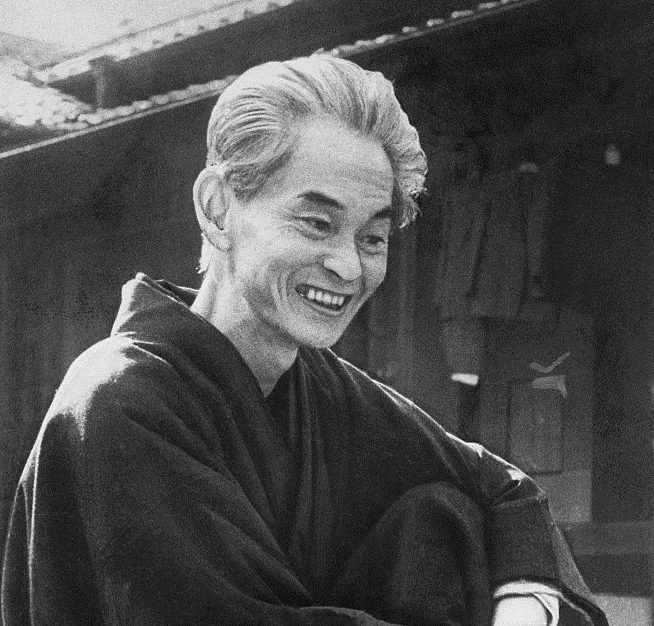
Kawabata Yasunari is the writer of the last moment before disappearance — the final light on snow, the gesture that is almost made, the feeling that is almost said, the beauty that exists most completely in the instant of its passing. His novels are not, in the conventional sense, about events. They are about the quality of consciousness at the edge of loss: the awareness that arrives when something is about to be gone, the particular sharpness of perception that grief or longing or the approach of death produces in people who are paying the fullest possible attention. He received the Nobel Prize in Literature in 1968 — the first Japanese writer to do so — and his acceptance speech, titled Japan the Beautiful and Myself, is one of the most precise accounts of the aesthetic tradition his work inhabits: a tradition in which beauty and sadness are not opposites but aspects of the same perception, in which the awareness of impermanence is not a wound to be healed but the very ground of the most profound human experience. He killed himself in 1972, four years after the Nobel, by inhaling gas in his studio in Zushi. He left no note. The silence was entirely in keeping with everything he had ever written.
The Orphan
Kawabata was born in Osaka in 1899 and was orphaned by the age of three — his father died when he was one, his mother when he was two — and spent his childhood in a succession of losses: his grandmother died when he was seven, his sister when he was ten, his grandfather, with whom he had lived and who was his last remaining family member, when he was fifteen. He sat with his grandfather through the final illness, recording the dying man’s last months in a diary he later published as Diary of a Sixteen-Year-Old, one of the earliest and most affecting of his writings, a document of solitary witness that established the central position he would occupy throughout his career: the observer at the edge of other people’s lives, present but not fully participating, attending to the beauty of what is passing with an intensity that is itself a form of mourning.
He studied Japanese literature at Tokyo Imperial University, entered the literary world in the early 1920s, and was associated with the Shinkankakuha — the Neo-Perceptionist school — a group of writers influenced by European modernism who sought to apply the techniques of stream of consciousness and sensory impressionism to Japanese material. But Kawabata was never simply a Japanese modernist. He was also, and perhaps more fundamentally, a writer working within and against the classical Japanese aesthetic tradition — the tradition of mono no aware, of wabi-sabi, of the haiku’s compression of a moment into an image that carries the full weight of what surrounds it. His greatest novels read like very long haiku: each scene a concentrated image, the narrative moving not through cause and effect but through association and mood, the emotional logic following the logic of sensation rather than the logic of event.
He was a close friend of Mishima Yukio, who would kill himself in 1970 in a dramatically staged act of political protest. Kawabata, by all accounts, never recovered from Mishima’s death. He lived two more years and then followed him, more quietly, with no statement, into the silence.
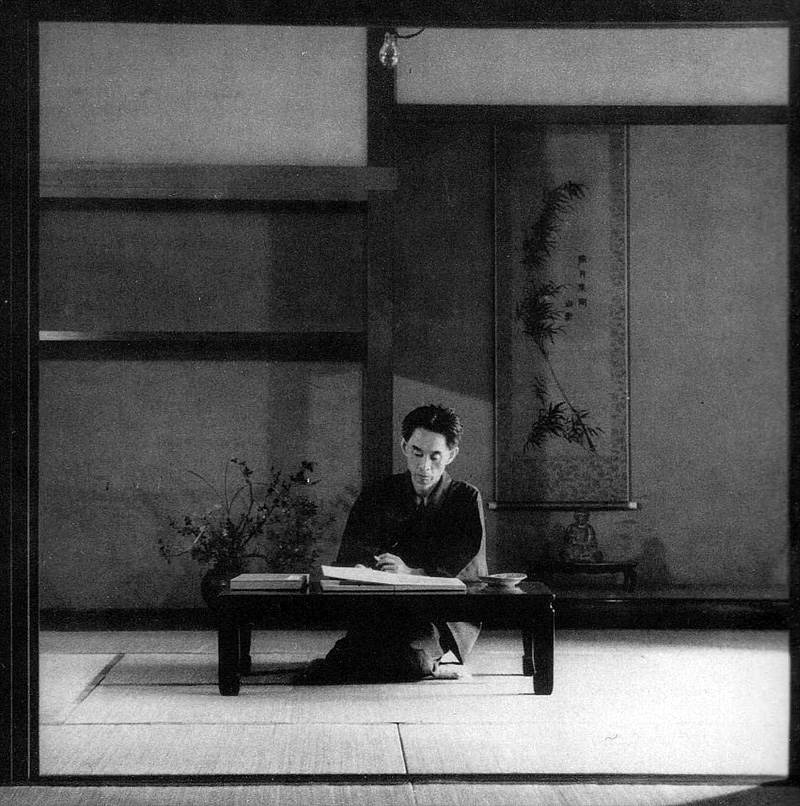
Snow Country
Snow Country, published in its final form in 1948 after years of serial publication and revision, is the novel by which Kawabata is most widely known and the one in which his method is most purely expressed. It is, in outline, a simple story: a wealthy dilettante from Tokyo named Shimamura travels repeatedly to a hot spring resort in the mountains of northwest Japan, in the deep snow country of the title, and maintains a relationship — if relationship is even the right word for something so deliberately undefined — with a geisha named Komako. He is also haunted by a young woman named Yoko, whom he glimpses on the train journey and who becomes, for him, a presence more vivid and more disturbing than the physical relationship he has with Komako.
The novel is not about what happens between these people. Very little happens. Shimamura visits, talks with Komako, watches Yoko from a distance, leaves, returns, watches the snow. The emotional content of the book is not in the events but in the quality of attention the prose brings to the moments between events — to the texture of Komako’s hair, to the sound of her shamisen practice heard through the walls of the inn at night, to the reflection of Yoko’s face in the train window against the darkening landscape, to the specific quality of the light on the snow at different times of day and night.
The novel’s most famous image occurs in its opening pages, on the train journey to the snow country, and it announces everything that follows. Shimamura is watching the reflection of Yoko’s face in the train window — a reflection that floats over the darkening landscape outside, so that her face and the mountains and the dying light occupy the same visual plane simultaneously. Her eye, at one point, coincides in the reflection with a distant light in the darkness, and the light seems to glow from within her eye. The image is hallucinatory and precise and it is, in Kawabata’s hands, a complete statement of his aesthetic: the real and the reflected occupying the same space, beauty and distance inseparable, the human face and the natural world superimposed in a single perception that belongs entirely to the observer and not at all to either of its objects.
Shimamura is, by any conventional novelistic standard, a disappointing protagonist. He is passive, self-indulgent, incapable of genuine commitment, a man who observes beauty with acute sensitivity and does nothing with it, who allows Komako to love him without offering her anything equivalent in return, who regards the whole of his life — including his aesthetic enthusiasms, including his relationships — as existing at one remove from genuine engagement. He is, in a sense, the negative space of the novel: defined by what he cannot do rather than by what he does, a consciousness of great perceptual refinement and almost no moral energy.
But this is not Kawabata’s failure of characterisation. It is his argument. Shimamura’s passivity is the condition of his perception: the withdrawal from engagement that allows the quality of attention that the novel requires. He cannot love Komako fully because full love would make him a participant rather than a witness, and the witness is what the novel needs him to be — the consciousness through which the beauty of the snow country, and of Komako’s wasted devotion, and of Yoko’s strange luminosity, can be fully registered and fully mourned. The novel sacrifices him to its own vision, and the sacrifice is honest: this is what the pure aesthetic life costs.
The Sound of the Mountain
The Sound of the Mountain, published in 1954 and widely considered Kawabata’s masterpiece, extends the method of Snow Country into deeper psychological and more explicitly elegiac territory. Ogata Shingo is an elderly Tokyo businessman who hears, one autumn night, a sound from the mountain behind his house — a deep, resonant sound that he cannot identify and that he takes, with the certainty of a man whose body already knows something his mind has not yet formulated, as an intimation of his approaching death.
The novel follows Shingo through a year of this knowing, through his relationships with his son Shuichi, whose marriage is failing; his daughter-in-law Kikuko, toward whom he feels an attraction that is simultaneously paternal, erotic, and aesthetic — the attraction of a man who recognises in a younger person the beauty and the vitality that are leaving him; and his dreams, which the novel treats with the same seriousness and the same precision as waking experience, as if the boundary between the two were merely a difference of light.
Shingo’s attraction to Kikuko is the novel’s central emotional fact and it is handled with a delicacy that makes it neither sentimental nor voyeuristic. He does not act on it. He barely acknowledges it to himself. What he feels is something closer to grief than to desire — the grief of a man who can still perceive beauty with complete acuity but who is losing the capacity to participate in it, whose relationship to the beauty of the living world is becoming that of the witness rather than the agent. Kikuko represents everything that is still alive and still possible, and his tenderness toward her is the tenderness of someone watching a world he is leaving, trying to attend to it fully before the attention is no longer possible.
The dreams are the novel’s most formally radical element. Kawabata treats them as continuous with waking experience — not as symbols to be interpreted or messages to be decoded but as events of equal reality to what happens in the daylight hours, the unconscious mind processing the same materials as the conscious one but without the social mediation that waking life requires. In one of the most beautiful and most disturbing of the dreams, Shingo sees his dead sister-in-law — a woman he loved before he married her sister, the original object of his deepest feeling — and she is young, as she was when she died, and he understands in the dream, with the clarity that only dreams provide, everything about his life that his waking self has been unable to formulate.
The sound of the mountain is heard only once more in the novel, near the end, and Shingo is uncertain whether he has actually heard it or only dreamed it. The uncertainty is appropriate. In Kawabata’s world, the most important things happen at exactly the point where the certain and the uncertain, the real and the dreamed, the living and the dying, cannot be distinguished from each other.
The Old Capital
The Old Capital, published in 1962 and set in Kyoto — the ancient imperial city, the repository of classical Japanese culture, the place where the traditions that Kawabata’s work inhabits were most completely preserved — is the novel in which the elegiac dimension of his vision is most explicitly connected to Japan’s own relationship with its past.
The story, which involves twin sisters separated at birth and reunited in Kyoto, is the slightest of the major novels in its plot — almost a fairy tale in its outline — but the city itself is the real subject, rendered season by season with an attention to the specific beauty of specific places at specific times of year that makes the novel read, in places, like a long prose poem to the Kyoto that was disappearing even as he wrote it: the cedar forests of the north, the wisteria at Heian Shrine, the weaving district of Nishijin where the old crafts were still practised, the summer festivals in which the ancient rituals were performed with a fidelity that was itself, by 1962, becoming a kind of mourning.
The question The Old Capital asks about the human condition is the question that mono no aware has always asked, here extended from the individual to the collective: how does a culture relate to the beauty it is losing, the traditions it is abandoning, the world that is passing as the new world replaces it? The answer Kawabata gives — through the texture of the prose, through the seasons turning and the festivals arriving and the sisters finding and losing each other in the beautiful old city — is the answer he always gives: by attending to it, fully, without flinching, without the consolation of the false hope that it will be preserved, with the honesty that acknowledges the loss and the love that makes the loss worth mourning.
Beauty and Sadness
Beauty and Sadness, published in 1965, is the novel that most directly addresses the relationship between aesthetic experience and human damage — the question of whether the artist’s capacity for beauty is inseparable from the capacity for cruelty, whether the sensitivity that makes great art possible is the same sensitivity that makes the people closest to the artist most vulnerable to the harm that sensitivity can do.
Oki Toshio, a successful novelist, travels to Kyoto on New Year’s Eve to hear the temple bells and perhaps to see Otoko, a woman he had an affair with twenty years earlier when she was sixteen and he was a married man. The affair ended in tragedy — Otoko became pregnant, the child died, she had a breakdown — and he had used the story as the basis for one of his most successful novels, transforming her suffering into art without her permission and with consequences for her life that the transformation did nothing to address. She has survived, become a painter of considerable reputation, and has a young protégée, Keiko, who loves her with a possessiveness and a ferocity that will, in the novel’s devastating final movement, become an instrument of destruction.
The novel is Kawabata’s most explicit meditation on a question that his entire career circles without ever directly landing on: what is the relationship between the artist’s use of other people’s experience and those other people’s lives? Oki used Otoko. The using made a beautiful book. The book made his reputation. She paid the cost. This is not presented as simple villainy — Kawabata extends to Oki the same quality of understanding he extends to everyone in his fiction — but it is not excused either. The beauty of the art and the damage done to produce it exist simultaneously, without resolution, as another version of the inseparability of beauty and sadness that gives the novel its title.
The Nobel Speech and the Silence
When Kawabata stood in Stockholm in December 1968 and delivered his Nobel acceptance speech, he chose as his text a sequence of Japanese poems about snow and the moon and the cherry blossom — the classic triad of Japanese natural beauty — and used them as doorways into a meditation on the aesthetic tradition that had formed him. He quoted the Zen monk Dogen: In the spring, cherry blossoms; in the summer, the cuckoo; in autumn, the moon; and in winter, cold and clear. He spoke of the four seasons as a form of religious awareness, of the beauty of nature as a form of spiritual practice, of the Japanese aesthetic tradition as a continuous and living inheritance rather than a historical artifact.
He also spoke, with a directness unusual in his public statements, of loneliness: the loneliness of the artist, the loneliness of the Japanese aesthetic tradition itself, the way that the most beautiful things in that tradition — the tea ceremony, the garden, the haiku — were created in and for conditions of solitude. Not the loneliness of the isolated individual, cut off from connection, but the loneliness of the person who is fully present to the world and therefore aware, with a completeness that company cannot provide, of the world’s beauty and its passing.
Four years later he was dead. The silence he left was the silence of the novels — the things unsaid, the feelings unacted on, the beauty attended to fully and released, the consciousness that had been the instrument of so much precise and so much grieving perception, stilled at last.
What Kawabata Gives
The Japanese cluster of this series has moved through a thousand years of literature and three entirely different relationships to the question of impermanence. Murasaki Shikibu gave us mono no aware — the full presence to the beauty of what is passing. Soseki gave us the modern self in crisis, the consciousness that can no longer find its ground. Kawabata gives us the endpoint of the tradition: the consciousness that has refined itself to the point where it exists almost entirely as perception, as the capacity to register beauty at the exact moment of its disappearance, as the witness who attends completely and holds nothing back and does not pretend that the attending is sufficient to prevent the loss.
This is the human condition understood from the inside of the Japanese aesthetic tradition, and it is, for all its cultural specificity, one of the most universal visions in this series. We all live at the edge of loss. We are all, at our most fully human, the witness of something passing — a person, a place, a moment, a world. The question is the quality of the witnessing: whether we attend or avert the eye, whether we let the beauty cost us what it costs or protect ourselves from the cost by not fully seeing.
Kawabata looked. The snow country was cold and the mountain made its sound in the night and the face in the window floated over the darkening landscape with a light in its eye that came from somewhere beyond the window, beyond the face, beyond the darkness itself. He looked, and he wrote what he saw, and the looking was everything.
Sources and Further Reading
Kawabata, Yasunari. Snow Country. Translated by Edward Seidensticker. Knopf, 1956.
Kawabata, Yasunari. The Sound of the Mountain. Translated by Edward Seidensticker. Knopf, 1970.
Kawabata, Yasunari. The Old Capital. Translated by J. Martin Holman. North Point Press, 1987.
Kawabata, Yasunari. Beauty and Sadness. Translated by Howard Hibbett. Knopf, 1975.
Kawabata, Yasunari. The Master of Go. Translated by Edward Seidensticker. Knopf, 1972.
Kawabata, Yasunari. Palm-of-the-Hand Stories. Translated by Lane Dunlop and J. Martin Holman. North Point Press, 1988.
Kawabata, Yasunari. Japan the Beautiful and Myself. Nobel Prize acceptance speech. Translated by Edward Seidensticker. Kodansha International, 1969.
Keene, Donald. Dawn to the West: Japanese Literature of the Modern Era. Henry Holt, 1984.
Petersen, Gwenn Boardman. The Moon in the Water: Understanding Tanizaki, Kawabata and Mishima. University of Hawaii Press, 1979.
Starrs, Roy. Soundings in Time: The Fictive Art of Kawabata Yasunari. Curzon Press, 1998.
Ueda, Makoto. Modern Japanese Writers and the Nature of Literature. Stanford University Press, 1976.
Miyoshi, Masao. Accomplices of Silence: The Modern Japanese Novel. University of California Press, 1974.
Seidensticker, Edward. This Country, Japan. Kodansha International, 1979.
Gessel, Van C. Three Modern Novelists: Soseki, Tanizaki, Kawabata. Kodansha International, 1993.
Cover image in the public domain by unknown photographer: Kawabata in 1968

