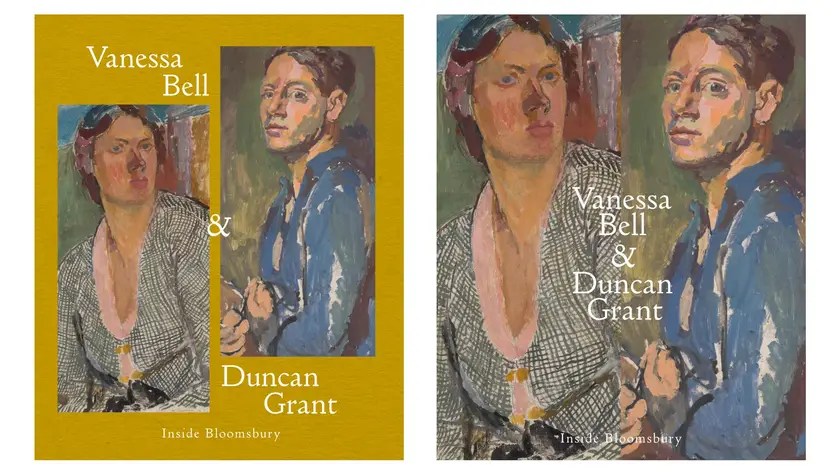
The new Tate catalogue brings together scholarship, conservation research and contemporary responses to the Bloomsbury painters. Its most revealing contributions expose the uncertainties of their artistic partnership, while its broader claims for their place in modernism deserve closer scrutiny.
On the last day of 1927, Vanessa Bell was struggling with a portrait of Duncan Grant at Charleston. Writing to him that evening, she complained that portraits were “desperate work”. The picture had some resemblance to its subject, she conceded, but she was dissatisfied with the result. Elsewhere in the letter, she mentioned Angelica’s nosebleed, the housekeeper injuring her hand while sawing wood, and Quentin painting a still life nearby.
The portrait is now untraced. What survives is Bell’s account of making it, preserved in the correspondence examined by art historian Jon King in Shared Rooms, Shared Lives, one of the strongest contributions to Vanessa Bell & Duncan Grant: Inside Bloomsbury, edited by Thomas Kennedy and published by Tate in 2026.
King begins with an absent painting and reconstructs the circumstances surrounding its creation. He also identifies a revealing disparity in the artists’ practice: Grant painted Bell repeatedly between 1911 and 1961, while she portrayed him only intermittently. The difference raises questions about their respective positions within the partnership, particularly the ease with which women artists could become subjects for others, even while maintaining substantial independent careers.
The final image in King’s account is a charcoal drawing Grant made of Bell in the mortuary room at Charleston, a week after her death in April 1961. It completes a sequence of portraits extending across fifty years, whose significance King establishes through close examination of the paintings and the circumstances in which they were made.
Kennedy’s catalogue accompanies the current Tate Britain exhibition, organised in collaboration with Charleston. Across 256 pages, it gathers contributions from historians, curators, conservators and contemporary artists. Eight thematic sections trace the painters’ development, their professional collaborations and the relationship that sustained their shared working life for more than fifty years.
The illustrations are given considerable space, frequently occupying full pages or appearing alongside closely related works. Archival photographs are particularly useful, sometimes providing direct evidence of subjects, working arrangements or domestic surroundings that subsequently entered the paintings. The thematic organisation allows readers to compare works produced decades apart. Although the catalogue includes a list of exhibited works, it provides no individual interpretative catalogue entries, leaving the accompanying essays to carry the analysis.
Grace Brockington’s Bloomsbury and Conversation makes effective use of conservation evidence. Her subject is Bell’s A Conversation, begun around 1913 and reworked in 1916. X-rays taken in 1978, together with a subsequent conservation report, revealed an earlier composition with a lighter palette and striped fabrics suggestive of the Omega Workshops.
Brockington argues that Bell’s revisions reflect the changing circumstances of Bloomsbury during the First World War. The original picture, with its decorative detail, belonged to the group’s period of intense sociability and artistic discussion. Its subsequent simplification, Brockington suggests, introduced a more isolated atmosphere, consistent with the disruption of those relationships during wartime.
The interpretation cannot establish Bell’s intentions with certainty, but it offers a convincing explanation for the painting’s development. Brockington is attentive to the relationship between formal decisions and the historical circumstances in which they were made.
Tate conservators Amy Griffin, Gabriella Macaro and Joyce H. Townsend contribute a technical investigation of how Bell and Grant approached related compositions, comparing their supports, preliminary drawing, collage techniques and pigments. Their findings reveal substantial differences in method, despite evidence that the artists sometimes shared materials.
An accompanying letter introduces a less comfortable aspect of artistic collaboration. Bell wondered whether the two painters might have a detrimental effect on one another, before suggesting that Grant’s influence on her was considerably greater than hers on him. Her remark raises questions about artistic confidence and dependency that the catalogue’s more celebratory passages tend to leave unexplored.
Eliza Spindel’s Beyond the Frame: The Omega Workshops examines the production of decorative objects with comparable care. Particularly instructive is her account of Grant’s rug for the 1913 Ideal Homes Exhibition. The design appears rectilinear, yet its lines are deliberately irregular. To reproduce them in woven form, the original drawing was transferred onto graph paper, square by square. The process required painstaking interpretation by the makers, whose technical contribution complicates the familiar description of Omega objects as spontaneous expressions of artistic freedom.
The catalogue also reveals the difficulty of maintaining a consistent critical approach across contributions by writers with very different interests.
Sophie Pickford’s account of Bell and Grant’s work for the theatre introduces a comparatively neglected aspect of their careers, including the mixed reception of Bell’s costume designs for Frederick Ashton’s Pomona in 1933. Claudia Tobin’s essay on Portrait of Angelica as a Russian Princess offers another close investigation, comparing Bell’s painting with photographs taken of her daughter in Cassis in 1928.
Tobin observes that the artist removed a woodpile, brick wall and shovel handle visible in the photographs, producing a more carefully controlled pictorial setting. The photographs’ association with Virginia Woolf’s Orlando, and Bell’s own ambiguous album annotations, allow Tobin to examine connections between photographic staging, literary invention and portraiture without forcing a definitive identification of Angelica’s role.
The discussion of Grant’s sexuality is more contentious. Simon Watney’s An Experiment in Living challenges the persistent tendency to interpret his relationship with Bell through conventional expectations of marriage and sexual fidelity. His account places Grant’s life within the legal persecution and social hostility faced by gay men in Britain, providing necessary historical context for a relationship frequently judged according to later assumptions.
Watney’s determination to defend Grant occasionally leads him towards assertions that require more qualification. His description of the artist’s inner world as essentially innocent and childlike is difficult to substantiate. Although he acknowledges Bell’s depression, jealousy and personal losses, he is sometimes too certain in dismissing Grant’s responsibility for her unhappiness.
A counterpoint comes from Virginia Nicholson, Bell’s granddaughter, interviewed by Kennedy towards the end of the book. Nicholson recalls her grandmother with warmth, including the sixpence an hour she received for sitting for portraits as a five-year-old. Yet she also believes that Grant caused Bell considerable unhappiness, despite the affection between them. Her account acknowledges the emotional difficulties of an arrangement that could nevertheless sustain a long and productive artistic partnership.
Louis Fratino and Alessandro Teoldi approach another aspect of Grant’s private life through the hundreds of erotic drawings he produced between 1946 and 1959. Many were made on discarded paper, including grocery lists and packaging. The authors examine their relationship to the artist’s visual interests and raise questions about the representation of Black men in some of the drawings. They acknowledge the difficulty of distinguishing personal experience from fantasy or fetishisation, leaving room for uncertainty where the surviving evidence cannot support a definitive conclusion.
The contemporary responses vary in their usefulness. Hannah Quinlan and Rosie Hastings consider the murals at Berwick Church against the historical circumstances of their creation, including the personal losses suffered by Bell and her family. Martino Gamper and Francis Upritchard, by comparison, concentrate largely on their own collaborative practice. Their enthusiasm for Omega is evident, but the essay offers less insight into the historical material than the surrounding scholarship.
The book’s editorial limitations become apparent in its treatment of some substantial works. The Famous Women Dinner Service receives reproductions and a brief discussion, despite the wealth of questions raised by its fifty decorated plates. Hana Leaper’s extensive 2017 study demonstrates how much there is to investigate concerning the commission, its feminist implications and its position within the artists’ careers. The catalogue’s account feels comparatively slight.
The section devoted to Bell and Grant’s return to more naturalistic painting after the First World War also lacks a sustained examination of that stylistic development. Essays on travel and individual portraits provide useful context, but the larger changes in their painting receive less attention than their early experiments.
The most consequential omission concerns those experiments themselves.
The catalogue repeatedly identifies Bell and Grant as pioneers of abstraction in Britain. Brockington goes further, arguing that Bell’s work between 1911 and 1917 approached the limits of European abstraction. These claims are important, but the book offers surprisingly little comparative analysis to establish them.
By the time Bell and Grant produced their most experimental compositions, abstraction was developing through several distinct artistic movements across Europe. The relationship of their work to Cubism, to artists such as Kandinsky and Kupka, and to contemporary developments in Britain, including Vorticism, deserves closer examination.
Such comparisons would help establish more precisely what distinguished Bell’s experiments from those of her contemporaries, and how far her development resulted from direct artistic exchange or independent investigation.
The absence is particularly noticeable because Brockington and Tobin had already addressed these questions in their substantial 2017 study of Bell’s Abstract Painting of 1914. That research considered the painting within international modernism, including its relationship to Islamic textiles and the wider reassessment of decorative art. A similarly expansive approach would have strengthened Kennedy’s volume and challenged the tendency to consider Bloomsbury primarily within its own intellectual and social circle.
There is also a missed opportunity to examine the artists’ later work with equivalent rigour. Bell’s explanation that she abandoned abstraction because nature offered more than she could invent is quoted in the catalogue, but the artistic consequences of that decision deserve fuller consideration. The changing relationship between experimentation, representation and decorative painting remains a significant part of their careers.
The letters, technical examinations and archival discoveries make Inside Bloomsbury a valuable contribution to the study of two artists whose work has often been overshadowed by accounts of their unconventional lives. They are particularly useful where they expose uncertainty or reveal distinctions between the artists that the familiar narrative of collaboration tends to obscure.
King cannot recover the lost portrait with which his essay begins, but he can establish what Bell was thinking about as she painted it, and the circumstances of its making. Kennedy’s contributors are at their best when they work with that degree of precision. Their larger claims about Bell and Grant’s place in European modernism still require the same scrutiny.
Book details
Vanessa Bell & Duncan Grant: Inside Bloomsbury
Edited by Thomas Kennedy
Tate Publishing, 2026
256 pages
Hardback £45 — ISBN 9781917055444
Paperback £35 — ISBN 9781917055451
Published to accompany the exhibition at Tate Britain, London, 12 November 2026–11 April 2027.
Cover image: book covers, courtesy of Tate Britain.

