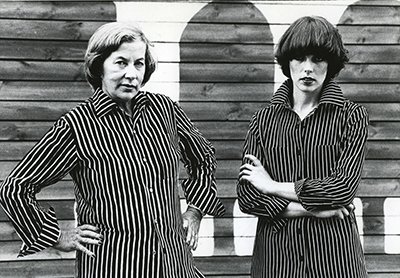
Armi Ratia founded Marimekko in postwar Helsinki with a proposition that was equal parts aesthetic and political: that Finnish women deserved clothes that were joyful, unstructured, and entirely their own. Jackie Kennedy wore them on the campaign trail. They have never gone out of fashion because they were never quite in it.
In the summer of 1960, Senator John F. Kennedy’s campaign for the American presidency was generating the kind of visual scrutiny that American presidential campaigns had only recently learned to court and had not yet fully learned to manage. Every photograph of Kennedy and his wife was studied — the clothes, the hair, the posture, the unspoken visual argument that this young couple made about what America could be. Jacqueline Kennedy’s wardrobe was, in this context, not merely clothing but communication, and the communication was being read with unusual care by a press and a public that understood, instinctively if not analytically, that a candidate’s wife’s dress was a statement about the candidate’s values, his taste, his idea of women, his relationship to the world.
That summer, Jacqueline Kennedy was photographed in seven Marimekko dresses — bold, graphic, simply cut shifts in the bright printed cotton that was the Finnish company’s signature. The photographs appeared in Sports Illustrated and were seen by millions of Americans who had never heard of Marimekko and who, looking at the photographs, responded to something in the dresses that was not quite fashion and not quite art and was entirely unlike anything in the American clothing market of 1960. The dresses were large in their patterns and simple in their construction, the opposite of the structured, fitted, status-conscious couture that the political wives of the era typically wore. They looked, in the most positive sense, as though they had been made for a woman who was comfortable in her own body and did not require her clothes to negotiate that comfort on her behalf. They looked free.
Marimekko sold out its American inventory in the weeks following the photographs. The company, which had been operating since 1951 in Helsinki with a combination of critical admiration and commercial precariousness, found itself, overnight, with an international market and an international identity. Armi Ratia, who had founded the company and who was, in every meaningful sense, its creative and intellectual author, received the news of the Kennedy photographs with the mixture of gratification and impatience that characterised her response to most external validation: gratified that the work had reached people who needed it, impatient with the idea that American celebrity was the measure of Finnish achievement. She was right on both counts, and the tension between them — between the international visibility that commercial success required and the specifically Finnish, specifically local identity that was the source of the work’s originality — runs through the whole history of Marimekko as a cultural phenomenon.
Helsinki, 1949
Armi Ratia was born in 1912 in Karelia — the eastern region of Finland that was ceded to the Soviet Union following the Winter War of 1939-1940, a loss that shaped a generation of Finns with the particular intensity of dispossession, of having had a homeland and been required to leave it. She studied textile design at the Central School of Arts and Crafts in Helsinki, the same institution where Wirkkala had trained, and graduated into the specific difficulties of wartime and immediate postwar Finland: a country that had fought two wars against the Soviet Union, lost territory and people and enormous quantities of material wealth, and was in the process of rebuilding its economy and its sense of itself under conditions of considerable austerity.
In 1949 she and her husband Viljo Ratia acquired a small oilcloth factory called Printex, which had been producing printed fabrics with a limited commercial success that suggested the potential for something considerably more ambitious. Armi Ratia’s insight — immediate, intuitive, and entirely correct — was that the factory’s potential lay not in the production of conventional printed fabrics but in the commissioning of genuinely original textile designs, designs with the visual ambition and the formal intelligence that the Finnish art world had been developing since the early years of the century but that had not previously found its way into the mass production of fabric. She began inviting Finnish artists and designers to produce prints for Printex, and the results were, even in those early years, remarkable: bold, graphic, formally inventive in ways that the conventional textile market had not demanded and did not expect.
Marimekko — the name means, roughly, Mary’s dress in Finnish, a combination of the common name and the word for a simple shift — was established in 1951 as the clothing arm of Printex, a vehicle for showing what the fabrics could become when they were made into garments. The first fashion show, held in Helsinki in 1951, was the founding statement of the company’s identity: the dresses were simple in construction, the emphasis entirely on the printed fabric, the silhouettes unstructured in ways that were, in the fashion culture of 1951, genuinely radical. This was not haute couture. It was not even, in the conventional sense, fashion. It was something else — a proposition about the relationship between a woman and her clothes that was simultaneously aesthetic and political, that said, in the most direct visual language available, that the purpose of clothing was not to shape the body into conformity with an externally imposed ideal but to provide a surface for colour and pattern and visual joy, a surface that belonged to the woman wearing it rather than to the culture determining what she should look like.
The Print and Its Politics
The Marimekko print is the company’s primary creative act, and understanding it requires understanding what a print is and what it is not. A print is not a pattern in the wallpaper sense — a repeating motif that tiles a surface uniformly, reducing the fabric to a background. A Marimekko print is a design event: a composition of shape and colour that has been thought about as a visual statement in its own right, that makes demands of the eye and rewards them, that transforms the surface of the fabric into a field of visual intelligence rather than mere decoration.
The designers Ratia recruited in the early years of the company — Maija Isola above all, whose fifty-year relationship with Marimekko produced some of the most extraordinary textile prints of the twentieth century, but also Vuokko Nurmesniemi, Annika Rimala, and a series of others whose contributions were less celebrated but no less significant — brought to the print design the same understanding of form and colour that the Finnish fine art tradition had been developing since the early decades of the century. Isola in particular was a painter who moved between canvas and fabric without the distinction between the two mattering very much to her — the visual intelligence was the same, the commitment to formal resolution was the same, the understanding that colour was not decoration but structure was the same. What changed was the scale of the audience: a painting in a gallery reached the people who chose to go to galleries, while a print on a dress reached the people who wore dresses, which was everyone.
The Unikko poppy print of 1964 — Isola’s response to Ratia’s stated position that Marimekko would never make a flower print, a declaration that Isola found sufficiently provocative to require a direct formal response — is the most famous single print in the company’s history, and its fame is justified by its quality: a composition of large, simplified poppy forms in red and black and white that manages to be simultaneously bold and delicate, graphic and organic, immediately legible and formally inexhaustible. It has been in continuous production since 1964, printed on fabric and applied to objects of every kind, and it has never, in sixty years of reproduction, become boring. This is the test of a great textile design: not whether it is striking in isolation but whether it survives repetition, whether it continues to reward looking after the initial visual impact has been absorbed. The Unikko survives this test with room to spare.
The politics of the Marimekko print were not separable from its aesthetics, and Ratia was explicit about this in ways that the fashion world of the early 1960s found unusual. She talked about her clothes as a form of liberation — not in the ideological vocabulary of second-wave feminism, which had not yet fully formed the language that would dominate the decade’s end, but in the more pragmatic vocabulary of a woman who had grown up in wartime Finland and understood, from direct experience, that the luxury of conventional fashion was not available to most women and that the alternative to luxury was not deprivation but a different kind of elegance, an elegance of simplicity and colour and joy that was available to anyone who could afford printed cotton.
The unstructured silhouette of the Marimekko dress was not merely a stylistic choice. It was a position about the relationship between women’s bodies and the clothing industry. The structured dress — the fitted bodice, the shaped skirt, the foundation garments that conventional fashion of the 1950s required — was a technology of conformity, a means of making the female body approximate an ideal that the fashion industry had determined rather than the woman herself. The Marimekko shift, loose and simple and comfortable, proposed an alternative: a dress that moved with the body rather than constraining it, that was available in a single size rather than a graduated series of inadequacies, that required no infrastructure of corsetry or tailoring to make the wearer look correct. It looked correct because it had no idea of incorrectness. This was not a small thing in 1951. It was not a small thing in 1960, when Jackie Kennedy wore it on the campaign trail and introduced it to America. It is, in some respects, still not a small thing.
The Atelier and the Workshop
Ratia’s vision for Marimekko extended beyond the clothing and the fabric into a broader proposition about the relationship between design, daily life, and Finnish culture. She wanted Marimekko to be not merely a fashion company but a design company in the fullest sense — a company that produced beautiful things for the home as well as the body, that understood the environment of everyday life as a totality and brought the same visual intelligence to the table and the wall and the floor as to the dress and the shirt. This vision was only partially realised in her lifetime, partly because the clothing business consumed most of the company’s commercial energy and partly because the domestic products — ceramics, textiles for the home, small objects — were never as commercially successful as the clothing.
But the vision shaped the company’s identity in ways that outlasted its partial realisation. Marimekko was always understood — by its designers, by its customers, by the culture that formed around it — as being about a way of living rather than a way of dressing: a commitment to bold colour, to graphic simplicity, to the rejection of the fussy and the overworked in favour of the direct and the joyful. The Marimekko interior — bright prints on the walls, striped textiles on the furniture, the general impression of a space that had been assembled by someone with strong visual convictions and no patience for the conventionally tasteful — was a recognisable aesthetic category in Finnish domestic life by the mid-1960s, and it spread, with the company’s international expansion, into the interiors of people across Europe and America and eventually the world.
The boutiques that Ratia opened, first in Helsinki and then internationally, were themselves expressions of this vision: spaces designed with the same visual intelligence as the products they sold, environments that made the argument for the Marimekko aesthetic by embodying it rather than merely displaying it. The shop was not a neutral container for the goods. It was a demonstration of what the goods were for — of what a space looked like when it was organised around the same principles of colour and pattern and visual boldness that governed the prints. This understanding of the retail environment as an extension of the design philosophy rather than its commercial frame is something Marimekko shared, across the decades and without necessarily knowing it, with John Derian’s shop on East Second Street and with Dover Street Market: the proposition that the space in which things are sold should make an argument for the things themselves.
The Designers and the Collective
One of the most distinctive features of Marimekko as a design organisation is the degree to which its creative identity has been collective — built from the contributions of many designers over many decades — while remaining, paradoxically, entirely coherent. The Marimekko aesthetic is instantly recognisable regardless of which designer produced the specific print being looked at, which is an unusual achievement for a company that has worked with dozens of creative contributors since its founding and that has always credited its designers by name rather than subsuming them into the brand.
Maija Isola is the canonical example. Her prints — produced for the company from 1949 until 1987, a collaboration of almost four decades — are as various in their formal approach as they are consistent in their quality: the Unikko poppy, the Kaivo well, the Melooni melon, the Lokki seagull, the bold abstract compositions that sit alongside the more figurative work without any discontinuity of intent. Isola was painting at the same time she was designing prints, and the relationship between the two practices was not hierarchical — the printing work was not applied art in the diminishing sense of the term, a lesser version of the real thing. It was a different expression of the same visual intelligence, constrained and enabled by the specific requirements of the medium in ways that produced, in the best cases, work that the canvas would not have generated.
The succession of designers who came after Isola — Annika Rimala, who introduced the Tasaraita stripe that became as much a Marimekko signature as the Unikko poppy; Fujiwara Ishimoto, the Japanese designer whose relationship with the company from the 1970s onward brought a different visual sensibility into dialogue with the established Finnish one; the contemporary designers who continue to produce new prints while maintaining the formal standards that the archive has established — constitutes a creative tradition in the fullest sense: not a set of rules to be followed but a quality of visual seriousness to be matched, a standard set by the best of what has come before that each new contribution is implicitly measured against.
After Ratia
Armi Ratia died in 1979, at the age of sixty-six, before the full extent of her achievement was internationally acknowledged. The company she had founded and driven for three decades went through a difficult period in the 1980s — the commercial pressures of international expansion, the changing fashion landscape, the difficulty of maintaining creative integrity under the conditions of growth that success imposed — before being stabilised and eventually revitalised in the 1990s and 2000s by a series of ownership changes and creative renewals that brought the company back to something closer to its founding principles.
The Marimekko of the twenty-first century is a global brand with shops on several continents, a licensing operation of considerable scale, and a cultural presence that extends well beyond Finland into the broader international conversation about what Scandinavian design means and why it continues to matter. The prints are still bold, the silhouettes still simple, the proposition still fundamentally the same as the one Ratia articulated in Helsinki in 1951: that clothing should be joyful, that colour is a form of freedom, that the woman who wears a well-made shift in a great print is dressed as seriously and as beautifully as the woman who wears a couture gown, and that the difference in price between the two reflects the economics of the fashion industry rather than the quality of the visual intelligence behind the garment.
This proposition has proven, across more than seventy years of commercial and cultural history, to be not merely defensible but increasingly persuasive. The fashion industry has moved, in the decades since Ratia made her argument, toward exactly the territory she was occupying: the casual, the unstructured, the bold print, the garment that does not require explanation or infrastructure or a particular body type to make its wearer look right. Whether this represents a vindication of her vision or simply the cultural absorption of it into the mainstream is a distinction that Ratia herself would probably have found unimportant. The dresses are being worn. The prints are being made. The colour is still joyful. That was always the point.
What Finland Made
The three essays that constitute this series’ Finnish chapter — Aalto, Wirkkala, Marimekko — tell, taken together, a story about a small country’s relationship to design that is unlike the story any other country could tell. The relationship is grounded in the specifics of the Finnish landscape and the Finnish climate and the Finnish experience of the twentieth century — the wars, the losses, the reconstruction, the particular quality of light and cold and forest and water that shapes the sensibility of everyone who grows up there — but it has produced work of universal resonance, work that speaks to people who have never seen a Finnish forest and who could not find Lapland on a map.
The reason, perhaps, is that what these three figures were making — each in their own medium and with their own specific intelligence — was not Finnish design in the narrow nationalist sense but something more fundamental: objects and spaces and images that took the relationship between the human being and the designed world seriously in a way that the international mainstream often did not. Aalto thought about what it felt like to be inside a building. Wirkkala thought about what it felt like to hold an object in your hand. Ratia thought about what it felt like to be a woman in a dress. These are not aesthetic questions in the narrow sense. They are questions about the quality of human experience — about what the world owes the people who live in it, what design can give and what it routinely withholds.
Finland gave generous answers. The forest thinks in wood. The ice holds the light. The poppy print covers the dress. The summer goes on.

