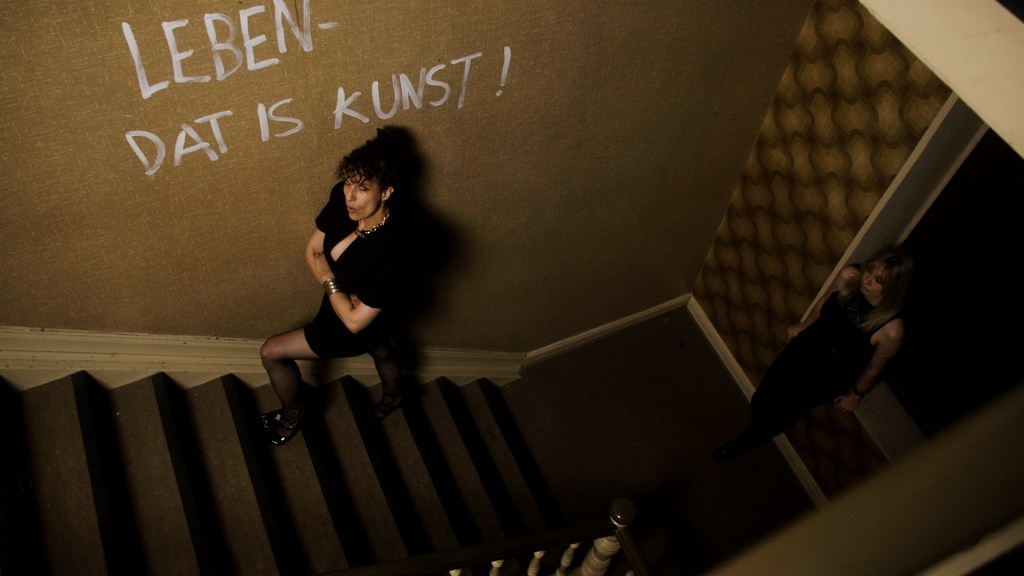
After a decade away from music, the former Zoot Woman bassist returned as a songwriter in her own right. Now 47, Jasmin OMEARA is confronting the pressures of ageing and appearance while pursuing the music she had never quite found the confidence to make before.
When Jasmin OMEARA performed her first concert under her own name, she discovered something unexpected. After years spent playing bass at the side of the stage, she was suddenly the frontwoman, with her name displayed behind her. The shyness that had accompanied much of her earlier career seemed to have disappeared.
“Luckily when you turn 40 you kind of magically don’t give a shit anymore about what people think of you,” she tells My World of Interiors.
“I remember my first gig as Jasmin OMEARA and how I just got up there and performed like I’d been a front woman my whole life. Not a hint of shyness. I surprised myself.”
OMEARA returned to music in 2023, aged 43, after approximately a decade away from performing. Marriage, motherhood and family life had intervened, and she had scarcely touched an instrument since leaving the British electronic group Zoot Woman following the birth of her first son in 2013.
Her return began with songs written privately at home and a recording session arranged almost before she had time to reconsider. Three years later, she has released a solo album, completed an electronic-pop album with producer George Raquet and established a live partnership with drummer Kelly Cairns.
Her latest single, Silhouette, is among her most outspoken recordings. Released in September 2026, it examines women’s often destructive relationships with their bodies, a subject that has acquired particular urgency for OMEARA as she navigates the music industry in her forties.
From Montreal to Zoot Woman
OMEARA grew up in Montreal in a household where music was a constant presence. Her stepfather, a photographer, had an extensive record collection that introduced her to David Bowie, Talking Heads, Kraftwerk, Prince and traditional French-Canadian folk music.
At six, she began studying violin, an experience she remembers without much affection. She wanted to play guitar, although it took another eight years and the sight of an all-female band performing live to convince her that she could become a musician herself.
At fourteen, she took a guitar from her uncle’s wall and began teaching herself. Soon she was auditioning for local bands, spending her teenage years among Montreal’s independent musicians.
The city’s underground scene during the 1990s gave her a practical, largely self-directed musical education. She played with different groups, experimented with musical styles and developed the attachment to punk and alternative rock that remains important to her work.
She subsequently studied design, including fashion at London’s Central Saint Martins, before returning to music through a chance encounter in the British capital.
There, she played bass in the electronic-rock groups Kill Electric and Temposhark, the latter led by Robert Diament, who would later become known as the co-founder of the Talk Art podcast.
Her most prominent association began in 2008, when she joined the performing line-up of Zoot Woman, the British electronic group established by Johnny Blake, Adam Blake and producer Stuart Price.
Zoot Woman had emerged in the late 1990s, developing a recognisable approach to electronic pop that combined carefully constructed melodies with synthesised arrangements and a strong visual identity. Their debut album, Living in a Magazine (2001), had established an international following, and their third album, Things Are What They Used to Be (2009), appeared during OMEARA’s years with the group.
She performed on bass, keyboards and backing vocals, touring extensively and learning the professional disciplines that accompany life in an established band. A contemporary concert review from Mainz in 2009 describes her moving between bass and keyboards during the group’s live performance.
“Being in Zoot Woman certainly was my school on how to walk through the world as a professional musician,” she recalls. “How to behave on and off stage. How to conduct yourself in interview and be interesting.”
Touring suited her enormously. She remembers a journey along the Pacific Coast Highway between San Francisco and Los Angeles, looking out of the van window and feeling an extraordinary sense of freedom.
“I absolutely loved it. I knew I was made for this.”
Yet her contribution remained primarily that of a performing musician. Zoot Woman’s songwriting was closely guarded by its established members, and she was not involved in composing the group’s material.
She nevertheless took away a lesson that would later prove valuable: a good pop song, she learned, should still work when played alone on a guitar.
The group’s carefully considered appearance also made an impression. Fashion was integral to their presentation, and OMEARA admired the relationship between the music, clothing and visual identity. The principle has carried into her own work: how musicians dress and present themselves on stage should, she believes, reflect the music they perform.
She enjoyed the performances and the travelling, but her years in bands had also established a particular position for her as a musician.
“I had successfully been trained (by male bandmates) over the years to be happy being the girl on the side of the stage playing bass,” she explains. “For a while that was good enough as I felt safer hiding behind my bass.”
She would eventually find that standing at the front was considerably less frightening than she had imagined.
Learning to write her own songs
At the end of 2022, OMEARA began writing songs in secret. She was sufficiently uncertain about their quality that she was reluctant to let her husband, Daniel O’Meara, hear them.
“I was scared to have my husband listen to them in case he thought they were crap,” she admits.
When she eventually played him the recordings, his reaction was immediate. He loved them and pushed her to take the songs further. Within two weeks they were in a London studio recording Take It Back.
The session was intended as an experiment. She had written only two or three songs in her twenties and had little experience of completing an arrangement entirely by herself.
The results encouraged her to continue. Her first EP, Desert Heart, was released in June 2023, followed by the seven-track solo album Lovely Creatures in February 2024.
The recordings explored romantic disappointment, emotional detachment and the uncertainties of contemporary relationships. Take It Back is written from the perspective of someone retracting a declaration of love, while Sleepwalker examines the numbness that can develop within unfulfilling relationships.
Some material had been waiting considerably longer to be recorded. The opening vocal phrase of Sleepwalker had remained in her head for thirteen years. Wolves, meanwhile, originated in a song written during a lonely period of her life more than a decade earlier.
OMEARA’s writing is informed by her interest in cinema. As she explained in a 2023 interview with Nene’s Butler, she often imagines situations and characters, constructing scenes through which a song’s emotional content can develop. The resulting lyrics are therefore not necessarily autobiographical, even when they concern intimate experiences.
Her influences include Depeche Mode, particularly Martin Gore’s guitar work on Violator, alongside PJ Harvey‘s To Bring You My Love and Nick Cave and the Bad Seeds‘ Let Love In. She has long been attracted to musicians willing to examine love through its less flattering emotions.
The process of writing alone was initially difficult. Having spent years developing material collaboratively, she was suddenly responsible for every decision.
Today, she constructs her songs in considerable detail before entering a studio. Arrangements take shape in her head over several weeks before she records them using Ableton.
“I develop the demo right down to the last cowbell and handclap,” she explains.
With the principal arrangement established, she then recreates the recording professionally, generally performing the instrumental parts herself apart from the drums.
Perfectionism was another obstacle. She had spent much of her earlier life worrying that her work was insufficiently developed or that she lacked the confidence to pursue opportunities.
Daniel, who also manages her music, encouraged her to work to deadlines and recognise when something was ready. She credits his insistence with helping her overcome a habit of endlessly revisiting unfinished material.
She has gradually become quicker at writing and more confident about recognising when a song is finished.
In her 2023 interview, she admitted that she had attempted to write the perfect three-and-a-half-minute pop song with Take It Back, only to find herself unable to keep the composition that short. She preferred long introductions and arrangements that allowed an atmosphere to develop gradually.
Three years later, she speaks enthusiastically about writing more compact, focused songs. Her growing confidence has changed how she approaches the construction of a song as much as how she performs it.
Silhouette: The pressure to disappear
OMEARA’s concerns about age and appearance began entering her songwriting almost as soon as she returned to music.
Her 2023 single Cool Kids approaches music and dancing as a way of escaping conventional judgements about beauty, wealth and social acceptance. Its central idea is that a shared enjoyment of music can temporarily dissolve the distinctions through which people judge themselves and one another.
Three years later, Silhouette addresses a related subject with considerably greater anger.
The song began with a phrase that appeared unexpectedly in OMEARA’s mind: “you’ve got a silhouette like a cigarette”.
Initially, she thought it might be too obvious. On reflection, however, she recognised something useful in its almost taunting quality. The phrase was memorable, faintly cruel and open to several interpretations.
The cigarette comparison can be read as an image of bodily disappearance. An object associated with slenderness and fashionable imagery is also something gradually consumed until nothing remains. OMEARA did not begin with this elaborate symbolism in mind; she followed a phrase whose sound and unpleasant implications interested her.
She had, however, been thinking about the subject for some time.
Growing up during the 1990s, she witnessed the fashion industry’s embrace of the extremely thin body, popularly described as heroin chic. Her later studies at Central Saint Martins reinforced an awareness of appearance that she admits has remained difficult to escape.
More recently, she observed the renewed cultural fascination with thinness as GLP-1 weight-loss medications became increasingly prominent in public discussion and the appearance of certain female celebrities attracted considerable attention.
At the same time, she was struggling with changes in her own body during perimenopause and worrying about how she appeared in photographs and on stage.
She describes comparing herself with younger female musicians on social media, wondering whether audiences would notice fluctuations in her weight.
In a workplace where she was until recently surrounded by other women, she also became conscious of how many colleagues were dieting, regardless of their size.
“Watching my weight has sadly been a life-long concern,” she says. “A very tiring one at that.”
What disturbed her was the extent to which women could recognise the cruelty of these expectations while continuing to impose them upon themselves.
Silhouette takes that contradiction seriously. Its references to bodily disappearance and self-erasure evoke the psychological harm associated with extreme dieting and disordered eating. There is particular force in the fact that its author is not approaching the subject from a position of complete detachment. She recognises the pressures she is criticising within her own life.
Her confidence is uneven. She can now take centre stage without the shyness that once restrained her, yet a photograph beside a younger performer on Instagram can still make her self-conscious. The song emerges from that unresolved tension.
Musically, Silhouette brings a punk-rock edge to an accessible pop structure. Its confrontational character does not prevent the song from being immediately engaging. The central hook is catchy enough to invite repetition, even as its subject becomes more uncomfortable.
OMEARA wrote and composed the track, performed its vocals, guitars, bass, synthesisers and programming, and co-produced it with Daniel. Kelly Cairns supplied the drums.
The accompanying music video, released on 7 November 2026, was filmed by Dominik Richter at an abandoned hotel found through OMEARA’s artist friend Gerrit Starczewski.
The worn interiors appealed to her immediately.
“It looks depressing. It’s perfect!” she remembers thinking when she first saw photographs of the location.
Despite the song’s carefully constructed arrangement, the film was made with comparatively little planning. The intention was to create something dark, and OMEARA had been looking at older videos that experimented with shadows. The team began with those ideas and improvised during filming, with OMEARA moving in front of the camera while Cairns contributed the athletic movements that became part of the video’s visual character.
Cairns joined the project in 2025, and OMEARA had not played in a band with another woman since 1996.
The two musicians are from different generations, but share a commitment to playing as professionally as possible. For OMEARA, the pleasure of looking across the stage and seeing another woman working towards the same goal has been one of the unexpected rewards of returning to live performance.
Between rock and electronic pop
While her solo recordings draw heavily on guitar-based alternative rock, OMEARA has continued exploring the electronic music that shaped her years in London.
Her collaboration with George Raquet, the professional name of Georg Conrad, one half of Cologne electronic duo COMA, became an important part of her development as a songwriter.
Working largely remotely over two years, they wrote enough material for the album Bitesize Bruises, released in February 2026.
The pace was demanding. Some months, they worked on several songs, compelling OMEARA to develop lyrics and vocal melodies much more quickly than she had previously managed.
She regards the project as a songwriting education in its own right.
“I gave birth to some of my best lyrics and vocal melodies during that project,” she says. “I’m very proud of that album.”
Songs such as Masks and Pretty Boy continue her interest in ageing, though from different perspectives. Masks concerns the unsettling experience of feeling betrayed by one’s reflection, while Pretty Boy was inspired by her husband’s difficulty recognising that he remains attractive as he gets older.
The album also allowed her to explore an electronic-pop approach to songwriting that she would probably never have pursued independently.
Her July 2026 solo single OMNI occupies similarly dark pop territory. Its atmosphere recalls aspects of Joy Division’s post-punk melancholy, although OMEARA’s melodic approach and vocal presence bring it closer to electronic pop.
The comparison is suggestive rather than a claim of direct influence. OMEARA’s interests have always extended across guitar-based alternative music and the electronic pop she knows from her years with Zoot Woman.
She is particularly interested in the point where a song can retain the force of alternative rock while possessing the melodic directness of pop. It is a balance she continues to pursue in her new recordings.
The handmade musician
OMEARA’s interest in design extends well beyond the visual presentation of her records.
Her stepfather’s profession introduced her to photography at an early age, and she grew up surrounded by art and design. Cinema and architecture remain important interests.
Asked how this background influences her work, she begins with characteristic humour.
“It has influenced that I have very expensive taste despite a limited budget,” she laughs.
She references Effie Smith’s 1956 song Champagne Mind With a Soda Water Income, a description she finds particularly appropriate.
Her ambitions are considerable, although the finances of an independent musician rarely allow her to realise everything she imagines. In her twenties, she remembers surviving on popcorn while living in London. Today, she has more resources available but also the financial responsibilities of family life.
She nevertheless approaches recording, photography and video with the same insistence on professional standards.
Her relationship with visual art is unusually intense. Sometimes, when she encounters a painting she finds particularly beautiful, she wants to become part of it.
“Not own it, but crawl in to it.”
That response helps explain her attachment to the complete presentation of a musical project, from the arrangement of a song to its accompanying images and live performance.
OMEARA is equally firm about the processes through which her work is made. She refuses to use generative artificial intelligence in her music, photography or videos, preferring to work directly with musicians and other creative collaborators.
“I will continue to make man-made, hand-made music till the very end, like a traditional basket-weaver.”
The comparison is unexpected from a musician who has spent years working with synthesisers and digital recording software. Yet her distinction concerns the creative decisions and involvement of human makers, rather than a rejection of technology itself.
She still identifies strongly with the independent music scene of 1990s Montreal, where creative work was often produced with limited means and considerable personal effort.
“Some element of punk rebellion and hand-made craft is still in me and present in my work,” she says.
Returning to music after a decade also meant adjusting to an industry transformed by streaming and social media.
She compares the experience to the opening of Danny Boyle’s 28 Days Later, in which Cillian Murphy’s character awakens to find London apparently deserted.
The musical landscape she remembered had changed. Streaming services had altered how audiences discovered and consumed music, while the pandemic had contributed to the closure of smaller venues.
OMEARA recalls a former bandmate cycling to a major record company’s headquarters in West London around 2006, carrying a burned CD in the hope that someone would listen. He was not even allowed through the door.
The old gatekeepers, she argues, have largely been replaced by new ones. Although independent musicians can now distribute recordings without a label, finding listeners remains extremely difficult.
She is particularly critical of the pay-to-play arrangements she says she has encountered at German venues, where musicians are expected to contribute financially for the opportunity to perform. She generally refuses to participate.
The demands of social media have proved similarly difficult to reconcile with making music.
“When I opened my Instagram account I didn’t even know how to post a picture. I still don’t know how TikTok works,” she admits.
Alongside her music, she has a family and regular employment, leaving limited time for the continuous online activity now expected of performers. She has begun treating Instagram less as a promotional obligation and more as a personal scrapbook.
The industry’s treatment of women remains another source of frustration. OMEARA says she has encountered support programmes for emerging musicians whose age restrictions exclude applicants over thirty, despite being relatively new to recording her own songs.
Her concerns about representation have a wider factual context. According to the USC Annenberg Inclusion Initiative’s March 2026 report, women accounted for 14.5 per cent of credited songwriters and 4.4 per cent of credited producers on the 2025 Billboard Hot 100 year-end chart.
Those figures describe commercially successful American popular music rather than the entire international industry, but they illustrate the imbalance in two of the roles most important to determining what music is made.
OMEARA is realistic about the scale of commercial success she can expect. When she released Desert Heart, she set herself a personal ambition: to accumulate one million streams across her catalogue by the age of sixty.
Three years into her return, she estimates that she has passed 250,000.
She is pleased with the progress, although the responses from listeners seem to matter just as much. Some have told her that her songs helped them through bereavement; others find that their echoes of 1980s and 1990s music recall periods of their own lives.
She values the possibility that a song might accompany somebody through a difficult experience, or simply make them want to dance.
The years ahead
OMEARA is now halfway through recording her next album, her second solo LP and a return to a harder indie-rock sound after the electronic collaboration with Raquet.
She believes her songwriting has become more economical. The arrangements are tighter, the melodies more immediate, and she is increasingly interested in songs that can move confidently between rock and pop.
Her ambitions have also become clearer. The earlier uncertainty about whether she had the right to stand at the front of the stage has largely disappeared, although she remains conscious of the pressures surrounding age and appearance.
Cairns, now 31, occasionally complains that she herself is getting old. OMEARA’s mother, at 73, tells her that at 47 she is in the prime of her life.
OMEARA finds herself somewhere between those perspectives. She regrets the opportunities she may have missed when she was younger, particularly the occasions when shyness prevented her from pursuing her ambitions.
Yet the experience she has accumulated has changed what she is capable of writing. The confidence she now possesses has come through years of performing, raising a family and eventually learning to trust her own creative judgement.
During her years with Zoot Woman, she learned the discipline of professional performance and the principles of effective pop songwriting, but the compositions themselves remained the work of others. Her independent career has required her to develop those skills for herself, working around the demands of family life, employment and the practical difficulties of making music without a record label.
The familiar encouragement that it is never too late to begin again hardly does justice to what has happened. OMEARA is making music that she could not have written during her years as a young bassist, partly because she had not yet developed the skills, and partly because she had not lived through the experiences that now inform her songs.
She is looking for what she calls the perfect little gem between rock and pop, with new songs taking shape more quickly than before. There is a telling difference between the opening phrase of Sleepwalker, which she carried for thirteen years before recording it, and the cigarette line in Silhouette, which she initially feared was too obvious but chose to keep.
Today, she is more willing to recognise when an idea deserves to be pursued. Silhouette exists because she trusted a phrase that her younger, more self-critical self might have discarded. It became one of her most forceful songs.
After years playing other people’s music, OMEARA has begun to trust what she makes herself. That growing certainty, expressed in songs that are becoming more direct and more personal, is the real achievement of her return.
Interview conducted for My World of Interiors, November 2026.
Photography and music video: Dominik Richter. Reproduced with permission of the artist.
Listen and watch: Jasmin OMEARA — Official Website | Silhouette — Official Music Video | Bandcamp

