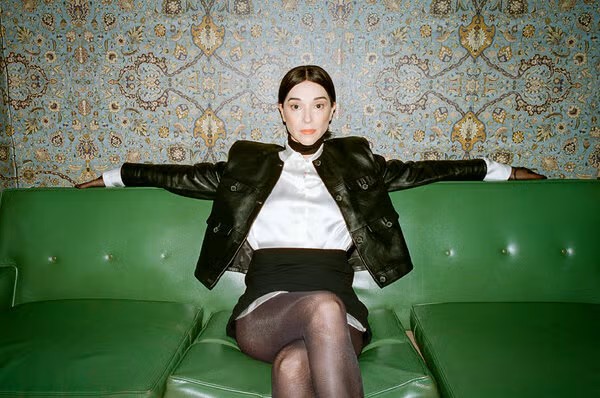
Annie Clark has spent nearly two decades dismantling and reconstructing the conventions of popular music. An exceptional guitarist, composer, producer and performer, she moves between experimental rock, sophisticated pop, orchestral composition and theatrical reinvention with a musical intelligence that is entirely her own.
On 26 October 2026, Annie Clark appeared on American television seated at a table in what looked like a dimly lit hotel cocktail lounge. A martini stood beside her lap-steel guitar. Around her were musicians including guitarist Marc Ribot, singers Hannah Cohen and Ella Hunt, and two upright bass players. The song was “Smoking Section”, originally released on her 2017 album MASSEDUCTION.
The arrangement began like an exhausted cabaret lament, its melancholy gradually acquiring weight through the interplay of voices, guitars and strings. It was a striking transformation of a song that had already undergone several reinventions.
The performance on The Tonight Show offered a useful illustration of how Clark, better known as St. Vincent, approaches music. A composition is never necessarily finished when it has been recorded. Its structure can be dismantled, its instrumentation replaced and its emotional character altered by the circumstances of performance.
Earlier this year, she released Live in London!, recorded at the Royal Albert Hall during the 2025 BBC Proms. Accompanied by the sixty-piece Jules Buckley Orchestra, she revisited nineteen songs spanning almost two decades of work.
The orchestral arrangements revealed harmonic and dramatic possibilities that had sometimes been concealed beneath the guitar distortion and electronic production of the original recordings. Melodies acquired a different weight; jagged rhythms became unexpectedly elegant; familiar songs revealed intricate internal architectures.
It is the kind of musical undertaking that makes particular sense for Clark, whose career has been distinguished by an appetite for finding unfamiliar possibilities within familiar forms.
A Guitarist with an Unusual Education
Born in Tulsa, Oklahoma, in 1982 and raised in Dallas, Texas, Clark began playing guitar as a child. She developed an early fascination with musicians whose work combined technical accomplishment with distinctive personal expression.
Her aunt and uncle, the jazz duo Tuck & Patti, provided an unusually direct introduction to professional musicianship. Touring with them as a teenager, she encountered the demands of performance, rehearsal and life on the road.
She subsequently studied at Berklee College of Music in Boston, although she left before graduating. Returning to Texas, she joined the exuberant orchestral rock ensemble The Polyphonic Spree and later toured with Sufjan Stevens.
These experiences provided an education that was both technical and practical. The Polyphonic Spree introduced her to the possibilities of large ensembles and densely layered sound; Stevens’s work required an exacting approach to arrangement and instrumental precision.
Her first solo album, Marry Me (2007), brought together chamber-pop instrumentation, elaborate melodic writing and sudden eruptions of distorted electric guitar.
Even at this early stage, Clark demonstrated an unusual ability to make contrasting musical materials coexist.
Strings and woodwinds established seemingly delicate arrangements before angular guitar passages disrupted their tranquillity. The songs frequently began within recognisable conventions of melodic pop, only to develop in directions that seemed increasingly unstable.
Her second album, Actor (2009), expanded these ideas considerably.
Inspired partly by the orchestral scores of classic Disney films, Clark began composing on a computer, constructing musical arrangements before translating them into performances by live musicians.
The approach freed her from the habits associated with writing directly on the guitar. Melodies developed according to their own internal logic, sometimes abandoning conventional symmetry or predictable harmonic progression.
On “The Strangers”, orchestral textures surround a delicate vocal melody while the arrangement gradually acquires an uneasy emotional character. “Marrow” combines an almost mechanical rhythmic insistence with guitar playing whose abrasive qualities disrupt the apparent order of the composition.
The collision between beauty and disturbance would become a defining feature of her work.
The Guitar as an Instrument of Disruption
Clark is among the most distinctive electric guitarists of her generation, although her playing bears little resemblance to the conventions of virtuoso rock performance.
She rarely seems interested in demonstrating technical ability for its own sake. Her playing is concerned with texture, interruption, rhythmic displacement and the creation of sounds that do not immediately resemble a conventional electric guitar.
A phrase may begin as a recognisable melodic figure before breaking into distorted noise. Notes are sharply articulated, then allowed to decay into effects that transform their original character.
Her approach draws upon the experimental traditions associated with Robert Fripp, Adrian Belew and Marc Ribot, musicians who extended the possibilities of the instrument beyond the established vocabulary of blues-derived rock.
In a 2011 interview, Clark discussed her interest in developing guitar passages that could function as unexpected hooks within otherwise carefully constructed songs.
The album Strange Mercy (2011) demonstrates the effectiveness of this approach.
The exuberant surface of “Cruel” conceals a disquieting narrative about domestic obligation, while “Cheerleader” develops from a restrained vocal opening into a chorus of enormous physical force.
The guitar rarely occupies the expected position of accompanying the singer. It interrupts, contradicts and occasionally appears to argue with the vocal melody.
This relationship between instrumental technique and compositional structure has remained central to Clark’s work.
In 2016, she collaborated with Ernie Ball Music Man to develop her own signature guitar.
The instrument’s angular body, narrow waist and carefully considered proportions reflected both her aesthetic preferences and her practical experience of performing.
Clark wanted a guitar that was lightweight, comfortable and appropriate to her physical proportions. She also wanted it to look unlike the conventional instruments associated with male rock musicians.
The resulting design became an important part of her visual identity, its distinctive silhouette immediately recognisable in photographs and live performances.
It is a particularly revealing example of her approach to artistic production: the instrument itself became an object of design, shaped by the relationship between the musician’s body, performance and the visual language surrounding the music.
David Byrne and the Theatre of Performance
A significant development occurred through Clark’s collaboration with David Byrne, with whom she released Love This Giant (2012).
The album was constructed largely around brass arrangements, replacing the conventional guitar-driven framework of rock with a deliberately unusual instrumental foundation.
Trumpets, trombones and other wind instruments assumed roles ordinarily performed by electric guitars and keyboards, creating a sound that was simultaneously mechanical, celebratory and slightly absurd.
The project also encouraged Clark to reconsider her physical presence on stage.
Byrne’s work with Talking Heads had long demonstrated how movement, choreography and theatrical presentation could become extensions of musical composition.
On their collaborative tour, the two musicians developed deliberately stylised movements, incorporating gestures and formations that echoed the rhythmic structures of the songs.
For Clark, the experience helped establish a more explicitly theatrical understanding of performance.
Her subsequent concerts increasingly employed controlled gestures, choreography, carefully designed costumes and visual environments that created distinct identities for each musical period.
By the time she released her self-titled fourth album, St. Vincent (2014), she had developed an unmistakable stage persona.
Her platinum-coloured hair, futuristic costumes and deliberately artificial movements suggested a character somewhere between a science-fiction heroine, a religious icon and a musician from an imagined future.
The album’s sound was similarly precise.
“Digital Witness” employed an insistent brass figure and tightly controlled rhythm to examine the relationship between technology, observation and modern self-presentation.
The music video directed by Chino Moya extended the song’s concerns into a regimented visual world of repetitive gestures and artificial environments.
Clark was examining the growing tendency to experience life through its documentation, a subject that has only become more relevant with the expansion of social media.
The album won the Grammy Award for Best Alternative Music Album in 2015, bringing her work to a substantially wider audience.
The Construction of a Persona
For an artist capable of considerable emotional directness, Clark has always maintained an interesting relationship with artificiality.
Her stage identities are carefully considered, drawing upon fashion photography, contemporary art, cinematic imagery and the history of popular performance.
The relationship to David Bowie is frequently mentioned, particularly his ability to construct characters that allowed him to explore different musical and psychological territories.
Yet Clark’s transformations are often more concerned with the relationship between the body and its representation.
In MASSEDUCTION (2017), she adopted an aesthetic of saturated pink, latex, elaborate staging and highly controlled photographic imagery.
The record examined desire, addiction, loneliness and the mechanisms through which contemporary culture transforms intimacy into spectacle.
Produced with Jack Antonoff, it brought Clark’s music closer to the conventions of contemporary electronic pop, although its arrangements retained her characteristic eccentricities.
“Los Ageless” places its subject within an environment of artificial beauty and perpetual self-reinvention. “New York” strips the production back to an affecting piano-led meditation on absence, while “Slow Disco” approaches emotional exhaustion through a combination of restraint and orchestral drama.
The album’s visual presentation was unusually coherent. Costumes, photography, stage design and promotional imagery formed a complete aesthetic environment around the music.
Clark’s interest in fashion belongs naturally within this wider understanding of performance.
She has collaborated with designers and performed at fashion presentations, including Diane von Furstenberg’s runway show in 2014.
More recently, on 5 October 2026, she provided the live soundtrack for Gabriela Hearst’s spring 2027 collection in Paris.
The collection drew upon the textile traditions of Afghan women, while Clark performed stripped-back versions of her own songs alongside a cover of the Yeah Yeah Yeahs’ “Maps”.
Her appearance demonstrated the ease with which her music moves between performance contexts. The relationship between fashion and music is particularly convincing when both are approached as forms of artistic expression rather than merely as opportunities for mutual publicity.
Clark understands the visual dimension of popular music without allowing it to replace the musical substance.
Indeed, in 2018 she released MassEducation, presenting songs from MASSEDUCTION in intimate arrangements built around piano and voice.
The exercise revealed how much of the elaborate original production had been constructed around carefully developed melodies.
Stripped of electronics, distortion and theatrical staging, the songs retained their emotional complexity.
The Seductions of the Past
With Daddy’s Home (2021), Clark moved towards a different musical and visual world.
Inspired by the sounds of New York during the early 1970s, the album incorporated elements of psychedelic soul, funk, languid rock and the atmospheric production associated with the period.
Its songs evoke the musical environments of artists such as Stevie Wonder, David Bowie, Sly Stone and the musicians surrounding the downtown New York scene.
Clark adopted a visual identity that echoed the period, with carefully styled hair, tailored suits and imagery recalling the cinematic atmosphere of early-1970s American popular culture.
The title referred partly to her father’s release from prison, although the album’s concerns extended across family relationships, personal identity and the mythology surrounding the period itself.
“Candy Darling” pays tribute to the transgender performer and actress associated with Andy Warhol’s Factory, while “The Melting of the Sun” reflects upon the experiences of women artists and musicians whose public achievements were frequently accompanied by extraordinary personal scrutiny.
The album represents one of Clark’s most explicit engagements with musical history.
Its arrangements are warm, elaborate and occasionally almost languid, creating a marked contrast with the hard surfaces and electronic precision of MASSEDUCTION.
At times the period styling becomes so persuasive that the original musical ideas seem slightly overshadowed by their historical references. Yet this is also part of the project’s fascination. Clark was investigating how the sounds and appearances of a previous era might accommodate contemporary emotional experiences.
Her interest in musical history has never been confined to imitation. It provides a collection of techniques, sounds and conventions that can be examined, altered and occasionally deliberately misused.
All Born Screaming
The arrival of All Born Screaming in April 2024 marked another significant development.
It was the first St. Vincent album produced entirely by Clark herself, following years of close collaboration with producers including John Congleton and Jack Antonoff.
The record emerged from a period shaped by grief, loss and an intensified awareness of mortality. Its sound is frequently harsh, employing industrial textures, heavy percussion and aggressive guitar arrangements.
“Broken Man” begins with an ominous electronic pulse before erupting into distorted instrumentation and the formidable drumming of Dave Grohl.
“Flea” moves through irregular rhythmic passages and sudden shifts of emphasis, while “Big Time Nothing” introduces a taut, funk-derived arrangement whose apparent playfulness conceals considerable musical complexity.
The album gradually changes character.
“Sweetest Fruit”, inspired partly by the death of pioneering electronic musician SOPHIE, provides a more reflective atmosphere. Later compositions introduce expansive melodies, suggesting the possibility of emotional renewal after the more abrasive material of the opening sequence.
Clark discussed the album’s construction in an interview with The Guardian, describing the creative freedom and technical demands of producing the entire project herself.
The production is particularly accomplished because its considerable density rarely obscures the underlying songs.
The guitars frequently operate as sources of texture rather than conventional harmonic accompaniment. Electronic sounds merge with live instrumentation, while the arrangements move between tightly controlled rhythmic structures and moments of deliberate instability.
The album won three Grammy Awards in 2025, including Best Alternative Music Album, Best Alternative Music Performance for “Flea”, and Best Rock Song for “Broken Man”.
Later in 2024, Clark released Todos Nacen Gritando, a Spanish-language version of the record, developed with filmmaker Alan Del Rio Ortiz.
The undertaking reflected her relationship with audiences in Spain and Latin America, but it also presented an unusual compositional challenge: translating songs into another language while preserving their rhythmic character, melodic phrasing and emotional intention.
It is entirely characteristic of an artist who remains curious about the possibilities concealed within her own work.
The Orchestra as Another Instrument
The orchestral performances of 2025 and 2026 represent a fascinating extension of Clark’s longstanding interest in musical arrangement.
At the BBC Proms, conductor and arranger Jules Buckley, working alongside keyboardist and co-arranger Rachel Eckroth, developed new orchestrations of songs drawn from across her catalogue.
The programme included early compositions such as “The Strangers”, “Black Rainbow” and “Marrow”, alongside later work including “Digital Witness”, “Los Ageless” and “Violent Times”.
The transformation is particularly effective in the older songs.
Clark’s early compositions were already distinguished by their unconventional harmonic structures and elaborate instrumental relationships. In the orchestral arrangements, those characteristics become more apparent.
“Black Rainbow”, originally from Actor, acquires an expansive dramatic quality through the interaction of strings and brass. “Digital Witness” becomes an exuberant orchestral construction, its rhythmic repetitions distributed across the ensemble.
The darker songs benefit from the orchestra’s ability to sustain tension through gradually changing instrumental colours.
The success of the project led Clark to undertake further orchestral concerts across North America during 2026, performing with local symphony orchestras under Buckley’s direction.
Her July appearance with the Chicago Symphony Orchestra at Ravinia demonstrated how convincingly the music could accommodate this expanded instrumentation.
An orchestra, after all, does not automatically confer seriousness upon popular music. The challenge lies in finding arrangements that reveal qualities already present within the compositions.
Clark’s work is particularly suited to this treatment because its harmonic and structural sophistication has never depended entirely upon the sonic conventions of rock.
The orchestral arrangements make that sophistication audible in a different way.
The Pleasure of Remaining Unpredictable
The current visibility of St. Vincent across fashion, music and cultural media reflects an artist who has arrived at a particularly interesting stage of her career.
In October 2026, the same musician who performed at Paris Fashion Week and reimagined “Smoking Section” as a cabaret arrangement is also appearing at New York’s Café Carlyle, one of the city’s most intimate and historically distinguished performance venues.
The contrast between these settings is striking, but neither feels inappropriate.
Clark has spent her career moving between musical contexts while maintaining an unusually recognisable artistic identity. Her guitar playing, melodic instincts and sense of arrangement remain identifiable even when the surrounding instrumentation changes dramatically.
Her work also occupies an interesting position within contemporary popular music.
At a time when artists are frequently encouraged to cultivate instantly recognisable sounds and repeat successful formulas, Clark has allowed individual albums to develop distinct musical and visual identities.
These transformations are sometimes theatrical, occasionally excessive and always carefully considered.
Yet beneath the costumes and elaborate production lies a musician with a rigorous understanding of composition.
She knows how a melody can be made stranger through an unexpected chord, how a rhythmic interruption can alter the emotional character of a song, and how a beautifully constructed arrangement can become more interesting when one instrument refuses to behave as expected.
The recent orchestral performances have revealed that this musical intelligence has been present from the beginning.
What once sounded like eccentric art-rock now reveals connections to classical composition, cinematic orchestration, funk, jazz and the more experimental traditions of twentieth-century popular music.
Perhaps the most appealing quality of St. Vincent’s work is that her technical accomplishment has never entirely eliminated the possibility of surprise. The songs remain open to accidents, interruptions and sudden changes of direction.
Annie Clark has developed an extraordinary command of her musical materials, and she continues to use that knowledge to pursue the unfamiliar.
It is a very good reason to keep listening.

