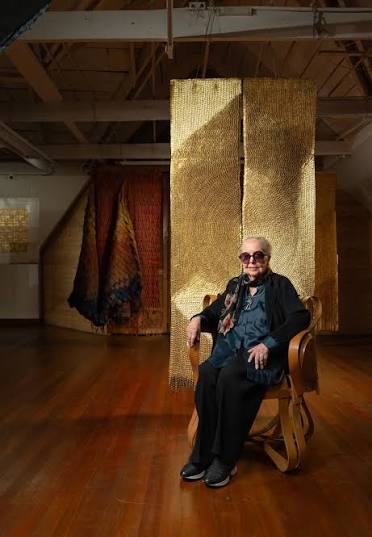
For more than six decades, Colombian artist Olga de Amaral has transformed weaving into sculpture, architecture and luminous abstraction. Her collaboration with Swiss fashion house Akris brings together two traditions of extraordinary textile craftsmanship, revealing how the simplest materials can acquire an almost monumental presence.
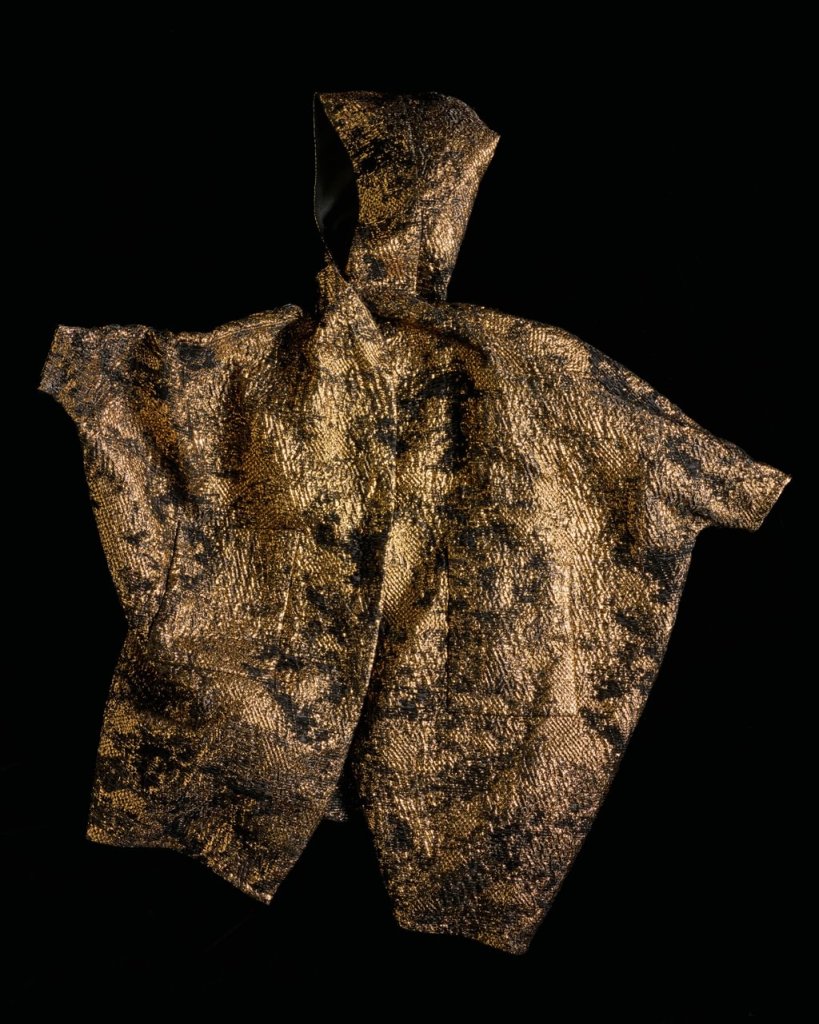
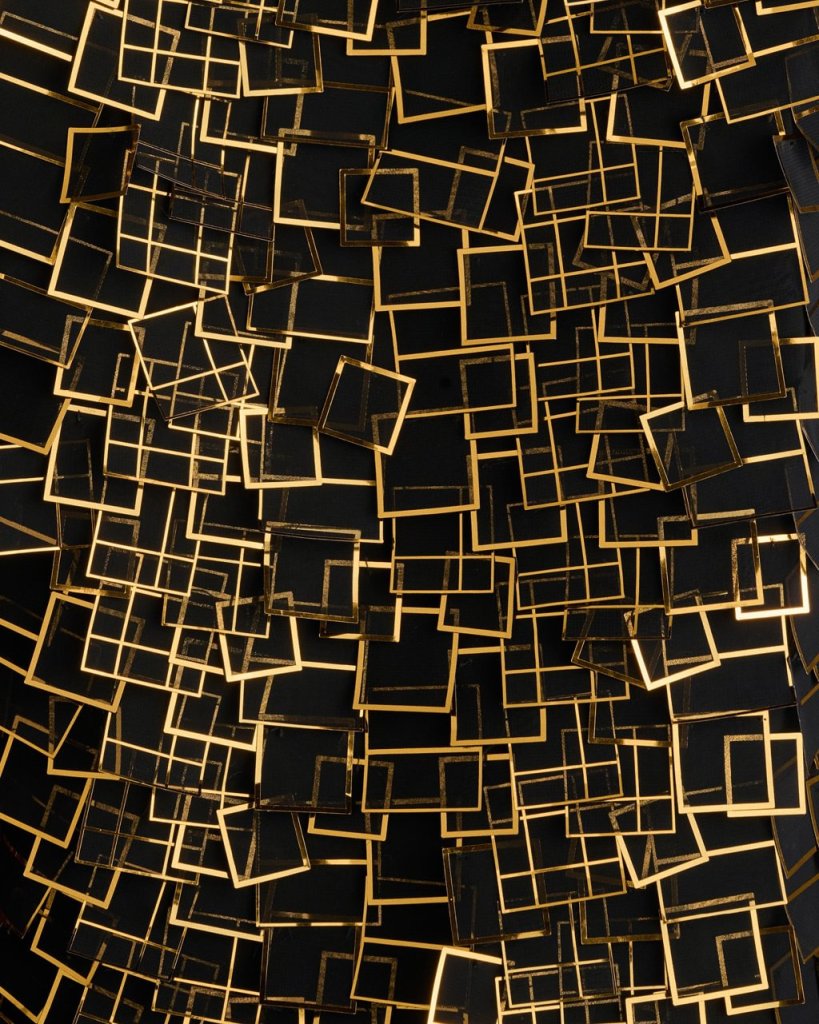
In the autumn/winter 2026 collection of Swiss fashion house Akris, a coat of shimmering gold jacquard appeared on the runway in Paris. Its surface was irregular, almost geological, catching the light like a fragment of gilded rock. Beneath it, a black dress constructed from overlapping organza rectangles suggested an intricate mosaic.
The clothes were the result of a collaboration between Akris creative director Albert Kriemler and Olga de Amaral, the Colombian artist whose woven constructions have fundamentally expanded the possibilities of textile art.
It was a meeting of practices with an unusually direct connection. De Amaral works with wool, linen, horsehair, gesso and gold leaf, transforming woven structures into objects that resist conventional definitions of painting or sculpture. Kriemler approaches fashion through the physical qualities of fabrics, allowing their weight, movement and texture to determine the construction of a garment.
The collaboration concerned considerably more than transferring an artist’s imagery onto clothing. It examined the methods by which textiles acquire form, structure and expressive power.
The Architecture of Weaving
Born in Bogotá in 1932, de Amaral initially studied architecture at the Colegio Mayor de Cundinamarca before travelling to the United States to study at the Cranbrook Academy of Art in Michigan in 1954.
There she encountered the legacy of the Bauhaus through Finnish-American textile designer Marianne Strengell, whose teaching emphasised material experimentation, structure and the expressive possibilities of the woven grid.
Returning to Colombia in 1955, de Amaral began developing a practice that combined modernist abstraction with the textile traditions, landscapes and material histories of her native country. In 1965, she founded and directed the textile department at Bogotá’s Universidad de los Andes.
Alongside artists such as Sheila Hicks and Magdalena Abakanowicz, she became an important figure in the international fibre-art movement of the 1960s and 1970s.
At a time when weaving was frequently classified as decorative craft rather than fine art, these artists challenged the distinction by creating works whose scale, complexity and physical presence demanded a different critical vocabulary.
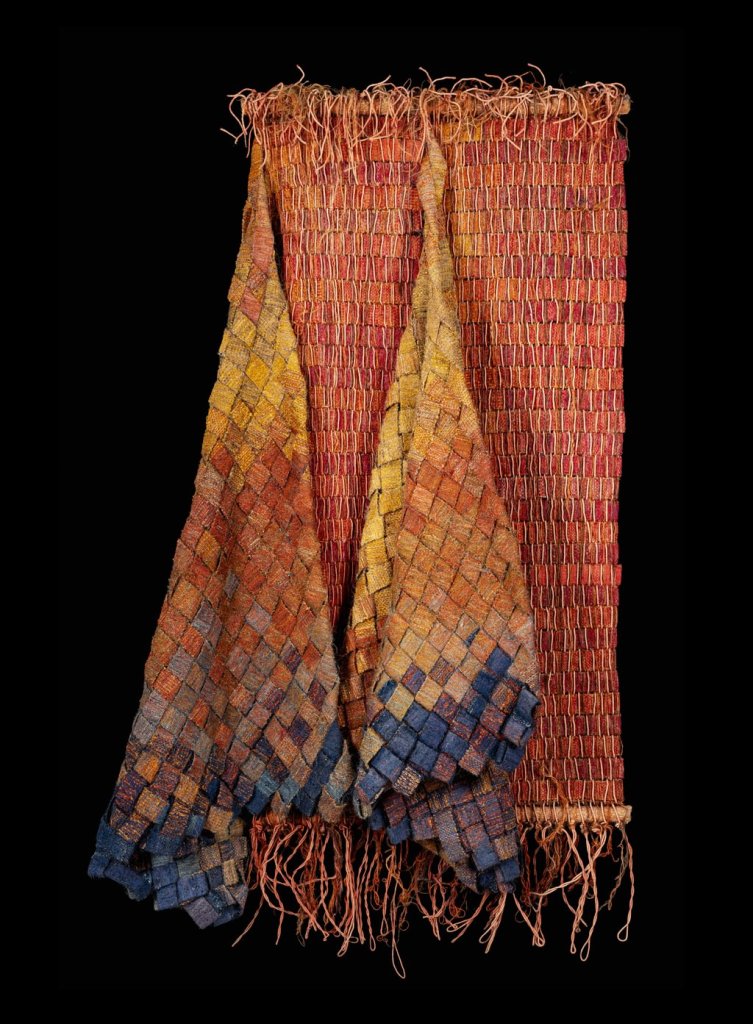
De Amaral’s monumental wall pieces incorporated dense layers of wool and horsehair, suggesting geological formations, architectural surfaces and the changing colours of the Colombian landscape.
By abandoning the conventional flat tapestry, she gave textiles the autonomy of sculptural objects.
The Discovery of Gold
Gold became central to de Amaral’s work during the 1970s, partly through her encounter with the British ceramicist Lucie Rie and the Japanese technique of kintsugi, in which fractured pottery is repaired using lacquer and powdered precious metal.
In Colombia, gold also carries an extensive cultural history, associated with pre-Hispanic craftsmanship, spiritual practices and the country’s complex colonial past.
De Amaral’s achievement was to transform these associations into a distinctive material language without reproducing historical objects.
In her Alquimia series, begun in the early 1980s, individually woven elements are assembled into geometric compositions before being coated with gesso, paint and metallic leaf.
The underlying textile becomes almost unrecognisable. What emerges resembles a wall of precious metal, its surface fragmented into hundreds of irregular components.
The Estelas series, initiated in 1996, develops this investigation into suspended, gilded structures. Their thick surfaces appear simultaneously ancient and unexpectedly weightless, shifting in colour as light moves across them.
De Amaral uses gold not simply for its brilliance or material value, but for its ability to dissolve the apparent solidity of the object. The woven structure becomes an instrument for reflecting and transforming light.
These works occupied a central position in her major Fondation Cartier retrospective, presented in Paris from October 2024 to March 2025.
Designed by architect Lina Ghotmeh, the exhibition brought together approximately eighty works from across six decades. The suspended textiles occupied a carefully composed environment in which visitors could experience them as something between painting, architecture and landscape.
It was here that Albert Kriemler’s longstanding interest in the artist developed into a collaboration.
Akris: A Shared Language of Materials
The history of Akris begins in St Gallen, Switzerland, where Alice Kriemler-Schoch established an embroidery atelier in 1922. The business grew into an international fashion house, retaining an unusually strong connection to the textile expertise of its region.
Under her grandson Albert Kriemler, Akris has become associated with precise construction, sophisticated materials and a restrained approach to luxury.
Art has long informed his collections, with previous collaborations involving artists including Thomas Ruff, Ugo Rondinone and Geta Brătescu. De Amaral, however, presented a different proposition: an artist whose primary medium was already fabric.
Kriemler had admired her work for nearly a decade before visiting her Bogotá studio after the Fondation Cartier exhibition.
There he encountered not only the artist’s remarkable woven constructions but also the collaborative working environment behind them.
De Amaral has worked for decades with a small team of seven assistants, describing their collective contribution through the affectionate expression fourteen hands.
Kriemler recognised a parallel with the longstanding pattern-makers, tailors and textile specialists who form the foundation of his own atelier.
The relationship between artist and designer was therefore grounded in something more substantial than visual admiration. Both understood craftsmanship as a cumulative form of knowledge, developed through repetition, experimentation and sustained collaboration.
From Woven Sculpture to the Runway
The Akris autumn/winter 2026 collection translated several of de Amaral’s distinctive techniques into clothing.
The opening cocoon coat, constructed in fragmented gold jacquard, recalled the irregular surfaces of her Estelas. An accompanying dress of layered organza tiles referred to the geometric structures of Alquimia.
Elsewhere, the artist’s knotted Nudo sculptures inspired long fringes that descended from dresses, skirts and accessories. The fringes introduced movement into otherwise disciplined silhouettes, creating a relationship between body and material that changed as the wearer walked.
For a gold-and-black cape coat, Akris developed a textured brocade incorporating foil tape, producing a fractured metallic surface closer to the complexity of de Amaral’s woven structures than to conventional decorative gold fabric.
The collection also employed a palette of vivid red, magenta, turquoise and green, recognising that de Amaral’s artistic practice extends far beyond the gilded works for which she is best known.
Particularly significant was the contribution of Jakob Schlaepfer, the renowned St Gallen textile manufacturer, which developed specialised sequin fringes for the collection.
The presentation at Paris’s Palais de Tokyo reinforced the relationship between the two practices. A monumental golden curtain provided the runway backdrop, its suspended strands recalling the shifting surfaces of de Amaral’s installations.
Yet the difference between the artistic object and the garment remained essential. A sculpture can occupy space independently; clothing must negotiate the proportions, movement and needs of the human body.
Kriemler’s interpretation was strongest where he recognised that distinction, translating the artist’s treatment of material rather than simply reproducing her compositions.
When Fashion Encounters Art
De Amaral’s collaboration with Akris belongs to a wider reconsideration of the relationship between textiles and the traditional hierarchy of artistic media.
For much of the twentieth century, fibre art was marginalised within museum collections, frequently associated with domestic labour and feminine craftsmanship rather than the established disciplines of painting and sculpture.
De Amaral helped challenge that hierarchy by making work whose scale and material sophistication could not be confined to conventional categories.
Her exhibitions at the Museum of Fine Arts, Houston, the Fondation Cartier and the Institute of Contemporary Art, Miami have contributed to a broader recognition of her importance within postwar abstraction.
Akris’s collaboration offers another perspective on that achievement. It places the technical intelligence of weaving at the centre of fashion, a discipline in which textile innovation is fundamental but the contribution of skilled makers is not always visible.
The result is an unusually coherent meeting between contemporary art and clothing design.
For de Amaral, weaving has always been a means of investigating space, light and the relationship between material and perception. For Kriemler, fabric becomes meaningful through its physical encounter with the body.
Their collaboration reveals how closely these concerns can intersect, and how much artistic possibility remains within the ancient practice of working with thread.

