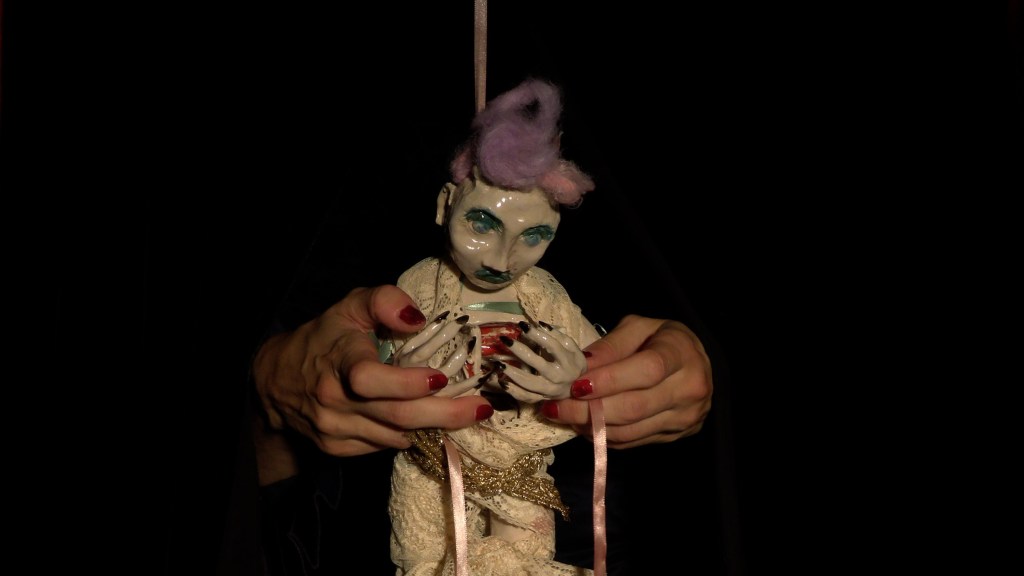
The Swedish artist brings ceramic sculpture, puppetry and operatic satire together in La Pupa del Diavolo, her new solo exhibition at Copenhagen’s O—Overgaden. Behind the extravagant characters lies a sustained interest in motherhood, social authority and the peculiar business of being human.
A thief in Ellinor Åslund’s new puppet theatre makes a discovery about the art market: “Little did I know, artworks have no value if someone has not said so.”
It is an observation that might have come from an art critic, a disgruntled collector or someone standing bewildered at an auction. Instead, it belongs to one of the ceramic marionettes inhabiting La Pupa del Diavolo, Åslund’s new exhibition at O—Overgaden in Copenhagen.
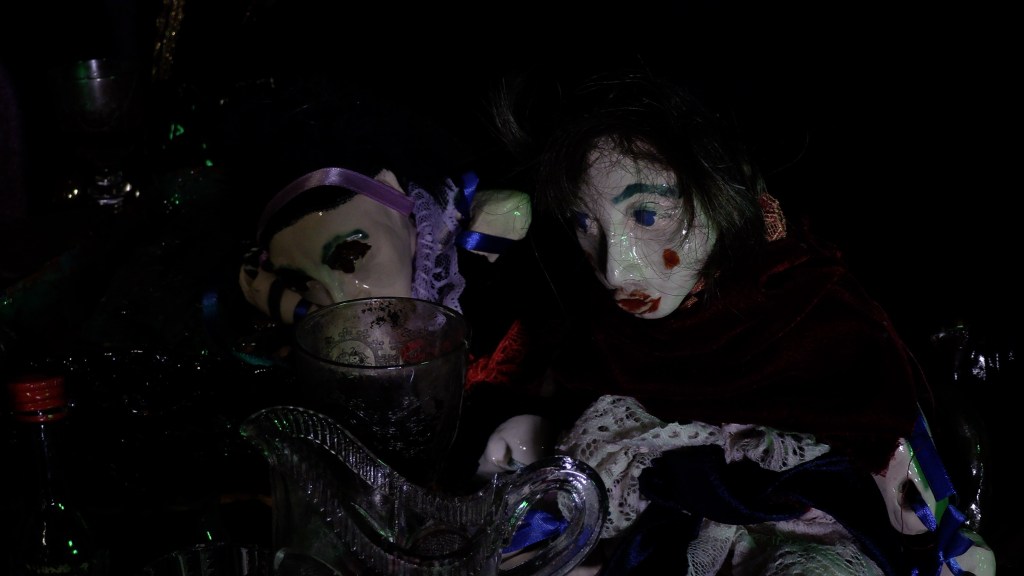
The thief shares the stage with a devil, a mask seller, an opera singer who doubles as a fishmonger, a bartender, angels and a crow whose revolutionary ambitions have apparently come to nothing. Their world is assembled from elaborate costumes, glazed ceramics, theatrical scenery and original music. Characters interrupt and comment upon one another, sometimes observing the proceedings from a balcony.
The exhibition brings together several strands of an artistic practice that has developed through increasingly ambitious combinations of sculpture, film and performance.
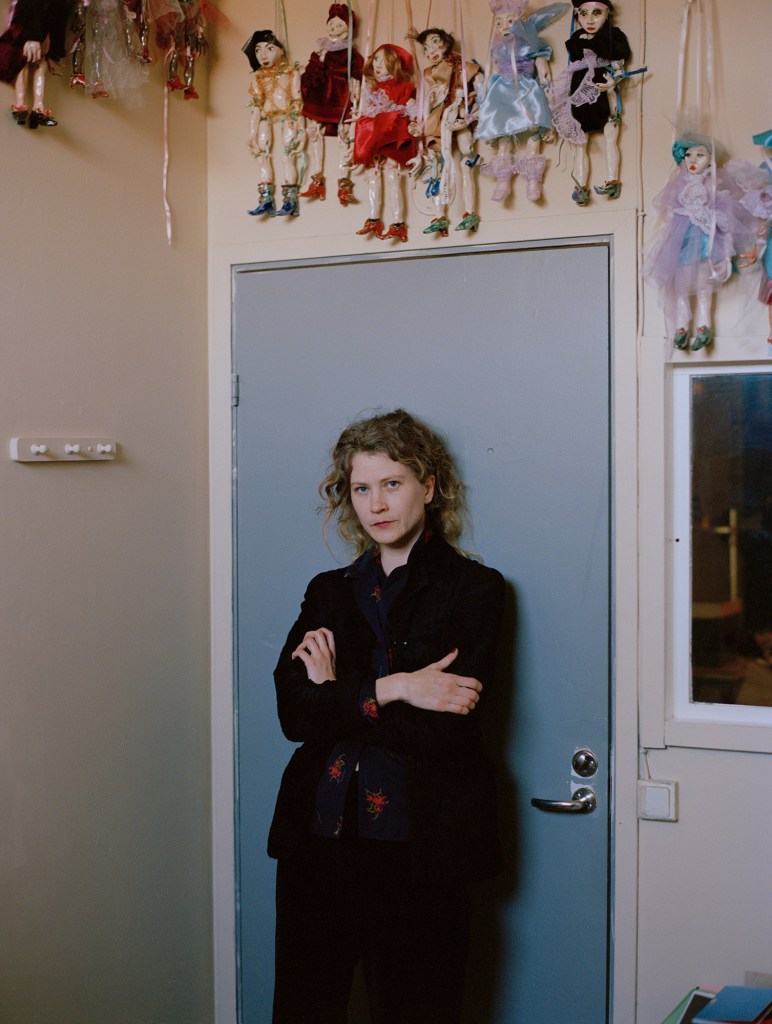
Born in Sweden in 1991 and now based in Malmö, Åslund studied aesthetics at Uppsala University before completing her MFA at the Royal Danish Academy of Fine Arts in 2025. She works as an artist, writer and musician, often assuming responsibility for virtually every element of her productions, from modelling the puppets to composing and performing their songs.
Her choice of ceramics is significant. These figures possess the physical weight and permanence of sculpture while remaining dependent upon manipulation for movement. Their glazed bodies can be extravagantly decorated, yet remain vulnerable to breakage. Åslund exploits these properties, particularly when addressing the human body and the limits placed upon individual autonomy.
An earlier work, Occupation of the Home for Pregnant Minors 1972, offers a revealing example.
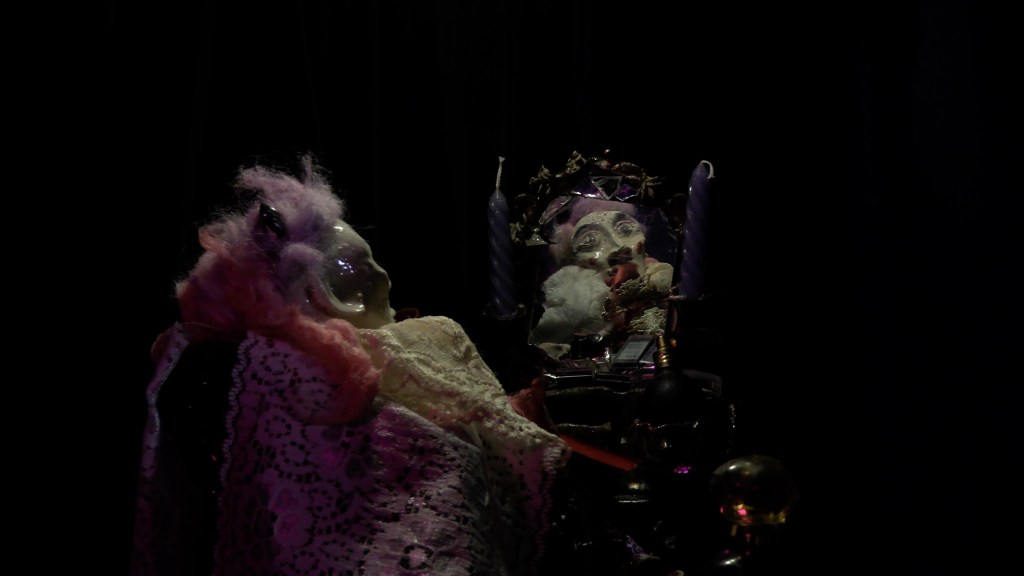
Created in 2024 for an exhibition marking a century of women’s equal access to education at the Royal Danish Academy of Fine Arts, the installation reconstructs an episode from the French women’s liberation movement.
Åslund encountered the story in the memoirs of feminist activist Claudine Monteil. In 1972, members of the Mouvement de Libération des Femmes, including Simone de Beauvoir, helped young pregnant women protest the conditions inside an institution at Plessis-Robinson outside Paris. The activists occupied the building, while the residents were given an opportunity to describe their circumstances through radio interviews.
Åslund recreated the event using small ceramic figures arranged on a podium, accompanied by fabric and a video showing intimate details of domestic and bodily life.
The historical reference is carefully chosen. In 1975, the landmark Kvindeudstillingen XX at Charlottenborg in Copenhagen had brought feminist concerns directly into an artistic institution. Åslund wanted to contribute an imagined work to that earlier exhibition, concentrating upon reproductive rights and the circumstances that determine whether women can participate freely in society.
Her miniature reconstruction also raises a question about which events receive artistic commemoration. Historical sculpture has traditionally celebrated rulers, military triumphs and mythological heroes. Åslund gives comparable attention to a group of young women asserting control over their own futures.
The domestic associations of ceramics make the choice of material particularly apt. A medium frequently connected with ornament and household objects becomes the vehicle for recording political action.
Motherhood and the Puppet Body
The relationship between bodily experience and social control became more pronounced in Åslund’s 2025 work Die Ewige Suppe.
This 73-minute puppet opera unfolds inside a bar, where a ceramic figure modelled upon the artist recounts episodes involving pregnancy, childbirth and early motherhood. Nurses, fairy-tale characters, ghosts from the Thirty Years’ War and nationalist booksellers enter the story. In one particularly grotesque sequence, human organs are cooked into a stew.
The imagery is outrageous, frequently funny and occasionally disturbing. Yet its construction is remarkably meticulous. Åslund made the puppets, developed their costumes and surroundings, wrote the music and performed the characters.
The material itself becomes part of the work’s account of childbirth. Ceramic bodies are solid, inflexible and sometimes awkward to manipulate. Their physical limitations acquire particular force when the subject is a body undergoing profound and often uncontrollable changes.
Åslund’s use of handmade puppets to explore motherhood recalls Jørgen Vestergaard’s 1977 Danish stop-motion film Historien om en moder (The Story of a Mother), which My World of Interiors examined in an earlier essay.
Adapted from Hans Christian Andersen’s 1847 tale, Vestergaard’s film follows a mother whose desperate search for her child requires successive acts of physical sacrifice. Åslund’s work concerns childbirth and the institutional and emotional demands surrounding motherhood rather than bereavement. Nevertheless, both exploit a distinctive quality of puppetry: an obviously manufactured body can become a remarkably effective means of representing experiences that are intensely physical.
The comparison is particularly interesting because the emotional power of these figures depends partly upon their artificiality. Their expressions are fixed, their movements restricted. Much of what they communicate takes place through gesture, rhythm, staging and the viewer’s interpretation.
Die Ewige Suppe attracted considerable attention in Denmark, including reviews in Weekendavisen, Politiken and Kunstkritikk. It also received the Poul Erik Bech Foundation Art Prize in 2025.
That same year, Åslund presented Evighedsgryden at Four Boxes Gallery in Skive, bringing together the puppet opera with earlier ceramic works and material relating to another substantial project, The Mechanical Theatre.
Commissioned by Public Art Agency Sweden and Akademiska Hus for a university campus in Lund, The Mechanical Theatre occupied three locations. Its subjects included Enlightenment thinking, the organisation of society and the relationship between rational systems and individual freedom.
One part consisted of a richly ornamented ceramic theatre. Another featured a human-sized puppet confined within a cage. The combination of elaborate craftsmanship and physical restraint made visible the difficulty of acting independently within systems that prescribe acceptable forms of behaviour.
Venice, Masks and the Theatre of Reputation
For La Pupa del Diavolo, Åslund returns to theatrical traditions with a long history of mocking social pretension.
The new production draws upon Venetian masking and commedia dell’arte, the improvised Italian theatre that became popular across Europe from the sixteenth century onwards. Its recognisable character types included scheming servants, foolish masters and pompous professionals, often revealing the ridiculous assumptions upon which social authority depended.
There is an additional art-historical connection worth noting. During the eighteenth century, characters from commedia dell’arte became popular subjects for European porcelain manufacturers. The Metropolitan Museum of Art preserves examples including Franz Anton Bustelli’s Harlequina, made at Nymphenburg around the middle of the century.
Åslund’s ceramic actors belong to a very different artistic context, but the historical connection between theatrical caricature and ornamental sculpture gives her work an intriguing precedent. She animates the decorative figure, allowing it to acquire a voice, a grievance and occasionally an opinion about its own social position.
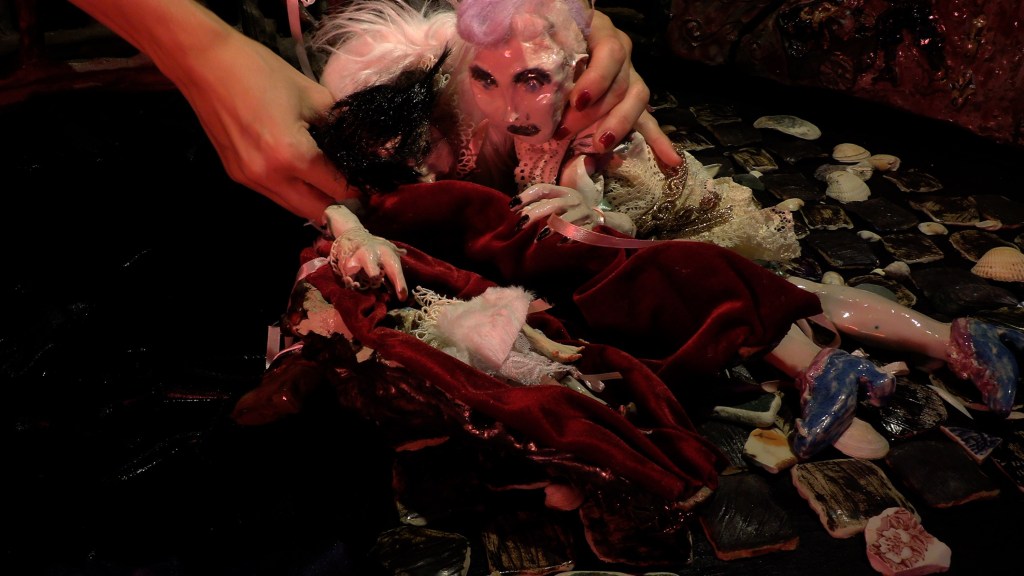
The exhibition’s theatre resembles an extravagant Venetian stage, with architectural references to the canals of Copenhagen’s Christianshavn. Its various characters appear within overlapping narratives, while others comment upon their behaviour from the balcony.
The installation extends beyond the central stage. Individual marionettes are displayed under spotlights, while filmed interviews allow the puppet characters to discuss their roles. A six-screen musical film lasting approximately ninety minutes develops the production further. Live performances are also scheduled during the exhibition.
The use of commentary recalls the theatrical strategies of Bertolt Brecht, whose work frequently encouraged audiences to examine the social assumptions behind apparently familiar behaviour. Åslund’s approach is less austere. Her puppets inhabit a theatrical environment crowded with ornament, music, absurd incidents and personal preoccupations.
This excess is an important part of her work. The labour invested in the figures and their surroundings makes the viewer conscious of the elaborate machinery required to produce even a miniature society.
The thief’s remark about artistic value introduces a further complication. La Pupa del Diavolo is Åslund’s first major institutional solo exhibition, presented at the conclusion of her participation in O—Overgaden’s year-long INTRO programme for emerging artists.
The artist is therefore exhibiting within the very system of cultural recognition that one of her characters finds so perplexing. It is a productive irony, particularly given her interest in the conventions through which people establish authority and confer importance upon one another.
Åslund has developed a form of theatrical sculpture in which the puppet’s dependence upon its maker is always apparent. The figures may quarrel over status, discuss artistic value or question the rules governing their existence, but their movements remain determined by someone outside their world.
In La Pupa del Diavolo, the characters acquire the opportunity to comment upon the performance in which they have been placed. Whether they understand its rules any better than the audience is another matter.
Exhibition Information
Ellinor Åslund: La Pupa del Diavolo
21 November 2026 – 31 January 2027
O—Overgaden, Institute of Contemporary Art
Overgaden neden Vandet 17
1414 Copenhagen, Denmark
Admission is free.
Live performances: 17 December 2026, 14 January and 23 January 2027.
View the exhibition at O—Overgaden
Visit O—Overgaden’s official website
Ellinor Åslund — Artist’s Website
Cover image and all other images: Ellinor Åslund, 2026 – courtesy of O-Overgaden

