How the Hudson Valley Textile Project is rebuilding a regional wool industry — and reconsidering the value of what we wear.
By Birgitte Enevoldsen / My World of Interiors
A small sheep farm in the northeastern United States can produce several hundred pounds of usable wool and still struggle to find anyone willing to process it. Commercial washing facilities require quantities far beyond what many individual farms produce, and naturally coloured fleece can be particularly difficult to place. Without access to suitable processing, wool that could become yarn, clothing or household textiles may have little commercial value.
For Mary Jeanne Packer, co-founder and executive director of the Hudson Valley Textile Project, this problem illustrates the difficulties facing regional textile production. Farmers, processors and manufacturers exist, but finding one another and working together has become increasingly complicated. Rebuilding those connections has been the organisation’s work since 2017.
Packer founded Battenkill Fibers, a carding and spinning mill in Greenwich, New York, in 2009. The idea for the Hudson Valley Textile Project emerged through her collaboration with Gail Parrinello, owner of the Cornwall Yarn Shop. Parrinello’s customers wanted yarn made from locally sourced wool, and Packer began producing it for her shop. Their conversations revealed how difficult it had become to connect the people producing raw materials with those who wanted to use them.
“Farmers didn’t know where to get their wool processed. Mills didn’t know how to reach the makers and brands who were looking for local materials. Everyone was working hard, but they weren’t connected to each other,” Packer tells My World of Interiors.
Together with a small group of collaborators, they established a network whose priorities included finding new uses for regional fibres, educating consumers and addressing gaps in the supply chain. Nearly a decade later, HVTP has developed its own fibre-processing and purchasing operations, creating practical solutions to problems that individual farmers and small businesses cannot easily resolve alone.
Its work offers an instructive example of sustainability at a time when clothing has become extraordinarily easy to acquire, replace and discard.
From Farm to Finished Garment
The first obstacle was washing the wool.
Known as scouring, the process removes grease, dirt and other impurities from raw fleece before it can be processed into yarn or other textile materials. Individual farms may be able to wash 50 or 100 pounds themselves, but larger quantities require specialist equipment.
Packer explains that the nearest commercial scouring facilities available to farmers in her region were in Texas and South Carolina. They generally required batches of at least 1,000 pounds and typically accepted only white wool.
For farmers with smaller quantities, particularly those raising sheep with naturally coloured fleeces, the economics rarely worked.
HVTP responded by establishing Clean Fleece NY, a scouring facility in Mechanicville, New York, which began operating in late 2023. It provides the washing and preparation services needed by regional farms and fibre businesses.
Demand has already outstripped capacity. Packer says the facility has accumulated a significant backlog, and the organisation is working with partners, including the New York Fashion Innovation Center, to secure funding for a larger regional operation.
Another initiative, the Northeast Fiber Exchange, tackles the problem of scale from a different direction. It gathers wool from individual farms, assesses its quality and combines smaller quantities into consistent batches that manufacturers can use.
A current pilot involves 1,100 pounds of medium-grade white wool collected from farms across the Northeast, principally New York State. Once cleaned, the wool is intended for uses including pillow filling, craft materials and needle-felted household products.
This last detail is important. Wool comes in many grades, and the characteristics that make a fleece unsuitable for fine knitwear may make it appropriate for rugs, upholstery, insulation or other applications. Finding the right use can give otherwise difficult-to-sell material a commercial future.
The organisation’s Local Sweater for Good provides a particularly clear account of how a functioning regional supply chain can operate.
Its wool comes from Crooked Creek Sheep and Wool in New York’s Finger Lakes region, while alpaca fibre is supplied by Woodland Meadow Farm near Saratoga Springs. The fibres are cleaned at Clean Fleece NY, then carded and spun into yarn at Battenkill Fibers. Finally, the sweater is knitted by Muriel’s of Vermont in North Hero.
The finished garment is a soft, undyed, mocha-coloured blend of wool and alpaca. Its colour comes from the fibres themselves, eliminating the need for a separate dyeing process.
Muriel’s combines computer-programmed knitting technology with hand finishing. Its whole-garment machines produce shaped knitwear with very little cutting waste, and the company offers repairs to customers whose sweaters have become damaged through wear. Responsible manufacturing, in this instance, includes both modern technology and the expectation that a garment should remain useful for years.
HVTP has documented the sweater’s production in a Farm to Fashion illustration, developed with the Empire Sheep Producers Association. It identifies the farms, processors and manufacturers involved, making visible the work that usually disappears behind a clothing label.
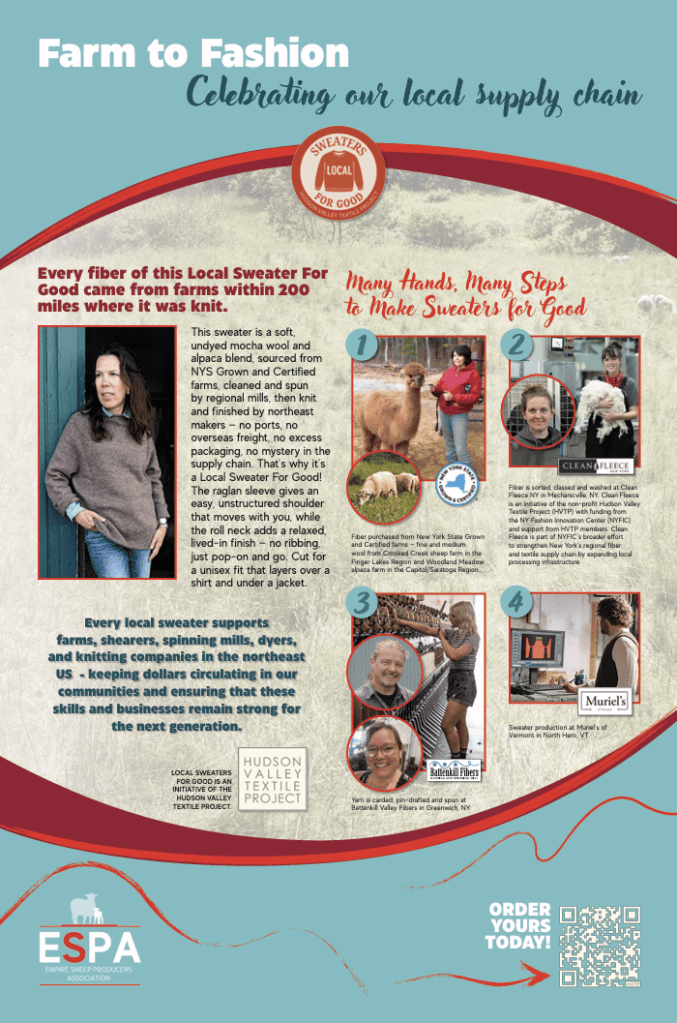
Farm to Fashion: The journey of the Local Sweater for Good, from regional farms to the finished garment. Courtesy of Hudson Valley Textile Project and Empire Sheep Producers Association.
For Packer, this transparency is essential. She compares the growing interest in textile provenance with the farm-to-table movement, which encouraged consumers to ask where their food originated and how it was produced.
“Brands and shoppers want to know where a garment came from and who had a hand in making it,” she explains.
Knowing the origins of a sweater does not automatically make it environmentally preferable to another garment. It does, however, allow consumers to understand its production and the businesses involved.
It also makes the price more intelligible. A regional sweater must support several specialised enterprises operating on a much smaller scale than the factories supplying international fashion chains. Washing, spinning and knitting require equipment, energy and skilled labour, regardless of how many garments are produced.
How Much Clothing Do We Need?
The wider context is a fashion industry whose production has expanded dramatically during the past generation.
According to the Ellen MacArthur Foundation, global clothing production approximately doubled between 2000 and 2015, while the average number of times a garment was worn before being discarded declined by more than a third.
The environmental consequences are substantial. The United States Environmental Protection Agency estimated that Americans generated 17 million US tons of textile waste in 2018, including clothing and other textiles. Of that amount, approximately 11.3 million tons went to landfill.
These are the latest figures in the EPA’s published historical series, but they give an indication of the quantities involved.
The situation is hardly confined to America. The European Environment Agency estimates that EU citizens consumed an average of 19 kilograms of clothing, footwear and household textiles per person in 2022, compared with 17 kilograms in 2019. The supply chains supporting that consumption generated an estimated 355 kilograms of carbon dioxide equivalent per person.
These figures invite consideration of how much clothing we actually require and how our expectations have changed.
Earlier generations generally maintained smaller wardrobes. Clothes were altered, repaired, handed down and sometimes remade because fabric and finished garments represented a significant investment. A worn adult garment might be adapted for a child, while damaged knitwear could be unravelled and its yarn reused.
The Victoria and Albert Museum’s collection of 1940s knitting patterns provides a revealing example. During the Second World War, when wool was rationed in Britain, households were encouraged to unravel old sweaters and knit the yarn into new garments.
Such practices were rarely motivated by environmental concerns. They arose from scarcity and necessity, and the work of repairing and remaking clothing fell disproportionately on women. The past should not be romanticised as an age of enlightened consumption.
Nevertheless, the expectation that clothing should be maintained rather than casually replaced deserves reconsideration.
Today, garments are frequently discarded because they have fallen out of fashion or developed minor damage. The availability of inexpensive replacements can make repair seem disproportionately troublesome, even when the garment itself has years of potential use remaining.
Quality complicates matters further.
A 2025 study published in Cleaner and Responsible Consumption examined the physical durability of commercially available T-shirts and jeans. Its researchers found that retail price could not reliably predict how well garments would perform.
A high price may reflect design, branding or other commercial considerations without guaranteeing superior construction. Conversely, inexpensive clothing is not necessarily poorly made. What matters is the performance of the fabric, its construction and the care it receives.
The environmental implications of longevity are considerable.
A 2021 life-cycle assessment published in The International Journal of Life Cycle Assessment examined the environmental effects of different use and care practices for a merino wool sweater. Increasing its lifetime from 109 to 400 wears reduced the modelled environmental impact per wear by roughly 60 per cent across several categories, with reductions varying according to the measure examined.
The study assessed a particular garment under specified conditions, so its findings cannot simply be applied to every type of clothing. Nevertheless, they demonstrate the importance of how long something remains in active use.
Repairing, altering and buying second-hand can all help extend the useful life of existing garments. Upcycling, in which discarded clothing or textiles are transformed into new products, can give materials another purpose without requiring an entirely new supply of fibres.
A 2022 life-cycle assessment published in Sustainability found that a recycled wool-blend sweater had lower environmental impacts than the virgin-wool comparison under the conditions studied.
But recycling and second-hand shopping are only part of the answer. Their environmental benefits diminish if they simply encourage further accumulation.
We have become accustomed to regarding clothing as something that must be constantly renewed. Fashion changes, retailers introduce new collections and perfectly serviceable garments begin to feel outdated.
A more useful understanding of sustainability begins with the possibility that we already own enough.
What Local Production Can Change
There is an obvious appeal in buying a sweater made from wool grown, processed and knitted within a relatively small geographical area.
Shorter supply chains can reduce some transport requirements and make it easier to identify producers. They can also support rural businesses that might otherwise struggle to survive.
Yet locality alone is not proof of a smaller environmental footprint.
Transporting raw materials and finished clothing around the world consumes fuel and generates emissions, particularly when goods are shipped by air. Nevertheless, transport accounts for a relatively modest proportion of the fashion industry’s overall greenhouse gas emissions compared with material production and textile processing.
A 2020 assessment by Global Fashion Agenda and McKinsey identified the production and processing of materials as major sources of emissions throughout the fashion supply chain.
Wool itself has environmental costs. Sheep produce methane, while land use, agricultural management and processing all affect the impact of the finished material. Synthetic fibres present different problems, including dependence on fossil-based raw materials and the release of microplastics.
A reliable comparison between local wool and imported textiles would therefore require life-cycle assessments of the particular products involved.
What HVTP demonstrates is a more transparent form of production, with identifiable suppliers and a regional infrastructure designed to make use of locally available fibre.
The Northeast Fiber Exchange establishes quality specifications for the wool it purchases and requires participating farms to acknowledge animal-welfare conditions. These are useful steps towards responsible sourcing, although the environmental and welfare performance of individual farms must ultimately be assessed through their actual practices.
The organisation’s greatest achievement may be its recognition that responsible consumption depends on systems of production that individual shoppers have little power to create.
Farmers cannot sell regional wool if there are no facilities to process it. Designers cannot use materials they cannot source in suitable quantities. Manufacturers cannot remain viable without customers willing to pay for their work.
HVTP has begun addressing those problems directly.
A Growing Interest in Something Different
Packer’s account of changing attitudes offers considerable grounds for encouragement.
She has attended the New York Sheep & Wool Festival in Rhinebeck for twenty-five years and exhibited there for fifteen. When she first began visiting, she recalls approximately 5,000 to 6,000 visitors over the weekend. At the October 2026 event, she estimates that attendance exceeded 40,000.
Her own sales at the festival, she says, have increased tenfold over fifteen years.
She has witnessed a corresponding change among professional designers.
“Designers never used to call the mill. Now we hear from someone at least once a week with a product idea or a search for local materials.”
Farms that once sold their wool to large yarn companies have developed their own branded products. Independent yarn dyers increasingly seek locally sourced and regionally processed materials, responding to customers who want greater knowledge of a fibre’s origins.
These observations describe Packer’s experience of a growing specialist market. They do not establish a comparable change across the American fashion industry as a whole, but they suggest that regional producers are finding customers interested in alternatives to conventional manufacturing.
One of HVTP’s members is Isabella Rossellini, whose Mama Farm + Friends Wool Lab in Bellport, Long Island, now provides a retail outlet for regional makers.
The relationship began when wool from Rossellini’s farm was sent to Battenkill Fibers for processing. She later became involved in HVTP’s events, including its 2025 annual summit, where she met small New York textile brands and makers. They explained that finding retail outlets for their finished products was their second-biggest difficulty, after the shortage of wool-scouring facilities.
Rossellini was already considering opening a shop in Bellport. Through HVTP, she connected with many of the makers whose work is now sold at the Wool Lab. During the 2026 holiday season, the shop is also carrying HVTP’s Local Sweater for Good.
She is realistic about the economic possibilities.
“I don’t think locally produced wool will ever compete commercially with mass-produced textiles, and I don’t think it needs to. The future of Northeastern wool is in smaller-scale production.”
Her comparison is with maple syrup, a regional product capable of supporting a specialised industry because consumers value its origins and particular qualities.
The same principle can apply to wool, whether used for clothing, blankets, rugs or household furnishings.
Packer also sees important benefits beyond the sale of individual products.
When farms and mills remain economically viable, they support surrounding businesses. Agricultural equipment dealers, feed suppliers and machinery repair shops depend on working farms and manufacturing enterprises. Their employees, in turn, support the everyday services on which small communities rely.
“Regional wool production matters for the same reasons all regional agriculture matters,” she explains.
The economic effects of a functioning textile industry consequently reach further than the people directly involved in raising sheep or making clothes.
None of this means that everyone can afford locally manufactured knitwear, or that small regional producers could realistically replace the volume of clothing supplied by global manufacturers. Environmental responsibility cannot rest entirely on individual purchasing decisions, particularly when consumers have very different financial circumstances.
Yet there is considerable value in demonstrating that another form of production is possible.
For those who need a new garment, initiatives such as HVTP offer greater knowledge of where materials originate and the work involved in manufacturing them. For everyone else, extending the life of existing clothing remains a practical way to reduce unnecessary consumption.
Packer and her colleagues are building an industry around a material that regional farmers have often struggled to sell. Clean Fleece NY has provided a service that was missing, the Northeast Fiber Exchange is developing a market for smaller quantities of wool, and a growing number of designers are approaching the mill in search of local materials.
The immediate challenge is now one of capacity. There is more wool waiting to be processed than Clean Fleece NY can currently handle, and HVTP is seeking the investment needed to expand.
It is an encouraging problem for an organisation founded because farmers and textile makers were struggling to find one another.
Cover image: The shortening winter’s day is near a close, Joseph Farquharson

