The city that travel writing has chronically miseaten — and where to go instead
The received wisdom about food in Venice is that it is disappointing — that the restaurants are tourist traps, that the quality is poor relative to the price, that the city’s geography makes it impossible for ingredients to arrive fresh and therefore impossible for kitchens to produce anything worth eating. This received wisdom is, like most received wisdom about Venice, a description of a particular way of being there that has very little to do with the city as it actually exists. Venice has some of the finest seafood restaurants in Italy. It has a street-food culture — the bacaro and the cicchetti — that is as good as anything in the country and better than most. It has a farmers’ market at the Rialto that has been operating on the same site since the 11th century and that continues to supply some of the most extraordinary produce in the region.
What Venice also has, in quantities that overwhelm the good restaurants, is millions of tourists per year passing through a city of 50,000 residents, creating an economic environment in which the easiest thing to do is to point a laminated menu at the Piazza San Marco and collect money from people who are going to leave tomorrow. The restaurants that exploit this situation are not hard to find. The restaurants that do not are also not hard to find, but they require a different approach: a willingness to walk past the canal-side tablecloths and the menus with photographs and the touts in the doorways, and to find the places where nobody is employed to explain what is on offer because the people who go there already know.
This is not a guide to Venice. It is a guide to eating in Venice, which is a different thing and requires a different set of instructions.
First: understand the city’s food
Venice sits in the middle of a lagoon, and the lagoon is the foundation of the city’s cuisine. The seafood of the Venetian lagoon — the soft-shell crabs (*moeche*), the spider crabs (*granceola*), the razor clams (*caparossoli*), the grey shrimps (*schie*) that are so small they are eaten whole on polenta, the cuttlefish whose ink turns the risotto the colour of deep water — is not the seafood of the open Mediterranean or the Atlantic. It is specific, seasonal, and extraordinary, and it is available in no other city in the world because no other city has this lagoon.
Beyond the lagoon, the agricultural island of Sant’Erasmo — the Venetians call it the garden of Venice — produces vegetables of unusual quality: artichokes, in particular, of a type that grows nowhere else, harvested in spring and treated with the reverence that the Venetians historically reserve for things they have been eating for centuries. The Rialto market, supplied by Sant’Erasmo and by the mainland farms of the Veneto, is one of the great food markets in Italy, operating every weekday morning under the same loggia that has housed it for a thousand years, and it is from this market that the best Venetian restaurants source their menus each day.
This is important context because it means that Venetian cuisine, when it is taken seriously, is seasonal in the most direct sense: the menu changes because the lagoon and the market change, and the correct question to ask in any serious Venetian restaurant is not what is on the menu but what arrived this morning.
How to eat: the bacaro crawl
The bacaro is Venice’s most important cultural institution after the Basilica and the gondola, and it operates on a completely different logic from both of those. A small, low-lit bar — often barely more than a counter and a few bottles — the bacaro serves cicchetti (pronounced chee-KET-ee) at prices that make London and Paris feel like a hallucination, accompanied by an *ombra* — a small glass of wine, the word meaning “shadow,” a reference to the practice of following the shade of the Campanile campanile to the nearest bar as the day heated up.
Cicchetti are not tapas, though the comparison is often made. They are the accumulated Venetian answer to the question of what to eat standing up with a glass of wine between lunch and dinner — small rounds of bread with baccalà mantecato (the creamy salt-cod spread that is the most essential single thing to eat in Venice), with sardines in saor (the sweet-sour preparation of fried sardines with onions, raisins, and vinegar that has been Venetian for centuries), with polpette (small fried meatballs), with the day’s catch of the lagoon in whatever form the kitchen has decided on. In a good bacaro on a good day, the counter is so loaded with cicchetti that the correct approach is to point at several and let the day develop from there.
All’Arco, in the San Polo sestiere a short walk from the Rialto market, is the bacaro that serious eaters cite first. Run by father and son, supplied directly from the market next door, changing its cicchetti selection daily depending on what arrived in the morning. No website. Calle Arco, San Polo 436. Arrive at opening — they run out of the best things.
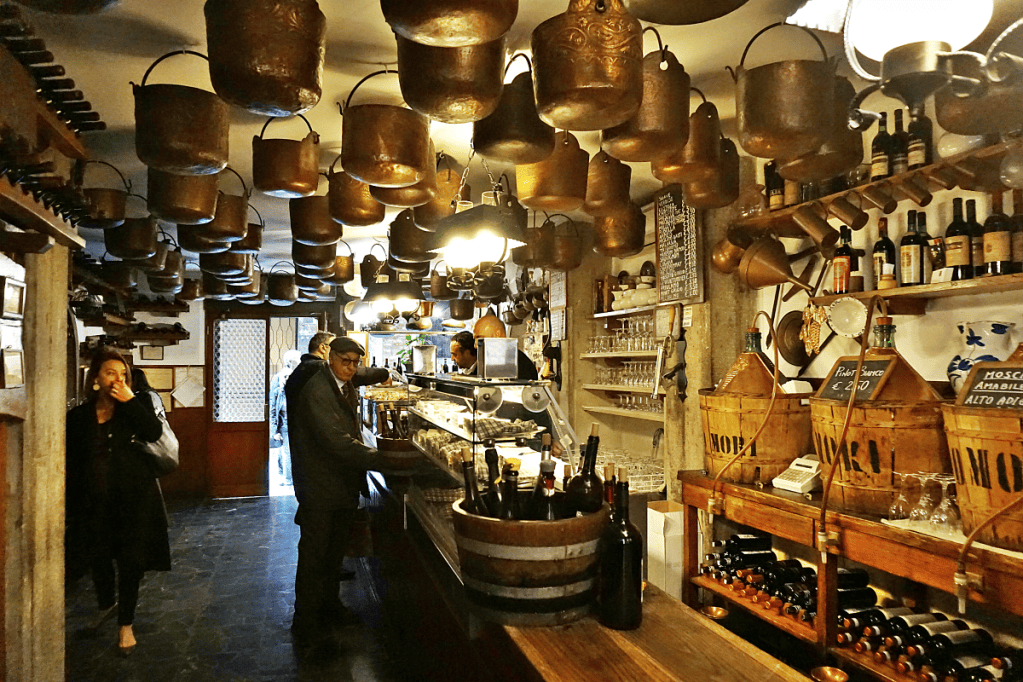
Cantina Do Mori is Venice’s oldest bacaro — operating since 1462, which is a date that requires a moment of accommodation. The interior is everything you would want from a place that has been doing this for five and a half centuries: dark wood, hanging copper pots, the accumulated atmosphere of an institution that has been serving its city since before most European countries existed in their current form. Calle Do Mori, San Polo 429.
Cantine del Vino già Schiavi, on the Fondamenta Nani in Dorsoduro opposite the gondola boatyard, is the bacaro-enoteca with the serious wine list — dozens of wines by the glass, cicchetti of the refined variety, and the specific quality of a neighbourhood bar that has never needed to advertise because the neighbourhood knows. Fondamenta Nani, Dorsoduro 992.
The correct procedure for the bacaro crawl is to begin at the Rialto market — ideally in the morning, when the fish market is operating under the loggia and the vegetable stalls are at their fullest — then work outward through San Polo, crossing the Grand Canal to Dorsoduro, ending the afternoon somewhere with a spritz and whatever cicchetti are left. Do not eat a large lunch. The evening’s serious restaurant will thank you.
The serious restaurants
Venice has a small number of restaurants that are doing something genuinely excellent with the ingredients of the lagoon and the market. They share certain characteristics: they are small, they are hard to find, they do not have outdoor tables in visible locations, and they are fully booked weeks in advance. This last point is not incidental — it is a function of the simple maths of a city where the good restaurants have perhaps twenty or thirty covers and the number of people who know about them has grown substantially while the restaurants themselves have not.
Osteria alle Testiere is the most celebrated of them, and the reputation is deserved. Eleven tables in the Castello sestiere, run by chef Bruno Gavagnin and sommelier Luca di Vita since 1993. The menu changes daily based on the market, the focus is seafood from the lagoon and the Adriatic, the wine list is outstanding, and the pasta — particularly the pasta with crab, or with the lagoon’s various crustaceans depending on the season — is among the finest in the city. The Michelin recognition has made reservations harder; book as far ahead as possible. Online reservations only — they do not take phone or email bookings.
http://www.osterialletestiere.it
One further thing worth knowing about Alle Testiere and its relationship to the food of Venice: along with twelve other Venetian restaurants, it is part of the Osti in Orto collective — a consortium that in 2021 collectively leased a four-hectare plot on the island of Sant’Erasmo to grow organic vegetables for their own kitchens. Cauliflowers, Savoy cabbages, courgettes, radicchio, artichokes: all grown communally, shared among the member restaurants, consumed at a remove of metres rather than kilometres from the lagoon. It is the most thoughtful thing the Venice restaurant community has done collectively in decades, and it matters to the food in ways that the person eating it may or may not be told about.
Antiche Carampane in San Polo is the restaurant for the visitor who wants to understand what Venetian seafood cooking looks like when it is done with complete conviction and without any concession to what tourists expect. Tucked down a street so obscure that the owners once posted a sign saying “no pizza, no lasagne, no tourist menus” — which was less an unfriendly notice than an accurate description of what they do not do. The fried soft-shell crab when in season, the *spaghetti al nero di seppia* (with cuttlefish ink), the simply grilled whole fish: all of it managed with the confidence of a kitchen that has been doing this for a long time and has decided that doing it correctly is sufficient. Book ahead.
http://www.antichecarampane.com
Corte Sconta, near the Arsenale in Castello, is an old-school seafood trattoria with a vine-covered courtyard and the specific pleasure of a restaurant that was famous before fame became a problem for restaurants. The tables are covered with butcher paper and red napkins. The antipasti arrive in a procession — small plates of the lagoon’s output, one following another, each one arguing for a different quality of the morning’s market. More casual than Alle Testiere, slightly less precise, entirely worth the reservation.
Al Covo, also in Castello, is the family-run restaurant — Cesare Benelli in the kitchen, his Texan wife Diane managing the room — that has been producing the most consistent fine seafood in Venice for decades. Closed Tuesday and Wednesday; otherwise the correct destination for a Sunday or Monday dinner when the other recommended restaurants are shut. The seasonal menu is built around the lagoon’s catch and the Veneto’s produce, and the cooking is precise without being showy — the kind of food that makes you understand, quietly, what the ingredients were before they arrived on the plate.
http://www.ristorantealcovo.com
Why November
The most honest thing to say about eating in Venice is that the experience is significantly better in November than in any of the summer months, for reasons that compound each other.
The tourists are largely gone. This means the bacari are operating at the pace of a neighbourhood institution rather than an attraction, and the restaurants can give the attention to the food that the food requires. The acqua alta — the periodic flooding of the low-lying areas of the city that comes with the autumn and winter high tides — is both an inconvenience and, for the visitor who approaches it correctly, one of Venice’s more atmospheric conditions. The city in the fog and the flood, with the palaces reflected in the water that covers the Piazza and the boats threading through the inundated calles: this is a Venice that the summer visitor does not see and that is, in its way, the truest version of the place.
The winter menu, too, is different from the summer one. The moeche season has passed by November, but the spider crabs are excellent, the baccalà is at its most comforting, the musetto — a soft pork sausage served with polenta — appears on bacaro counters as it does not in July. The lagoon’s rhythms produce different food at different times, and November’s food is honest and warming in a way that summer food, for all its lightness, cannot quite be.
The Rialto market
Whatever else you do in Venice, go to the Rialto market on a weekday morning before eleven. The fish market — the Pescheria — operates under the neo-Gothic loggia on the Grand Canal, and what is on the slabs each morning is a fairly complete account of what the lagoon and the northern Adriatic are producing at that moment: the various lagoon crabs in their various seasonal forms, the turbot and sole and sea bass, the scallops, the octopus, the grey mullet, the razor clams still alive in their shells, everything arranged with the artisanal pride of people who know they have one of the finest fish markets in Europe and want you to understand this. The vegetable market alongside it is less theatrical but equally serious: the radicchio of Treviso, the artichokes of Sant’Erasmo, the squash and the bitter greens of the Veneto autumn.
You are not required to buy anything. But understanding what is on the slabs at nine in the morning helps you understand what is on the plate that evening, and the connection — that directness between the lagoon and the kitchen and the table — is what makes Venetian food worth the argument.
The essentials
Bacari
All’Arco — Calle Arco, San Polo 436. The best cicchetti in Venice. Arrive at opening; no reservations; no website.
Cantina Do Mori — Calle Do Mori, San Polo 429. Since 1462.
http://www.cantinandomori.com
Cantine del Vino già Schiavi — Fondamenta Nani, Dorsoduro 992. The serious wine bacaro. No website; no reservations needed.
Restaurants
Osteria alle Testiere — Calle del Mondo Novo, Castello 5801. Eleven tables; online booking only; reserve weeks ahead.
http://www.osterialletestiere.it
Antiche Carampane — Rio Terà de le Carampane, San Polo 1911. No pizza, no tourist menu. Book ahead.
http://www.antichecarampane.com
Corte Sconta — Calle del Pestrin, Castello 3886. Courtyard; old school; good antipasti.
http://www.cortesconta.it
Al Covo — Campiello della Pescaria, Castello 3968. Family run; closed Tuesday and Wednesday; the Sunday option.
http://www.ristorantealcovo.com
Go to
Rialto fish and vegetable markets — weekday mornings until 11am. Sestiere San Polo, by the Grand Canal.
Order
Baccalà mantecato — the creamy salt-cod spread. Non-negotiable.
Sarde in saor — fried sardines in sweet-sour onion preparation. Venetian and ancient.
Spaghetti al nero di seppia — pasta with cuttlefish ink. Order it wherever it appears.
Moeche (spring and autumn only) — the soft-shell crabs of the lagoon, fried whole.
Schie e polenta — the tiny grey lagoon shrimps on polenta. November onwards.
An ombra — a small glass of whatever is open. At a bacaro counter. Standing.
When to go
November through February. The city is quieter, the food is better suited to the season, and the acqua alta is a feature rather than a problem if you have the right boots.
Getting there
Fly to Marco Polo Airport (VCE), 12 kilometres from the city. The Alilaguna water bus takes 75 minutes to San Marco and is the correct way to arrive, because it puts you on the water before you have even unpacked. The taxi boat is faster and considerably more expensive and skips the experience of the approach across the lagoon, which you should not skip.

