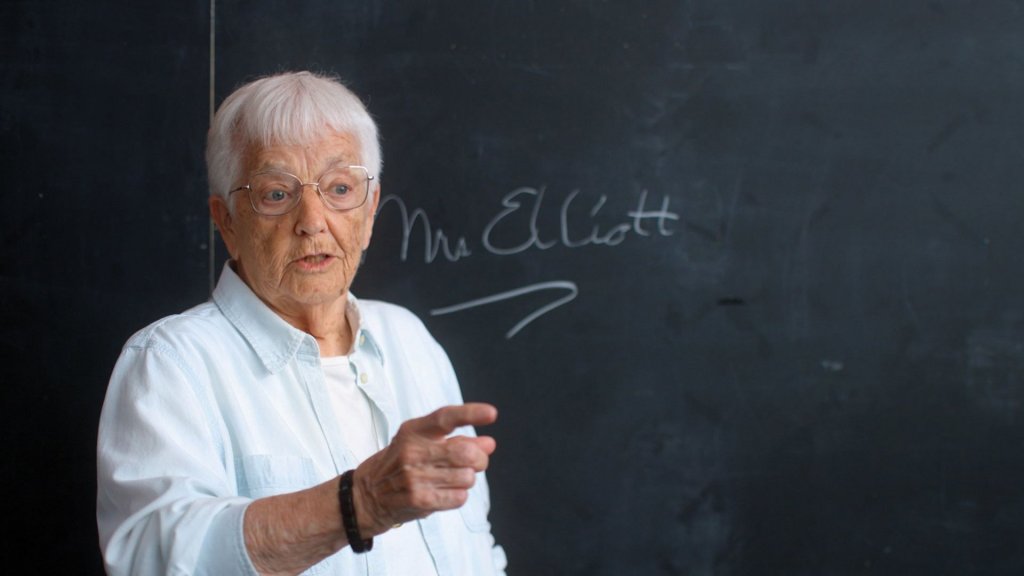
Nearly sixty years after she devised a classroom exercise that forced white American children to confront racial discrimination, Jane Elliott is still fighting. Judd Ehrlich’s remarkable documentary examines the experiences that shaped her convictions, the price paid by her family and the determination of a ninety-two-year-old educator who refuses to be silenced.
Years before Jane Elliott became known for her uncompromising opposition to racism, she received a telephone call about renting her house in Waterloo, Iowa. Elliott and her husband were preparing to move, and the property was available. The woman on the telephone wanted to know whether Black people were welcome in the neighbourhood. Elliott had already been warned against renting to African Americans, although she considered her neighbours’ objections prejudiced. When the question came, she hesitated before explaining that everyone living nearby was white. The caller thanked her and hung up.
Elliott knew immediately that she had failed. She could have invited the woman to view the house, but when confronted with the possibility of angering her neighbours, she had chosen the easier course. The incident stayed with her, and she later recalled the shame she felt at having allowed other people’s prejudices to determine her behaviour. She had discovered how little it took to make someone who knew discrimination was wrong participate in it.
That experience provides one of the most revealing episodes in Judd Ehrlich’s Jane Elliott Against the World, a documentary that traces the life of the American educator from her childhood in rural Iowa to her continuing activism in her nineties. Elliott has become internationally recognised for confronting people with their racial prejudices, frequently in circumstances calculated to make them deeply uncomfortable. Yet she is equally frank about her own shortcomings, and Ehrlich is interested in the experiences that produced the formidable woman she became.
Drawing upon extensive archival recordings, family interviews and Elliott’s continuing engagement with contemporary American politics, Ehrlich has made an exceptionally thorough and affecting film. Her husband and children occupy an important place in the story, as does the upbringing that shaped her understanding of what it meant to be considered inferior. Elliott’s public achievements are considerable, but the documentary also examines the demands her activism placed upon those closest to her, whose experiences have seldom received the same attention as her famous classroom exercise.
The Education of Jane Elliott
Born in 1933, Jane Elliott grew up on a farm outside Riceville, a small community in northeastern Iowa. The fourth of seven children, she attended a one-room schoolhouse before training as a teacher at Iowa State Teachers College, now the University of Northern Iowa. She began teaching in 1953, but her childhood had already given her a painful understanding of how easily a child could acquire a sense of inadequacy.
Elliott recalls that her mother had wanted another son and was disappointed when she gave birth to a daughter. Another sister was favoured, and the girl’s subsequent death complicated an already difficult family history. Elliott grew up believing that she was never quite good enough, an experience she would carry into adulthood.
In Ehrlich’s documentary, she explains how those feelings influenced the kind of teacher she wanted to become. She was determined that no child should leave her classroom believing themselves incapable or inferior. Having experienced the damage such assumptions could do, she understood the importance of an educator’s expectations and the influence those expectations could exert upon a child’s confidence.
Her early work reflected this conviction. Elliott became particularly interested in teaching children with reading difficulties, including dyslexia, which was poorly understood during much of her career. Her own son Brian was dyslexic, and she recognised the harm caused when pupils who struggled academically were dismissed as unintelligent. She refused to accept that a child’s difficulty with reading necessarily reflected an absence of ability.
Former pupils appearing in the documentary remember her confidence in them and the determination with which she approached their education. Some had already been treated as failures before entering her classroom. Elliott expected them to learn and took considerable satisfaction in proving that they could.
Her ideas about race developed through experiences beyond Riceville. After marrying Darald Elliott in 1955, she lived for a period in Waterloo, where her husband worked at a supermarket serving a predominantly Black neighbourhood. The people she encountered challenged assumptions she had absorbed growing up in an almost entirely white rural community. Their lives bore little resemblance to the stereotypes she had been taught.
The telephone call about renting the couple’s house brought these discoveries into sharper focus. Elliott had begun questioning racial prejudice, but she had not yet learned to withstand the social pressure that helped sustain it. Her failure troubled her enough to prompt further reading, including John Howard Griffin’s Black Like Me, first published in 1961, which described the experiences of a white journalist travelling through the segregated American South after darkening his skin.
Her parents had offered contrasting lessons about how to conduct oneself. Elliott later recalled her mother’s advice as “go along to get along”, while her father insisted upon doing what was right. Yet he too had grown up accepting racial prejudices that he rarely questioned. Elliott adored him, but she would eventually challenge his language and assumptions, just as she had begun challenging her own.
By the time she returned to teaching in Riceville, the American civil rights movement had secured major legislative victories. The Civil Rights Act of 1964 and Voting Rights Act of 1965 had challenged institutionalised discrimination, although segregation and racial inequality remained firmly embedded in American life.
On 4 April 1968, Martin Luther King Jr. was assassinated in Memphis. The following morning, Elliott faced a classroom of third-grade children who knew little about Black Americans beyond the stereotypes they had acquired from the adults around them. She wanted them to understand how discrimination operated, and an ordinary classroom discussion seemed unlikely to accomplish what she intended.
She divided the pupils according to eye colour, announcing that one group was superior to the other. The supposedly superior children received privileges and praise, while the others were subjected to restrictions, ridicule and the indignity of wearing identifying collars. The following day, the hierarchy was reversed.
The speed with which the children adapted to their assigned positions astonished Elliott. Pupils who had previously been friends began insulting one another, while those granted authority became increasingly willing to exercise it. Children subjected to inferior status grew uncertain of themselves, with apparent consequences for their academic performance. Elliott had provided no evidence that eye colour determined intelligence or character, yet the children accepted her classifications because they came from the person responsible for their education.
The footage most people know was recorded in 1970, when filmmaker William Peters documented Elliott repeating the exercise for ABC News. The resulting programme, The Eye of the Storm, won a Peabody Award and brought her teaching to a national audience. Peters returned to the subject in 1985 with A Class Divided, which included a reunion of former pupils and a later exercise conducted with adult employees of Iowa’s correctional system.
The reunion was especially revealing. Former pupils recalled the humiliation of being classified as inferior, their anger towards classmates who had accepted the hierarchy and the influence Elliott’s teaching had exerted on their subsequent understanding of prejudice. Several had carried the experience into adulthood, including the way they approached raising their own children.
Elliott’s intervention belongs within a longer history of efforts to understand the psychological consequences of racism. During the 1930s and 1940s, Black psychologists Kenneth and Mamie Clark investigated how racial segregation affected African American children’s perceptions of themselves. Their celebrated doll studies demonstrated the extent to which children could internalise the prejudices of the society around them. The research contributed to the evidence considered in Brown v. Board of Education, the 1954 Supreme Court decision that declared racial segregation in public schools unconstitutional.
The Clarks investigated children experiencing the consequences of actual racial discrimination. Elliott constructed an artificial hierarchy among white pupils, enabling children with little experience of racial diversity to observe how quickly prejudice could emerge when unequal treatment received institutional approval.
Her contribution was an unusually direct method of confronting white audiences with the mechanics of discrimination. It would eventually reach millions of people, although the attention also brought consequences that Elliott could scarcely have anticipated.
The Price Paid at Home
Elliott’s subsequent appearance on The Tonight Show Starring Johnny Carson brought widespread attention, much of it hostile. Back in Riceville, colleagues refused to associate with her, neighbours became openly antagonistic and members of the community objected to the reputation she was bringing upon the town. Her children were bullied and physically assaulted, while a boycott of her parents’ business eventually forced it to close.
Ehrlich gives Elliott’s four children considerable space to describe what growing up under those circumstances meant to them. They were exposed to hostility because of their mother’s work, and they sometimes felt that her commitment to her pupils and public responsibilities left insufficient room for their own needs.
Her daughter Mary describes Elliott as a small package of C4, an affectionate but remarkably accurate description of her explosive personality. Elliott is funny, impatient and capable of making herself difficult. Ehrlich allows those qualities to emerge through conversations with family members whose affection for her has never entirely erased the grievances accumulated over the years.
Her children were young when the backlash began. They had little understanding of the forces their mother was challenging or why her activities provoked such anger. Their recollections suggest that the consequences continued long after the immediate hostility had subsided. Some felt that Elliott’s determination to help other people’s children came at the expense of her own family.
The film gives those experiences the attention they deserve. Elliott can be defensive when her children challenge her, and she remains convinced that the importance of her work justified many of the decisions she made. Their accounts are not necessarily reconciled with hers, nor does Ehrlich attempt to resolve every disagreement. The family has lived with the consequences for decades, and its members are entitled to different understandings of what happened.
Darald Elliott emerges as an especially important figure. The couple married in 1955 and remained together until his death in 2013. Elliott speaks about him with tremendous affection, remembering a gentle and loving man who understood her convictions and encouraged her to follow them. He supported her through the public hostility that followed the classroom exercise and the increasingly demanding career that developed from it.
Their personalities appear to have been strikingly different. Elliott could be combative and uncompromising, while Darald offered a steadier presence within the family. His support was fundamental to her ability to continue working, even when the consequences were difficult for them both.
The domestic history gives Ehrlich’s documentary much of its emotional depth. Elliott’s public career has been extensively recorded, but the family interviews reveal how much was happening beyond those appearances. Darald’s love and encouragement sustained a marriage that endured considerable external pressure, while the children’s memories offer a more complicated understanding of what it meant to live with such an uncompromising public figure.
The documentary is especially persuasive because it allows these accounts to coexist. Elliott’s achievements remain considerable, and the hurt experienced by her children is no less real. Their testimony raises difficult questions about the obligations of an activist towards the people closest to them, particularly when a public commitment becomes inseparable from family life.
The ethical questions surrounding Elliott’s teaching methods have also attracted substantial criticism. Her exercise deliberately subjected children to humiliation and emotional distress, and critics have questioned whether such treatment could be justified, even when intended to promote understanding.
Journalist Stephen G. Bloom examined the controversy in his 2021 book Blue Eyes, Brown Eyes: A Cautionary Tale of Race and Brutality. Drawing upon interviews with former pupils and residents of Riceville, Bloom challenged the largely celebratory account of Elliott’s methods. Some former students recalled lasting discomfort, while others questioned her behaviour as a teacher.
Research into the exercise’s effectiveness has produced mixed findings. A 2003 study published in the Journal of Applied Social Psychology identified improvements in participants’ attitudes towards some racial and ethnic minorities, although the results were uneven and did not establish lasting behavioural change.
The concerns are legitimate. A temporary experience of discrimination cannot reproduce the accumulated consequences of racial inequality, and the emotional force of an educational exercise does not settle questions about its long-term effectiveness. Nevertheless, the classroom footage demonstrated how readily discriminatory behaviour could be encouraged by someone in authority. Its disturbing quality lies in how little persuasion the children required.
Elliott subsequently spent much of her career addressing adults, often using similarly confrontational methods to challenge assumptions about race. Her workshops took her into universities, workplaces and government institutions, and her lectures continued reaching new audiences through television and online recordings.
Throughout, she maintained that personal opposition to racism meant little if people remained unwilling to challenge discriminatory behaviour within their own communities. She had experienced the temptation to avoid conflict in Waterloo and understood how easily that hesitation could become complicity.
America Still Hasn’t Learned the Lesson
Ehrlich’s documentary follows Elliott into the political arguments of contemporary America, where disputes over race and public education have become increasingly contentious.
In Temecula, California, where members of her family have attended school, a controversy over teaching materials brought Elliott into another confrontation about history, discrimination and the responsibilities of educators.
In 2023, the Temecula Valley Unified School District’s governing board rejected proposed elementary social studies materials after objections to a reference to Harvey Milk, the pioneering gay rights politician, in associated teaching resources. The dispute escalated when California Governor Gavin Newsom threatened financial penalties if the district failed to adopt an appropriate curriculum. The board eventually approved revised materials in July 2023, although the controversy exposed deep disagreements about the teaching of American history and the authority of school boards to restrict particular subjects.
For Elliott, the dispute was painfully familiar. She had begun her campaign against racial prejudice after discovering that her pupils had absorbed discriminatory assumptions without understanding where they came from. She believed that education had a responsibility to challenge those assumptions, however uncomfortable the discussion might become.
The documentary places the conflict within the wider political developments of recent years, particularly the resurgence of conservative campaigns against diversity programmes and the policies of Donald Trump’s administrations.
Since returning to office in January 2025, Trump has pursued the dismantling of federal diversity, equity and inclusion initiatives, including measures affecting the Department of Education. His administration has presented the changes as necessary to eliminate discriminatory preferences and political ideology from public institutions. Civil rights organisations and other critics have argued that withdrawing these programmes weakens efforts to address longstanding inequalities.
Elliott has little sympathy for the arguments advanced to justify the restrictions. She regards attempts to limit the teaching of racial history as deeply troubling, particularly when they prevent pupils from examining the historical origins of discrimination.
Ehrlich makes the consequences of these disputes tangible through the experiences of teachers in Temecula. Dianne Cox, a local educator who became involved in the controversy, describes finding an ally in Elliott after facing pressure from the district’s conservative school board. At the film’s Sundance premiere, Cox spoke about Elliott’s ability to say publicly what she herself had been unable to express in the same circumstances.
The contrast between the elderly activist and the teachers attempting to continue their work is revealing. Elliott has little professional standing left to lose, while younger educators remain vulnerable to decisions made by school boards and administrators. She can afford a degree of confrontation that would carry considerable consequences for someone whose livelihood still depends upon those institutions.
The film also examines Elliott’s Christian faith and her impatience with those who invoke religion to justify discriminatory behaviour. She is particularly critical of Christian nationalism, distinguishing between the ethical teachings she understands Christianity to represent and the political uses to which religious language can be put.
Her forthrightness has always been part of her effectiveness. Elliott has little interest in reassuring audiences that their existing assumptions are reasonable, and her lectures frequently begin from the proposition that people possess prejudices they have never properly examined.
Killer Mike and historian Ibram X. Kendi appear in the documentary, placing her work within the wider history of American anti-racist education and activism. Elliott’s particular contribution has been to address white audiences from within their own social institutions, challenging assumptions that Black Americans and earlier civil rights campaigners had spent generations exposing.
At the Sundance premiere, Killer Mike related her work to the position advanced by Stokely Carmichael, later known as Kwame Ture, who argued that white Americans had a responsibility to confront racism within their own communities.
Elliott had accepted that responsibility early in her career. Nearly sixty years later, she remains involved in the same arguments, frequently expressing astonishment that such elementary lessons still need to be taught.
Ehrlich’s use of archival material gives the contemporary sections their historical weight. The classroom footage records an era when the civil rights movement was confronting legally enforced segregation, while the present-day material concerns conflicts over the teaching of that history and the policies intended to address its continuing consequences. The decades separating the two periods are considerable, but the resistance encountered by educators attempting to challenge prejudice remains an unsettling point of continuity.
What a Teacher Can Change
Some of the documentary’s most affecting material concerns the people whose lives were changed through their encounters with Elliott.
Former pupils describe the confidence she gave them and the sense of responsibility she encouraged them to develop. One of them, Rex Kozak, went on to become a teacher and school principal. Speaking at the film’s Sundance premiere in January 2026, he credited Elliott with giving him the courage to challenge inequality and explained how he had tried to apply those lessons throughout his career.
Such recollections offer a perspective on Elliott’s influence that extends beyond the original classroom exercise. Her teaching affected the way former pupils approached their own lives, sometimes determining how they subsequently treated the children entrusted to their care.
An especially moving episode concerns Elliott’s father, whose response to The Eye of the Storm she has recounted over the years.
He had grown up in a society where racist jokes and language were commonplace. Elliott had already confronted him about such remarks, explaining that she could not allow her children to hear them from someone they loved and respected. He agreed to stop speaking that way around the family.
When he later watched the classroom documentary, his response went considerably further.
Elliott remembered her father standing after the film, visibly moved and with tears in his eyes. She had not seen him cry since the death of her little sister. He told her, “I wish somebody had taught me that when I was 9 years old.”
Afterwards, he began challenging racist remarks made by other people. He was no longer content simply to avoid offending his daughter; he had come to recognise that the remarks themselves required a response.
For Elliott, it was an extraordinary affirmation. Her father had spent much of his life accepting assumptions that he had rarely examined, yet the experience of watching children subjected to arbitrary discrimination had prompted him to reconsider his own behaviour.
She had grown up hearing him insist upon doing what was right. Now he had recognised something in his own conduct that needed to change.
The documentary draws upon a remarkable body of material accumulated over Elliott’s lifetime, moving between the public record and the experiences of people who knew her privately. The archival footage establishes the historical reach of her work, while the family conversations reveal relationships that have been complicated by affection, resentment and the demands of sustained activism.
Ehrlich also benefits enormously from Elliott’s personality. At ninety-two, she remains quick-witted, outspoken and extraordinarily energetic. Her humour can be sharp, and her impatience with evasive answers has scarcely diminished. She is quite prepared to argue with members of her own family, and the documentary allows those exchanges to expose qualities that a more reverential portrait might have avoided.
The result is an unusually comprehensive account of a public figure whose reputation has often been reduced to one celebrated classroom exercise. Elliott’s childhood feelings of inadequacy, the experiences in Waterloo that unsettled her assumptions, and the support of her husband all contribute to our understanding of the woman whose work became so influential.
Ehrlich also gives serious attention to the personal consequences of her convictions. The children’s recollections complicate the public account of a courageous educator, while Darald’s enduring support emerges as essential to the career she was able to pursue. Their experiences remain part of the history of her activism, whatever judgement one reaches about the choices she made.
The film is particularly accomplished in the way it brings this intimate history into contact with contemporary America. Elliott’s life encompasses almost six decades of political and social change, yet her determination to confront racial prejudice has remained remarkably consistent. She has continued speaking publicly through personal loss, periods of intense hostility and repeated attempts to discourage educators from addressing discrimination.
At the Sundance premiere in January 2026, Elliott appeared remotely during the discussion following the screening. The audience greeted her with prolonged applause, which she promptly interrupted. They had only a few minutes, she told them, and she wanted to get on with the conversation.
It was a wonderfully characteristic response from someone who has spent most of her adult life demanding that people do something about the injustices they recognise. At ninety-two, Jane Elliott remains impatient with ceremony, uninterested in being treated as a historical monument and determined to use whatever time she has left.
Jane Elliott Against the World (2026), directed by Judd Ehrlich, premiered at the Sundance Film Festival on 27 January 2026. The documentary is scheduled for broadcast on PBS’s Independent Lens on 29 March 2027.
Official film website | PBS: A Class Divided
Cover image: film still from Jane Elliott Against the World.

