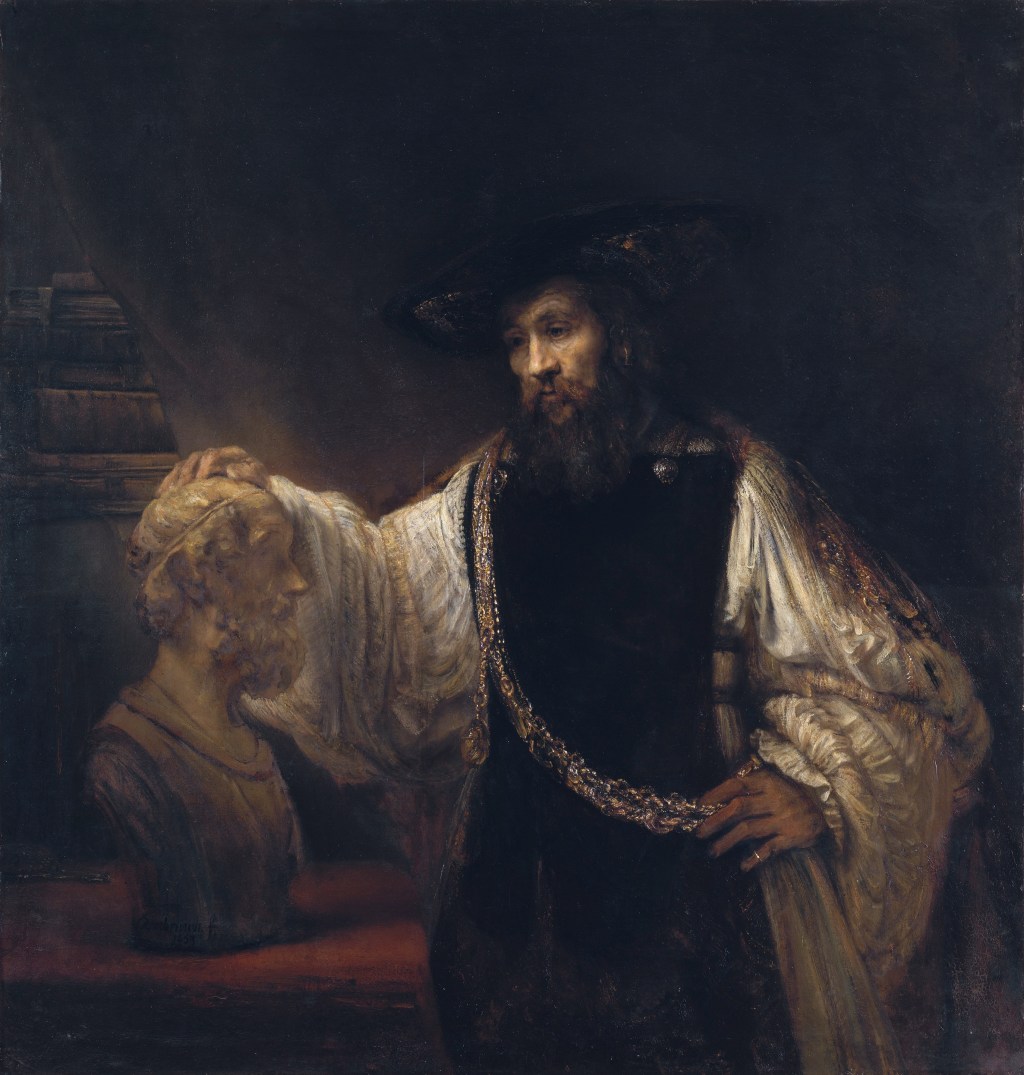
He spent twenty years in Plato’s Academy, absorbing everything, and then he disagreed with almost all of it. He brought the Forms back down from the heavens and put them inside the things themselves. He said the soul was not imprisoned in the body but was the body’s form — what the body does when it is fully alive. He said the good life was not the ascent to the eternal but the flourishing of the specific, mortal, social, political, embodied animal that the human being actually is. He was right about most of it, and the world has not fully caught up.
The image that has organised the reception of Plato and Aristotle since the Renaissance — since Raphael painted them together in the School of Athens, Plato pointing upward toward the heavens, Aristotle gesturing downward toward the earth — is a simplification and is also, as simplifications sometimes are, entirely accurate. Plato’s philosophy is oriented toward the transcendent: toward the Forms that exist beyond the sensory world, the soul that existed before the body and will survive it, the Good that illuminates reality as the sun illuminates the visible world. Aristotle’s philosophy is oriented toward the immanent: toward the forms that exist in the things themselves, the soul that is the form of the living body, the good that is achieved not in the vision of an eternal archetype but in the flourishing of a specific mortal life in a specific human community.
The difference is not merely a difference of emphasis. It is a difference of fundamental orientation toward reality — toward what is most real, what most deserves philosophical attention, what the human being’s relationship to the rest of what exists actually is. Plato looked up. Aristotle looked at the thing in front of him. Both gestures were, in their different ways, acts of philosophical seriousness. The consequences of the difference have organised Western thought for two and a half thousand years.
Aristotle was born in 384 BCE in Stagira, in the Chalcidice peninsula of northern Greece. His father was the physician to the Macedonian royal court, and the influence of the biological sciences — the habit of careful, systematic observation of living things in their specific particularity — runs through his philosophy as thoroughly as the mathematical sciences run through Plato’s. He arrived at the Academy at seventeen and stayed for twenty years — until Plato’s death in 348 or 347 BCE, when he left Athens, spent time in Asia Minor and Lesbos conducting biological research, and then returned to Macedonia to serve as the tutor of the thirteen-year-old who would become Alexander the Great.
In 335 BCE he returned to Athens and founded his own school, the Lyceum, where he taught and wrote for the remaining twelve years of his life. When Alexander died in 323 BCE and the anti-Macedonian reaction in Athens made his position dangerous, he left the city, saying — according to a tradition that may be apocryphal but is philosophically perfect — that he would not allow Athens to sin against philosophy twice. He died in Chalcis the following year, at sixty-two.
What he left behind is staggering in its range and in its influence: works on logic, physics, biology, psychology, metaphysics, ethics, politics, rhetoric, and poetics. The logical writings organised Western philosophical method for two thousand years. The biological writings constitute the founding documents of the science. The ethical and political writings shaped the moral philosophy of the Christian Middle Ages through Aquinas’s great synthesis, and continue to organise the most productive currents in contemporary moral philosophy. He is not merely the most influential philosopher who ever lived. He is, in certain disciplines, simply the founder — the person without whose work the discipline as we know it does not exist.
Against the Forms: Bringing Reality Back to Earth
The first and most fundamental move Aristotle makes against Plato is the critique of the theory of Forms, and it is a critique of such decisive force that the theory of Forms, as Plato stated it, has never quite recovered.
The core of the objection — the third man argument, which Plato himself had already worried about in the Parmenides — is as follows. Plato introduces the Forms to explain what particular things have in common: the Form of Beauty explains what all beautiful things share. But the relationship between the Form of Beauty and the particular beautiful things is itself a relationship that requires explanation: what do the Form of Beauty and the beautiful things share that makes them all beautiful? A further Form — a third man, as the argument came to be called — and then a further one, and so on without end. The Forms do not explain the particulars. They generate an infinite regress.
But Aristotle’s objection goes deeper than the logical problem. The Forms, he argues, are explanatorily useless even if they exist: they are supposed to be the causes of the particular things of the sensory world, the reason why things are what they are, but a separately existing eternal archetype cannot cause the existence of a particular temporal instance. The Form of Beauty does not make anything beautiful. The Form of Horse does not make anything a horse. The Forms are, in the most precise philosophical sense, inert — they sit in their eternal heaven and the sensory world goes on without them, borrowing nothing from their supposed authority.
What Aristotle proposes instead is that the form — not the Platonic Form but the Aristotelian form, immanent rather than transcendent — is in the thing itself. The form of the horse is not a separately existing eternal archetype but the organisation, the structure, the specific way of being that makes this particular animal a horse rather than a dog or a stone. The form is what the thing does, how it functions, what it is for — and it cannot be separated from the matter it organises except in thought, as an abstraction, not in reality.
This is a revolution in the history of philosophy, conducted with the calm thoroughness of someone who has thought through the alternative position with complete seriousness and found it wanting. Aristotle is not dismissing Plato. He is correcting him — taking the genuine insight of the theory of Forms (that there is something more to the identity of a thing than its current sensory properties, that what a thing is involves its form as well as its matter) and removing the part of the theory that generates the problems (the separate existence, the transcendence, the sunlit realm of eternal archetypes).
The result is a world that is genuinely real in itself — not a shadow-world of appearances that imperfectly reflects a more real world beyond it, but the world itself, the only world there is, fully real and fully knowable in its own right. This is not a reduction of philosophy’s ambitions. It is a redirection of them: from the world behind the world toward the world as it actually is, in all its specific, various, mortal, changing particularity.
The Four Causes: Why Things Are What They Are
Aristotle’s account of causation — the doctrine of the four causes — is one of the most useful analytical tools in the history of philosophy, and its usefulness has survived the specific natural philosophy in which it was embedded into the contemporary world, where the questions it was designed to answer remain as live as they ever were.
A complete explanation of anything, Aristotle argues, requires answers to four questions: What is it made of? (the material cause). What is its form or structure? (the formal cause). What produced it? (the efficient cause). What is it for? (the final cause).
For a bronze statue: the material cause is the bronze; the formal cause is the shape, the form that the bronze has been given; the efficient cause is the sculptor; the final cause is the purpose the statue serves — commemoration, worship, aesthetic pleasure. All four are genuinely causal — all four are part of a complete explanation of why this statue exists and is what it is — and any account that leaves one out is incomplete.
The most philosophically contentious of the four causes — and the one that marks the deepest difference between Aristotelian and modern scientific explanation — is the final cause: the explanation in terms of purpose or end. Modern science, in its Newtonian and post-Newtonian forms, operates without final causes: the universe is explained in terms of efficient causes (forces, interactions, mechanisms) and material and formal causes (mass, charge, structure), but the question of what things are for is not a scientific question. It is the question that science has most deliberately excluded from its domain, on the grounds that the attribution of purpose to natural processes is an anthropomorphic projection rather than a genuine feature of nature.
Aristotle disagreed, and the disagreement is not obviously wrong. Living things — organisms — behave in ways that are most naturally described in terms of purpose: the heart pumps blood in order to circulate oxygen, the eye perceives in order to guide action, the plant grows toward the light in order to photosynthesize. The “in order to” is not merely a convenient shorthand for a more fundamental mechanical explanation. It is, Aristotle argues, a genuinely explanatory category — the kind of explanation that is irreducible to efficient causation because the thing’s behaviour is organised around an end that the efficient causes alone do not determine.
This is the argument that contemporary philosophy of biology has been having with itself, with increasing sophistication and without decisive resolution, for the past half century. Aristotle identified the question with a precision that the subsequent two and a half millennia of reflection have not made redundant.
The Soul as Form: What It Means to Be Alive
The Aristotelian account of the soul — developed in the De Anima, one of the most rigorously argued and most consequential texts in the history of philosophy — is the place where the disagreement with Plato is most direct and most philosophically productive.
Plato’s soul is a separately existing entity — immortal, immaterial, temporarily imprisoned in the body, genuinely itself only when separated from the body’s confusions. The body and the soul are two different things, related as the prisoner is related to the prison or, in a more benign image, as the sailor is related to the ship.
Aristotle’s soul is the form of the living body — not a separately existing thing but the organisation, the structure, the specific way of functioning that makes a living body alive. The soul is what the body does: perceiving, moving, desiring, reasoning, growing. The relationship between the soul and the body is not the relationship between the prisoner and the prison but the relationship between the shape of an axe and the iron it is made of — the form and the matter of a single thing, inseparable except in thought.
“If the eye were an animal,” Aristotle writes, with the concise clarity that marks his best thinking, “sight would be its soul.” The soul of the eye is the capacity for sight — what the eye does when it is functioning properly, what it is for. The soul of the human being is the complex of capacities that constitute human life — the capacities for nutrition and growth that we share with plants, the capacities for sensation and locomotion that we share with animals, and the capacity for rational thought that is specifically and distinctively human.
This account has consequences that Aristotle draws with complete consistency: the soul does not pre-exist the body and does not survive the body’s death. The soul is what the living body does, and when the body ceases to live, the soul ceases to be — as the shape of the axe ceases to be when the iron is melted down. Death is not a liberation. It is simply the end of the specific form of being that the living body constituted.
The consequence is bracing. There is no Platonic consolation available — no immortal soul that will eventually return to its eternal home, no previous existence in which the Forms were seen directly and now dimly remembered, no metaphysical guarantee that the person who has lived well will be rewarded beyond death. The human being is mortal all the way down, and the good life must be achieved, if it is to be achieved at all, within the conditions that mortality imposes.
This is, in its way, the most honest position in ancient philosophy — more honest than Plato’s consoling dualism, more honest than the Stoic account of the soul as a fragment of the universal logos that will eventually be reabsorbed into it. It is also, for exactly that reason, the most demanding: it places the entire weight of the good life on the specific mortal life being lived, with no transcendence available to redeem what the mortal life fails to achieve.
Eudaimonia: The Flourishing That Is the Point
The central concept of Aristotle’s ethics is eudaimonia — usually translated as happiness but better translated as flourishing, as the full actualisation of the human being’s characteristic capacities, as the specific kind of living well that is available to the specific kind of being that the human being is.
The Nicomachean Ethics — named for his son Nicomachus, and either dedicated to him or edited by him after Aristotle’s death — opens with one of the most commanding first sentences in the philosophical tradition: “Every art and every inquiry, and similarly every action and pursuit, is thought to aim at some good; and for this reason the good has rightly been declared to be that at which all things aim.”
The argument that follows — that every action aims at some good, that the goods form a hierarchy, that at the top of the hierarchy must be a good that is desired for its own sake and not for the sake of anything else — identifies eudaimonia as the highest good: the thing that everyone desires as an end in itself and that all other goods are pursued in order to achieve or contribute to. Wealth is not desired for its own sake but for what it enables. Health is not desired for its own sake but for what it makes possible. Even pleasure, which might seem to be desired simply for itself, is desired as a component of the good life rather than as its whole content.
Eudaimonia is not a feeling. This is the point that distinguishes Aristotle’s account from most modern accounts of happiness, which understand happiness primarily as a subjective state — a feeling of satisfaction or pleasure or contentment that the person who has it experiences as such. Eudaimonia is an activity: the activity of living and faring well, of actualising the characteristic human capacities in the conditions that allow their fullest expression. It is something the human being does, not something she has or feels.
The characteristic human capacity — the capacity that, actualised, constitutes the distinctively human form of flourishing — is rational activity. Not rational calculation, not the efficient pursuit of given ends, but the kind of rational engagement with the world that is characteristic of the fully developed human being: practical wisdom in the management of one’s own life and relationships, theoretical wisdom in the investigation of the world’s deepest structures, the virtues of character that allow reason to govern desire and emotion in the way that genuine human flourishing requires.
Virtue as Habit: The Self That Is Made Through Practice
The Aristotelian account of virtue is the most practically useful contribution to moral philosophy in the ancient world, and its usefulness derives precisely from its refusal of the Platonic assumption that knowledge of the good automatically produces the good behaviour.
Plato had argued — following Socrates — that virtue is knowledge: that the person who genuinely knows what is good will automatically do what is good, and that wrongdoing is always a form of ignorance. This is an attractive position, and it has attracted defenders across two and a half thousand years. It is also, as Aristotle points out with characteristic directness, obviously false to the evidence of ordinary human experience. Everyone knows that excessive eating is bad for them. Most people overeat anyway. Knowledge of what is good is necessary for good action but not sufficient for it — something else is required, something that Plato’s account leaves out.
What is required is the right character — the stable disposition to perceive situations accurately, to feel the appropriate emotions in the appropriate degree, and to act in the appropriate way. This disposition is what Aristotle calls virtue — aretē — and it is not an innate quality but an achievement: something produced by the repeated practice of virtuous actions until the actions become habits and the habits become character.
“We become just by doing just acts, temperate by doing temperate acts, brave by doing brave acts.” The sentence is simple and radical. The self is not given — it is made, through the specific pattern of choices and actions that constitute a life. The person who acts courageously, repeatedly, in situations that call for courage, becomes courageous — not merely performs courageous actions but acquires the stable disposition that constitutes genuine courage. The person who acts justly, repeatedly, becomes just. The person who repeatedly chooses the cowardly or the unjust course becomes a coward, becomes unjust — not as a moral judgment but as a psychological description of what the repeated choices are doing to the character that is doing the choosing.
This is the insight that every teacher and every parent and every person who has tried to change her own behaviour knows to be true: that the self is, within limits, plastic — that character is not fate but the accumulated result of a lifetime of choices, and that the choices we make today are making the person who will make the choices tomorrow. The habits of attention and action and response that we build over time are not merely behaviours but the formation of a self — the progressive actualisation of a character that becomes, eventually, genuinely ours.
Virtue is a disposition to hit the mean between excess and deficiency — between too much and too little of the relevant emotional response or action. Courage is the mean between cowardice (too little) and rashness (too much). Generosity is the mean between miserliness and prodigality. The doctrine of the mean is not a counsel of mediocrity — it is not recommending the tepid, the timid, the half-hearted. The mean is relative to the situation and the person, and in extreme situations it may be very far from the moderate in any absolute sense. The courageous soldier in battle is not being moderately brave. She is doing exactly what the situation requires, which may be something that looks, from outside, like extraordinary fearlessness.
The Political Animal: The Self That Needs Others
“Man is by nature a political animal” — one of the most famous sentences in the history of philosophy, and one of the most misread. The usual misreading takes “political” to mean something like “interested in politics” or “naturally inclined to political life,” and the claim seems to be about a specific human preference. This is not what Aristotle means.
Zōon politikon — the political animal — is the animal whose specific form of flourishing requires the polis, the city-state, the organised community of free citizens who share a common life and a common understanding of justice. The claim is not that human beings like politics. It is that the full actualisation of the human capacity for rational and social life — the achievement of eudaimonia — requires a specific kind of social environment: one in which the human being can exercise the virtues, develop genuine friendships, participate in the common deliberation about the good that politics, properly understood, consists of.
The person who lives outside the polis — who needs no community, who is self-sufficient without the social — is, Aristotle says, either a beast or a god. Not a human being. The human being is constitutively social: constituted in her specifically human nature by the social relationships and the social institutions that make the exercise of the human capacities possible. Strip away the polis — the community, the laws, the shared understanding of justice and the good — and you do not get a freer human being. You get a diminished one: a being who cannot exercise the specifically human virtues, who cannot achieve the specifically human form of flourishing, who is less than what the human being is capable of being.
This is the deepest disagreement between Aristotle and the tradition that, in the modern period, produced the social contract theorists and then the libertarians: the tradition that imagines the individual as naturally prior to the community, the community as a construction of pre-social individuals who come together for mutual benefit. For Aristotle, this imaginary pre-social individual is not a human being. It is a fiction — a useful fiction for certain purposes, but a fiction nonetheless. The human being is always already social, always already constituted by the relationships and the institutions and the shared understandings that the social life requires and produces.
Friendship — philia — is, in this context, not a private comfort but a social necessity: one of the conditions of eudaimonia, one of the specific forms through which the human being’s social nature is most fully expressed. Aristotle distinguishes three kinds of friendship: friendships of utility, in which each values the other for the benefit she provides; friendships of pleasure, in which each values the other for the pleasure she gives; and friendships of virtue, in which each values the other for what the other genuinely is — for her character, her specific human excellence, the specific quality of the person who is the friend. Only the third kind is genuine friendship, and only the third kind contributes to eudaimonia: the friendship that is, as Aristotle says, another self — the relation in which I encounter in another person a mirror of my own best self, and in which each friend is, through the relationship, enabled to become more fully what she is capable of being.
The Contemplative Life: The Question That Remains
The tenth book of the Nicomachean Ethics introduces a complication that the preceding nine books have not quite prepared the reader for: the claim that the highest human life, the life that most fully achieves eudaimonia, is not the life of political participation and civic virtue that the rest of the Ethics has been describing, but the life of contemplation — of the sustained, disinterested theoretical inquiry that the philosopher pursues.
The contemplative life is the highest because the capacity for theoretical reason is the highest human capacity — the capacity that most clearly expresses the divine element in human nature, the element that is most fully itself when most fully engaged in the activity that is its own proper end. The person who lives the contemplative life most fully is the most fully human, in the sense of most fully actualising the highest capacity that the human being possesses.
The tension with the preceding books is real and has generated enormous scholarly discussion. The ethical life — the life of civic participation, virtuous action, practical wisdom, genuine friendship — is the best life for the human being as a social and political animal. The contemplative life is the best life for the human being as a rational being with a divine element. Aristotle does not quite resolve the tension, and the failure to resolve it is philosophically honest: these are two genuine goods, and the claim that one completely overrides the other is not one that the evidence of ordinary moral experience supports.
He was, by his own practice, both. He engaged in the life of civic participation — advising kings, founding a school, participating in the intellectual life of Athens. And he contemplated: the biological investigations, the logical treatises, the Metaphysics, the sustained theoretical engagement with the deep structure of reality. The life that held both was, in practice, his own — and the tension between the two that the Nicomachean Ethics leaves unresolved was the tension he lived with.
Who We Are According to Aristotle
We are form-matter composites: not souls temporarily imprisoned in bodies, not consciousnesses floating in a physical world, but unified beings in whom the form and the matter are inseparable — in whom what we are is constituted by both what we are made of and how we are organised, and in whom the form is not the imposition of an external archetype but the specific way of being that is ours.
We are mortal, all the way down. The soul does not pre-exist the body, does not survive the body, is not on its way back to an eternal home. What we have is this life — this specific, embodied, temporal, mortal life in this specific community with these specific relationships and these specific opportunities for the exercise of the virtues that constitute our characteristic form of flourishing. The consolations of Platonism are not available. The demand is to make something of what is actually available, within the conditions that actually obtain.
We are social and political animals: constituted by our social relationships, incapable of the full actualisation of our human capacities outside the community that makes those capacities possible, genuinely ourselves only in the context of the friendships and the civic relationships and the shared institutions that are not the conditions of an independently existing self but the medium in which the self comes to be.
We are beings of habit and character: not fixed by nature but shaped by the accumulated choices of a lifetime, capable of becoming courageous or cowardly, just or unjust, generous or miserly, by the repeated practice of the actions that constitute these dispositions. The self is not what we are given but what we make of what we are given, and the making happens in the specific texture of the specific daily choices that most of us, most of the time, do not recognise as the moral work they actually are.
We are rational — not in the sense of being always calculating or always correct, but in the sense that the capacity for rational engagement with the world is what is most distinctively ours, what most fully expresses our nature when most fully actualised, what eudaimonia consists in when most completely achieved.
And we are, finally, beings for whom the question of the good life — of what human flourishing actually consists of, what the specific form of excellence available to the specific kind of animal we are — is the most important question, more important than the Platonic question of what lies beyond the world, more important than the pre-Socratic question of what everything is made of. The question is here, in this world, in this life, in this community, with these people. The answer is here too, if the attention is sufficient.
Plato pointed upward. Aristotle gestured at the world in front of him. The world in front of him was sufficient for the inquiry — sufficient, if attended to with the right quality of attention, to reveal everything that needed to be known about what the human being is and what the human being is for.
The essential Aristotle texts are the Nicomachean Ethics, the Politics, the De Anima, and the Metaphysics, all available in the Hackett series of translations: the Nicomachean Ethics in the Terence Irwin translation, the Politics in the C.D.C. Reeve translation, and the De Anima in the Christopher Shields translation, all of which are the most rigorous currently available. The Complete Works of Aristotle, edited by Jonathan Barnes (Princeton University Press), is the standard scholarly edition. For philosophical commentary, Julia Annas’s The Morality of Happiness (Oxford University Press) is the most comprehensive account of Aristotle’s ethics in its ancient context. For the biology, Armand Leroi’s The Lagoon: How Aristotle Invented Science (Bloomsbury) is a magnificent popular account. Jonathan Lear’s Aristotle: The Desire to Understand (Cambridge University Press) is the most philosophically rich general introduction.
