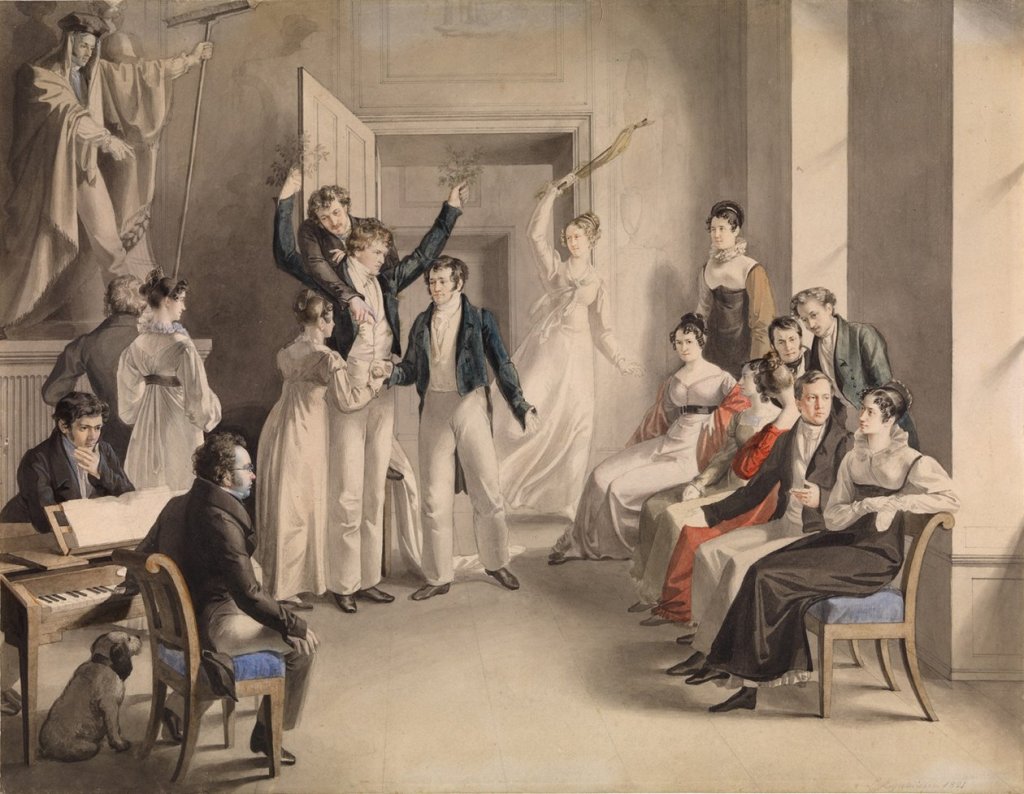
The piano is the most democratic and the most intimate instrument in the history of Western music — democratic because it found its way into the parlours and drawing rooms of the emerging middle classes, intimate because it is the one instrument on which a single person, alone, can produce a complete musical world without assistance. It was this combination — the domestic scale, the solitary player, the instrument capable of everything from a whisper to a thunderclap — that made the piano the ideal vehicle for the central artistic project of the Romantic period: the exploration of the individual human consciousness in all its complexity, its contradictions, its ecstasies and its suffering. Three composers above all others defined what the Romantic piano could do and, in doing so, changed what music was for. Franz Schubert discovered that a song could contain an entire inner life. Frédéric Chopin discovered that a single instrument, played alone at night, could carry a nation inside it. Robert Schumann discovered — and was eventually destroyed by the discovery — that the self is not one thing but many, that consciousness is multiple and unstable and glorious and terrifying, and that music could say so with a precision that language could not match. Together they made the piano into a mirror, and what it reflected was us.
Schubert: the long winter walk
Franz Schubert was born in Vienna in 1797 and died there in 1828, at thirty-one, of typhoid fever, having contracted syphilis three years earlier and spent his final years in the knowledge that his time was short and his recognition shorter still. He was not famous in his lifetime. He was known in Vienna’s musical circles, loved by a devoted group of friends and fellow artists who gathered regularly at what they called Schubertiaden — evenings of music and sociability built around his songs — but he never achieved the public recognition that his contemporary Beethoven commanded, never held a significant court appointment, spent most of his adult life in a state of genteel poverty, and died before the age at which most composers are just beginning to find their mature voice.
The statistics of what he produced in those thirty-one years are almost incomprehensible. More than six hundred songs. Nine symphonies. A vast quantity of chamber music, piano music, choral music, opera. The productivity was not the result of facility in the shallow sense — not the pouring out of uncritical abundance — but of a creative intelligence so alert, so constantly engaged with the musical problems it was setting itself, that it seems to have been constitutionally incapable of rest. He wrote, famously, with his glasses on, because he could not bear the time it took to find them in the morning. He went to bed with his glasses on for the same reason. The music was always there, waiting to be written down.
The piano is at the centre of his achievement in two forms: the solo piano pieces — the impromptus, the moments musicaux, the late sonatas — and the songs, in which the piano is not merely an accompaniment but a second protagonist, as expressive and as essential as the voice above it. To understand what Schubert did with the instrument it is necessary to understand what he did with song, and to understand what he did with song it is necessary to start with the Winterreise.
Winterreise — Winter Journey — is a song cycle of twenty-four songs, composed in 1827, the year before Schubert’s death, to poems by Wilhelm Müller. Its subject is a journey through winter undertaken by a young man who has been rejected by the woman he loves and who walks out into the cold without destination or hope, moving through a frozen landscape that mirrors and amplifies his inner state, until the cycle ends with “Der Leiermann” — The Hurdy-Gurdy Man — in which he encounters an old beggar playing a hurdy-gurdy to which no one listens, and asks him, in the final line, whether the old man will grind his songs. The question is unanswered. The music stops.
This is not a work that offers consolation. It is a work that accompanies you into a darkness and stays there with you, honestly, without pretending there is a way out. Schubert himself, when he played the songs to his friends for the first time, is reported to have said: “These songs I like more than all the rest, and you shall hear them soon.” One friend described the evening as one of the strangest he had ever spent — the beauty of the music in obvious and disturbing tension with the desolation of the subject. They did not know, that evening, that the desolation was not merely poetic — that the man sitting at the piano was himself on a winter journey that had no spring at the end of it.
But the formal achievement of Winterreise is inseparable from its emotional weight, and the formal achievement is what makes it more than autobiography, more than the document of a dying man’s grief. It is the piano writing that does the most work, and the piano writing is extraordinary in its precision. When the young man watches the weathervane spinning on his beloved’s house in “Die Wetterfahne” — the wind vane pointing in every direction, as indifferent and as fickle as love — the piano’s right hand spins around itself in a figure of barely controlled agitation that is the musical equivalent of the image, that expresses in sound the specific quality of a mind fixed on a symbol of betrayal. When the traveller watches the frozen brook in “Auf dem Flusse” — where the water that once flowed freely is now locked under ice — the piano moves with an underground current, a slow pulse beneath the melody that suggests the water still moving beneath the freeze, and the lyric asks: my heart, is your image also frozen under the ice?
This question — whether the feeling is still alive under the frozen surface — is the question the entire cycle asks, and it is a question Schubert answers at the level of musical technique rather than narrative. The piano is the feeling. It is not describing the feeling or commenting on it from outside. It is doing the feeling, in real time, in front of you, and the doing is so precise, so formally accurate, that it functions as a kind of proof: this is what it is like to feel this way, and here is the evidence that it is real, and here is the exact shape it makes when someone has had the honesty and the craft to get it right.
The late piano sonatas — particularly the final three, written in the last year of his life, D. 958, 959, and 960 — extend this achievement into purely instrumental form. The B-flat major sonata, D. 960, is the work that most fully realises what the Romantic piano could be: forty minutes of music that moves at the pace of thought rather than the pace of drama, that takes time as seriously as any Afrobeat composer took time, that trusts the listener to be present with it without offering conventional rewards for the patience. The opening movement contains one of the most extraordinary moments in all piano music: a low trill in the bass, held for what seems like an impossible duration, under a melody that keeps moving without acknowledging the tremor beneath it — a technical device that functions as a philosophical statement, the ground moving under the surface of things while the surface tries to continue as normal. It is the sound of someone who knows what is coming and is continuing anyway.
Schubert did not live to hear the late sonatas performed in public. He died before they were published. They waited in a drawer for a decade before anyone played them. They are now understood as among the supreme achievements of the piano literature. The waiting, as with Nick Drake, as with Mulatu Astatke, did not diminish them. The truth does not expire.
Chopin: the country inside the music
Frédéric Chopin was born in 1810 in the Duchy of Warsaw, the son of a French father and a Polish mother, and he left Poland at twenty and never went back. He could not go back. The Russian Empire, which controlled Poland, had crushed the November Uprising of 1830 — the patriotic rebellion in which many of Chopin’s friends and contemporaries were involved — and the Poland that Chopin had grown up in, the Poland of his childhood and his formation, ceased to exist in any political sense while he was still a young man. He spent the rest of his life in Paris, at the centre of the most brilliant artistic and intellectual society of the nineteenth century — friends with Balzac, Delacroix, Liszt, the novelist George Sand with whom he had a decade-long relationship — and he died in 1849, at thirty-nine, of tuberculosis, in his Paris apartment, with his sister at his bedside. His body is buried in Paris. His heart was removed, at his request, and taken back to Poland, where it was interred in the Church of the Holy Cross in Warsaw. It is still there.
This image — the body in one country, the heart in another — is not merely a biographical detail. It is the structural principle of his music. Chopin’s piano writing is always, underneath its formal surface, about the experience of being somewhere other than where you belong, of carrying a place inside you that the geography around you refuses to confirm. This is not a metaphor. It is a technical reality. The rhythms of Polish folk music — the mazurka, the polonaise — are woven into the fabric of his compositions with such intimacy that they are not quotations or references but presences, the actual pulse of a specific place beating inside forms borrowed from the European concert tradition.
The mazurkas are the clearest case. There are sixty-nine of them, written across his entire career, and they are among the strangest and most personal things he made — piano pieces of mostly modest length, built on the triple-time rhythm of the Polish peasant dance, that range in character from the exuberant to the heartbroken and that share a harmonic language of such originality that they still sound, in the twenty-first century, like nothing quite written before or since. The harmonic language comes from the specific modal scales of Polish folk music, which do not conform to the Western major/minor system in ways that create moments of unexpected, slightly disorienting beauty — phrases that seem to be heading toward a conventional resolution and then slip sideways onto a note that is technically wrong and emotionally exactly right, that is right precisely because it is the note from the other country, the note that doesn’t belong here and belongs nowhere else.
The nocturnes are the work through which most people first encounter Chopin, and the familiarity has perhaps blunted the strangeness of what they are. The nocturne as a form was invented not by Chopin but by the Irish composer John Field, who gave the name to a type of slow, lyrical, night-time piece for solo piano. Chopin took Field’s template and did with it something Field had never imagined: he turned it into a philosophical form, a form for thinking by, for the specific quality of consciousness that arrives at night when the day’s activity has stopped and the mind is left alone with itself.
The nocturnes are not sad, exactly, though many of them carry sadness. They are nocturnal in the deepest sense: they have the quality of thought that happens in the dark, when the usual social performances have been suspended and something more honest becomes possible. The melodies are long and ornate, elaborated with runs and trills that are not decoration but extensions of the melodic line, the melody thinking out loud, taking a phrase further than it needs to go because the feeling behind it has not yet been fully expressed. The left hand holds a pattern of open chords, widely spaced, that creates the acoustic space within which the right hand’s melody can exist — a darkness, a room, the night itself made structural.
The B minor nocturne, Op. 9 No. 1, the E-flat major nocturne, Op. 9 No. 2, the C-sharp minor nocturne, Op. 27 No. 1 — these are not pieces you analyse your way into. You enter them the way you enter a room at night, adjusting to the light available, finding your way by feel. They ask for a quality of attention that is different from the attention required by more dramatic music: not the forward-leaning, event-anticipating attention of a symphony, but something quieter and more lateral, a willingness to be in the music as it is rather than waiting for what comes next.
The two piano concertos, the four ballades, the two piano sonatas — the second of which contains the famous funeral march, and the third of which is among the most formally adventurous piano works of the century — complete a body of work that is at once instantly recognisable and endlessly surprising. Recognisable because the voice is so distinctive, so fully itself from the earliest published works to the last pieces written in the months before his death, that there is never any doubt whose music you are hearing. Surprising because the voice keeps finding new things to say, keeps discovering new corners of the harmonic world it inhabits, keeps being more strange and more beautiful than you expect.
Liszt, who knew him well and outlived him by thirty-seven years, wrote after his death: “In losing him, we have lost one of the most legitimate titles to the glory of our epoch.” It was not hyperbole. It was, as these things occasionally are, accurate.
Schumann: the house divided against itself
Robert Schumann was born in Zwickau, Saxony, in 1810 — the same year as Chopin — and died in an asylum in Endenich, near Bonn, in 1856, two years after attempting suicide by throwing himself from a bridge into the Rhine. He was forty-six. The last two years of his life were spent in the asylum, where he received occasional visits from his wife Clara, the pianist who had been the centre of his emotional and musical life for two decades, and from the young Johannes Brahms, whom Schumann had championed extravagantly in his final critical essay and who devotedly attended the dying man he had proclaimed a genius. He was, at the end, largely unable to communicate. The music had stopped.
The arc of Schumann’s life and career is the most dramatically painful in this cluster, and the temptation — as with Joy Division — is to read the music backwards from the breakdown, to find in every composition the evidence of the instability that would eventually overwhelm him. This essay resists that reading for the same reason: because the music is not the symptom of the illness. It is the alternative to it. The formal organisation that Schumann brought to the chaos of his inner life, the discipline of composition through which he gave shape to the multiplicity of voices inside him, is precisely the thing that the illness eventually took away. The music is not the breakdown. The music is what he did instead of breaking down.
Schumann was, before he was a composer, a critic — arguably the greatest music critic of the nineteenth century, the founder and editor of the Neue Zeitschrift für Musik, the journal through which he championed Chopin and Berlioz and Brahms and a new generation of Romantic composers against the conservative establishment of the German musical world. He wrote criticism under pseudonyms: Florestan, the impulsive, passionate extravert, and Eusebius, the dreamy, introspective romantic. These were not simply pen names. They were, in Schumann’s own understanding, genuine aspects of his personality — different voices that inhabited him simultaneously, different modes of being that coexisted within the single consciousness that went by the name Robert Schumann.
This self-division — this multiplicity of inner voices — is the key to everything he made. His piano music is full of it. The Davidsbündlertänze — Dances of the League of David, written in 1837 — is a set of eighteen character pieces, each one marked either F (for Florestan) or E (for Eusebius) or both, the two personae taking turns to speak, sometimes interrupting each other mid-phrase, sometimes completing each other’s sentences. The music shifts between passionate outburst and tender introspection, between the forceful and the fragile, between public declaration and private murmur, not because Schumann was being theatrical but because this is genuinely how the inner life works — not as a single sustained mood but as a conversation between different versions of the self.
The Kinderszenen — Scenes from Childhood, written in 1838 — are thirteen short pieces of such extraordinary simplicity and emotional precision that they have become, paradoxically, the work through which most people first encounter Schumann’s genius, and also the work most frequently misunderstood. They are not music for children. They are music about childhood, written from the perspective of an adult looking back — the title “Kinderszenen” means “scenes from childhood” in the past tense, the scenes recalled rather than inhabited. The most famous of them, “Träumerei” — Dreaming — is two pages of music that achieves, in its three minutes, a state of suspended reverie so complete that it has functioned, for nearly two centuries, as the musical definition of a specific human experience: the experience of being momentarily elsewhere, in a time before the present’s complications, in a space of safety that may or may not have existed but is nonetheless remembered.
The piano cycle Carnaval, written in 1835, is the most extravagant statement of the multiple-selves principle: twenty-one pieces depicting characters at a masked ball, including musical portraits of Chopin, Paganini, Florestan, Eusebius, and the woman Schumann loved and eventually married — Clara Wieck, the daughter of his piano teacher, whom her father forbade him to see and whom he married only after winning a court case against Friedrich Wieck’s opposition. Clara is present in the music before the marriage, during it, and after it; her musical theme appears in Schumann’s compositions the way a person appears in dreams, reliably, transformed but recognisable, the underlying presence around which the other material organises itself.
Clara Wieck Schumann is herself one of the great figures of the period — a pianist of extraordinary technical command, widely considered the finest interpreter of her era, and a composer of genuine originality whose own work has been systematically undervalued by a musical culture that found it difficult to take a woman composer seriously. Her relationship with Robert was one of the great artistic partnerships of the nineteenth century and one of its most complicated human stories: she supported him, championed his music, managed his increasingly unstable mental state, bore eight children, continued concertising throughout, and after his death devoted decades to editing and promoting his work. To encounter Robert Schumann’s music without understanding Clara’s role in it is to miss a structural element of what the music is and what it was for.
The Fantasie in C major, Op. 17, written in 1836, is the summit of Schumann’s piano achievement and one of the great works in the entire piano literature. It was written as a contribution to a fund for a monument to Beethoven, and the dedication is to Liszt, but the soul of the piece is Clara — the slow movement in particular, which is a love song of such unguarded tenderness that Schumann, in a letter to Clara, told her it was only comprehensible to someone who understood the situation between them. The situation was that they were forbidden from communicating. The music was the communication.
This is a recurring theme in this cluster — music as a form of speech when direct speech is impossible, as the language of the inner life when the outer life has closed off other channels — and in Schumann’s case the necessity was literal. He could not reach Clara directly. He could reach her through the music. The music was therefore not simply expression but transmission, a message encoded in notes because notes were the one medium that Friedrich Wieck could not intercept.
By the late 1830s and 1840s — after the marriage, after the move to Leipzig and then Dresden and then Düsseldorf — Schumann turned increasingly to orchestral and chamber music, and the piano works of the later period, while containing individual achievements of great beauty, do not sustain the concentrated intensity of the early piano cycles. The illness was advancing. The voices inside him were becoming harder to manage, harder to separate into the formal structures that had previously given them shape. In 1854 he heard voices that were not Florestan and Eusebius but something more frightening, something he described as music of extraordinary beauty coming to him from the spirits of Schubert and Mendelssohn — a visitation he could not control and could not stop. He threw himself from the bridge. He was taken to the asylum. He asked for music paper but the doctors refused, fearing it would agitate him further. He died without it.
What the three of them made together
Schubert, Chopin, Schumann — three composers, three countries, three different relationships to the piano, three different versions of the Romantic project. What do they share, and why does it matter?
They share, first, the understanding that the piano is not primarily a virtuosic instrument — not a vehicle for the display of technical accomplishment, not a machine for impressing audiences with speed and power — but a thinking instrument, an instrument for the exploration of inner states that are too complex and too unstable for any other medium to hold. The piano can be loud and soft, fast and slow, simple and ornate, simultaneously — it can embody contradiction within a single phrase in a way that no other instrument can, and it was this capacity for internal contradiction that made it the ideal instrument for the Romantic consciousness, which understood the self precisely as a site of contradiction, of multiple competing impulses, of feeling and reason and memory and desire all occupying the same space at the same time.
They share, second, the relationship between music and the unsayable. What Schubert put into the Winterreise, what Chopin put into the nocturnes, what Schumann put into the Fantasie and the Davidsbündlertänze, was not something that could have been expressed in words — not because these were not literary men (all three were deeply engaged with poetry and literature and criticism) but because the specific thing they were expressing was the thing that exists below the level of language, the feeling that language points toward but cannot occupy. The piano got there first. The piano got there more completely. This is the argument for instrumental music that these three composers make more powerfully than anyone before or since: that there are truths which music can tell and words cannot, and that those truths are not vague or ineffable but precise, specific, as exact in their musical form as an equation is exact in its mathematical form. You just need the right instrument to read them.
They share, third, the shadow of time. All three lived with the awareness of limited time — Schubert with the explicit knowledge of his own approaching death, Chopin with the slow erosion of tuberculosis, Schumann with the creeping approach of the instability that would eventually silence him. This awareness does not make the music morbid. It makes it urgent. It makes it honest. It makes every note feel chosen rather than automatic, every phrase feel earned rather than simply produced. Listening to the late Schubert sonatas, the late Chopin nocturnes, the early Schumann piano cycles, you are in the presence of people who knew what they had to say and understood that time was the one resource they could not renew. The result is music in which nothing is wasted, nothing is filler, every moment justifies its place in the whole.
They were all, by the standards of their time, imperfectly received. Schubert was known for his songs but the large-scale instrumental works were understood only after his death. Chopin was celebrated in Parisian salon society but misunderstood as a miniaturist, a salon composer, rather than the radical harmonic thinker he was. Schumann’s critical writing was more widely read than his compositions, and his mental illness was used, as it has always been used in such cases, to retrospectively invalidate his judgement and cast doubt on his work. In each case the full reception came later, after the composer was gone, when the music could be heard without the interference of the person’s circumstances.
This is one of the things that the classical tradition does well, that popular music does less reliably: it keeps the music. The institutions that preserve and perform it — the concert halls, the conservatoires, the recording industry — have their flaws and their biases, but they have kept Schubert’s late sonatas and Chopin’s mazurkas and Schumann’s piano cycles available to every generation since they were written, played by musicians who have devoted their lives to understanding them, renewed in each performance by the encounter between a living interpreter and a dead composer’s intentions. The music does not need to sell. It needs to be played, and it has been played, continuously, for nearly two centuries, because the people who encounter it understand that they are in the presence of something that cannot be replaced.
Put on the Winterreise sung by Dietrich Fischer-Dieskau with Gerald Moore at the piano — the 1951 recording, if you can find it, or the 1972, both extraordinary — and follow the young man out into the snow. Listen to the first nocturne of Op. 9 on a night when you can give it your full attention, in the dark if possible, and let the left hand’s opening chords establish the space before the melody arrives. Find a recording of the Davidsbündlertänze — Radu Lupu’s, or Murray Perahia’s, or Clara Haskil’s — and listen to Florestan and Eusebius argue and agree and interrupt each other, the two voices that were one person, the one person who held them as long as he could.
This is what the Romantic piano was for. This is what these three composers discovered, separately and together, in the four decades between Schubert’s first mature piano works in the 1820s and Schumann’s death in 1856. They discovered that the instrument in the room, the one that everyone owned and everyone could play at the basic level, was capable of containing the whole interior life of a human being — the grief and the longing and the joy and the terror and the love, especially the love, which all three composers understood as the force that makes the darkness both unbearable and bearable, that makes the winter journey worth undertaking even when you know it has no destination.
The piano is still in the room. The music is still there. The winter is always somewhere.
Sources and further reading
Primary works — recommended recordings
Schubert: Winterreise — Dietrich Fischer-Dieskau (baritone) and Gerald Moore (piano). EMI, 1951 and 1972 recordings both essential. Hans Hotter’s 1954 recording with Moore offers a darker, weightier interpretation. For a more contemporary approach, Mark Padmore with Paul Lewis (Harmonia Mundi, 2009) is outstanding.
Schubert: Piano Sonatas D. 958, 959, 960 — Alfred Brendel’s three recordings (Vox, 1960s; Philips, 1987; Philips, 2000) constitute the most comprehensive recorded exploration of these works. Sviatoslav Richter’s live recordings, particularly the 1979 Aldeburgh performance of D. 960, are incomparable in their gravity.
Chopin: Nocturnes — Arthur Rubinstein (RCA, 1965) remains the classic reference recording; Maria João Pires (Deutsche Grammophon, 1996) offers a more inward, less overtly expressive approach. Both are indispensable.
Chopin: Mazurkas — Rubinstein again (RCA, 1966), but also Maurizio Pollini (Deutsche Grammophon, 1999) for the structural clarity he brings to the harmonic language.
Schumann: Fantasie in C major, Davidsbündlertänze, Carnaval — Murray Perahia (Sony, various) and Radu Lupu (Decca, various) are the most consistently satisfying interpreters of the piano cycles. For the Fantasie specifically, Maurizio Pollini’s recording (Deutsche Grammophon, 1973) is the landmark version.
Schumann: Kinderszenen — Vladimir Horowitz (CBS/Sony, 1968 Carnegie Hall recording) for the most emotionally direct interpretation; Perahia (Sony) for the most musically complete.
Critical and biographical writing
Deutsch, Otto Erich. Schubert: A Documentary Biography. Dent, 1946. The essential primary source collection for Schubert’s life; everything known about him in documents, letters, and contemporary accounts assembled in one volume.
Newbould, Brian. Schubert: The Music and the Man. Gollancz, 1997. The most thorough modern account of the music; particularly strong on the late instrumental works and the song cycles.
Samson, Jim. Chopin. Oxford University Press, 1996. The standard scholarly biography in English; balanced, rigorous, and genuinely illuminating about the relationship between Chopin’s Polish identity and his harmonic language.
Eigeldinger, Jean-Jacques. Chopin: Pianist and Teacher as Seen by His Pupils. Cambridge University Press, 1986. An account of Chopin’s teaching methods assembled from the testimonies of his students; invaluable for understanding how he thought about the piano and what he wanted from performers of his music.
Ostwald, Peter. Schumann: The Inner Voices of a Musical Genius. Northeastern University Press, 1985. A psychobiography by a psychiatrist who was also a musician; more convincing than most psychobiographies because Ostwald is genuinely equipped to discuss both the clinical and the musical dimensions of Schumann’s life.
Reich, Nancy B. Clara Schumann: The Artist and the Woman. Cornell University Press, 1985; revised edition 2001. The essential biography of Clara; makes the case for her importance as a composer and performer with the rigour and the passion the subject deserves.
For the general reader — introductory essays and guides
Rosen, Charles. The Romantic Generation. Harvard University Press, 1995. The most intellectually distinguished account of the Romantic musical period available in English; Rosen was a concert pianist as well as a scholar, and his writing on the piano music of this period — particularly on Schubert’s song forms and Chopin’s harmonic language — is the best starting point for any reader who wants to understand what these composers were doing technically without becoming lost in specialist terminology.
Schonberg, Harold C. The Great Pianists. Simon & Schuster, 1963; revised 1987. A history of piano playing from the Baroque to the twentieth century; the chapters on the Romantic period give a vivid account of how Chopin and Schumann were received as performers and what their contemporaries understood them to be doing.
