
The Geometry of the Instant
Henri Cartier-Bresson invented a way of seeing so complete that it became the unconscious grammar of photography itself. Then, quietly, he put down the camera and went back to drawing. He had always said it was a sketchbook, not a vocation. He meant it.
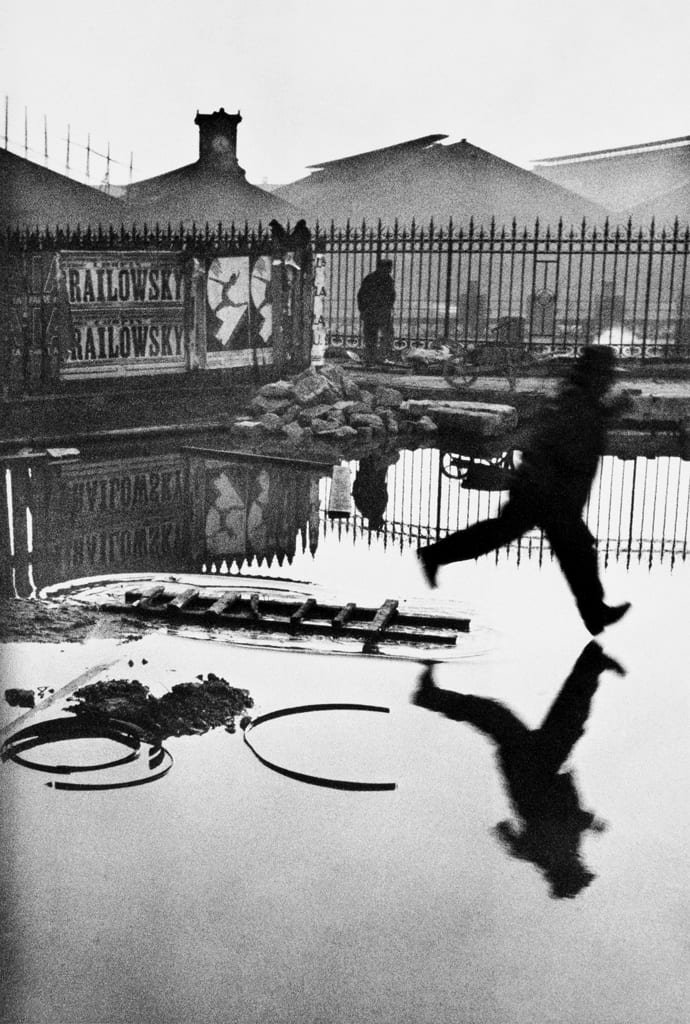
Behind the Gare Saint-Lazare in Paris, sometime in 1932, a man leaps over a puddle. He is caught in the air, mid-stride, his reflection perfectly preserved in the water below him, a ladder and a poster and the iron lattice of the station roof arranged behind him with a precision that no stage designer could have improved on. The photograph lasts a fraction of a second. It has lasted ever since. Henri Cartier-Bresson made it with a Leica he poked through a gap in a hoarding, not quite knowing what was on the other side, and he called it — or rather the moment it represents — the decisive moment: the instant at which form and content align so completely that the image becomes, in his word, inevitable.
The phrase has followed him like a shadow for ninety years. It is both perfectly accurate and slightly misleading, in the way that all great critical formulations are: accurate because the images it describes do have that quality of necessity, of rightness, of the feeling that this is the only possible image of this moment; misleading because it makes the achievement sound passive — as if Cartier-Bresson simply waited for the world to arrange itself correctly and then pressed the shutter — when the reality was something far more active, more intellectual, more wilfully constructed than the word “moment” tends to imply.
The decisive moment: the instant at which form and content align so completely that the image becomes inevitable. Accurate and slightly misleading, in the way all great critical formulations are.
The Painter Who Became a Photographer
Henri Cartier-Bresson was born in 1908 in Chanteloup-en-Brie, outside Paris, into a prosperous bourgeois family — his great-uncle had founded the thread company whose name still appears on spools of cotton in haberdasheries across Europe. He was given a conventional education and an unconventional amount of freedom, and what he did with that freedom was paint. He studied with the Cubist painter Jacques-Émile Blanche, then with the more rigorous André Lhote, who taught him the geometrical principles of composition — the golden section, the organisation of the picture plane into zones of tension and balance — that would govern everything he subsequently made. He is often described as a photographer who thought like a painter. The truth is simpler and more interesting: he was a painter who discovered that photography was a faster and more demanding version of the same activity.
The decisive influence was Surrealism. In the late 1920s, Cartier-Bresson moved in circles that included André Breton, Max Ernst, and the Surrealist circle that was reorganising the relationship between the conscious and unconscious mind, between intention and accident, between the planned image and the found one. What the Surrealists gave him was permission to take the street seriously — to treat the everyday world as a source of images as rich and strange as anything the deliberate imagination could construct. The photographer whom he most admired was not a Surrealist but might as well have been: Eugène Atget, who had spent decades photographing the streets and courtyards and shop windows of Paris with an old-fashioned plate camera, accumulating a record so complete and so strange that it looked like a dream of the city rather than a document of it.
He bought his first Leica in 1932, in Marseille, and understood immediately that it was the right instrument. The Leica was small, quiet, fast — a camera you could carry in a coat pocket, raise to the eye and fire before the subject had registered that they were being photographed. It was, relative to the studio cameras and press cameras of the period, almost invisible. This was not incidental to Cartier-Bresson’s project. Invisibility was the project. He wanted to photograph the world without disturbing it, to be present without being seen, to catch life in the act of being itself rather than in the act of performing for a camera.
The Decisive Moment, Properly Understood
The phrase comes from a seventeenth-century French cardinal, Jean de Retz, who wrote that there is nothing in this world that does not have a decisive moment. Cartier-Bresson took it as the title of his 1952 book — published in French as Images à la Sauvette, images on the run, a title that is in some ways more accurate — and used it to describe his theory of the photograph: the simultaneous recognition, in a fraction of a second, of the significance of an event and of a precise organisation of forms which gives that event its proper expression.
The key word is simultaneous. What Cartier-Bresson was describing was not the fortunate accident — the photographer who happens to be in the right place at the right moment and presses the shutter in time — but a cultivated capacity: the ability to see form and content together, at speed, in the midst of movement, under the pressure of a world that does not pause for the photographer’s convenience. The decisive moment is not found. It is recognised, which is a different and much harder thing. Recognition requires preparation: the trained eye, the internalized geometry, the understanding of how bodies move through space and light falls across surfaces and crowds organise themselves into compositions that open briefly and then close again.
He practiced this with the discipline of an athlete. He walked cities for hours. He returned to the same streets at different times of day, in different weather, in different seasons. He shot thousands of frames and used very few — he was ruthless in editing, and the ruthlessness was itself part of the method. The images that survived were the ones in which everything was right simultaneously: the moment, the light, the geometry, the human content, the relationship between foreground and background, between stillness and motion, between the particular and the general. When all of these aligned, the image had the quality he was after. When any one of them was wrong, the image was discarded.
The decisive moment is not found. It is recognised — which is a different and much harder thing. Recognition requires preparation: the trained eye, the internalised geometry, the understanding of how bodies move through space.
Magnum
In 1947, Cartier-Bresson co-founded Magnum Photos with Robert Capa, David Seymour, George Rodger, and William Vandivert. The agency was a collective — photographer-owned, photographer-controlled, structured to give its members the rights to their own negatives and the freedom to pursue the stories they judged important rather than the ones editors dictated. It was a radical proposition in the photojournalism of the post-war period, when picture agencies owned the work their photographers made and used it as they saw fit. Magnum made the photographer an author rather than an employee, and it changed the economics and the ethics of the profession permanently.
Capa was the war photographer, the extrovert, the man who made his name at the Spanish Civil War and would die stepping on a landmine in Indochina in 1954. Cartier-Bresson was the traveller — quieter, more interior, more interested in the texture of ordinary life than in the drama of conflict. He photographed the liberation of Paris, but he also photographed Gandhi hours before his assassination in 1948, and the last days of the Kuomintang in China, and the coronation of George VI, and the streets of Mexico and India and the American South. He went everywhere and he looked at everything with the same quality of attention: the same patience, the same geometrical intelligence, the same refusal to impose a meaning on the image that the image itself did not contain.
The photographs he made across these decades constitute one of the most remarkable archives in the history of the medium — not because they document important events, though many of them do, but because they document the quality of being alive in the mid-twentieth century with a specificity that no written account quite matches. To look through the contact sheets — the unedited strips of film from which the final images were chosen — is to understand how the decisive moment is made: most frames slightly off, the geometry not quite right, the moment a fraction too early or too late, and then, among dozens of near-misses, the one that is right, that has the quality of necessity, that looks as if it could not have been otherwise.
The Eye and the Golden Section
Cartier-Bresson was insistent, in a way that some of his admirers found slightly inconvenient, that photography was a matter of the eye first and last — that technical questions of equipment and darkroom process were of secondary importance, that the negative was a sacred document which must not be cropped or manipulated, that the image was made at the moment of exposure and nowhere else. He did not dodge. He did not burn. He printed full-frame, showing the black border of the negative to demonstrate that nothing had been altered. The image was what it was at the moment of its making, or it was nothing.
This sounds like a puritanism, and it is partly that. But it is also a philosophical position about what photography is for. Cartier-Bresson believed that the camera’s specific virtue was its relationship to time — its ability to stop a moment that would otherwise be continuous and irrecoverable — and that any manipulation after the fact was a betrayal of this virtue. The photograph was honest or it was a lie, and the honesty lay in the fidelity to the moment as it actually was, not as the photographer subsequently wished it had been.
What he brought to this honesty was the Lhote training: the understanding that a good image is a geometrically organised image, that the elements within the frame must relate to each other according to principles of tension and balance that the eye feels before the mind names. He composed instinctively, at speed, but the instinct was the product of years of deliberate study, of drawing and looking and understanding the principles by which the eye is organised and satisfied. The decisive moment, in this sense, is not a moment at all. It is the convergence of a prepared eye and a fleeting configuration of the world, lasting perhaps a twentieth of a second, in which everything that Cartier-Bresson knew about geometry and light and human movement came together in a single press of the shutter.
The decisive moment is not a moment at all. It is the convergence of a prepared eye and a fleeting configuration of the world, lasting perhaps a twentieth of a second.
The Return to Drawing
In the early 1970s, Cartier-Bresson put down the camera. Not dramatically, not with a manifesto — quietly, gradually, the way a person stops doing something they have done for forty years when they discover they have said what they needed to say. He returned to drawing, which had been his first practice and which he had always regarded as the more fundamental discipline. He drew portraits, landscapes, nudes — in pencil, slowly, without the speed and instinct that photography had required. He said that drawing was meditation, that it put him in a different relationship to the world than photography had: more patient, more intimate, more accepting of time.
He lived until 2004, dying at ninety-five in his house in Provence, having spent the last three decades of his life largely in private, drawing and reading and refusing most interviews. He had always said that photography was a sketchbook, a tool of the instant, and that the deeper pursuit was something slower and more demanding. Whether drawing was that pursuit, or whether it was simply the activity that remained when the urgency of the decisive moment had passed, is not entirely clear. What is clear is that he did not miss the camera — or if he did, he did not say so.
What he left behind is a body of work that has shaped the way everyone who has picked up a camera since 1932 sees the world, whether or not they know it. The grammar of the decisive moment — the instinct to wait for the instant of maximum form, to see the street as a stage on which geometry and chance collaborate — is so thoroughly absorbed into photographic culture that it functions now as a kind of visual common sense: the way the medium seems naturally to work, the standard against which all street photography is still, consciously or not, measured. He made the invisible visible. Then he went home and drew.
Works referenced: Behind the Gare Saint-Lazare (1932); Images à la Sauvette / The Decisive Moment (1952); The Europeans (1955); From One China to the Other (1954); Henri Cartier-Bresson in India (1987). Magnum Photos (founded 1947). This essay is part of an ongoing series, Encounters, on artists whose practice cannot be easily categorised.
Discover more from My World of Interiors
Subscribe to get the latest posts sent to your email.

