
By Bergotte
Joy Division made two studio albums and a handful of singles between 1978 and 1980, and their singer Ian Curtis hanged himself in his kitchen in Macclesfield on the eve of the band’s first American tour, at the age of twenty-three. It would be easy — it has been easy, for forty years — to make the death the meaning, to read the music backwards from the suicide and find in every lyric a premonition, in every performance a farewell. This essay refuses that reading, not because the death is irrelevant but because it is the music, not the biography, that has earned Joy Division their place in history. What they did in those two albums was take the electronic language that Kraftwerk had built in Düsseldorf — the pulse, the machinery, the cold beauty of the modern world rendered in synthesizers — and fill it with something Kraftwerk had never put inside it: the specific weight of an English post-industrial city, the specific texture of a consciousness that perceives the world at an angle that makes ordinary life feel simultaneously vivid and utterly, bewilderingly remote. They made the darkness habitable. That is their achievement, and it belongs to all four of them, and it does not require a death to be real.
Salford, and the weight of the place
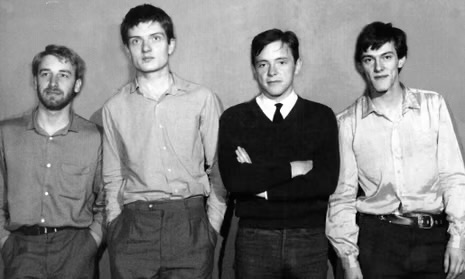
Ian Curtis was born in Macclesfield in 1956. Bernard Sumner and Peter Hook grew up in Salford. Stephen Morris came from Macclesfield. They were, with the exception of Morris who joined later, teenagers at the same Manchester concert in June 1976 at which the Sex Pistols played to an audience of perhaps forty people, and the concert did to them what that concert is reported to have done to everyone who attended it: it told them that making music was not a specialist activity requiring specialist training but an act of will available to anyone with enough conviction. They formed a band. They called it Warsaw, then Joy Division. They began to find out what they sounded like.
But the place matters before the music, because the music cannot be separated from it. Manchester and Salford in the late 1970s were cities in the advanced stages of a deindustrialisation that had been underway for decades and was about to accelerate catastrophically under Thatcher. The textile mills and engineering works that had made the region the engine of the Industrial Revolution were closing. The communities built around them were fraying. The Victorian infrastructure — the warehouses, the canal systems, the dense terraced housing — remained, but the economic life that had justified it was draining away, leaving behind a landscape of enormous, melancholy grandeur: these vast brick structures built for a purpose that no longer existed, standing in the rain under a sky that seemed lower and heavier than skies elsewhere.
This landscape is not incidental to Joy Division’s music. It is the music’s emotional climate, the air it breathes. The space and the weight of those post-industrial spaces — the way they dwarf the human figure, the way they are simultaneously familiar and strange, the way their beauty is entirely bound up with their desolation — is present in every bar of every Joy Division recording. Bernard Sumner has spoken about growing up in a Salford slum that was demolished when he was a child, about the specific grief of watching the streets you knew reduced to rubble in the name of progress, about the particular quality of absence that remained. The music is full of that absence. It echoes in it the way sound echoes in an empty building.
Martin Hannett and the sound of the void
Before the songs themselves, something must be said about Martin Hannett, the Manchester producer who recorded both Joy Division albums and who was responsible, as much as the band, for the sound that made those albums what they are.
Hannett was a difficult, drug-addled, visionary eccentric who understood immediately what Joy Division were trying to do and understood, equally immediately, that the way to realise it was not to record them playing live in a room — which is how most rock bands of the period were recorded — but to take them apart and put them back together in a space of his own construction. He used techniques that were, in 1978 and 1979, genuinely novel: recording the drums in a stairwell to capture the specific reverb of hard surfaces and empty space; using digital delay on Stephen Morris’s snare to create a crack that hangs in the air slightly longer than physics should allow; burying the bass in the mix and elevating the treble, inverting the conventional rock frequency balance, creating a sound that felt both close and enormously distant simultaneously.
What Hannett built, across the two albums, was a sonic architecture that was the aural equivalent of those post-industrial spaces: vast, reverberant, slightly unreal, full of air and emptiness and the occasional sound that arrives from somewhere you can’t identify. When you listen to Unknown Pleasures on headphones — and it is one of those records that headphones transform — you are inside a space rather than listening to a performance. The instruments occupy specific locations in that space, separated by distances that feel physical, and Curtis’s voice moves through it with the quality of something not quite anchored: present, audible, immediate, and also somehow remote, as if arriving from a place slightly outside the room.
This is the third member of the cluster’s great formal discoveries, following Kraftwerk’s motorway and Mulatu’s modal space: the studio itself as an instrument, the recording space as a meaning-making element rather than a neutral container. Hannett understood that the story Joy Division were telling required a specific acoustics, and he built those acoustics from scratch.
Unknown Pleasures: the sound that arrived
Unknown Pleasures, released on Factory Records in June 1979, is one of those records that sounds, on first hearing, like something that has always existed — as if it were not made but discovered, as if the music had been present in the atmosphere of its time and place and the four musicians had simply been the ones standing in the right position to receive it.
The cover — Peter Saville’s iconic design, a white rendering on black of the stacked pulsar signal from the Cambridge Encyclopaedia of Astronomy, no band name, no album title — is a statement of intent. This is not a record that will explain itself to you. It will not make itself accessible. It will wait for you to meet it on its own terms, and its terms are the terms of the music inside: precise, austere, lit from within.
“Disorder” opens the album with a guitar figure of compressed, nervous energy and a bass line that Peter Hook plays high on the neck — a distinctive choice that gives the low end of the Joy Division sound a melodic quality unusual in rock music, the bass functioning as a second lead instrument rather than a rhythmic foundation. Curtis enters with a voice that is baritone in register and entirely without the conventional markers of rock vocal performance: no vibrato, no emphasis, no emotional colouring of the kind that signals to the listener how they are supposed to feel. He states. He reports. He describes a consciousness in a state of disturbance with the flat precision of someone reading an instrument that is giving bad readings and cannot be sure whether the instrument is faulty or the readings are correct.
This vocal approach — the flat affect, the reportorial quality, the refusal to perform emotion while clearly being consumed by it — is Curtis’s greatest formal achievement and the most misunderstood aspect of his art. It is routinely read as depression, as numbness, as the voice of someone who has given up. It is, in fact, the voice of someone engaged in a very particular kind of emotional labour: the labour of maintaining enough distance from what you are feeling to be able to describe it accurately. The control is not the absence of feeling. It is what feeling costs when you are determined to tell the truth about it rather than perform a version of it.
“She’s Lost Control” — written about a girl with epilepsy whom Curtis had met in his work as an employment counsellor, and which takes on its full weight only when you know that Curtis himself was diagnosed with epilepsy in late 1978, that his seizures were becoming more frequent and more severe, that the song is therefore both observation and self-portrait — is the album’s most fully realised track: a groove of terrible urgency, the bass and drums locked into a pattern that suggests not momentum but entrapment, a rhythm that is moving without going anywhere, that circles rather than advances. The lyric describes a woman losing the thread of herself, losing the boundary between her consciousness and the world around it, and the music underneath the description does what Hannett’s production does throughout: it creates space around the thing being described, space that makes the thing more visible rather than less, space that says: look at this, do not look away, this is real and it matters and it is happening right now.
The live performances and what they cost
Between the two albums, Joy Division toured with an intensity that was already damaging Curtis’s health before anyone fully understood how damaged it was. The epilepsy was worsening. The medication he was prescribed — phenobarbitone, later sodium valproate — had side effects that included depression. He was, by all accounts, extraordinarily present in performance: the dancing that became his stage signature, the physical abandon, the movements that resembled and were later revealed to be related to his seizures, gave the concerts a quality of exposure that was genuinely disturbing to witness. People who saw Joy Division live in 1979 and 1980 speak about the performances with a consistency that is striking: they were not like other concerts. Something was at stake that was larger than the occasion.
This quality of exposure — the sense that what was happening on stage was not a performance in the conventional sense but an event, something whose outcome was uncertain — translated into the recordings in a way that is hard to fully account for technically. The music sounds like it is at risk. It sounds like something could go wrong. The control is total — the arrangements are precise, the playing is disciplined — and yet there is an edge of something uncontrolled beneath the control, a feeling that the discipline is being maintained against pressure rather than simply applied. This tension between control and its absence is what gives Unknown Pleasures and its successor their sustained power: you are always aware of what the music is holding back, of the thing underneath the surface that the surface is containing, barely, for the duration of the album.
Closer: the formal achievement
Closer, recorded in March 1980 and released in July of that year, two months after Curtis’s death, is a more formally ambitious record than Unknown Pleasures and, taken on those formal terms, a greater one. It is the record on which Joy Division moved definitively beyond the post-punk context that had shaped their debut and toward something that owed more to the European avant-garde — to Krautrock, to the minimal electronic compositions of the German and American traditions, to the string-driven austerity of certain contemporary classical composers — than to anything in the British rock tradition.
The opening track, “Atrocity Exhibition,” takes its title from J.G. Ballard’s experimental novel about the psychological damage of the media age, and the music matches the ambition of the reference: six minutes of controlled disintegration, the drums processed into something percussive but not quite rhythmic, the guitar and synthesizer creating a texture rather than a melody, Curtis’s voice at its most extreme and most compelling. The lyric moves through images of violence and spectacle and the numbing of feeling that comes from too much exposure to both, and it does so with the hallucinatory precision of genuine vision rather than the portentous vagueness that the subject might have invited from a lesser writer.
“Isolation” is the album’s most purely beautiful track: a synthesizer melody of great delicacy, a drum machine pattern that has shed the organic roughness of Morris’s live playing and taken on something cleaner and more mechanical, Curtis singing about the specific loneliness of being unable to make ordinary emotional contact, the gap between what he feels and what he can transmit. The word “isolation” is used not as dramatic hyperbole but as a clinical description of a state: the condition of being inside a consciousness that cannot find the connection it needs, that is fully alive and fully alone simultaneously.
“The Eternal” and “Decades” close the album as a diptych of extraordinary stillness — long, slow, orchestrated tracks that move at the pace of elegy rather than the pace of rock music, that seem to exist outside of the album’s time signature and outside of ordinary time entirely. They are, of all the things Curtis wrote, the most exposed and the most formally resolved: the feeling and the form in complete alignment, nothing wasted, nothing overdone, the darkness fully inhabited and fully expressed and left where it is, without consolation, without resolution, because consolation and resolution would have been false.
Curtis hanged himself on the 18th of May 1980. He had watched Werner Herzog’s Stroszek — a film about a German immigrant in America whose life ends in bewilderment and isolation — and listened to Iggy Pop’s The Idiot through the night. Closer was already recorded. Its contents were already fixed. Whether or not the record is a farewell in the conscious sense is a question that cannot be answered. What can be said is that it sounds complete: a body of work that has said what it needed to say, that has arrived somewhere, that does not require a continuation to be finished.
What the darkness was for
It is at this point that the essay must make its most important argument, the one that the biography most aggressively obscures: the argument about what Joy Division’s darkness actually is and what it is for.
The easy reading — the reading that has generated the mythology, the films, the hagiography, the generation of young men who have worn the Unknown Pleasures cover on their chests as a badge of sensitivity — is that Joy Division are music for despair: that they speak to the listener who is suffering and confirm that the suffering is real and that there is no way through it. This reading is not entirely wrong. They do speak to suffering. They do confirm its reality. But it mistakes the confirmation for the end of the argument, when the confirmation is only the beginning.
What Joy Division actually do — what distinguishes them from mere depression-as-aesthetic, from the many artists who have borrowed their surface without their substance — is take the suffering seriously enough to shape it. The darkness is not wallowed in. It is worked. The songs are not expressions of helplessness but acts of agency: the agency of someone who has taken the most difficult material of their inner life and made from it something formally beautiful, something with structure and discipline and meaning, something that can be given to another person and received.
This is what art does with suffering and what separates art from self-pity. Self-pity leaves the suffering where it finds it, raw and undifferentiated, available only to the person experiencing it. Art transforms the suffering into something transmissible — into a form that another person can receive and recognise and use, that says: this darkness you are feeling is not a private pathology but a known human state, and here is proof, here is the shape it makes when someone who has felt it has had the honesty and the craft to get it right.
Joy Division got it right. That is their legacy, and it is separate from the circumstances of Curtis’s death, and it belongs to Bernard Sumner and Peter Hook and Stephen Morris as much as to Curtis himself — to the musicians who built the architecture within which the darkness could be expressed, who played with the precision and the discipline that the material required, who made Unknown Pleasures and Closer together and whose contribution to those records is inseparable from their greatness.
The silence and what came after
After Curtis’s death, three musicians remained. Bernard Sumner, Peter Hook, and Stephen Morris chose, eventually, to continue — not as Joy Division, which ended with Curtis, but as something new, something that would have to find its own answer to the question the death had posed: how do you go on? What do you make after this?
The answer they found was Blue Monday. But that is the next essay.
What Joy Division left behind is two albums, a body of singles, and a series of live recordings that constitute one of the most coherent and fully realised artistic statements in the history of popular music. The coherence is formal as much as emotional: these records have a sound, a world, a consistent set of values about what music is for and how it should work, that is entirely their own and entirely earned. They borrowed from Kraftwerk and from the post-punk scene around them and from the European avant-garde, but the synthesis is so complete that the sources have been digested rather than displayed. The result is original in the deepest sense: not new for the sake of novelty, but new because the thing being expressed was genuinely new, had never been expressed in this way before, and required a new form to hold it.
The pulse that runs through Unknown Pleasures and Closer — the pulse that Hannett placed at the centre of the sound, that mechanical heartbeat underneath the guitars and the bass and the voice — is still running. It runs through the music that came out of Manchester in the decade after Curtis’s death, through the music that came out of every city that received the records and understood them. It runs through the music of people who have never heard of Joy Division but have heard the music of people who have. It is the sound of a specific city in a specific moment of historical change, and it is also the sound of a consciousness at its limit, shaped into something that can be shared.
That is what Joy Division were for. That is enough.
Sources and further reading
Primary works
Joy Division. Unknown Pleasures. Factory Records, 1979. The essential starting point; headphone listening is strongly recommended for the full effect of Hannett’s production.
Joy Division. Closer. Factory Records, 1980. The formal completion; “Atrocity Exhibition,” “Isolation,” and “Decades” are the tracks that reward the most sustained attention.
Joy Division. Still. Factory Records, 1981. A posthumous double album containing live recordings and studio outtakes; the live performances are essential for understanding what the band were doing on stage that the studio recordings only partially capture.
Joy Division. Substance. Factory Records, 1988. The singles compilation; “Transmission,” “Love Will Tear Us Apart,” and “Atmosphere” are the essential tracks outside the two studio albums.
Biographical and critical writing
Hook, Peter. Unknown Pleasures: Inside Joy Division. Simon & Schuster, 2012. The bass player’s account of the band’s history; partisan and occasionally self-serving, as all band memoirs are, but contains irreplaceable primary detail about the formation of the sound and the experience of working with Hannett.
Middles, Mick, and Lindsay Reade. Torn Apart: The Life of Ian Curtis. Omnibus Press, 2006. The most thorough biographical account of Curtis; Reade was married to Tony Wilson, the Factory Records founder, and her proximity to the Manchester scene gives the book an intimacy that more distant accounts lack.
Morley, Paul. Nothing. Secker & Warburg, 2000. A memoir and meditation by the NME journalist who was present at the centre of the Manchester post-punk scene; not a conventional biography or criticism, but one of the most intelligent pieces of writing about what Joy Division meant and why.
Reynolds, Simon. Rip It Up and Start Again: Post-Punk 1978–1984. Faber and Faber, 2005. The indispensable critical account of the broader movement; the Joy Division chapters are among the book’s strongest, situating the band within the post-punk context while making clear how thoroughly they transcended it.
Documentary and film
Joy Division, directed by Grant Gee, 2007. A documentary drawing on archival footage and interviews with surviving band members and collaborators; the performance footage is essential.
Control, directed by Anton Corbijn, 2007. A dramatisation of Curtis’s life, shot in black and white, based on Deborah Curtis’s memoir Touching from a Distance. Corbijn was the photographer most closely associated with the visual world of Joy Division and Factory Records, and his film has an authenticity of visual atmosphere that more conventional biopics lack.
On the wider context
Haslam, Dave. Manchester, England: The Story of the Pop Cult City. Fourth Estate, 1999. The most thorough account of the cultural geography that produced Joy Division — the specific relationship between the post-industrial landscape of Manchester and Salford and the music that emerged from it in the late 1970s and 1980s.
Savage, Jon. England’s Dreaming: Sex Pistols and Punk Rock. Faber and Faber, 1991. The essential account of punk as context; the trajectory from the Sex Pistols concert that Sumner and Hook attended to the formation of Joy Division is one of the most consequential lines in British cultural history and Savage traces its beginning with definitive precision.
Discover more from My World of Interiors
Subscribe to get the latest posts sent to your email.

