
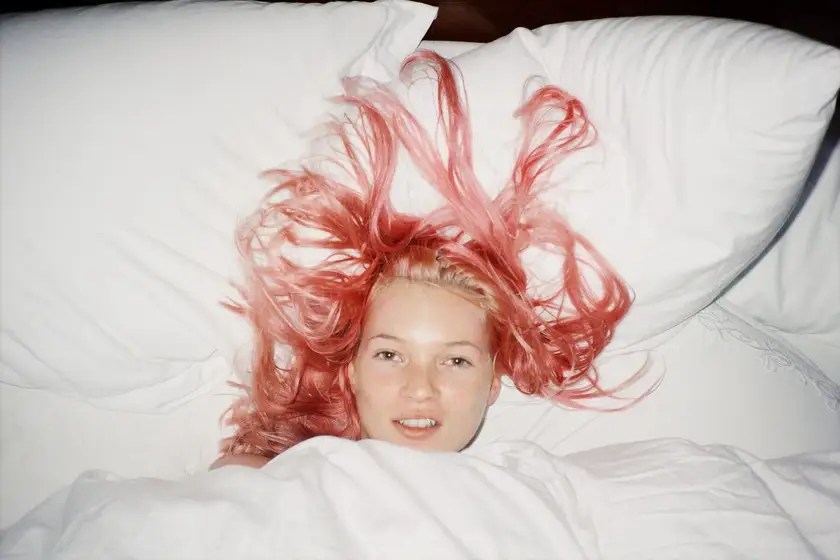
The 1990s have become unusually easy to recognise and increasingly difficult to remember in their complexity. Kate Moss, a slip dress, a warehouse party, a shark suspended in formaldehyde: the decade survives through images whose familiarity can conceal the circumstances that produced them. Tate Britain’s new exhibition, The 90s: Art and Fashion, brings this visual inheritance into focus. Curated by Edward Enninful with Tate’s curatorial team, and running from 8 October 2026 to 14 February 2027, it gathers more than 100 photographs, artworks and garments by nearly 70 artists, photographers and designers. Its subject is a period when British culture acquired a new international visibility, while the question of who could participate in that culture remained fiercely contested.
Placing fashion beside contemporary art offers a persuasive way into this history. A magazine photograph, a runway presentation and a gallery installation each organise the relationship between bodies and spectators. They establish who commands attention, what counts as desirable, and which forms of behaviour appear respectable or transgressive. During the 1990s, these questions moved between disciplines with particular intensity. The exhibition’s premise invites us to consider the decade as an exchange of ideas across studios, clubs, magazines and fashion schools, with reputations and visual languages developing through encounters between people working in different fields.
Enninful brings the experience of a participant to this exchange. He became fashion editor of i-D at eighteen, entering an industry in which magazines could provide a meeting place for emerging photographers, stylists and designers. His recollections emphasise the freedom to experiment before social media made every tentative gesture potentially permanent. That perspective helps explain the exhibition’s interest in identity and access. For someone working through images, the question of who appears in the frame is inseparable from the question of who has the authority to construct it. Fashion’s contribution to cultural history becomes particularly consequential when those two kinds of visibility begin to change together.
There is also a material history beneath the remembered excitement. In her account of the period for British Vogue, Gillian Wearing recalls artists alerting one another to affordable, disused commercial warehouses, accepting uncomfortable conditions in exchange for somewhere to work. These recollections complicate the mythology of effortless creative brilliance. Experiment requires time, space and people willing to help one another; it also requires the possibility of making something without knowing whether it will earn money. Read in this light, the decade’s apparent spontaneity raises a practical question about the conditions under which a cultural scene can develop. The freedom associated with the 1990s had an economic foundation as well as an aesthetic expression.
Photography makes that aesthetic shift especially legible. Corinne Day, Nigel Shafran and Juergen Teller helped establish a language of informality that challenged the polished assurances of conventional fashion imagery. Day’s work, described by the V&A in terms of documentary-like “dirty realism”, gave uncertainty, awkwardness and the ordinary body a new visual prominence. The significance lay partly in the setting and partly in the apparent relationship between photographer and subject. A picture could suggest an encounter between acquaintances, allowing the viewer to imagine a life continuing beyond the photograph’s commercial purpose. The image’s authority increasingly depended on its claim to intimacy.
That claim deserves scrutiny. A photograph that looks unarranged still involves selection, framing and editorial decisions. The aesthetics of authenticity can become as prescriptive as the aesthetics of glamour, particularly when youth and thinness retain their privileged position. The decade’s visual experimentation therefore contains a tension between expanding the language of fashion and expanding the range of people fashion permits us to see. Its most useful legacy may be the invitation to examine that tension carefully: to distinguish a change in photographic style from a change in the distribution of cultural power.
The familiar account of British art in this period centres on the Young British Artists and figures such as Damien Hirst, Tracey Emin and Sarah Lucas. Yet the publicity surrounding that generation can obscure the seriousness of its engagement with vulnerability, mortality and everyday life. Rachel Whiteread’s House, made in 1993 and demolished in January 1994, provides an illuminating historical example. By casting the interior of an East London terraced house in concrete, Whiteread gave domestic absence an extraordinary physical weight. The work’s disappearance sharpened its relationship to loss and the changing city. Remembering this broader context helps restore emotional and intellectual substance to a period too often compressed into stories of scandal.
Nightlife supplies another route into the relationship between experience and its remains. Included in the exhibition, Mark Leckey’s Fiorucci Made Me Hardcore (1999) assembles found footage of British dance subcultures into a work concerned with collective memory. Its dancers belong to particular places and moments, while the editing draws attention to the difficulty of recovering those moments intact. Clothes, gestures and music survive as fragments of an experience whose intensity depended on being there. The film can be read as an account of how culture inhabits the body: how belonging is learned through movement, and how an individual gesture becomes recognisable as part of a shared social world.
The exhibition’s photographs of club nights, raves and queer social spaces extend this account beyond the gallery. Images by figures including Normski, Eddie Otchere and Dave Swindells record communities whose cultural importance exceeds their usefulness as fashion inspiration. Such spaces could offer recognition, encounter and the temporary freedom to behave differently. Their history also involves conflict over the use of public and private land. The Criminal Justice and Public Order Act 1994 gave police powers to stop certain rave gatherings, defining music for these purposes through the notorious phrase “a succession of repetitive beats”. The legal language makes a revealing companion to the remembered euphoria: collective pleasure could also be treated as a problem of public order.
The limits of national optimism become more painful in Chris Ofili’s No Woman, No Cry (1998), one of the exhibition’s major works. Made in response to the racist murder of Stephen Lawrence in 1993, the painting draws on the dignity of his mother, Doreen. Its tears contain small collaged photographs of Stephen’s face, bringing an individual life into the image of mourning. The work gives grief both a private and a public dimension. A mother’s loss becomes inseparable from the society in which that loss occurred, and from the failures exposed by the investigation into her son’s death. In a survey of an ostensibly confident decade, the painting insists on the unequal conditions under which confidence was possible.
This is where the exhibition’s attention to Black British creativity acquires particular importance. The inclusion of Ozwald Boateng and Joe Casely-Hayford places designers within a history of British cultural authorship; Yinka Shonibare’s work opens that history to further questioning. His photographic series Diary of a Victorian Dandy (1998), commissioned by Iniva, cast the artist as the central figure in an elaborately staged aristocratic world. As a contextual example, the series reveals how dress, interiors and social choreography manufacture the appearance of belonging. Shonibare occupies the image of privilege with sufficient assurance to expose its conventions. The resulting humour makes visible the racial and class assumptions embedded in apparently familiar accounts of British history.
The body’s vulnerability is equally necessary to any understanding of the period. Hamad Butt, represented in Tate’s exhibition, developed a practice connecting art, science, desire and danger during the AIDS crisis. Born in Lahore and raised in East London, he died of AIDS-related complications in 1994, aged thirty-two. His sculptural work employed hazardous materials to bring attraction and apprehension into an unsettling relationship. Against an account of the decade built around exuberance, his work recalls the proximity of illness, stigma and premature death. It also asks how fear attaches itself to bodies and identities, turning physical vulnerability into a wider question of social exclusion.
Fashion’s experimental treatment of the body belongs within this discussion, although its meanings require attention to particular designers and particular works. Alexander McQueen’s historical imagination is especially revealing. His 1995 Highland Rape collection drew on Scottish history and the Highland Clearances, using damaged garments and exposed flesh to challenge romanticised accounts of the past. This example from his wider practice helps explain why his work rewards consideration alongside contemporary art. The runway became a place where tailoring, historical reference and theatrical staging could generate an argument. The discomfort of those presentations remains open to criticism, including questions about the display of women’s bodies, but it cannot be adequately understood through an account of clothes as surface alone.
Bringing these different practices together nevertheless creates a curatorial challenge. Early criticism has questioned whether the exhibition gives its art sufficient space beside its fashion imagery. That concern identifies a real risk in any survey organised around the atmosphere of an era: the attractiveness of the overall picture can absorb the specificity of individual works. A photograph commissioned to circulate a fashion image, a sculpture examining mortality and a painting commemorating a murdered teenager have different obligations to their subjects and audiences. Their proximity becomes intellectually useful when those differences remain available to scrutiny. The exhibition’s premise is strongest as an invitation to sustained comparison, allowing shared visual concerns to emerge without making every object serve the same story.
The lasting interest of The 90s: Art and Fashion lies in the questions its subject returns to the present. How do emerging artists find room to work? Who enters the picture of national culture, and who determines its composition? What happens when the language of a subculture becomes commercially valuable? The decade’s achievements grew through collaboration and improvisation, alongside profound inequalities and losses. Revisiting them can restore a sense of culture as something made through social relationships, with all the possibilities and conflicts those relationships entail. That is a demanding and useful reason to look again: the images may be familiar, but the conditions of creativity and belonging remain unsettled.
The 90s: Art and Fashion is at Tate Britain, Millbank, London, from 8 October 2026 to 14 February 2027. For tickets and visitor information: www.tate.org.uk.
Sources / Read More
● Tate Britain, The 90s: Art and Fashion, exhibition information: www.tate.org.uk.
● Tate, exhibition announcement and curatorial outline, 27 April 2026: www.tate.org.uk.
● British Vogue, recollections by Edward Enninful, Gillian Wearing and other participants in the decade, 21 August 2026: www.vogue.co.uk.
● Victoria and Albert Museum, “Photographing masculinities: gender, identity and the gaze”: www.vam.ac.uk.
● Artangel, Rachel Whiteread’s House: www.artangel.org.uk.
● Tate, Mark Leckey: O’ Magic Power of Bleakness, exhibition catalogue information: shop.tate.org.uk.
● Tate’s No Woman, No Cry feature on Google Arts & Culture: artsandculture.google.com.
● Iniva, Yinka Shonibare’s Diary of a Victorian Dandy: www.iniva.org.
● Whitechapel Gallery, Hamad Butt: Apprehensions, curatorial background: www.whitechapelgallery.org.
● Victoria and Albert Museum, “Alexander McQueen — an introduction”: www.vam.ac.uk.
● Criminal Justice and Public Order Act 1994, section 63: www.legislation.gov.uk.
● Jonathan Jones, exhibition review, The Guardian, 6 October 2026: www.theguardian.com.
Discover more from My World of Interiors
Subscribe to get the latest posts sent to your email.

