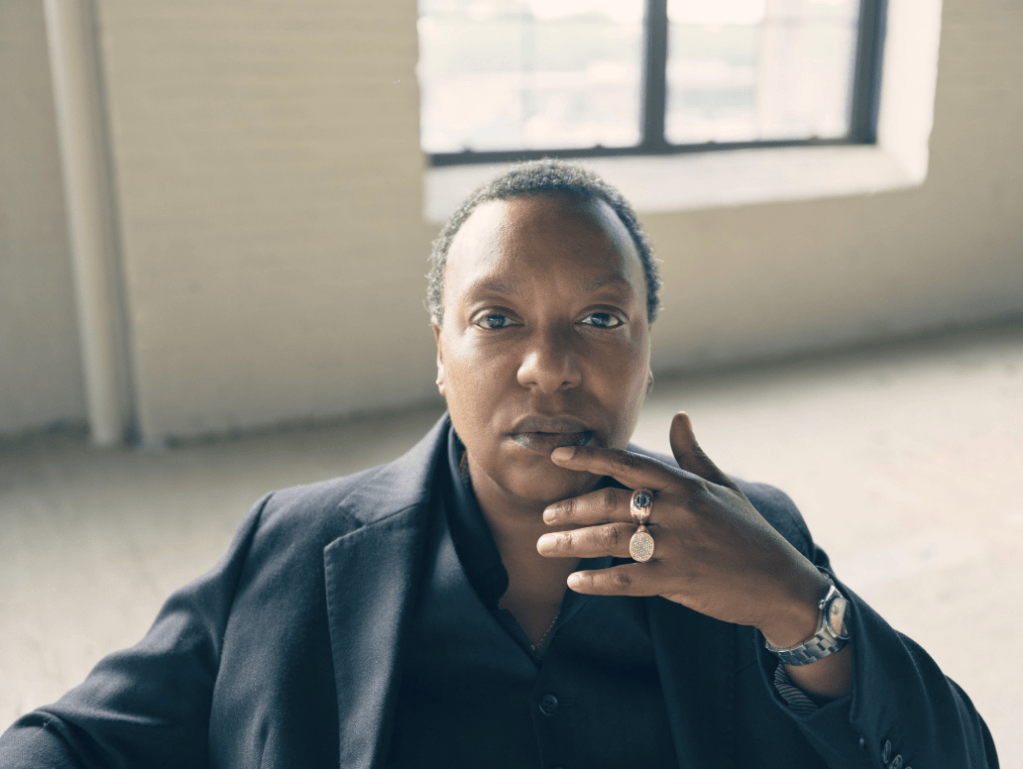
What happens when we change the voices in a love song? On Synonym, released on 2 October 2026, Meshell Ndegeocello revisits fifteen familiar recordings with an extraordinary cast of collaborators, from Chaka Khan and Cat Power to ANOHNI, Cynthia Erivo and Bill Callahan. The results move between intimate soul, reggae, country, experimental jazz and electronic music. But beneath the musical invention lies a more ambitious proposition: that even the most familiar songs can reveal unexpected ideas about love, identity and freedom when someone else is allowed to tell the story.
(130) Meshell Ndegeocello – YouTube
The Love Song Belongs to Everyone
In 1981, the Human League released Don’t You Want Me, one of the defining singles of British synth-pop. Its instantly recognisable electronic arrangement disguised a rather uncomfortable little drama: a man reminds a former lover of the part he played in her success, while she insists upon her independence.
The song became an international sensation. Its competing voices, catchy chorus and theatrical arrangement turned a struggle over possession and autonomy into an irresistible piece of popular entertainment.
Forty-five years later, Meshell Ndegeocello has returned to it with Cat Power, transforming the original’s bright electronic urgency into a beautifully understated reggae performance.
The change in musical atmosphere is immediately striking. But something more interesting happens when the voices begin.
Ndegeocello’s delivery is restrained, almost wounded. Cat Power sounds detached, as though the relationship has already ended and she has little interest in returning to the argument. What once sounded like an escalating confrontation becomes an exchange between people whose emotional distance is already established.
The familiar lyrics remain recognisable, yet the drama has changed.
It is an excellent introduction to Synonym, Ndegeocello’s remarkable new album, which explores the possibilities of transforming familiar songs through different arrangements, voices and musical relationships.
Her choices are wonderfully unpredictable. Bob Dylan sits alongside the Bee Gees; Sonny and Cher encounter the experimental sensibility of ANOHNI; the Human League shares space with the country music of George Jones and Tammy Wynette. There are contributions from Cynthia Erivo, Brandi Carlile, Lianne La Havas, Moses Sumney and Chaka Khan, among many others.
On paper, it might sound like an expensive exercise in nostalgia.
In practice, it is considerably more adventurous.
Ndegeocello understands that a song is not a fixed object. Its meaning depends upon who performs it, how it is arranged and the historical circumstances in which we hear it.
A melody may survive almost unchanged while acquiring an entirely different emotional character. Familiar words can suggest new relationships when placed in another person’s mouth.
Synonym is an exploration of that extraordinary flexibility.
Watch Meshell Ndegeocello and Cat Power perform Don’t You Want Me — Official YouTube video
Thirty Years of Refusing to Belong
Born Michelle Lynn Johnson in Berlin in 1968, Ndegeocello grew up principally in Washington, DC, where her musical education took place within a remarkable combination of formal training, church music and the city’s influential go-go scene.
Her father, a jazz saxophonist who played in a military band, introduced her to the discipline and architecture of musical arrangement. The city’s go-go musicians demonstrated another possibility: songs could be extended, transformed and reconstructed through rhythm and collective performance.
These experiences would remain central to her work.
Ndegeocello emerged internationally in 1993 with Plantation Lullabies, released through Madonna’s Maverick Records. The album combined funk, soul, jazz and hip-hop with unusually candid explorations of sexuality, race, desire and personal identity.
Its arrival helped establish what would subsequently become known as neo-soul, although Ndegeocello proved reluctant to remain within that or any other musical category.
Over the following three decades, she moved between experimental rock, alternative R&B, jazz, folk and gospel, producing a catalogue whose variety could easily obscure the consistency of her artistic intelligence.
Her bass playing remained distinctive throughout: supple, rhythmically assured and interested in the spaces between notes as much as the notes themselves.
But Ndegeocello was also becoming increasingly interested in the possibilities of collective creation.
Her 2023 album The Omnichord Real Book, the first of her recordings for the historic Blue Note label, brought together an extraordinary group of musicians in a sophisticated exploration of improvisation and contemporary song.
The following year’s No More Water: The Gospel of James Baldwin approached the writings and political philosophy of James Baldwin through music, spoken word and performance. It was a major artistic statement, examining how the novelist’s understanding of race, love and historical responsibility might be communicated through sound.
Both albums won Grammy Awards for Best Alternative Jazz Album.
What unites these apparently different projects is Ndegeocello’s refusal to regard music as a vehicle for individual self-expression alone.
Her increasingly collaborative practice suggests that musical identity can be strengthened rather than diminished through the contributions of others.
On Synonym, she develops that proposition further.
The album reunites her with David Gamson, who produced her first two recordings, and brings in drummer and producer Abe Rounds. An extensive group of musicians and singers contributes to arrangements that frequently transform the original material beyond immediate recognition.
The guiding principle is generosity. Ndegeocello seems more interested in what her collaborators might reveal about a composition than in demonstrating her own authority over it.
It is an unusual approach in an industry that places enormous emphasis upon recognisable individual personalities.
What Changes When the Voices Change?
The album’s central idea involves revisiting songs traditionally associated with male-female duets and allowing performers of similar or fluid gender identities to inhabit them.
Ndegeocello describes the project as an expression of queer liberation, but its implications extend beyond questions of representation.
By changing the voices, she changes the assumptions listeners bring to familiar material.
Consider I Knew You Were Waiting (For Me), the 1987 duet by Aretha Franklin and George Michael.
The original is an exuberant celebration of romantic and emotional perseverance, combining the extraordinary vocal authority of Franklin with Michael’s polished pop sensibility.
Ndegeocello’s version, featuring Cynthia Erivo, approaches the song through a more intimate and rhythmically relaxed arrangement. The emphasis shifts from spectacular vocal confrontation towards shared emotional experience.
Erivo possesses the technical ability to overwhelm almost any recording, but here her performance becomes part of a carefully balanced conversation.
The result suggests that the power of a duet need not depend upon contrasting musical personalities competing for attention.
It can emerge through mutual recognition.
The album’s interpretation of Islands in the Stream, featuring Chaka Khan, is similarly revealing.
Originally written by the Bee Gees and made famous by Dolly Parton and Kenny Rogers, the song has become almost inseparable from its image of heterosexual romantic companionship.
Ndegeocello and Khan transform it into a warmer, less conventionally theatrical arrangement. The original’s declaration of mutual dependence remains, but the emotional context becomes more expansive.
The recording can be heard as an expression of friendship, admiration or intimacy without requiring the listener to establish a definitive relationship between the singers.
Ndegeocello has spoken movingly about Khan’s importance to her, describing the older artist as someone who offered encouragement during the early years of her career.
That personal history adds something beautiful to the performance.
A song once associated with romantic partnership becomes an expression of solidarity between two women whose careers span different generations of popular music.
The musical meaning has changed because the relationship between the performers has changed.
This is the central achievement of Synonym. Its reinterpretations reveal that familiar songs have never belonged exclusively to the identities or circumstances of their original performers.
A love song can acquire new meanings without surrendering the qualities that made it compelling in the first place.
Queer Music Without the Obligation to Explain
One of the more interesting aspects of Ndegeocello’s recent interviews is her reluctance to make gender the only subject of discussion.
Speaking with NPR in October, she explained that the performers’ gender identities were fundamental to the concept, while also expressing a desire for listeners to experience the music without making identity their first consideration.
The distinction is important.
Contemporary cultural discussion frequently places considerable emphasis upon representation, and for understandable reasons. Who is visible, whose experiences are considered legitimate and whose stories are allowed to circulate have profound consequences for artistic life.
But there is a risk that representation becomes an obligation for artists to continually explain themselves through personal identity.
Ndegeocello appears particularly resistant to this demand.
Her approach suggests that freedom involves not only the right to be recognised but also the ability to create without being confined by the categories through which recognition occurs.
This tension becomes especially apparent in her extraordinary collaboration with ANOHNI on Sonny and Cher’s I Got You Babe.
The original 1965 recording has become an emblem of youthful romantic optimism, its conversational structure inseparable from the public image of the couple performing it.
Ndegeocello and ANOHNI dismantle much of that familiarity.
The arrangement becomes a sparse, unusually angular form of jazz, with unexpected harmonic movements and voices that resist the innocent certainty of the original.
ANOHNI brings an almost operatic emotional intensity, while Ndegeocello’s low register creates a striking contrast.
It is an intellectually fascinating interpretation, although not entirely convincing as an emotional experience. In removing the original’s cheerful simplicity, the arrangement sometimes seems uncertain about what should replace it.
But even that uncertainty has value.
The recording asks us to reconsider why certain songs have become associated with particular romantic ideals.
Its achievement lies less in replacing one interpretation with a definitive alternative than in revealing how contingent the familiar interpretation always was.
A song does not need to describe the same relationship every time it is sung.
Nor does it require its performers to inhabit identities determined by its original recording.
When an Arrangement Becomes an Argument
The most compelling recordings on Synonym go beyond changing the voices. They transform the musical environment so thoroughly that the arrangement becomes a form of criticism.
Bob Dylan’s It Ain’t Me Babe, featuring Madison Cunningham, is a particularly beautiful example.
The original 1964 song is built around a refusal to become the idealised figure someone else desires. Its emotional strength lies in the distance between romantic expectation and the narrator’s insistence upon personal independence.
Ndegeocello’s interpretation dissolves much of the familiar folk structure into a dreamlike arrangement of guitars, delicate electronic textures and unusual harmonic movements.
The result is almost weightless.
Rather than presenting independence as a dramatic confrontation, the music creates a strange atmosphere of emotional detachment, as though the refusal has already been absorbed into the fabric of the relationship.
The song remains recognisable in fragments, but its emotional centre has shifted.
Equally impressive is Be Real Black for Me, originally recorded by Roberta Flack and Donny Hathaway.
The song’s relationship between romantic affection and Black identity gives it particular historical resonance. Ndegeocello’s interpretation, featuring Emily King and Lizz Wright, preserves its tenderness while placing the vocal interplay within a relaxed, subtly reconfigured arrangement.
The performance feels neither nostalgic nor demonstratively contemporary. It simply allows the song’s emotional intelligence to emerge through new voices.
There is considerable sophistication in that restraint.
Perhaps the album’s most arresting moment arrives at the end.
Ndegeocello concludes with With God on Our Side, Bob Dylan’s 1964 examination of how religion and national identity can be invoked to justify violence.
The performance features Bill Callahan and Chris Thile, whose contrasting musical personalities introduce an unusual tension.
Callahan’s restrained baritone and Thile’s delicate instrumental sensibility initially suggest an intimate folk performance. But as the song develops, the arrangement becomes increasingly unsettled, introducing distorted guitars and electronic noise.
The effect is profoundly uncomfortable.
Dylan’s original challenged the assumption that moral authority could be established through national or religious identification. Ndegeocello’s version asks how that argument might sound in a world saturated with political noise and competing claims to righteousness.
The recording does not update the lyrics with references to current events.
It changes the conditions in which we hear them.
That is an important distinction.
The arrangement allows an established political song to acquire contemporary urgency without reducing it to a topical statement.
Watch With God on Our Side, featuring Bill Callahan and Chris Thile — Official YouTube video
Music as a Collective Art
There is another reason Synonym feels unusually significant.
Popular music has long celebrated collaboration, but the mythology of the singular artist remains remarkably powerful.
An album is generally understood as the expression of the person whose name appears on its cover. Producers, arrangers, session musicians and collaborators may receive recognition, but the work is ultimately organised around an individual identity.
Ndegeocello has increasingly challenged that convention.
Her current ensemble operates according to the idea that Meshell Ndegeocello is a band, recognising the collective effort behind recordings that might otherwise be attributed primarily to one musician.
On Synonym, this principle becomes part of the album’s artistic structure.
Each song depends upon a new relationship between performers. Cynthia Erivo brings a different energy from Cat Power; Chaka Khan’s voice transforms the emotional character of her duet, while Bill Callahan’s presence creates an entirely different atmosphere.
Yet the album never becomes a disconnected collection of celebrity collaborations.
Its coherence emerges from Ndegeocello’s sophisticated understanding of musical arrangement.
She knows which elements of a song are essential, which can be discarded and where an unfamiliar instrument or voice might reveal something previously concealed.
That skill reflects the experience of a musician who has spent decades working across genres and performance traditions.
In a recent NPR interview, she explained that she approaches songs as structures open to reinterpretation, an attitude shaped partly by her early experiences playing go-go music in Washington.
The song provides a framework.
What matters is what musicians can discover within it.
There is something genuinely democratic about this understanding of musical authorship, although it would be naïve to pretend that all collaborators possess identical authority.
Ndegeocello remains the project’s guiding creative intelligence.
But her leadership is expressed through the relationships she creates rather than the insistence that every recording must foreground her own performance.
The result is an album whose identity depends upon the presence of others.
A Familiar Song Is Never Finished
Synonym is not a flawless album. Its extensive cast and stylistic ambitions occasionally produce interpretations that are more interesting in conception than execution. Some songs retain an extraordinary emotional immediacy; others seem so intent upon escaping their familiar arrangements that they sacrifice qualities which made the originals memorable.
At just over an hour, the album also asks a good deal of the listener.
But these are comparatively minor objections to a project of remarkable musical intelligence and generosity.
Ndegeocello has created a record that treats popular music as an evolving cultural conversation rather than a fixed collection of definitive performances.
The idea has a long history, particularly within jazz, where reinterpretation is fundamental to the tradition. A familiar standard acquires different meanings through changes in tempo, harmony, instrumentation and improvisation.
What makes Synonym distinctive is the extent to which Ndegeocello applies that principle to the cultural assumptions surrounding popular songs.
She understands that a recording carries more than a melody and a lyric.
It carries associations with performers, relationships, generations and identities.
Changing those associations can reveal possibilities that were always present in the music but rarely allowed to emerge.
The album’s title contains a beautiful contradiction.
Strictly speaking, a synonym is a word possessing the same or nearly the same meaning as another.
Yet Ndegeocello’s arrangements demonstrate that repetition rarely produces perfect equivalence. A new performance may preserve the essential character of a song while transforming the emotional and cultural significance of its words.
That is precisely what makes interpretation worthwhile.
If every cover version meant exactly the same thing as its original, there would be little reason to make it.
Ndegeocello’s achievement is to demonstrate how much can change while something essential survives.
Her album is ultimately a celebration of the freedom to imagine familiar things differently.
In an age when cultural identity is frequently treated as something to be defined, defended and maintained, Synonym offers a more generous understanding of artistic possibility.
Songs move between people. Voices enter conversations that began long before them. Musical traditions remain alive through reinterpretation.
And sometimes, when we change the person singing, we discover that the song was never quite about what we thought it was.
Listen to Synonym
Explore the complete album through Blue Note Records
The official album page includes streaming access, background on the recordings and links to performances. The following verified YouTube videos offer an especially good introduction.
1. Don’t You Want Me — with Cat Power
The essential starting point. A brilliantly restrained reggae interpretation that transforms the Human League’s familiar confrontation into something emotionally quieter and far more ambiguous.
2. I Knew You Were Waiting (For Me) — with Cynthia Erivo
The album’s opening track. Two remarkable voices reinterpret the Aretha Franklin and George Michael duet with extraordinary warmth.
3. Islands in the Stream — with Chaka Khan
A wonderfully affectionate collaboration that reimagines a familiar country-pop duet as a celebration of musical companionship.
4. Golden Ring — with Brandi Carlile
George Jones and Tammy Wynette’s country classic acquires a new tenderness through an understated arrangement and the relationship between the performers.
5. Don’t Look Any Further — with Lianne La Havas
A beautifully assured reinterpretation of the Dennis Edwards and Siedah Garrett original, demonstrating Ndegeocello’s extraordinary understanding of rhythm and bass.
6. With God on Our Side — with Bill Callahan and Chris Thile
The album’s extraordinary conclusion. An increasingly unsettling interpretation of Dylan’s protest song, in which the changing arrangement gives the familiar words renewed force.
Album Information
Meshell Ndegeocello — Synonym
Released: 2 October 2026
Label: Blue Note Records
15 tracks | 62 minutes
Produced by Meshell Ndegeocello, David Gamson and Abe Rounds
Featuring Cynthia Erivo, Cat Power, Chaka Khan, Brandi Carlile, ANOHNI, Bill Callahan, Chris Thile, Lianne La Havas, Moses Sumney, Madison Cunningham, WILLOW, Robert Glasper and other collaborators.
Official album information and streaming links — Blue Note Records
Meshell Ndegeocello — Official website
Further Reading and Listening
Meshell Ndegeocello on Synonym — Blue Note Records
An extensive account of the album’s conception, collaborators, arrangements and the artist’s understanding of reinterpretation.
Meshell Ndegeocello Reflects on Her Musical Influences — NPR Fresh Air, October 2026
A substantial interview with Tonya Mosley about Ndegeocello’s musical upbringing, collaborative practice and approach to identity.
Meshell Ndegeocello Pays Tribute to Classic Duets — NPR, October 2026
Michel Martin discusses the recordings, guest performers and the process of reinterpreting familiar songs.
Alexis Petridis examines the musical ambition and occasional contradictions of the album’s extraordinarily varied arrangements.
No More Water: The Gospel of James Baldwin — Blue Note Records
Ndegeocello’s 2024 project exploring the writing, political thought and historical legacy of James Baldwin.
The Omnichord Real Book — Blue Note Records
Her acclaimed 2023 album, demonstrating the remarkable breadth of her contemporary musical language and the collaborative approach that has become central to her work.

