From the pearl fisheries of the Arabian Gulf to the silversmithing traditions of southern China, an exhibition at M7 in Doha examines the extraordinary variety of meanings that human beings have attached to the objects they wear.
Jewellery occupies an unusual position in the history of material culture. Its scale and composition are closely related to the human body. Its significance may depend upon who wears it, where it is worn and the circumstances under which it is acquired, given away or inherited. A small object can establish a person’s position within an elaborate social order, while an ornament made from seemingly inexpensive materials may carry considerable cultural or spiritual importance.
These distinctions provide the intellectual framework for Around the World in Jewellery, currently on view at M7 in Doha. Presented by Qatar Museums in collaboration with L’ÉCOLE, School of Jewelry Arts, supported by Van Cleef & Arpels, the exhibition brings together more than 500 objects, including jewellery, sculpture, artworks and photography.
Curated by the art historians Inezita Gay-Eckel and Paul Paradis, with exhibition design by Johanna Grawunder, it represents the most extensive presentation of jewellery from Qatar Museums’ collections to date.
Its thematic organisation offers an opportunity to consider traditions of personal adornment alongside one another without arranging them according to an assumed hierarchy of artistic or technological development.
Around the World in Jewellery
27 October – 26 December 2026
M7, Msheireb Downtown, Doha, Qatar
Presented by Qatar Museums in collaboration with L’ÉCOLE, School of Jewelry Arts, supported by Van Cleef & Arpels.
Curated by Inezita Gay-Eckel and Paul Paradis.
Exhibition design by Johanna Grawunder.
Exhibition information and reservations
The decorated body
The human practice of wearing ornaments extends deep into prehistory. Excavations at Blombos Cave in South Africa have yielded perforated marine shells dating back approximately 75,000 years. Archaeological research into the shells has identified evidence of their use as beads, suggesting that early human communities were already investing natural materials with social or symbolic significance.
Precisely what these ornaments communicated remains beyond our knowledge. Their existence nevertheless establishes a remarkable antiquity for the deliberate modification of personal appearance through manufactured objects.
The exhibition in Doha demonstrates how differently this impulse has developed across cultures.
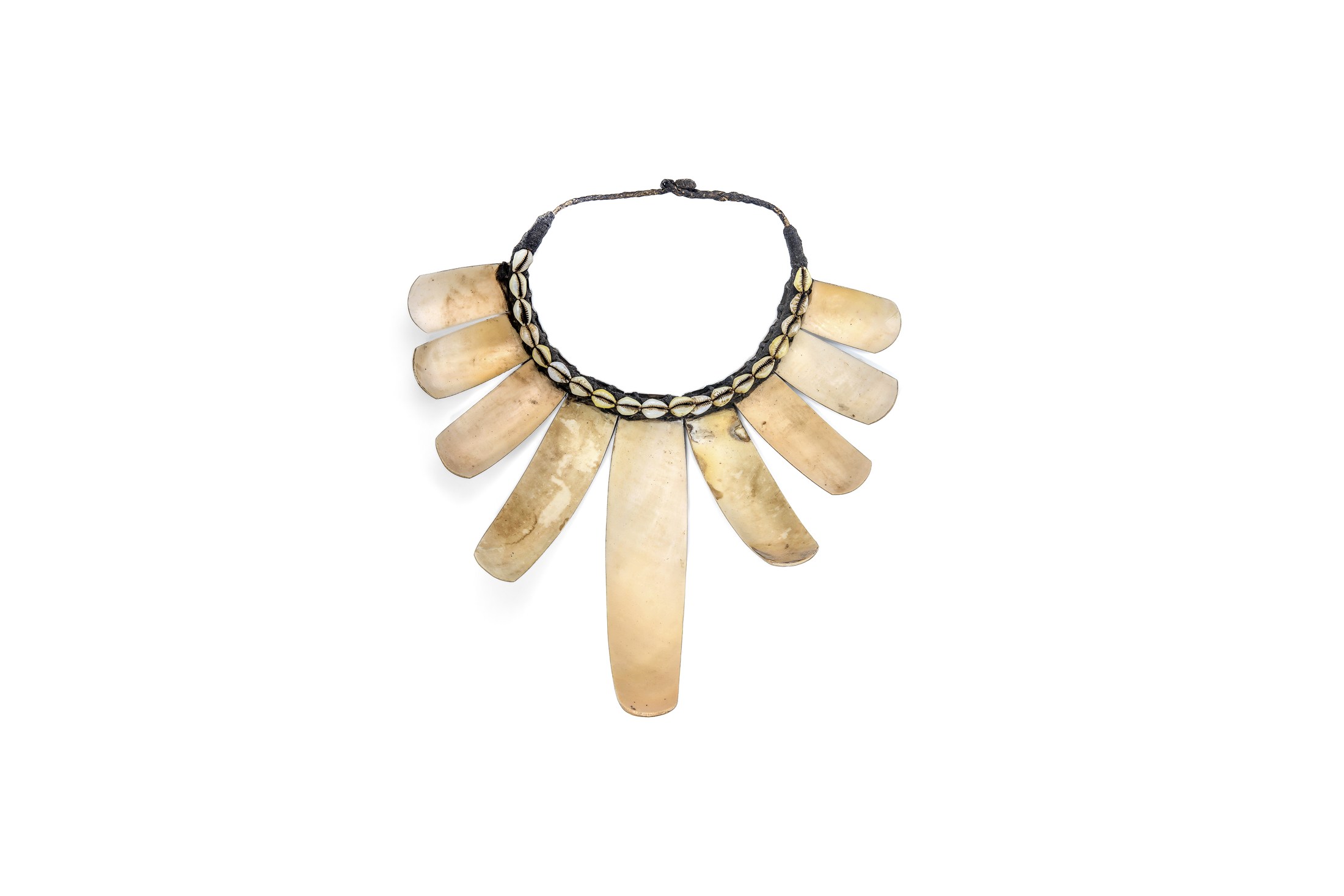
A twentieth-century necklace from Papua New Guinea combines cowrie shells with elongated plaques cut from melo melo shells. The pale surfaces of the larger elements contrast with the darker fibre choker, while their arrangement creates a radiating composition across the wearer’s chest. Much of the visual effect depends upon the inherent characteristics of the shells themselves.
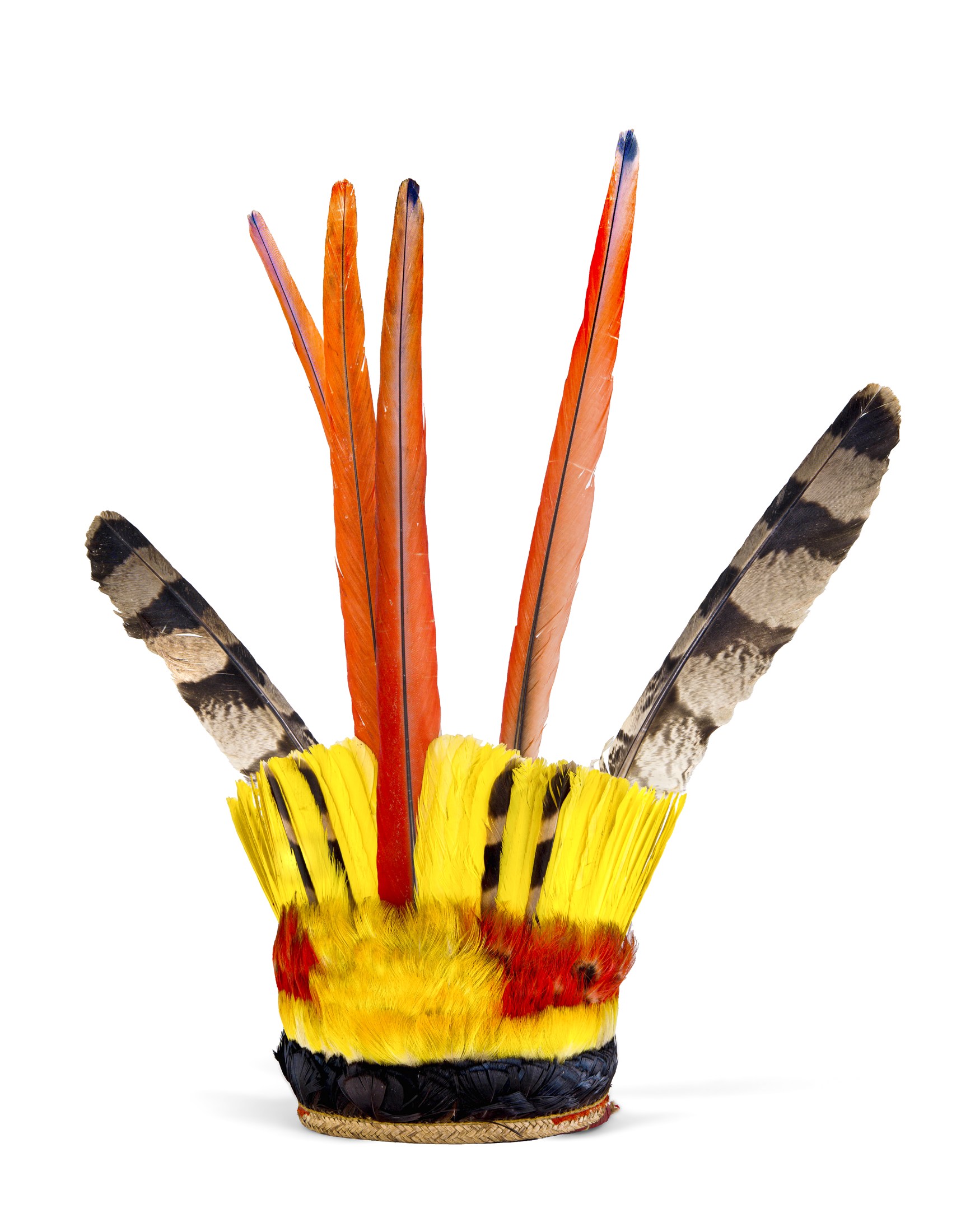
An Akangitat headdress from Brazil, constructed from feathers and fibre, achieves a very different relationship with the body. Its vertical arrangement extends the silhouette of the wearer, with vivid yellow and red plumage forming a dense base beneath the taller feathers.
According to the exhibition’s curatorial research, this type of headdress is traditionally worn by men in the Upper Xingu region. During the Yamurikumã festival, however, women assume roles and wear ornaments ordinarily associated with men. The cultural meaning of the headdress therefore changes according to the occasion and the identity of its wearer.
Pearls and the economy of the sea
For an exhibition taking place in Qatar, the relationship between jewellery and the marine environment has particular historical resonance.
Long before the development of the country’s petroleum industry, pearling sustained communities along the Arabian Gulf. The archaeological remains of Al Zubarah, a fortified coastal settlement that prospered during the late eighteenth and early nineteenth centuries, bear witness to the commercial networks that developed around the trade.
The pearl fisheries required considerable organisation. Divers, boat crews, merchants and their families depended upon an industry whose fortunes were shaped by seasonal conditions and international demand. Pearls harvested in Gulf waters entered trading networks extending far beyond the Arabian Peninsula, eventually finding their way into jewellery produced in India and Europe.
The National Museum of Qatar documents this history through its permanent collections, placing the equipment of the pearl merchant alongside the finished objects that emerged from these networks of labour and exchange.
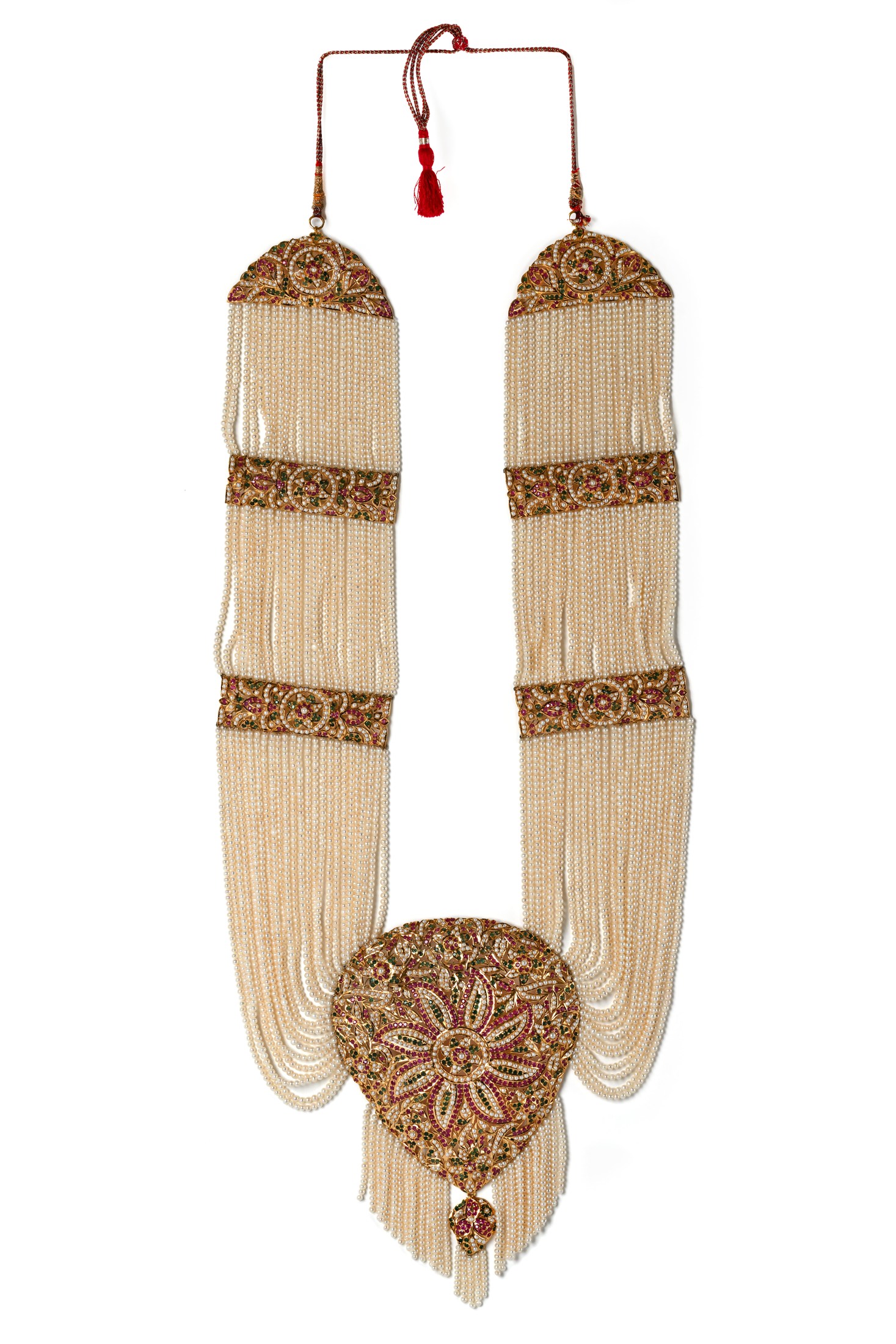
Among the objects selected for the Doha exhibition is a twentieth-century Qatari jewellery ensemble known as Taqum lulu. Long strands of small pearls are interrupted by bands of gold ornamentation and gathered around a richly decorated central element.
The pearls acquire their visual strength through accumulation and careful arrangement. Their value is inseparable from the work required to obtain, sort and assemble them.
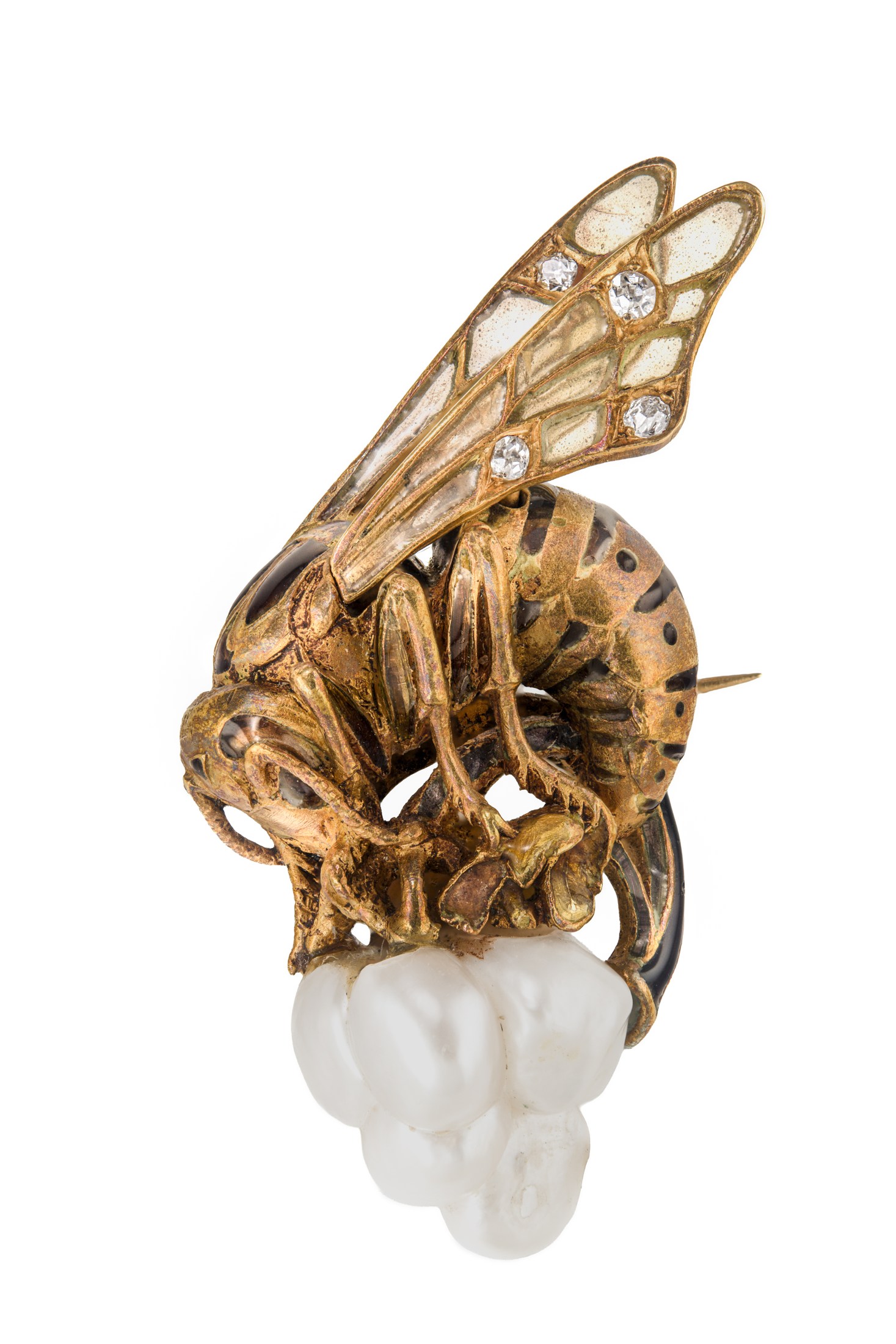
A striking comparison is provided by a brooch made around 1900 by the French Art Nouveau jeweller Lucien Gautrait. A European hornet is fashioned in gold, diamonds and enamel, while an irregular baroque pearl evokes the structure of its nest. The delicate wings employ plique-à-jour enamel, a technique in which light passes through translucent enamel unsupported by a permanent metal backing.
Where the Qatari ensemble depends upon the repetition of numerous small pearls, Gautrait’s design makes the irregularity of an individual pearl the starting point for an imaginative representation of nature.
The two objects illuminate quite different ways of working with the same natural material.
Silver, ceremony and inheritance
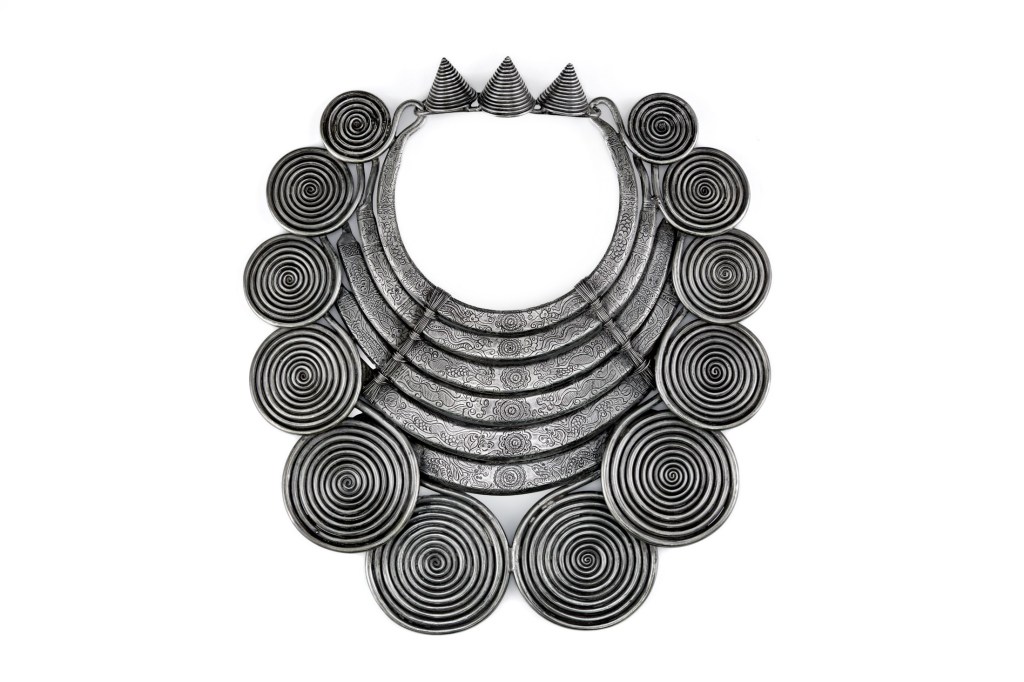
One of the most visually compelling objects in the exhibition is a twentieth-century Miao torque from Guangxi in southern China.
Made from engraved silver, the ornament consists of six curved tiers terminating in prominent spirals. Its elaborate symmetry and the relationship between the curved bands and circular elements give it an almost architectural quality. Worn around the neck, it transforms the upper body into a broad field of patterned metalwork.
Silver occupies an important place in Miao traditions of ceremonial dress. As the exhibition’s curators explain, elaborate silver ornaments are worn at festivals and weddings, and a bride’s jewellery may represent a significant part of her personal wealth, subsequently passed down through generations.
These objects bring together several histories: the transmission of specialist metalworking techniques, the organisation of family resources and the preservation of cultural identity through dress. Their survival within families also complicates the distinction between jewellery as an artistic object and jewellery as a form of property.
The Miao torque demonstrates how profoundly an ornament can alter the appearance of its wearer. Its considerable visual presence is achieved through the organisation of a single material, rather than through the introduction of precious stones or contrasting colours.
Jewellery at the Indian court
Elsewhere in the exhibition, the relationship between adornment and political power emerges through the Patiala Sarpech, a northern Indian turban ornament dated by the exhibition’s organisers to around 1880.
Its composition incorporates gold, silver alloy, emeralds, spinels, enamel and diamonds. A curved, ascending plume rises from a densely jewelled horizontal arrangement, beneath which green pendants introduce movement into the design.
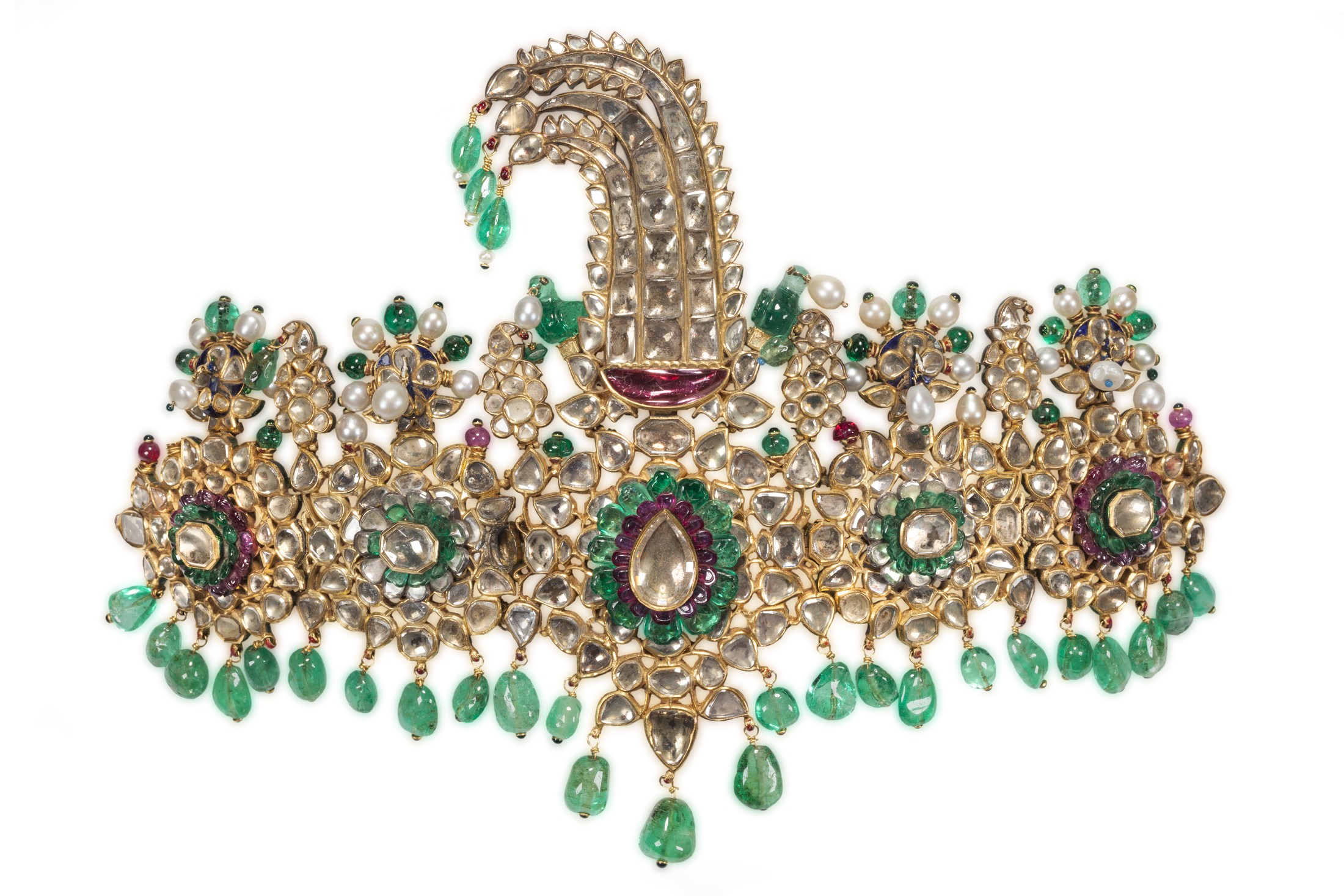
The sarpech belongs to a tradition of courtly ornamentation associated with Mughal India and its successor states. Worn at the front of the turban, such jewels established the status of their owners through a readily recognisable visual vocabulary.
An account published by the Metropolitan Museum of Art documents an instance in 1673 when the Mughal emperor Aurangzeb presented a related type of turban ornament, known as a jigha, to his general Shuja’at Khan in recognition of military service.
The political significance of such jewels consequently extended beyond their monetary value. Their presentation could formalise a relationship between a ruler and a recipient, while their subsequent display made that relationship publicly visible.
Jewellery and protection
A museum exhibition devoted to jewellery inevitably encounters a difficulty: the objects have been separated from the bodies and social circumstances for which they were created.
This is especially apparent in a pair of bronze anklets from Burkina Faso, attributed to the Lobi or Gan communities. Their substantial, cylindrical forms are decorated with patterned bands and serpentine motifs. The exhibition’s interpretation connects the serpent with protective beliefs among the Gan people, identifying it with Dibira, a mythical figure associated with the protection and ancestral history of the community.
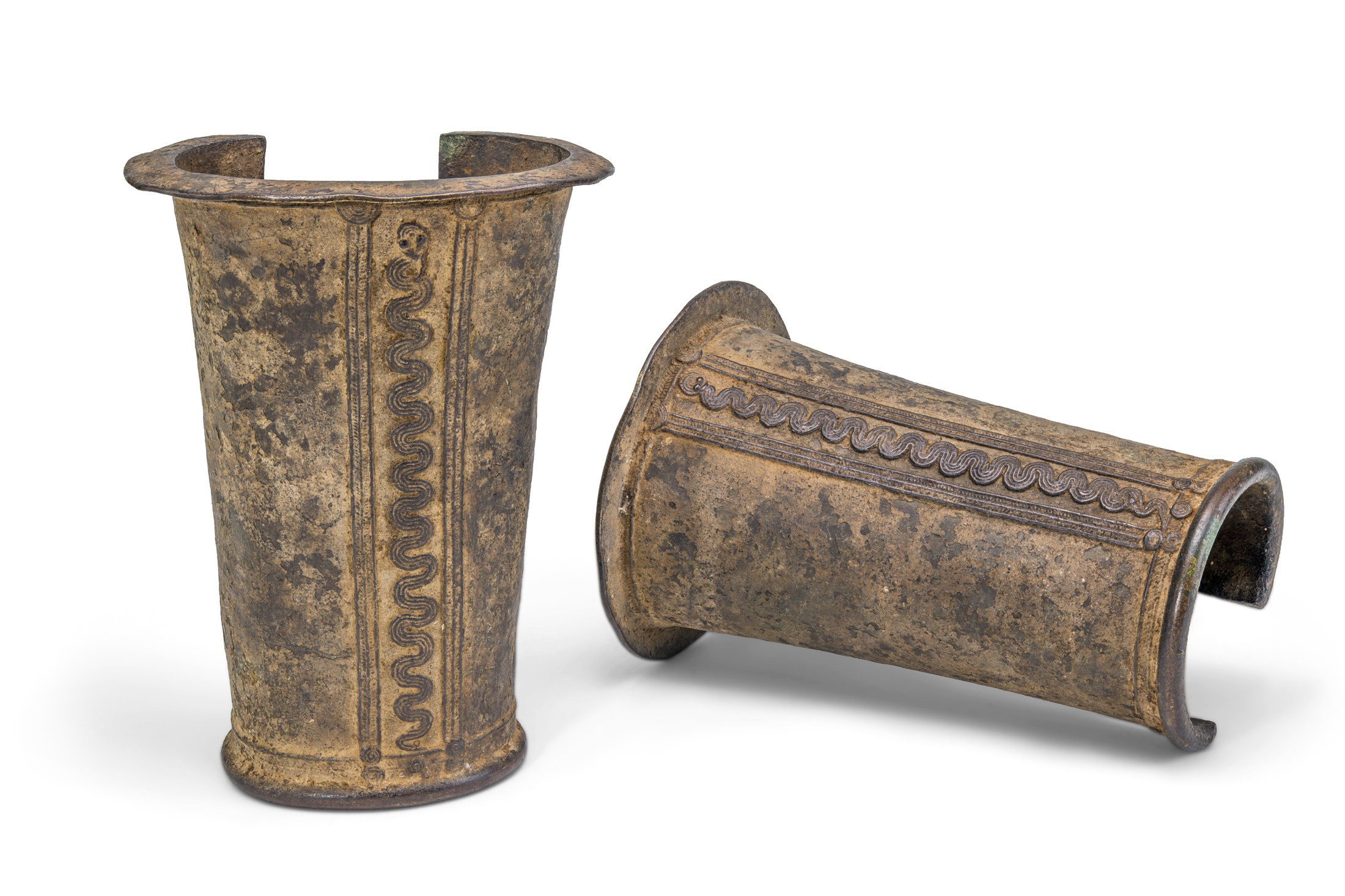
The anklets illustrate a dimension of jewellery that cannot be recovered through an examination of materials and craftsmanship alone. To understand their significance requires knowledge of the beliefs and traditions within which they were worn.
It is here that the thematic structure of Around the World in Jewellery has particular value. By incorporating objects associated with ceremony, protection and collective identity alongside examples of luxury jewellery, the exhibition broadens the historical understanding of personal adornment.
An accompanying English- and Arabic-language publication extends this research through contributions from curators, historians and specialists.
The bronze anklets, the Miao torque and the Indian turban ornament were made within very different traditions, yet each acquired much of its significance through being worn. The identity of the wearer, the occasion and the understanding of those who encountered the ornament were all part of its history.
For the museum, preserving the object is only one aspect of preserving that history. The more difficult undertaking is to recover the knowledge that once allowed an ornament to be recognised as a declaration of status, an inheritance or a source of protection. The exhibition in Doha makes this knowledge as worthy of attention as the jewellery itself.
Photography courtesy of Qatar Museums and L’ÉCOLE, School of Jewelry Arts. Individual photographic credits accompany the images.
Cover image: Miao Torque with Spirals, 20th century, Guangxi, China. Engraved silver. © Qatar Museums / National Collection of Qatar, Doha. Photo by Dmitry Kostyukov.
