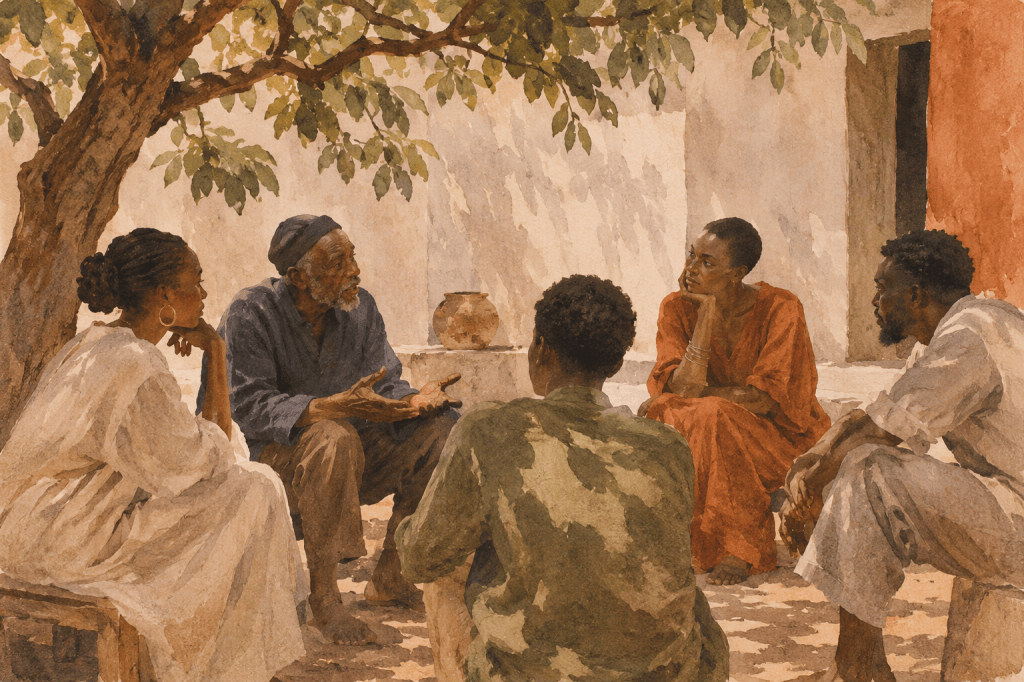
The most radical challenge to the Western philosophical tradition does not come from Nietzsche or Heidegger or Derrida. It comes from a philosophy that has been practised across sub-Saharan Africa for centuries, that has no founding text and no single author, and that can be stated in four words: I am because we are. Those four words dissolve the assumption on which thirteen essays about Western philosophy were built. They do so quietly, without aggression, and with a generosity that is itself part of the argument.
Begin with what the Western philosophical tradition assumes, because Ubuntu is most clearly understood as the answer to a question that the Western tradition has been asking in the wrong way.
From Socrates to Sartre — across the entire arc of the Western philosophical series that preceded this one — the question has been: who am I? The question assumes a self that is, in some fundamental sense, prior to its relationships and its community: a self that then enters into relationships, that then becomes part of a community, that is shaped by its social world but is not constituted by it. Even the philosophers who most thoroughly challenged this assumption — Aristotle with his political animal, Hegel with his account of the self’s constitution through recognition by others, Heidegger with his being-in-the-world — remained, in the end, within the framework that the question imposes. The self is the starting point. The community is what the self enters or is shaped by. The individual is the unit.
Ubuntu does not ask who am I. Ubuntu says: the question is already wrong, because there is no I that exists prior to the we. The self is not the unit. The community is the unit, and the individual person is the community’s specific expression in this particular body at this particular time, constituted by her relationships, sustained by her community, genuinely herself only in and through the web of obligations and recognitions and shared practices that the community provides.
“Umuntu ngumuntu ngabantu.” The Nguni phrase — from the Zulu and Xhosa languages — is usually translated as “a person is a person through other persons,” and the translation is accurate but insufficient, because the English word “through” suggests a causal relationship — the person is formed or influenced by other persons — when what Ubuntu asserts is something stronger: the person is not merely formed by other persons but constituted by them. Take away the relationships, take away the community, take away the web of mutual recognition and mutual obligation that Ubuntu describes, and you have not left an individual. You have left nothing that deserves the name.
The Philosophy Without a Text
Ubuntu is the most philosophically challenging subject in this series to write about, and the challenge is not a limitation of the philosophy but a feature of it. It has no founding text. It has no single author. It was not codified in a system by a philosopher sitting alone working out its implications. It is a living philosophy — a way of being in the world that has been practised and transmitted and refined across centuries and across the vast geographic and cultural diversity of sub-Saharan Africa, expressed not in treatises but in proverbs, in communal practices, in the specific texture of social life, in the way decisions are made and disputes resolved and children raised and the dead mourned.
This is not a deficiency. It is a philosophical position. The Ubuntu tradition’s preference for oral transmission over written codification, for communal practice over individual authorship, for the living conversation over the fixed text, is not an accident of historical circumstance but an expression of the philosophy’s own deepest commitments. A philosophy that says the self is constituted by community cannot, without self-contradiction, be the product of an isolated individual working in solitude. A philosophy that says wisdom is generated and held communally cannot, without self-contradiction, be fully captured in the written work of a single author. The form of the philosophy expresses its content.
The name Ubuntu comes from the Nguni languages — Zulu, Xhosa, Ndebele, Swati — but the concept it names is present across a vast range of African philosophical traditions, under different names and with different specific emphases. The Akan people of Ghana and Côte d’Ivoire express it in the phrase “onipa na ohia onipa” — a person needs persons. The Sotho-Tswana peoples of southern Africa express it in “motho ke motho ka batho” — a person is a person through persons. The Luo people of East Africa, the Yoruba of Nigeria, the Igbo, the Wolof of Senegal — across the continent, in different languages and different cultural contexts, the same fundamental insight is expressed: the person is not prior to the community. The community is prior to the person.
The philosophical literature on Ubuntu has grown substantially in the past three decades, as African philosophers — many of them trained in Western philosophical traditions and therefore able to articulate the Ubuntu insight in terms that the Western tradition can engage with — have worked to bring this living philosophy into the academic conversation it has too long been excluded from. Augustine Shutte, Mogobe Ramose, Thaddeus Metz, Desmond Tutu, and others have produced philosophical work that takes Ubuntu seriously as a contribution to the central questions of ethics, political philosophy, and metaphysics rather than as an interesting cultural curiosity. Their work is the primary resource for this essay, and the debt to it is considerable.
The Self That Is Not Prior
The Western philosophical tradition has, across its history, offered several accounts of the relationship between the individual and the community. The social contract tradition — Hobbes, Locke, Rousseau — imagines individuals as prior to the community, coming together to form political societies for mutual benefit from a pre-social condition of natural freedom. The communitarian tradition — Burke, Hegel, and more recently Michael Sandel and Alasdair MacIntyre — argues that the individual is always already shaped by the community, that the self is constituted by traditions and practices and relationships rather than being prior to them. The liberal tradition — from Kant through Mill to Rawls — attempts various syntheses of individual rights and communal obligations, always keeping the individual as the primary locus of moral consideration.
Ubuntu is not a version of any of these positions. It is something categorically different, and the difference matters.
The communitarian critique of liberalism says: the self is not prior to its ends, not prior to the values and relationships and communities that constitute it. Ubuntu goes further: the self is not, in the deepest sense, a separate thing at all. The boundaries between self and other that Western philosophy takes as given — the boundary that makes it possible to speak of the individual as the unit of moral consideration, the boundary that makes rights-claims and duties-claims possible, the boundary that organises the Western political tradition’s entire architecture of the person — are, in the Ubuntu account, not hard ontological boundaries but soft and permeable and continually negotiated in the lived practice of the community.
This requires some precision, because it is easy to misread the Ubuntu account as the denial of individuality — as the claim that the individual does not exist, that persons are simply cells in a social organism with no inner life of their own. This would be wrong. Ubuntu does not deny that persons are distinct. It denies that the distinction is foundational — that the distinct person is what is most real, most morally significant, most ontologically prior. What is most real, in the Ubuntu account, is the relationship. What is most morally significant is the web of mutual recognition and mutual obligation that constitutes personhood. What is most ontologically fundamental is not the individual but the communal life that the individual participates in and through which the individual becomes genuinely herself.
The distinction between the Ubuntu account and the Western communitarian account can be stated precisely: the communitarians say that the self is constituted by community. Ubuntu says that personhood — ubuntu, the quality of being fully human — is achieved through community. The first is a claim about the causal formation of the self. The second is a claim about the ongoing constitution of personhood through relational practice. You are not fully a person by birth. You become a person — you achieve ubuntu — through the continuous practice of the relationships and the obligations that the community requires and sustains.
Personhood as Achievement and Practice
The concept of ubuntu — the noun from which the philosophy takes its name — refers to the quality of being fully human, of having achieved the relational depth and the communal rootedness that genuine personhood consists of. It is not a binary — you either have it or you don’t. It is a quality that can be more or less fully realised, that grows through the practice of the communal obligations that develop it, that can be diminished or lost through the failure of those obligations.
The person who is generous, who shares what she has, who participates in the communal life, who fulfils her obligations to her elders and her children and her community, who resolves disputes with wisdom and care, who mourns the dead with appropriate ceremony and welcomes the newborn with appropriate celebration — this person has ubuntu. She is fully a person. The person who is selfish, who withdraws from the communal life, who neglects her obligations, who prioritises her individual interest over the good of the community — this person diminishes her own ubuntu, becomes less fully herself, loses the relational depth that genuine personhood requires.
The practical consequence of this account for the organisation of social life is considerable. The ubuntu tradition does not produce the liberal conception of rights — the claims of the individual against the community, the protections of individual autonomy from collective interference. It produces a different conception of the good social life: one organised around the obligations of persons to each other and to the community, around the practices of mutual care and mutual recognition that sustain the relational web in which personhood is achieved, around the collective deliberation about the good that the community undertakes together rather than the aggregation of individual preferences that liberal democracy typically models itself on.
The tradition of indaba — the communal gathering for deliberation and decision-making that has been practised across southern Africa — is the political expression of this philosophical commitment. The indaba is not a majority vote. It is a process of communal conversation that continues until genuine consensus is reached, until every voice has been heard and every concern has been addressed, until the community has arrived at a decision that reflects the genuine good of the whole rather than the preference of the majority. The process is slow and demanding. It is also, the ubuntu tradition insists, more genuinely democratic than the quick aggregation of individual preferences that Western democracies tend to mistake for genuine participation.
Nelson Mandela, who drew explicitly on the ubuntu tradition throughout his political career, described the indaba process as central to his understanding of the democratic culture that the new South Africa needed to build. “Ubuntu,” he said, “does not mean that people should not enrich themselves. The question therefore is: are you going to do so in order to enable the community around you to be able to improve?” The formulation is precise: self-enrichment is not condemned, but it is always understood in its relational context, always measured against its contribution to or subtraction from the communal web of mutual flourishing.
Ubuntu and the Western Self: The Dialogue
The encounter between Ubuntu philosophy and the Western philosophical tradition is not a simple confrontation between opposed positions. It is a productive dialogue that illuminates the limitations of both and the genuine insights of each.
The Western tradition’s emphasis on individual autonomy — on the rights and the dignity of the individual person considered as a distinct locus of moral significance — has produced achievements that the ubuntu tradition, in its traditional forms, has sometimes struggled to accommodate: the protection of the individual against the tyranny of the community, the recognition of the rights of those whose communities have excluded or oppressed them, the space for the individual to dissent from communal norms, to develop in directions the community did not anticipate or approve.
The ubuntu tradition’s response to these concerns is not to deny them but to contextualise them. The individual who needs protection from the tyranny of her community is, in the ubuntu account, the individual who has been failed by a community that has itself lost its ubuntu — a community that has allowed its internal hierarchies and its power structures to override the genuine mutual recognition that the philosophy requires. The abuser, the oppressor, the community that silences dissent — these are not expressions of ubuntu but violations of it, failures of the communal practice that ubuntu demands. The protection that the individual needs is not protection from the community as such but protection from the community’s failure to be genuinely communal in the ubuntu sense.
The ubuntu critique of Western individualism is, conversely, a critique that the Western tradition has found genuinely challenging and has not fully absorbed. The liberal tradition’s conception of the autonomous individual — the individual who is prior to her community, who has rights that exist independently of any communal context, who can in principle opt out of any particular communal arrangement — is not, in the ubuntu account, a description of a genuinely free human being. It is a description of a human being who has been abstracted from the conditions of her own humanity: who has been separated, conceptually, from the relationships that constitute her, and who then finds, in the freedom that the separation produces, not the fullness of personhood but its diminishment.
The epidemic of loneliness in contemporary Western societies — the specific, pervasive, clinically significant loneliness of people who are surrounded by technology and entertainment and the formal structures of liberal democratic society but who are not genuinely known by others, who do not genuinely know others, who lack the specific quality of relational depth that ubuntu describes as the condition of genuine personhood — is the ubuntu diagnosis made visible in contemporary pathology. The tradition that produced the most sophisticated philosophical account of individual autonomy has also produced the most individualised, most atomised, most relationally impoverished societies in human history. Ubuntu says: these two facts are connected.
The Ethics of Care and the Communal Good
Ubuntu generates an ethics that is structurally different from the dominant traditions of Western moral philosophy — different from Kant’s deontology, different from Mill’s utilitarianism, different from Aristotle’s virtue ethics, though it has affinities with all three.
The Kantian tradition grounds morality in the rational autonomy of the individual: the moral law is the law that the rational individual gives to herself, and the fundamental moral obligation is to treat rational beings as ends in themselves rather than merely as means. Ubuntu does not deny the dignity of the person — it insists on it, more thoroughly than the Kantian tradition, because it insists on the relational conditions without which dignity cannot be sustained. But it grounds morality not in individual rational autonomy but in the communal relationships that constitute personhood: the fundamental moral obligation is not to respect the autonomy of the isolated individual but to sustain the relational web through which persons become genuinely themselves.
The utilitarian tradition grounds morality in the maximisation of aggregate wellbeing: the right action is the action that produces the greatest happiness for the greatest number. Ubuntu’s objection to this is that it treats the community as an aggregate of individuals whose wellbeing can be summed and maximised, rather than as a relational entity whose good cannot be reduced to any aggregation of individual goods. The community that sacrifices the few for the many has not maximised the common good in the ubuntu sense. It has violated the relational obligations that the common good, properly understood, consists of.
The virtue ethics tradition — particularly Aristotle’s — is the closest to Ubuntu in its emphasis on the formation of character through social practice and on the communal conditions required for genuine flourishing. But even Aristotle’s account of the political animal remains within the framework of the individual who needs community for her individual flourishing. Ubuntu goes beyond this: the community is not the condition of individual flourishing but the medium in which flourishing happens and in which the self that flourishes is constituted.
Thaddeus Metz, the South African philosopher who has done the most rigorous work on the philosophical foundations of Ubuntu, argues that the ubuntu ethical principle can be stated as: an action is right insofar as it positively relates to others and thereby realises oneself; an act is wrong insofar as it does not relate positively to others and thereby fails to realise oneself. The formulation captures the essential ubuntu insight: the good for the individual and the good for the community are not in tension but are constitutively connected. To live well is to live in genuine relationship. To live in genuine relationship is to live well. The two descriptions refer to the same state.
Ubuntu and the Contemporary World
The ubuntu philosophy arrives in the contemporary world at a moment of acute relevance — a moment in which the pathologies of Western individualism are fully visible, in which the atomisation of social life, the erosion of the communal bonds that sustain genuine personhood, and the political consequences of a culture organised around the isolated consumer-individual rather than the relational communal person are producing consequences that the tradition has not found adequate resources to address.
The loneliness epidemic is the most visible of these consequences, and it is the one that ubuntu diagnoses most precisely. But it is not the only one. The political fragmentation of societies in which shared community has dissolved into competing identities and interests, the environmental crisis produced by a civilisation that treats the natural world as a resource to be exploited rather than a community to be sustained, the mental health crisis of individuals who have been given unlimited formal freedom and an extreme poverty of genuine relational connection — all of these are, in the ubuntu analysis, the consequences of the same fundamental error: the organisation of social and political life around the isolated individual rather than the relational community.
Ubuntu is not a nostalgic call for the return to a pre-modern communal life that was often characterised by its own forms of exclusion and hierarchy. The ubuntu tradition, as it has been developed by contemporary African philosophers, is fully aware of the ways in which communal norms can be used to suppress dissent, to enforce conformity, to deny the rights of those — women, sexual minorities, those who challenge the community’s self-understanding — whose lives do not fit the communal norm. The ubuntu tradition’s response to these failures is not to abandon the communal framework but to insist more rigorously on the genuinely relational character of ubuntu: a community that excludes or oppresses is not expressing ubuntu but betraying it.
Desmond Tutu, who made ubuntu central to his account of the moral foundations of the Truth and Reconciliation Commission in post-apartheid South Africa, describes ubuntu as the philosophy that made reconciliation possible: the understanding that the perpetrators of apartheid’s violence were not simply enemies to be defeated or criminals to be punished but human beings who had lost their ubuntu through the practice of dehumanisation, and who could recover it — partially, imperfectly, through the difficult work of acknowledgment and forgiveness — in the communal process of truth-telling. The TRC was not an ubuntu institution in any pure sense, but it drew on ubuntu’s philosophical resources in ways that the retributive justice tradition of Western law could not have provided.
Who We Are According to Ubuntu
We are not individuals who then enter into relationships. We are relationships that have taken individual form. The distinction matters more than it might initially appear, because it changes what the fundamental question of ethics and politics is: not how do we balance the claims of individuals against each other and against the collective, but how do we sustain and deepen the relational web in which genuine personhood is achieved and maintained.
We are persons in the process of becoming more fully persons — the achievement of ubuntu is not complete at birth, is not guaranteed by membership in a community, but requires the continuous practice of the obligations that genuine relationship demands: the sharing, the care, the recognition, the participation in the communal life, the willingness to be known and to know, to be present to the suffering of others and to receive their presence in one’s own.
We are beings whose flourishing is inseparable from the flourishing of those around us — not because our interests happen to align with theirs in a way that makes mutual benefit possible, but because the self that flourishes is constituted by its relationships, and the degradation of those relationships is the degradation of the self that depends on them. The loneliness of the atomised individual is not merely uncomfortable. It is the diminishment of personhood itself.
We are accountable — not primarily to a divine judgment or a moral law or the internal demands of our own rational nature, but to each other: to the community of persons whose recognition constitutes our personhood, whose wellbeing is bound up with our own, whose claims on us are not external impositions but the very conditions of our own humanity.
And we are, finally, more than we know ourselves to be in isolation. The self that is known only to itself — the Cartesian self, the existentialist self, the self that Kierkegaard described choosing itself in absolute solitude — is a diminished self, a self that has not yet encountered the full range of what it is because it has not yet encountered the full range of the relationships through which it is constituted. Ubuntu says: you are larger than you think. You are because we are. And the we that you are part of extends further than you can see — to those who have died, to those not yet born, to the community of living beings in the natural world with whom the relational web of human life is also, ultimately, connected.
The feather that Ma’at weighs the heart against is not heavier than the heart alone. But the heart that has been formed by genuine relationship — the heart that carries in it the weight of all the persons it has known and cared for and been constituted by — that heart, weighed against the feather, finds them in balance. Because the heart that has ubuntu has the lightness of the thing that is where it belongs.
The foundational philosophical texts for Ubuntu include Augustine Shutte’s Ubuntu: An Ethic for a New South Africa (Cluster Publications), Mogobe Ramose’s African Philosophy Through Ubuntu (Mond Books), and Thaddeus Metz’s A Ubuntu as a Moral Theory and Human Rights in South Africa (African Human Rights Law Journal). Desmond Tutu’s No Future Without Forgiveness (Doubleday) is the most accessible account of Ubuntu’s application in the context of the Truth and Reconciliation Commission. Kwame Gyekye’s Tradition and Modernity: Philosophical Reflections on the African Experience (Oxford University Press) provides essential context on the relationship between individual and community in African philosophy more broadly. For the contemporary development of Ubuntu philosophy, Leonhard Praeg’s A Report on Ubuntu (University of KwaZulu-Natal Press) is the most rigorous recent scholarly treatment.
Cover image by CHATGPT
