The Man Who Left Everything Unfinished
Auguste Rodin spent thirty-seven years on a single pair of doors he never completed, destroyed the woman who loved him, and in the process invented modern sculpture. The question is whether these things are separable.
In 1880, the French government commissioned Auguste Rodin to design a pair of bronze doors for a planned new museum of decorative arts in Paris. The museum was never built. The doors were never finished. Rodin worked on them, on and off, for the remaining thirty-seven years of his life, accumulating figures and fragments and visions drawn from Dante’s Inferno until the project had consumed hundreds of individual sculptures, including, almost incidentally, two of the most reproduced works of art in the world. He died in 1917, the doors still uncast in bronze, still accreting, still not done. They stand now in the Musée Rodin in Paris — finally cast in 1926, nine years after his death — as perhaps the most magnificent act of productive failure in the history of Western art.
The Gates of Hell are not a failure, of course, except in the narrow administrative sense that the commission was never fulfilled. They are something stranger: a work that became an ecology, a self-sustaining creative environment from which Rodin extracted figures when he needed them and to which he returned, always, when the need to make something overwhelming and unresolvable came over him. The Thinker began as a small figure above the lintel, representing Dante surveying the damned. The Kiss was originally among the condemned souls — Paolo and Francesca, the adulterous lovers from the fifth canto — before Rodin removed it because it seemed, among all that suffering, too happy. He was right. The happiness made it dangerous.
The Gates of Hell are not a failure. They are something stranger: a work that became an ecology — a self-sustaining creative environment from which Rodin extracted figures when he needed them.
Three Rejections
Rodin was born in Paris in 1840, the son of a minor police official, and spent his adolescence at the Petite École — a school for applied arts, a lesser institution — after being rejected three consecutive times by the École des Beaux-Arts. The rejections shaped him. The École, with its emphasis on classical form, its hierarchy of smooth finish over raw surface, its suspicion of anything that looked as though a human hand had made it, was precisely the institution whose authority Rodin would spend his career dismantling. The training he received at the Petite École — in drawing, in ornament, in the close observation of natural forms — turned out to be more useful than the prestigious education he had been denied. But the denial rankled, and the chip it left on his shoulder was never entirely smoothed away.
He worked for years as a craftsman and assistant, making decorative sculpture for architects and more established artists, learning the trade from the inside in a way that the École’s students never did. He was thirty-five before he had his first serious public showing. By then he had spent two decades with his hands in clay and plaster, learning the properties of surfaces with the patience of someone who has no other option. When his moment came, he was ready in a way that more formally trained sculptors were not, because he understood materials as substances with their own logic, their own resistance, their own desire.
The Accusation
In 1877, Rodin exhibited a bronze figure of a standing young man at the Paris Salon. The figure — The Age of Bronze — was so naturalistic, so precisely observed in its anatomy and its weight and its particular quality of being occupied by a living person, that the critics accused him of casting it directly from a model’s body. The accusation was intended as an insult: it implied that the work required no art, only a mould and some liquid metal. Rodin was furious and mortified. He gathered testimonials from his models, from other sculptors, from anyone who could attest that the figure had been made the hard way, from observation and labour. The accusation was eventually withdrawn.
But the episode had, embedded in its insult, an inadvertent compliment. What the critics were saying, beneath the sneer, was that Rodin had made something so alive that it seemed impossible to have been made at all — that the transition from living body to bronze had occurred without the usual visible loss. This was exactly what Rodin was trying to do. He wanted his figures to seem not carved or modelled but found, as if the bronze had always contained them and he had merely removed what was in the way. The accusation called him a cheat. What it actually described was his ambition.
Camille
In 1882, a young woman arrived at Rodin’s studio. She was nineteen, the daughter of a civil servant from the Champagne region, and she had come to Paris to study sculpture against the wishes of nearly everyone she knew. Her name was Camille Claudel. She was, by any serious assessment, one of the most gifted sculptors of her generation. She became Rodin’s student, his model, his collaborator, and his lover. She was also, eventually, his victim — though the word requires care, because the damage done to Claudel was the product of many forces beyond Rodin alone, and the habit of reducing her story to his is itself a form of the harm.
What is clear is that the years of their relationship, roughly 1882 to 1898, were years of ferocious mutual influence. Claudel’s touch — more delicate than Rodin’s, more interested in psychological interiority, in the specific geometry of tenderness — can be felt in his work of this period. His ambition, his technical reach, his willingness to pursue an idea to its extreme, left marks on hers. The hands in Rodin’s figures change in these years. They become more expressive, more various, less monumental. This may be coincidence. It is more likely the result of working in proximity to someone who understood hands differently.
Rodin did not leave Rose Beuret, the working-class woman who had shared his life since the 1860s and who would remain with him until her death — they married weeks before she died, and he followed her into death within the year. He did not leave Rose for Claudel, and Claudel, who had perhaps believed he would, began to understand that he would not. The dissolution of the relationship was prolonged and terrible. Claudel, by her late thirties, was working in isolation, her family estranged, her mental state increasingly fragile. In 1913, her brother — the poet and playwright Paul Claudel — had her committed to a psychiatric institution. She was forty-eight. She remained institutionalised for the next thirty years, until her death in 1943. She made almost nothing after her committal. She had asked, repeatedly, to be released. She never was.
Claudel’s story has the structure of a cautionary tale, but the lesson it teaches is not about madness. It is about what happens when an institution — art, family, medicine — decides that a difficult woman is more manageable as a patient than as a person.
Rodin’s role in this is contested and uncomfortable. He did not commit her. He was not, by the time of her committal, a significant presence in her life. But he had, across two decades, absorbed her influence, benefited from her labour, failed to protect her professionally, and — crucially — failed to advocate for her publicly in ways that might have sustained her reputation during the years when her mental health was deteriorating. After her committal, he expressed regret in private. He did not express it where it might have done some good.
Claudel’s story has the structure of a cautionary tale, but the lesson it teaches is not about madness. It is about what happens when an institution — art, family, medicine — decides that a difficult woman is more manageable as a patient than as a person. Rodin himself never faced an institution that made that decision. He had, among other advantages, the advantage of being a man.
Balzac
In 1891, the Société des Gens de Lettres commissioned Rodin to make a monument to Honoré de Balzac. What they wanted, clearly, was a dignified commemorative statue of a great writer — a figure in frock coat, perhaps with a book, perhaps with a noble expression suggestive of literary profundity. What Rodin delivered, after seven years of research and revision, was a massive, shrouded figure that appeared to have erupted from the earth — a man-mountain, a force rather than a person, the creative energy of a novelist given physical form. The Société rejected it. The critics called it a snowman, a sack of flour, a foetus. Rodin withdrew the work and kept it at his studio in Meudon, where it stood in the garden, growing more magnificent with each year, until it was finally cast in bronze and installed in Paris in 1939, twenty-two years after his death.
The Balzac is now generally considered one of the greatest sculptures ever made. It is also the work in which Rodin made the decisive break with the tradition he had been trained in — the tradition that held that a monument should represent its subject legibly, that it should convey recognisable human features and readable symbolic attributes, that it should explain itself. The Balzac explains nothing. It insists. It occupies space with the authority of something that has always been there and intends to remain. To stand in front of it at night, in the boulevard Raspail where it now stands, is to feel the peculiar unease of encountering something that is more alive than you expected a piece of bronze to be.
The Surface
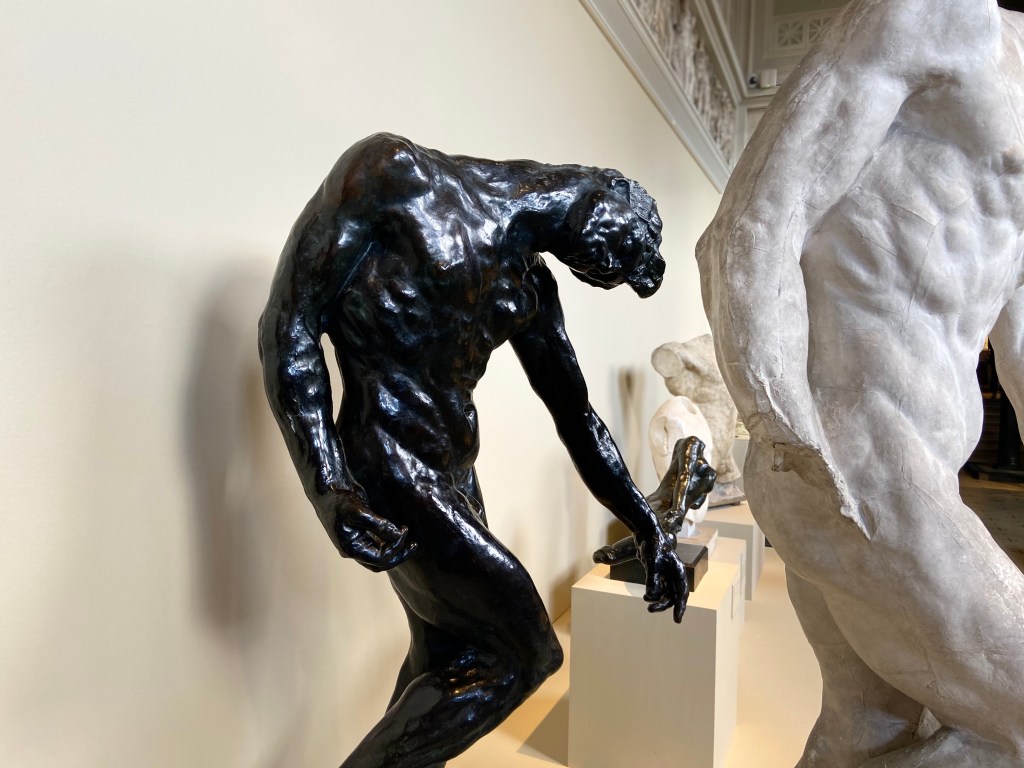
What Rodin discovered, and what his best work demonstrates with a consistency that his enormous output does not always sustain, is that the surface of a sculpture is not its skin. It is its nervous system. The marks left by the modelling tool, the roughness of an incompletely worked area, the deliberate unevenness of a finish — these are not imperfections. They are the record of making, and the record of making is inseparable from what is made.
This sounds, stated baldly, like a fairly routine piece of modernist aesthetic doctrine. In the context of 1880s academic sculpture — in the context of the smooth, impersonal, ideally finished surfaces that the Prix de Rome produced — it was revolutionary. Rodin was insisting that you could see the hand of the artist in the finished work, that this visibility was not a failure of refinement but a form of honesty, and that honesty, in art as in life, was more interesting than perfection.
Rilke, who served as Rodin’s secretary for a year in 1905 and wrote one of the finest essays ever written about a living artist’s work, understood this immediately. He wrote that Rodin’s surfaces were alive in the way that skin is alive — not because they were smooth but because they were responsive, because they registered light and shadow and touch the way a living body does, because they seemed to be in the process of becoming rather than in the condition of having become.
Rodin was insisting that the record of making is inseparable from what is made. In the context of 1880s academic sculpture, this was not a minor stylistic preference. It was a declaration of war.
This is the thing about Rodin that the ubiquity of The Thinker — on coffee mugs, on posters in student accommodation, on the covers of philosophy textbooks — tends to obscure. The familiar images have been so thoroughly absorbed into the furniture of general culture that it requires an effort to see them again as the strange, difficult, formally radical things they are. The Thinker is not a man thinking. It is a body in the extremity of thought, the muscles engaged, the weight borne forward, the whole physical frame complicit in a mental act. The mind, Rodin is saying, is not separate from the body that houses it. They labour together, and the labour shows.
He was seventy-six when he died, famous beyond any reasonable expectation for a man who had been rejected three times before he was twenty, who had spent his middle years in chronic financial anxiety, who had made his greatest works in the face of institutional hostility and public incomprehension. He left the bulk of his estate — the sculptures, the drawings, the studio, the house at Meudon — to the French state, which established the Musée Rodin in the Hôtel Biron, the beautiful eighteenth-century mansion where he had spent his last years. The museum is, among the art museums of Paris, the one that feels most like a living place — partly because of the garden, where bronze figures stand among the roses in the afternoon light, and partly because the work itself still seems to be in motion, still seems to be deciding what it is, still seems, in some obscure way, unfinished.
Which is, perhaps, the appropriate condition for work that was always more interested in becoming than in being.
Works referenced: The Age of Bronze (1877); The Gates of Hell (1880–1917, cast 1926); The Burghers of Calais (1889); Balzac (1898, cast 1939); The Thinker (1902 enlargement). Rainer Maria Rilke, Auguste Rodin (1903). This essay is part of an ongoing series, Encounters, on artists whose practice cannot be easily categorised.
Cover image: Birgitte Enevoldsen
