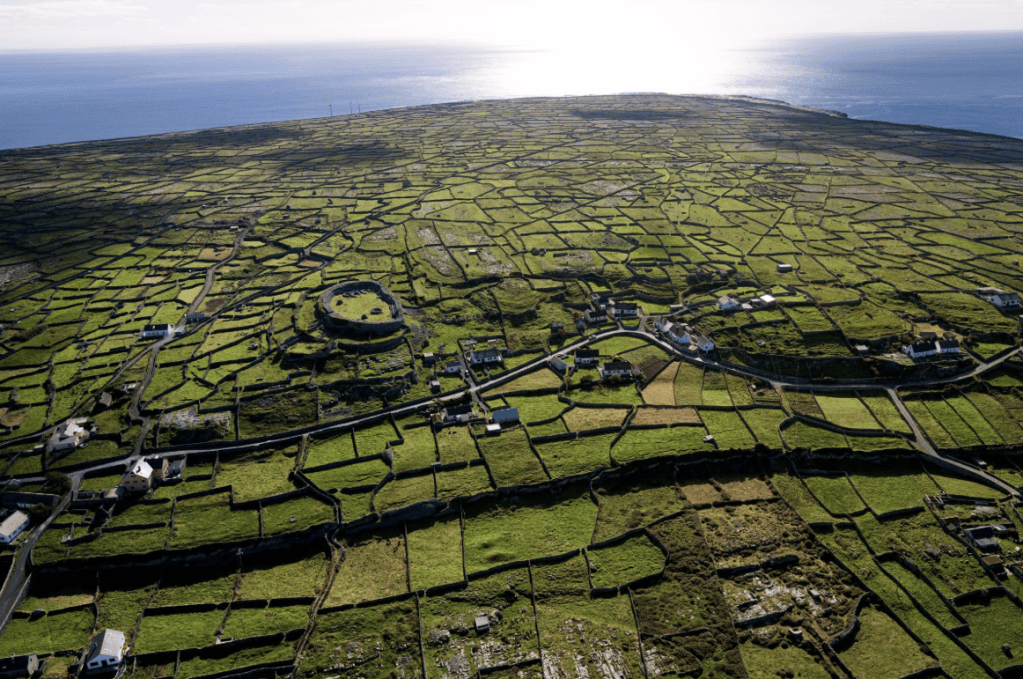
On a small island off Ireland’s Atlantic coast, dry-stone walls divide the landscape into hundreds of irregular fields, Irish remains the language of everyday life, and one of the country’s most sophisticated knitwear companies produces clothing for an international clientele. Inis Meáin, the least visited of the three Aran Islands, has an extraordinary history encompassing ancient fortifications, literary giants and an unlikely luxury fashion business. It is also a compelling example of how traditional craftsmanship can help sustain an isolated community.
An Island Written in Stone
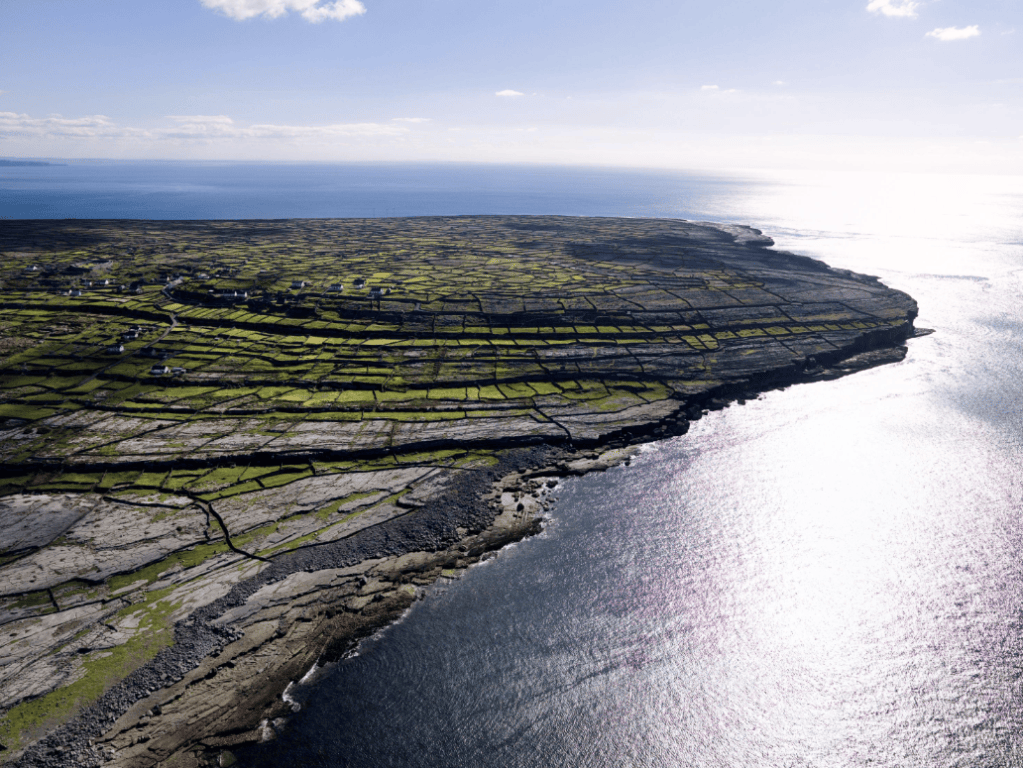
Approaching Inis Meáin by boat, the first remarkable sight is the landscape. An intricate network of dry-stone walls extends across a limestone plateau, dividing the island into small fields whose shapes reflect generations of agricultural labour. There are few trees, and the exposed Atlantic coastline provides little protection from the weather. It is a beautiful, demanding environment, where the practical requirements of everyday life have produced an unusually distinctive landscape.
Situated between Inis Mór and Inis Oírr at the entrance to Galway Bay, Inis Meáin measures approximately five kilometres by three. Its small, predominantly Irish-speaking population maintains a cultural identity closely associated with the Gaeltacht, Ireland’s Irish-language regions.
The island’s history extends far beyond its present settlement. Dún Chonchúir, an imposing prehistoric stone fort occupying one of its highest points, contains substantial defensive walls whose construction required thousands of tonnes of limestone. The fort is among Ireland’s most impressive ancient monuments, offering expansive views across the surrounding landscape.
Nearby, Séipéal Muire gan Smál, the island’s Catholic church, contains stained-glass windows produced by the celebrated Harry Clarke Studios. Their jewel-like colours provide a striking contrast with the restrained tones of the limestone outside. The church’s carved limestone altar is also noteworthy: it was made by James Pearse, father of the Irish revolutionary Patrick Pearse.
For walkers, the island offers several rewarding routes, including an 8.5-kilometre circuit passing Dún Chonchúir, the church and the house associated with playwright J. M. Synge. The longer coastal walks lead through wildflower-rich limestone terrain towards views of the Cliffs of Moher.
Where J. M. Synge Found His Voice
The literary history of Inis Meáin is almost as compelling as its landscape.
The playwright John Millington Synge began visiting the Aran Islands in 1898, encouraged by W. B. Yeats to immerse himself in the life and language of the Irish-speaking west.
Synge returned over several summers, staying with island families, learning Irish and recording the conversations, customs and stories he encountered. His experiences became the basis of The Aran Islands (1907), an extraordinary account of island life at the turn of the twentieth century.
His observations also contributed to the dramatic world of Riders to the Sea (1904), his devastating one-act play about a family confronted by the dangers of maritime life.
Visitors can still see Teach Synge, the cottage associated with his visits, and walk towards Cathaoir Synge, or Synge’s Chair, a natural stone lookout above the Atlantic where the writer is said to have spent time contemplating the landscape.
Synge’s writings helped introduce the Aran Islands to an international literary audience, although his work also belongs to a period when educated outsiders frequently approached rural Irish communities as repositories of supposedly disappearing traditions.
The island is worth encountering on its own terms, rather than simply through the romantic imagination of its famous visitor. Inis Meáin is a living community, with contemporary businesses, schools, cultural initiatives and the challenges familiar to small island populations.
One of its most successful responses to those challenges began with knitting.
A Luxury Knitwear Company in the Atlantic
In 1976, Tarlach de Blácam and his wife Áine Ní Chonghaile founded the Inis Meáin Knitting Company, determined to create lasting employment in a community where young people frequently left in search of work.
Tarlach, a graduate in Celtic languages from Trinity College Dublin, had come to the island during the late 1960s to study its language and culture. Áine was born on Inis Meáin and understood the difficulties involved in sustaining a livelihood there.
The couple began with six knitting machines, drawing upon the skills of local women whose families had long produced practical knitted clothing and garments for the tourist trade.
Fifty years later, the business is among Ireland’s most distinctive luxury knitwear producers, supplying specialist retailers around the world while continuing to design and manufacture its garments on the island.
Its collections reinterpret traditional Aran stitches through contemporary silhouettes, subtle colours and exceptional materials. Cashmere, linen, merino wool and silk are used to produce garments that combine the textures of traditional workwear with the refinement of modern luxury clothing.
Production involves advanced knitting machinery and meticulous hand-finishing, allowing the company to make small runs rather than pursue mass production.
The distinction is important. Inis Meáin’s achievement is not the preservation of an unchanged historical craft. It is the intelligent development of that craft into a viable contemporary business.
The company also challenges some of the romantic mythology surrounding Aran knitwear. The familiar claim that fishermen could be identified after drowning by unique family sweater patterns is not supported by convincing historical evidence. Indeed, the story appears to owe something to a misinterpretation of Synge’s Riders to the Sea, in which a dead man’s stocking is identified through its knitting.
The real history is considerably more interesting: skilled island knitters developed a distinctive tradition that subsequently adapted to changing markets, materials and economic circumstances.
In 2023, the founders handed the business to their son Ruairí and daughter-in-law Marie-Thérèse de Blacam, beginning its second generation of family ownership.
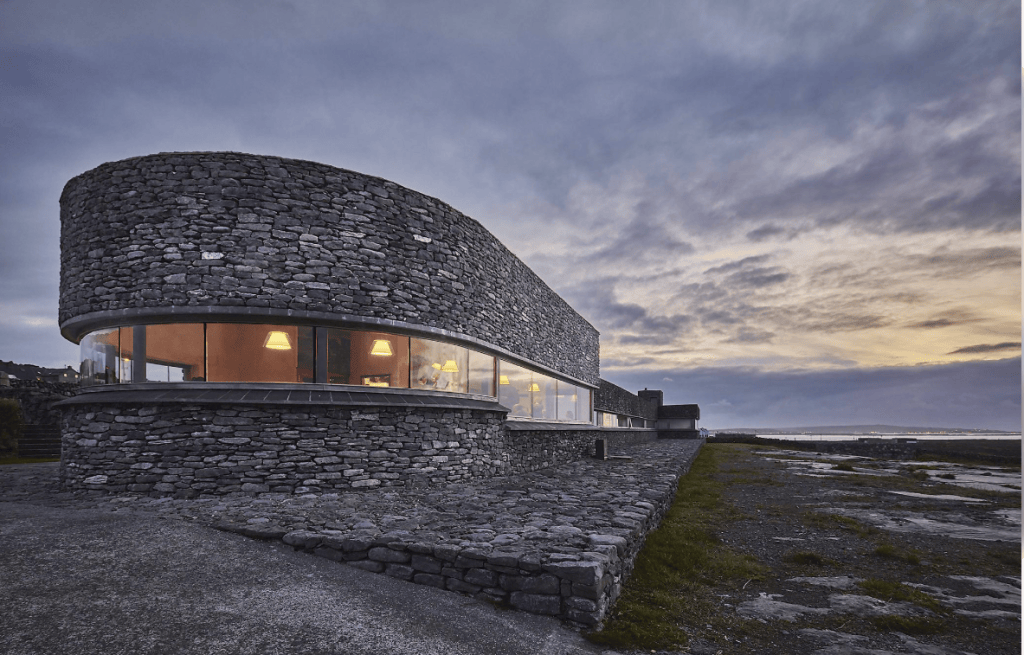
The company’s island shop is worth visiting, not least because it occupies a light-filled building designed by Irish architect Shane de Blacam. Alongside current collections, visitors may find archive pieces and experimental garments produced in the workshop.
Opening hours are limited, particularly outside the summer season, so arranging a visit in advance is advisable.
For anyone interested in fashion, craftsmanship or the relationship between design and place, the workshop is one of the island’s most compelling attractions. Its existence demonstrates how a geographically isolated community can participate in international design without relocating its production elsewhere.
Staying on Inis Meáin
The same family has also contributed to the island’s hospitality industry.
Ruairí and Marie-Thérèse established the acclaimed Inis Meáin Restaurant & Suites in 2007, attracting visitors interested in contemporary Irish cooking and the island’s unusually beautiful landscape.
The restaurant closed after the 2022 season when the couple took over the knitwear company. Its former accommodation has since been reconfigured as Inis Meáin Island Stays, offering two exclusive-use houses rather than individual hotel rooms.
The larger Karst House, designed by de Blacam and Meagher Architects, accommodates up to eight guests. Its limestone exterior, carefully framed views and restrained interiors draw directly upon the island’s architectural traditions. The smaller Currach House, formerly associated with the construction and repair of traditional boats, accommodates four.
Both properties offer self-catering accommodation, with optional prepared meals delivered to guests.
Visitors looking for simpler accommodation will find additional guesthouses and self-catering options through the island’s community tourism website.
For food and drink, Teach Ósta Inis Meáin serves traditional pub meals and offers an opportunity to encounter the island’s social life, while Café Synge provides a place to stop for coffee.
Inis Meáin rewards an overnight stay. The arrival and departure of day-trippers alters the atmosphere considerably, and the quiet evenings reveal something of the experience that attracted Synge more than a century ago.
But the island’s most interesting characteristic is not its apparent remoteness from modern life. It is the way its inhabitants have combined cultural continuity with practical innovation.
The ancient stone walls, Irish-language traditions and sophisticated knitwear business belong to the same place and the same continuing history. Inis Meáin is neither an outdoor museum nor a fashionable escape from contemporary society. It is a small community working to maintain its future in an exceptionally beautiful and demanding landscape.
And it has produced some very fine sweaters along the way.
Plan Your Visit
Inis Meáin — Official Community Visitor Guide
The best starting point for accommodation, local services, island events, walking routes and practical information.
Getting there: Aran Island Ferries operates sailings from Rossaveel, west of Galway. Aer Árann Islands operates short flights from Connemara Regional Airport. Seasonal services from Doolin in County Clare may also be available. Confirm schedules before travelling, as Atlantic weather can affect crossings.
Explore the collections, the company’s history and its fiftieth-anniversary celebration. The island shop has limited opening hours; contact the team before visiting.
Synge’s House and the Island’s Historic Sites
Information about Teach Synge, Synge’s Chair, the ancient forts and the Harry Clarke Studio windows.
Three waymarked circuits, ranging from 8.5 to 13 kilometres, with downloadable maps.
Architecturally designed accommodation for groups of four or eight, with optional prepared meals and equipment for exploring the island.
Read J. M. Synge’s The Aran Islands
The complete historical text, first published in 1907, available through Ireland’s digital heritage collection.
