Sri Lanka in December, January, and February — and why the most underwritten food culture in Asia deserves your full attention
Sri Lanka is shaped like a teardrop falling from the southern tip of India, a fact that the tourist literature never tires of pointing out as though the geography were a premonition of the visitor’s emotional response. Set that aside. What the shape actually tells you is that the island is small — about the size of Ireland — and therefore capable of delivering, within a single itinerary, a range of experiences that would require a continent elsewhere: ancient Buddhist temples, Portuguese and Dutch and British colonial architecture, highland tea estates wrapped in cloud, a coastline that extends for 1,340 kilometres around a country the width of England, and some of the finest marine wildlife watching in the world. The blue whale, the largest animal that has ever existed, gathers off the southern coast between December and March in numbers that make Mirissa one of the two or three best places on earth to see them.
The food, which is the island’s most significant underrated asset, is a separate argument that deserves separate treatment and will receive it below.
December through February is the correct season for the south and west coasts — the monsoon has ended, the skies are clear, the temperatures settle in the upper twenties, and the Indian Ocean off Galle and Mirissa is warm, blue, and populated with cetaceans of extraordinary scale and variety. The north and east are wetter at this time, which is fine because everything worth visiting in winter — Galle, the southern beaches, Yala, the hill country — is on the appropriate side of the island.
The approach: understanding Sri Lanka as layered
Sri Lanka rewards the visitor who resists the temptation to make it a beach holiday. The beaches are genuinely excellent — the stretch of coast from Hikkaduwa through Weligama to Mirissa and on to Tangalle constitutes some of the finest swimming and surfing in the Indian Ocean — but to use them as the organising principle of the trip is to miss the layers that make the island extraordinary rather than simply pleasant.
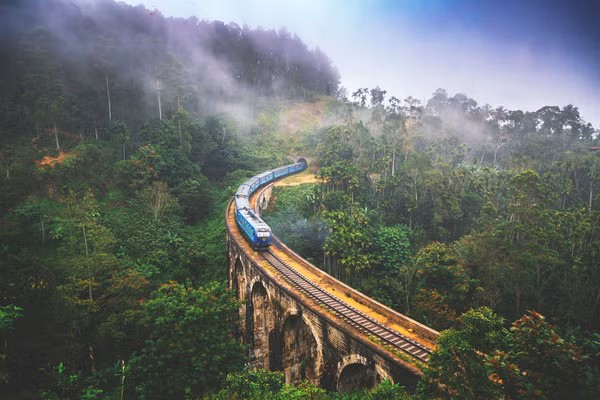
The south coast beach and Galle Fort make the natural base. From there, the national parks — Yala for leopard, elephant, sloth bear, and the highest concentration of leopard per square kilometre of any habitat in the world; Udawalawe for elephant in large herds — are within a half-day’s drive. The hill country — Ella, Kandy, Nuwara Eliya, the tea estates that cover the central highlands in a specific shade of green that has no equivalent elsewhere — is four to five hours from the coast and worth two nights minimum. The train from Kandy to Ella, which runs through the tea country on a narrow-gauge railway of colonial vintage, is one of the great train journeys in Asia: not for the speed but for the landscape, which presents itself as a continuous moving panorama of waterfalls, estates, tunnels through hillsides, and the specific mist that the highlands generate in the mornings.
The Cultural Triangle — Sigiriya, the 5th-century rock fortress that rises from the jungle floor like an unfinished idea about architecture; Dambulla, the cave temple complex; Polonnaruwa, the medieval capital — is better visited in the dry season and therefore accessible in January and February for those who want to combine coast and culture in a single trip.
Galle Fort
Galle Fort is the organisational centre of any serious south coast itinerary and one of the most satisfying small cities in Asia. The Portuguese founded it in 1588. The Dutch expanded it massively after capturing it in 1640, building the ramparts that still stand — two kilometres of fortified wall enclosing a peninsula of streets, churches, warehouses, and residences — and leaving behind a grid of Dutch colonial buildings that the British subsequently occupied without fundamentally altering. The result is a city of extraordinary architectural coherence: the same streets, the same proportions, the same vernacular adapted across three colonial powers, and between and among them the Sri Lankan life that has always been there and has absorbed all of it without being erased by any of it.
UNESCO listed the Fort as a World Heritage Site in 1988. What this has meant in practice is a wave of restoration and conversion — the old Dutch and British buildings turned into boutique hotels, galleries, restaurants, and the kind of independent shops that sell things worth buying — which has made the Fort one of the most liveable small heritage districts in the world. The ramparts can be walked in their entirety in about an hour, the Indian Ocean on one side and the rooftops of the Fort on the other, and the walk at sunset — when the light is going golden over the water and the fishermen are coming in — is one of those experiences that makes a place feel specifically and irreducibly itself.
Where to stay: Fort Bazaar
http://www.teardrop-hotels.com/fort-bazaar
The hotel occupies a 17th-century merchant’s townhouse on Church Street — a building that spent a century as a spice, tea, and gem trading house before being acquired and restored over eleven years by the Teardrop Hotels group, reopening as an 18-room boutique property that is, by any reasonable assessment, the best-designed hotel in the Fort. The restoration preserved the original structure — the high ceilings, the courtyard, the banyan tree that has been growing in the grounds for longer than the hotel has existed — while adding the contemporary comfort that makes a stay in a 300-year-old building a pleasure rather than a historical endurance exercise.
The rooms are arranged around a central sun-dappled courtyard: four-poster beds, high ceilings, the specific quality of air that moves through a well-designed tropical building at night. The Church Street Social restaurant, which opens to the street and is used by non-guests as much as guests, serves a menu of dishes that blend Sri Lankan, Moroccan, Turkish, and Mediterranean influences — an eclectic combination that sounds improbable and tastes very good. The spa is one of the best in the Fort. There is a private cinema, a library, and the new pool that the hotel opened in 2024, which sits in the garden beneath the banyan tree and is, in the afternoon, the most pleasurable place in Galle.
Fort Bazaar — 26 Church Street, Galle Fort, Southern Province, Sri Lanka.
The alternative at the higher end of the spectrum is the Amangalla — the former New Oriental Hotel, the oldest hotel in Sri Lanka, which has been welcoming P&O passengers since 1865 and Aman guests since 2005. Original Burmese teak floors, four-poster beds, lofty ceilings, the Aman Spa in the vaulted basement. The most historically atmospheric accommodation in the Fort, and priced accordingly.
http://www.aman.com/resorts/amangalla
The food: the argument
Sri Lankan cuisine is one of the great underwritten food cultures in the world — underwritten not because it is obscure but because the writing that exists about it tends to reduce it to “rice and curry” and then move on, as though rice and curry were a single dish rather than a framework capable of containing the entire range of a civilisation’s relationship with flavour, spice, and ingredient.
The foundation is the coconut, which appears in everything: coconut milk in the curries, freshly grated coconut in the pol sambol (the coconut relish, mixed with chilli, lime, red onion, and salt, that accompanies almost every meal and is as essential to understanding Sri Lankan food as olive oil is to understanding Puglia), coconut toddy fermented for the hoppers. The spice profile is more complex and more layered than the Indian cuisines with which Sri Lankan food is often grouped — the use of cinnamon, which Sri Lanka produces in its finest form and has been exporting since the spice trade was a matter of geopolitical consequence, is particularly distinctive, appearing in meat dishes and curries in ways that create a warmth and depth quite different from the heat of chilli.
The dishes that the visitor should not leave without eating:
Hoppers (appa) — bowl-shaped pancakes made from fermented rice flour and coconut milk, with crispy edges and a soft, spongy centre. The egg hopper, with a whole egg cracked and cooked in the bowl, eaten with pol sambol and dhal curry, is the correct Sri Lankan breakfast and one of the great breakfasts in the world. Found everywhere; best at a local eatery rather than a hotel.
Rice and curry — not a single dish but a composition: a mound of red or white rice surrounded by four to six small portions of different curries — typically a dhal, a vegetable curry or two, a fish or chicken preparation, a sambol, and pickles. The variety changes daily based on what is available, which means that eating rice and curry at the same restaurant three days running produces three different meals. The best versions are at family-run lunch spots and roadside establishments rather than tourist-facing restaurants.
Kottu roti — the sound of kottu is the sound of Sri Lankan streets after dark: the rhythmic clanging of metal blades on a flat iron griddle, chopping and mixing shredded godamba roti with vegetables, egg, and a choice of meat or seafood. Invented as street food, now universal, it is filling, cheap, and produced with a performance of knife work that is as worth watching as the result is worth eating. Order chicken or seafood kottu from the late-night stalls in Galle or along the beach towns, eat it standing, and understand that this is what the island tastes like when it is not trying to impress you.
Curd and treacle — buffalo curd with palm treacle: the simplest dessert in Asia, the cleanest, the most direct expression of two ingredients in their best possible relationship. Available everywhere. Usually better than anything more elaborate that follows it on a menu.
The whales
Between December and March, the waters off Mirissa — a fishing village and beach town an hour east of Galle — are visited by blue whales, the largest animals that have ever lived on earth. A blue whale is thirty metres long and weighs two hundred tonnes. Its heart is the size of a small car. Its tongue weighs as much as an elephant. These facts are recited endlessly in travel writing about whale watching and none of them adequately prepares you for the actual experience of a blue whale surfacing at close range in the Indian Ocean at dawn.
The boats leave Mirissa harbour at dawn — around five-thirty in the morning — and spend three to five hours on the water. The sighting rate in peak season (January and February) is approximately ninety percent for blue whales, with sperm whales, Bryde’s whales, and spinner dolphins making frequent appearances. The blue whales that visit Mirissa are among the largest individuals of the species — the Sri Lankan population is, in the view of many marine biologists, a distinct sub-species of the blue whale, and its members have been growing large on the krill of the deep Indian Ocean water for generations.
Choose an operator with a responsible watching protocol — the whale watching industry in Mirissa has been subject to criticism for practices that cause stress to the animals, and the better operators maintain distances and approach angles that the research community considers appropriate. The Mirissa Water Sports cooperative and the Whale Watching Sri Lanka team both have reasonable reputations. Go in the morning, not the afternoon. Bring seasickness medication if you are susceptible; the water beyond the shelf is open ocean.
http://www.mirissawatersports.com
Yala and the leopards
Yala National Park, two hours east of Galle along the south coast, has the highest density of leopards per square kilometre of any habitat in the world. This fact is, like the blue whale facts, slightly abstract until you are in an open jeep at dawn and a leopard drops from a tree ten metres in front of you and walks across the track without looking at the vehicle, confident in the way that apex predators in their own territory are confident.
Yala also has elephants, sloth bears, crocodiles, water buffalo, peacocks, and over 200 species of birds. The dry season — which in the south of the island runs through the winter months — concentrates the wildlife around the remaining water sources and makes sightings more reliable. Go in the early morning; the animals are active between five and nine, and between four and six in the afternoon. The midday hours are for returning to the hotel.
The hill country train
The train from Kandy to Ella is a seven-hour journey on a narrow-gauge railway through the central highlands, past tea estates and waterfalls and through tunnels that emerge onto views of valleys falling away to the coastal plain far below. It runs on colonial-era track laid in the 1860s and 1870s to carry tea from the highlands to Colombo, and it remains in operation because the road alternatives in the hill country are sufficiently impractical that the train, slow as it is, remains competitive.
The viewing from the open doorways between carriages is the correct way to travel — standing in the doorway as the train curves through the hills, the tea estates on all sides, the mist rolling in from the valleys, the cooler air of the highlands at a thousand metres altitude. Book in advance: the observation car (the “Expo Rail” on the Kandy-Badulla line) sells out weeks ahead in peak season.
The essentials
When to go
December through February for the south and west coast, Galle, Yala, Mirissa whales. The hill country is accessible year-round but best in the dry months. Peak season — and therefore book-ahead season — is Christmas through January.
Stay
Fort Bazaar — 26 Church Street, Galle Fort. 18 rooms; courtyard; pool under the banyan tree; Church Street Social restaurant.
http://www.teardrop-hotels.com/fort-bazaar
Amangalla — Church Street, Galle Fort. The historic grande dame; 28 suites; Aman Spa; original teak floors.
http://www.aman.com/resorts/amangalla
Eat
Egg hoppers with pol sambol — at any local breakfast spot in Galle or the beach towns. Not the hotel version; the street version.
Rice and curry at lunch — family-run establishments inland; ask the hotel to recommend somewhere local rather than tourist-facing.
Kottu roti — any late-night street stall in Galle town, Mirissa, or Hikkaduwa. Order chicken or seafood. Follow the sound of the blades.
Curd and treacle — available everywhere as dessert. Buffalo curd; palm treacle. Non-negotiable.
Whale watching
Mirissa, December through March. Early morning departure only. Sighting rate approximately 90% for blue whales in peak months.
http://www.mirissawatersports.com
Wildlife safari
Yala National Park — highest leopard density in the world. Dawn and dusk drives. Book ahead; Yala fills fast in peak season.
http://www.yalasrilanka.lk
The train
Kandy to Ella — book the observation car months in advance. Seven hours through the tea country. http://www.railway.gov.lk
Getting there
Fly to Bandaranaike International Airport (CMB), Colombo. Direct flights from London Heathrow (approximately ten hours), Amsterdam, Frankfurt, Dubai. Galle is approximately two hours south of Colombo by road. The expressway from the airport to the south coast makes the transfer straightforward.
