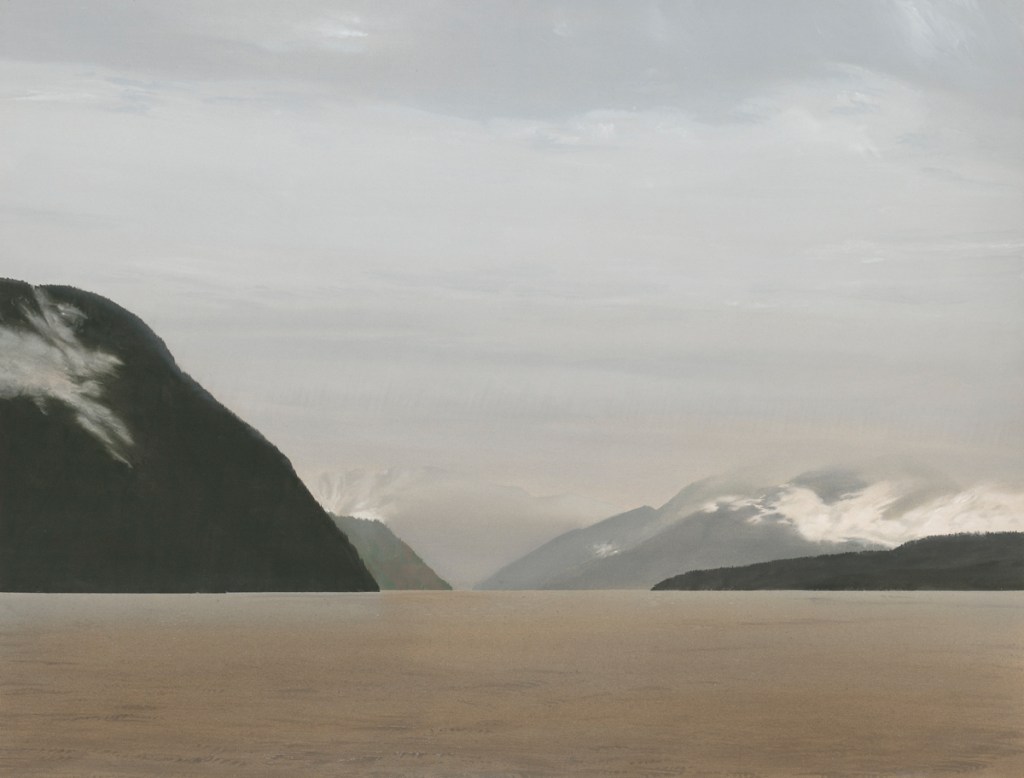
From his early experiments with abstraction to the expansive landscapes of the Prairies and the Pacific coast, the Japanese Canadian painter Takao Tanabe has developed a distinctive approach to landscape painting. A centenary retrospective at the National Gallery of Canada examines the evolution of his practice over seven decades.
One of the more surprising aspects of Takao Tanabe’s prairie paintings is the speed with which they were executed. Having spent several days selecting a composition, preparing his materials and mixing his colours, the artist could complete a large canvas in approximately an hour. His later paintings of the Pacific coast, some of which required months of work, were produced with a similar ambition: to minimise the visible evidence of the painter’s hand.
For Tanabe, whose career began in the experimental atmosphere of post-war abstraction, landscape became a means of investigating the relationship between colour, pictorial space and the physical properties of paint.
The artist, who celebrated his hundredth birthday on 16 September 2026, is the subject of Takao Tanabe: Inside Passage at the National Gallery of Canada in Ottawa. Running from 27 November 2026 until 18 April 2027, the retrospective brings together more than fifty paintings from public, private and corporate collections.
From Seal Cove to Winnipeg
Tanabe was born in 1926 in Seal Cove, a fishing community now incorporated into Prince Rupert on the northern coast of British Columbia. The fifth of seven children born to Japanese immigrants, he spent part of his childhood accompanying his father to fishing camps along the Skeena River.
In 1942, his family was among approximately 22,000 Japanese Canadians forcibly displaced under the Canadian government’s wartime policies. They were sent to Lemon Creek, an internment settlement in the interior of British Columbia, and Tanabe’s secondary education was interrupted.
By 1944, he had joined several of his older siblings in Winnipeg. His subsequent employment included working in a warehouse, cutting peat and labouring in an iron foundry.
As the Canadian art historian Ian Thom documents in Takao Tanabe: Life & Work, Tanabe’s introduction to art education came through an evening class in sign painting in 1946. He had enrolled for practical reasons, hoping to acquire a marketable skill, but became intrigued by the drawing and painting classes taking place elsewhere in the Winnipeg School of Art.
His decision to pursue fine art brought him into contact with Joseph Plaskett, a painter who had studied with Hans Hofmann and Clyfford Still. Through Plaskett, Tanabe encountered ideas about abstraction that would inform his artistic development for the next two decades.
Abstraction and the Japanese Brush
In 1951, Tanabe travelled to New York, where he attended the Brooklyn Museum Art School and took evening drawing classes at the Hans Hofmann School of Fine Arts. Further studies at London’s Central School of Arts and Crafts and extensive travels in Europe followed.
Among the subjects he explored during these years was the Danish countryside, which provided material for a series of watercolours hovering between landscape and abstraction.
The ambiguity is particularly interesting in Interior Arrangement with Red Hills (1957), an oil painting in the collection of the National Gallery of Canada and one of the works included in the current retrospective.
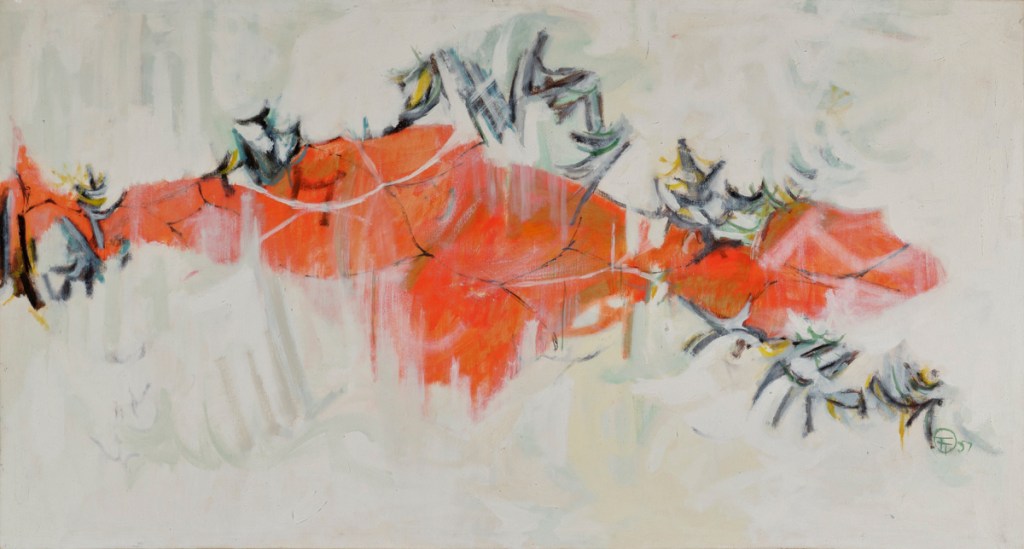
As Thom’s analysis demonstrates, the painting’s recurring linear marks and expanses of colour establish spatial relationships without describing a specific geographical location. Even the title seems to question the distinction between an arrangement of forms within the picture plane and the representation of an external landscape.
In 1959, a Canada Council grant enabled Tanabe to visit Japan for the first time. The journey had personal significance for an artist whose Japanese ancestry had determined his treatment by the Canadian authorities during the war.
At the Tokyo National University of Fine Arts and Music, he studied with Ikuo Hirayama, a practitioner of Nihonga, a modern painting tradition grounded in Japanese materials and techniques. He also received private instruction from the calligrapher Yanagida Taiun.
His studies in calligraphy and sumi-e, Japanese ink painting, introduced him to a discipline in which the behaviour of the liquid medium demands considerable anticipation on the part of the artist. The relationship between preparation and execution would become particularly important when Tanabe began working extensively with acrylic paint.
Painting the Prairies
In 1972, Tanabe returned to Canada from the United States to lead the art programme at the Banff School of Fine Arts in Alberta. Although surrounded by the Rocky Mountains, he directed much of his attention towards the comparatively uneventful terrain to the east.
In a 2014 interview with the National Gallery of Canada, Tanabe explained his deliberate exclusion of railway lines, telephone poles, grain elevators and livestock from his compositions. The cultivated landscape remained visible through its changing colours and surface patterns, but the infrastructure of agriculture largely disappeared.
The result was a particularly demanding compositional problem. When a horizon divides two extensive areas of colour, even a slight adjustment to its position alters the distribution of visual weight across the entire painting.
Tanabe adapted his working methods accordingly. As documented in Thom’s study of his painting techniques, he worked with unprimed canvas stretched horizontally across a table, using a fluid mixture of acrylic paint and glue.
The Canadian art critic Nancy Tousley, whose research Thom discusses, describes how the selection of a photographic reference, its transfer to canvas and the preparation of colours could occupy several days. The painting itself was executed rapidly, beginning with the land and continuing with the sky. A final, delicate wash of black paint helped to unify the composition.
In The Land 22/77 (1977), a canvas measuring approximately 140 by 230 centimetres, Thom identifies the importance of an almost imperceptible tonal change immediately above the horizon. A track disappearing into the distance is among the few recognisable features of the landscape.
The painting demonstrates how little descriptive information is necessary to establish a convincing impression of distance. Its spatial complexity depends largely upon relationships between adjacent colours.
Between 1973 and 1980, Tanabe produced more than two hundred paintings in his prairie series. Working repeatedly with comparable subject matter enabled him to investigate variations in atmosphere and topography that might otherwise have escaped attention.
The Waters of British Columbia
In 1980, Tanabe moved to Vancouver Island, where the coastal scenery presented an entirely different set of pictorial problems.
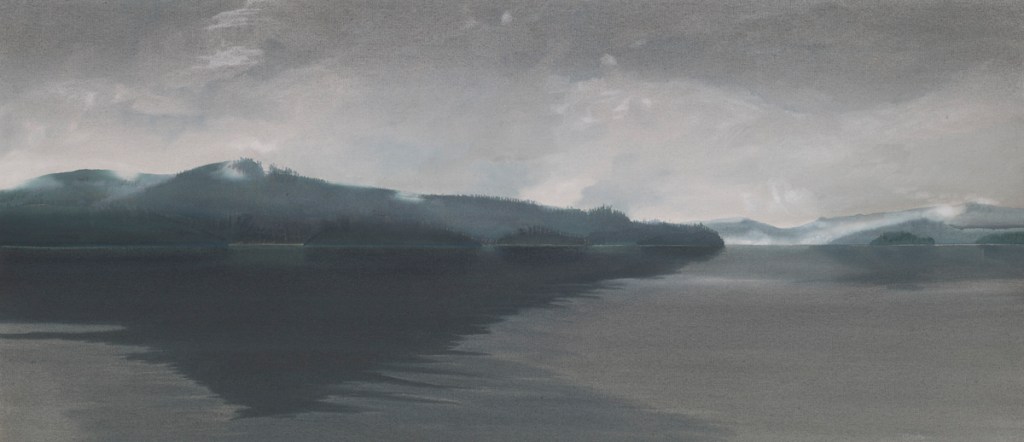
The geography of British Columbia required him to consider how successive islands, separated by expanses of water, could be distinguished through subtle differences in tone. Mist and rain frequently obscured the very geographical features that a conventional landscape painter might have emphasised.
Tanabe was particularly drawn to these conditions. In his 2014 interview, he described the attraction of coastal fog and storms, as well as his determination to suppress conspicuous brushwork. Some paintings involved as many as eight or nine applications of paint.
Among the works presented in Ottawa is Dawn (2003), an acrylic painting measuring more than three metres across.
In his examination of the work, Thom describes two islands beneath a dark sky, illuminated by shafts of sunlight that emerge through breaks in the clouds and reach across the water.
The Canadian artist and curator Jeffrey Spalding identified in this composition an affinity with the European Romantic tradition, particularly the dramatic use of light penetrating an overcast sky.
His interpretation is useful in understanding the complexity of Tanabe’s artistic formation. Japanese painting techniques were instrumental in the development of his working methods, but his interest in the expressive possibilities of light and atmosphere also belonged to a much wider history of landscape painting.
Tanabe was able to draw upon these traditions without adopting their established compositional conventions wholesale. The panoramic scale of Dawn gives the weather itself an extraordinary prominence within the painting.
Inside Passage
The centenary retrospective has been organised jointly by the National Gallery of Canada, the Audain Art Museum and the Art Gallery of Greater Victoria.
Its presentation in Ottawa encompasses five thematic sections, beginning with Tanabe’s early modernist experiments and moving through his transitional abstractions, hard-edge paintings, prairie landscapes and coastal works.
Writing in the independent Canadian publication The Tyee in June 2026, critic Dorothy Woodend described a revealing experience during the exhibition’s earlier presentation in Whistler.
Viewed from several metres away, Rivers 1/01: Jordan River (2001) appeared almost photographic. At close quarters, she discovered a complex arrangement of fine lines and small applications of colour.
The observation touches upon something fundamental to Tanabe’s practice. His landscapes are often described in terms of their apparent stillness, yet their creation required sustained technical experimentation. The apparent realism of the later paintings depended upon an understanding of abstract pictorial relationships acquired during the earlier decades of his career.
There is consequently much to be gained from exhibiting these different periods together. The early abstractions help to explain how the mature landscapes work, particularly how Tanabe creates depth through colour rather than elaborate descriptive detail.
A viewer standing before one of his large coastal canvases might initially attend to the atmosphere or the distant islands. Moving closer reveals the extent to which that impression has been constructed through paint. After seven decades of experimentation, Tanabe’s paintings still reward this simple act of looking twice.
Takao Tanabe: Inside Passage
27 November 2026 – 18 April 2027
National Gallery of Canada
380 Sussex Drive, Ottawa, Canada
Curated by Jonathan Shaughnessy, Kiriko Watanabe and Steven McNeil.
The exhibition subsequently travels to the Art Gallery of Greater Victoria, where it will be presented from 29 May to 10 October 2027. A further presentation at the MacKenzie Art Gallery in Regina is planned, with dates to be announced.
Further reading: Ian Thom, Takao Tanabe: Life & Work, Art Canada Institute.
Cover image: Takao Tanabe, Strait of Georgia 1/90: Raza Pass, 1990. Acrylic on canvas, 142.2 × 186 cm. Collection of the Audain Art Museum, Whistler. Gift of Michael Audain and Yoshiko Karasawa. © Takao Tanabe. Photo: Courtesy the Audain Art Museum
