Opening on 28 November, an exhibition at Kunstmuseum Basel brings together more than fifty artists from three collections, exploring how artworks are seen and the circumstances that shape their interpretation.
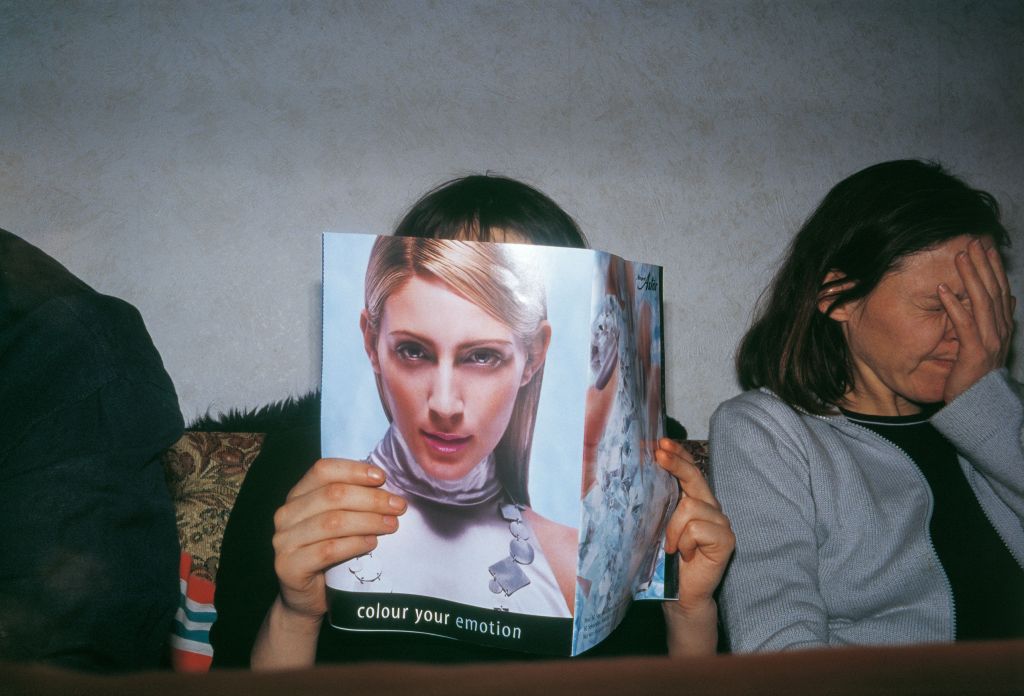
In Nele Stecher’s photograph Colour your Emotion (2000), a person holds an open magazine in front of their face. The glossy page shows a heavily made-up model looking directly towards the camera. Beside it, a woman covers her face with one hand, while a third figure is almost entirely excluded by the edge of the photograph.
The composition is deceptively straightforward. The most clearly visible face belongs to a printed image, while the people physically present remain concealed. Across the bottom of the magazine page appear the words “colour your emotion,” an instruction that seems increasingly peculiar when applied to the people behind it.
Stecher’s photograph belongs to the Kunstkredit Basel-Stadt, one of three collections represented in Wenn ich hier bin (When I’m Here), opening at Kunstmuseum Basel | Gegenwart on 28 November 2026.
The exhibition takes its title from a painting by the Swiss artist Rémy Zaugg, made between 1995 and 1998. Its inscription reads: Und würde, wenn ich hier bin, die Welt mich anblicken — “And were the world to look at me when I’m here.”
Zaugg (1943–2005) spent much of his career investigating perception, often through paintings in which language becomes the principal visual element. His texts and images resist immediate interpretation, asking the viewer to consider the relationship between what is written, what is seen and the conditions in which that encounter takes place.
His thinking provides a useful starting point for an exhibition that gathers works made between 1970 and 2026 by more than fifty artists, almost half of whom live in Basel.
The Architecture of Looking
Zaugg’s interest in perception extended beyond painting. In 1986, he wrote The Art Museum of My Dreams, or A Place for the Work and the Human Being, a detailed examination of museum architecture and its effect on the experience of art.
He considered the proportions of galleries, the positioning of entrances and the relationship between floors, walls and ceilings. For Zaugg, such practical decisions influenced how an artwork could be approached and understood.
The setting of Wenn ich hier bin is particularly relevant to these concerns.
Kunstmuseum Basel | Gegenwart opened in 1980 as the Museum für Gegenwartskunst, one of Europe’s earliest museums dedicated specifically to contemporary art. Designed by architects Katharina and Wilfrid Steib, it combines a converted nineteenth-century paper mill with a purpose-built extension.
The building arose from the need to accommodate contemporary works acquired by the Kunstmuseum and the Emanuel Hoffmann Foundation. Much of this art could not be adequately presented in the museum’s existing galleries.
The Steibs designed a building with different types of exhibition spaces, allowing considerable freedom of movement rather than prescribing a single route. Its architecture reflects the changing requirements of contemporary artistic practice during the second half of the twentieth century.
Six years after the museum opened, Zaugg’s essay would articulate many of the questions involved in creating such spaces.
Six Ways of Seeing
Curated by Stephanie Seidel and Team Gegenwart, Wenn ich hier bin is arranged across two floors in six thematic sections, each named after a German preposition: In, Mit, Hinter, Gegenüber, Vor and Zwischen — In, With, Behind, Opposite, Before and Between.
The arrangement avoids a conventional chronological survey. Instead, the sections examine different relationships between bodies, objects, images and their surroundings.
In considers architectural space through works by artists including Ayşe Erkmen, Ruth Buchanan and Renée Levi. Hinter addresses the legacy of the readymade, bringing together artists whose work investigates what happens when familiar objects are removed from their usual contexts.
The body becomes central to Gegenüber, while Vor approaches landscape through personal experience and perception. The final section, Zwischen, considers the uncertain territory between what appears familiar and what remains difficult to interpret.
Such a structure allows works produced under very different circumstances to be considered together. Its success will depend partly on whether their individual histories remain apparent within these broad categories.
The Body and Its Representation
One of the works associated with the exhibition is VALIE EXPORT’s Syntagma (1983), an eighteen-minute experimental film that investigates the representation of the female body.
EXPORT uses montage, divided screens and overlapping visual perspectives to disrupt the conventional relationship between the camera and its subject. The body appears through different photographic and cinematic arrangements, resisting the coherence of a single viewpoint.
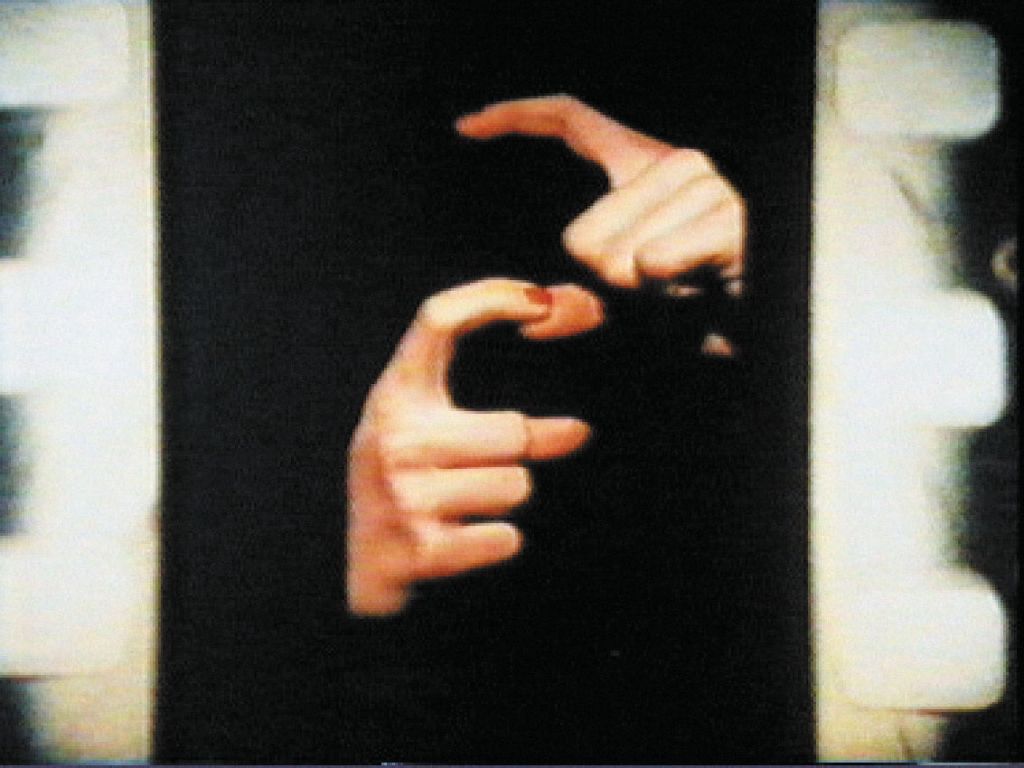
The film developed from EXPORT’s wider experiments with performance, photography and Expanded Cinema. Throughout her career, she examined how women’s bodies were represented in visual culture and how established conventions of looking shaped their reception.
In Syntagma, the female body is both the subject of the image and the means through which its construction is questioned.
The work is particularly relevant to an exhibition organised around Zaugg’s proposition. Looking is never entirely innocent when the subject being observed is another person. EXPORT’s film makes the relationship between representation and the viewer’s position difficult to overlook.
Stecher’s Colour your Emotion approaches a related problem through the familiar conventions of commercial photography.
The model on the magazine page presents a carefully constructed image of femininity, while the people surrounding it avoid direct visual recognition. The photograph’s humour comes partly from the incongruity between the polished advertising image and the awkward, informal scene in which it appears.
The central figure’s borrowed face draws attention to the conventions through which photographs establish an apparently direct relationship with their viewers. The model looks out from the page, but the person holding it remains inaccessible.
Stecher does not need an elaborate visual arrangement to produce this effect. A magazine, a camera and a few ordinary gestures are sufficient.
Seeing Through Technology
Elsewhere, Thomas Ruff’s Nacht 9 II (1992) examines a different kind of mediated vision.
Ruff began his Nights series after encountering television images made with night-vision equipment during the Gulf War of 1990–91. Interested in the technology, he acquired a light intensifier and used it to photograph streets and buildings around Düsseldorf.
The resulting photographs reproduce the distinctive green illumination associated with military surveillance. Familiar urban environments acquire an unsettling appearance, even when nothing particularly unusual is taking place.
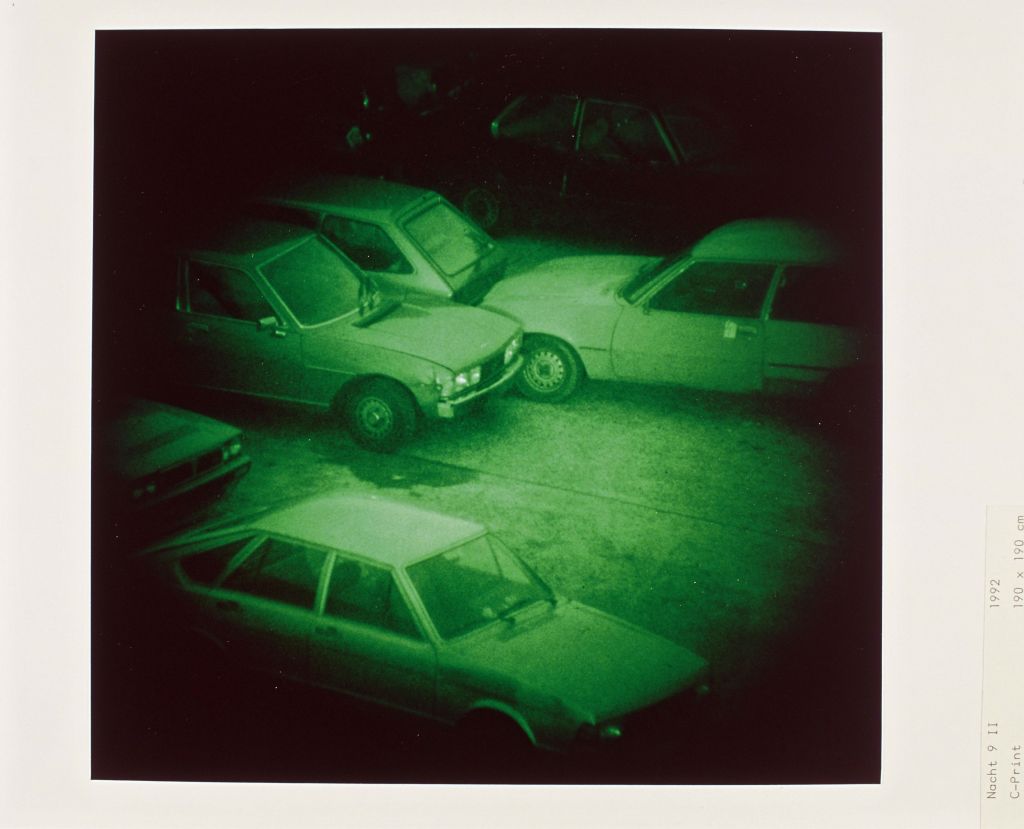
Night-vision technology makes details visible in conditions where ordinary photography struggles, but it also imposes its own visual characteristics upon the scene.
Ruff’s interest lies partly in this contradiction. The equipment extends the capacity to see while altering the appearance of the subject. Its association with military reconnaissance influences how the resulting photographs are interpreted.
This historical context matters. Without the connection to televised wartime imagery, the photographs might appear to be experiments in atmospheric night photography. Their visual language carries associations that precede the individual images.
EXPORT and Ruff employ very different artistic methods, yet both demonstrate how the technologies of representation influence what becomes visible and how it is understood.
Their inclusion also suggests the limitations of treating perception as a purely philosophical question. The conventions of looking have histories connected to media, gender and the political circumstances in which images circulate.
The History Behind the Collections
The exhibition’s institutional context introduces another important question: how do works come to be available for exhibition in the first place?
The three participating collections emerged from different historical circumstances.
The Öffentliche Kunstsammlung Basel traces its origins to 1661, when the city acquired the Amerbach Cabinet. The collection, assembled by a family of humanist scholars, included paintings, drawings, prints, books and other objects. Its acquisition established an exceptionally early example of civic art collecting.
The Emanuel Hoffmann Foundation was established in 1933 by Maja Hoffmann-Stehlin, following the death of her husband. Its purpose was to continue their commitment to acquiring and preserving contemporary art. In 1941, the foundation placed its collection on permanent loan to the Kunstmuseum.
The foundation also played a decisive role in the establishment of the Museum für Gegenwartskunst in 1980, helping to finance the building that now houses Wenn ich hier bin.
The Kunstkredit Basel-Stadt originated in 1919 as a municipal programme supporting artists through acquisitions and public commissions. During the economically difficult interwar period, it provided a source of material assistance to artists working in the region.
That programme developed into an important collection of regional artistic production.
Its history is particularly relevant to an exhibition in which almost half the participating artists live in Basel. The presence of internationally recognised figures such as Cindy Sherman, Julie Mehretu, Wolfgang Tillmans and Thomas Ruff alongside artists associated with the city’s own cultural institutions allows different collecting histories to be considered within the same exhibition.
A work acquired through municipal support for local artists enters a collection under different circumstances from one selected by a privately endowed foundation. Those distinctions can influence which artists are represented, how their work is preserved and the opportunities it receives for public exhibition.
The three collections therefore offer different accounts of artistic production and patronage, even when works from them are presented under a shared thematic heading.
The Collection in the Present
Wenn ich hier bin brings these histories into a single exhibition without requiring the works to be understood as stages in one continuous development.
There are potential difficulties in such an approach. The six thematic categories are sufficiently broad to accommodate substantially different artistic practices, and connections based on visual or conceptual similarities can sometimes obscure the circumstances in which individual works were made.
Yet the collection itself provides opportunities for more specific comparisons.
Stecher’s Colour your Emotion, for example, belongs to a municipal collection established to support artistic production in Basel. Her photograph can now be considered alongside works that emerged from very different artistic and institutional environments.
The connection does not depend upon establishing a direct influence between artists. It rests upon the possibilities created when works with distinct histories are brought into proximity.
Zaugg’s thinking remains useful here. The museum determines many of the physical and institutional circumstances in which artworks are encountered, while the works themselves bring their own histories into those spaces.
Stecher’s photograph, made in 2000, offers a precise example of how much can be communicated through a seemingly ordinary image. Its borrowed face, concealed subjects and commercially produced photograph establish several competing relationships between the people represented and the person looking.
The work belongs to the Kunstkredit Basel-Stadt, whose history reaches back more than a century. Its inclusion in Wenn ich hier bin connects a particular photographic investigation with the much longer history of public support for artists in the city.
That history is part of what makes this exhibition worth examining.
Exhibition Information
Wenn ich hier bin (When I’m Here)
Kunstmuseum Basel | Gegenwart
St. Alban-Rheinweg 60, Basel, Switzerland
28 November 2026 – 21 March 2027
Curated by Stephanie Seidel and Team Gegenwart.
Official exhibition information
Image Credits
Cover: Nele Stecher, Colour your Emotion, 2000. Colour photograph mounted on aluminium, 51.1 × 75.5 × 0.2 cm. Kunstkredit Basel-Stadt. © the artist. Photo: Kunstkredit Basel-Stadt.
Image supplied through the Kunstmuseum Basel press image archive.
