On moral conviction, the limits of tolerance, and the difficult question of who has the right to decide how others should live.
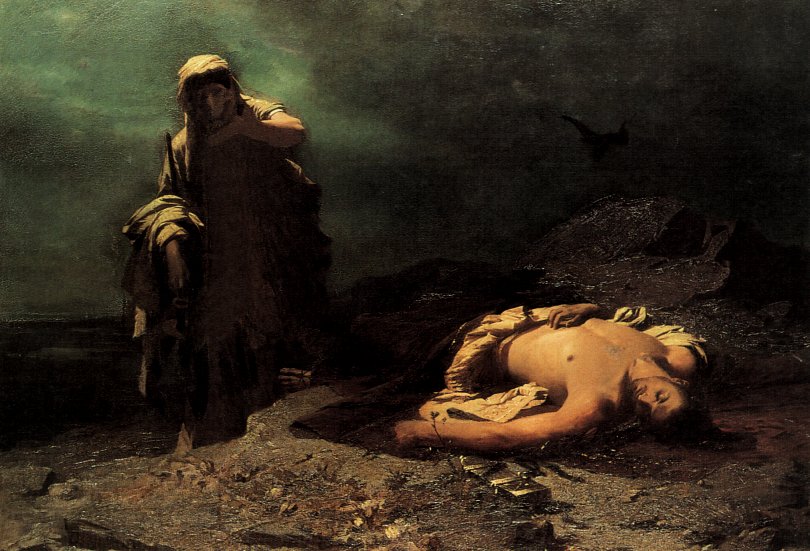
In Nikephoros Lytras’s Antigone and Polynices (1865), a woman stands beside a corpse beneath a darkened sky. The dead man’s body is illuminated, while his sister, almost absorbed into the surrounding landscape, raises a hand towards her face. Lytras has dispensed with the ruler, the soldiers and the public confrontation. His painting, now in the National Gallery in Athens, concentrates on the private consequences of an official decree: a woman mourning the brother she has been forbidden to bury.
The story comes from Sophocles’ Antigone, written in fifth-century BC Athens. Following a civil war in Thebes, the new ruler, Creon, orders that Polynices, who attacked the city, must remain unburied. His brother Eteocles, who died defending it, receives the customary funeral honours. For Creon, the distinction is a matter of justice and political order. To honour a traitor would undermine the authority on which the damaged city depends.
Antigone disagrees. She believes that the obligations owed to the dead, established by the gods and older than any human government, cannot be cancelled by a ruler’s command. Knowing the punishment, she performs the forbidden burial rites. When confronted, she makes no attempt to deny what she has done.
There is another response available. Her sister Ismene initially refuses to participate, fearing the consequences of defying the law. Antigone’s conviction gives her the courage to act, but Ismene’s fear is hardly incomprehensible. The sisters understand the danger equally well. Their disagreement concerns what they are prepared to sacrifice.
The tragedy is frequently understood as a confrontation between divine and human law. Yet another distinction is equally important. Antigone and Creon are both convinced of the justice of their positions, but they do not possess equal power. Antigone can disobey. Creon can condemn her to death. The difference between holding a moral conviction and possessing the authority to enforce it is central to what follows.
The psychology of moral certainty
In 2025, social psychologist Namrata Goyal and her colleagues Lorenzo De Gregori, Yuqi Liu and Krishna Savani published a study in the Journal of Personality and Social Psychology examining the relationship between political orientation, moral absolutism and support for prohibiting practices considered immoral.
Their investigation comprised nine studies, including an analysis of responses collected in 59 countries. The researchers distinguished between moral absolutism, broadly understood as the belief that certain moral principles apply regardless of circumstances, and moral relativism, which gives greater weight to context and variation in moral judgement.
They found that conservative participants were, on average, more inclined towards moral absolutism than liberal participants. More significantly, people expressing absolutist views were also more likely to support banning practices they considered morally wrong. Experimental studies suggested that exposure to more contextual ways of thinking about morality could reduce support for such prohibitions. In one experiment involving a petition to ban hunting, participants exposed to relativist moral framing were less likely to sign.
The findings deserve attention, although their scope requires care. The large international survey drew on responses from 1981 to 2004 rather than a contemporary worldwide sample. The association between political orientation and absolutism was statistically significant but modest, and its strength varied considerably between countries. In some, the anticipated pattern was weak or reversed.
One detail is particularly revealing. When approximately 95,000 respondents were presented with statements representing absolute and relative morality, 12 per cent rejected both alternatives. The researchers treated these responses as missing observations for their principal comparison. This does not establish that the respondents shared a coherent third moral philosophy. It does, however, expose a limitation of asking people to choose between two statements that leave little room for intermediate positions.
The distinction is also more complicated in philosophy than it is in a questionnaire. Believing that certain principles are universally valid does not necessarily mean that circumstances are irrelevant to their application. Equally, accepting that moral judgements are influenced by culture does not establish that every judgement is equally defensible.
The strongest contribution of Goyal’s research may therefore be its more specific finding about prohibition. Two people can condemn the same behaviour while disagreeing about whether it should be legally prevented. Moral disapproval and support for coercion, though related, are separate judgements.
This raises a question about the limits of moral authority: what someone believes they are entitled to do because they consider themselves right.
The authority to interfere
The nineteenth-century philosopher John Stuart Mill confronted precisely this problem in On Liberty (1859). His concern was the extent to which society may legitimately interfere with individual freedom. He recognised that coercion could come from legislation, but also from the pressure of prevailing opinion.
Mill’s central principle was that restricting someone’s liberty requires justification in terms of preventing harm to others. The mere conviction that another person is behaving foolishly, immorally or against their own interests is insufficient.
This was a demanding argument in a society where religious, social and conventional expectations exercised considerable influence over private conduct. Mill defended the freedom to pursue ways of life that others might thoroughly disapprove of. He was not asking those others to abandon their principles. He was questioning their entitlement to enforce those principles where the conduct concerned did not harm others.
Of course, determining what constitutes harm is itself a moral problem. Conduct that one person regards as a private choice may have consequences that another considers significant. Mill’s principle does not resolve every disagreement, nor does it remove the need for laws and collective obligations. It changes the burden of justification. Before restricting someone’s liberty, disapproval must be accompanied by a reason for interference.
Tolerance requires more intellectual effort than simple indifference. It becomes relevant precisely when we object to something and nevertheless recognise limits to our authority over it.
The philosophical discussion of moral relativism makes another important distinction. Relativism does not automatically produce tolerance. A society may regard its moral standards as culturally specific and still insist on enforcing them. Conversely, a person may believe in universal human rights and regard respect for individual freedom as an obligation that applies everywhere.
It is possible to possess firm moral principles while exercising restraint in their application to other people. Indeed, some of our most important protections against coercion depend on principles we consider sufficiently fundamental to defend consistently.
When values cannot be reconciled
For Isaiah Berlin, the difficulty lay partly in the nature of moral values themselves.
Berlin’s theory of value pluralism challenged the assumption that all legitimate human purposes could ultimately be arranged into one harmonious system. Liberty, equality, justice, loyalty and compassion may each have genuine worth, yet circumstances can bring them into conflict. Greater realisation of one value may require a sacrifice of another.
His argument should not be confused with the claim that all moral positions are equally valid. Berlin believed that moral reasoning remained possible and necessary. What he resisted was the expectation that every conflict between legitimate values could be settled by applying a single principle that would leave nothing of importance unresolved.
The significance of this position becomes clearer when we consider ordinary moral decisions. Loyalty to a friend may conflict with an obligation to tell the truth. Protecting someone from distress may require withholding information they have a right to know. A decision may be justified and still involve a loss that deserves acknowledgement. Philosophers including Bernard Williams have examined the possibility of rational regret: the recognition that choosing well does not always mean that everything valuable has been preserved.
Such conflicts do not make moral judgement meaningless. They demand an awareness of competing obligations and of what our decisions may cost others.
Berlin offers a way of thinking beyond the apparent choice between an unchanging moral code and a world in which every judgement depends entirely on circumstance. We may acknowledge several genuine moral claims without supposing that each can be satisfied simultaneously. Nor must we abandon judgement simply because its exercise is difficult.
Understanding another person’s perspective will not always produce agreement. Sometimes it clarifies why disagreement persists.
The cost of refusing to listen
Sophocles understood something of this difficulty long before modern philosophical terminology existed. As Antigone develops, Creon’s defence of public order increasingly becomes inseparable from his insistence on personal authority. He refuses to recognise that the city might possess a moral and political existence beyond his own commands.
His son Haemon challenges him. In R. C. Jebb’s translation of Antigone, he declares: “That is no city, which belongs to one man.”
The objection matters because Haemon does not simply ask Creon to adopt Antigone’s position. He challenges the assumption that a ruler’s judgement can stand in place of everyone else’s. Creon responds by treating disagreement as disloyalty, and his own authority as something that must be preserved at almost any cost.
Later, the prophet Teiresias warns him that his actions have brought religious pollution upon Thebes. “All men are liable to err,” he tells the king. The critical question is whether a person can recognise an error and repair it rather than persist through pride.
Creon eventually relents. He agrees to bury Polynices and release Antigone, but his change of mind comes too late. Antigone has died, and her death is followed by those of Haemon and Creon’s wife Eurydice. His recognition of error cannot reverse the consequences of his earlier decisions.
The tragedy does not suggest that moral certainty is always dangerous. Without conviction, Antigone would never have challenged the decree. Her resistance depends upon her belief that some obligations deserve defence even against the law. The catastrophe arises from Creon’s refusal to examine the limits of his authority, to listen to those who question him, or to recognise the possibility that he has mistaken his own judgement for justice.
We cannot conduct our lives without moral commitments, and some circumstances require us to defend them with considerable courage. But the strength of a conviction is not, by itself, proof of its correctness, still less sufficient justification for imposing it on others.
The problem, then, is not simply whether morality is absolute or relative. It is how we reason from our convictions to our actions, particularly when those actions determine the freedom and possibilities of other people. In Antigone, reconsideration comes after the punishment has already been carried out. The play leaves us with the harder demand of examining the grounds of our authority while there is still time for dissent to matter.
Cover image: Nikiforos Lytras, Public domain.

