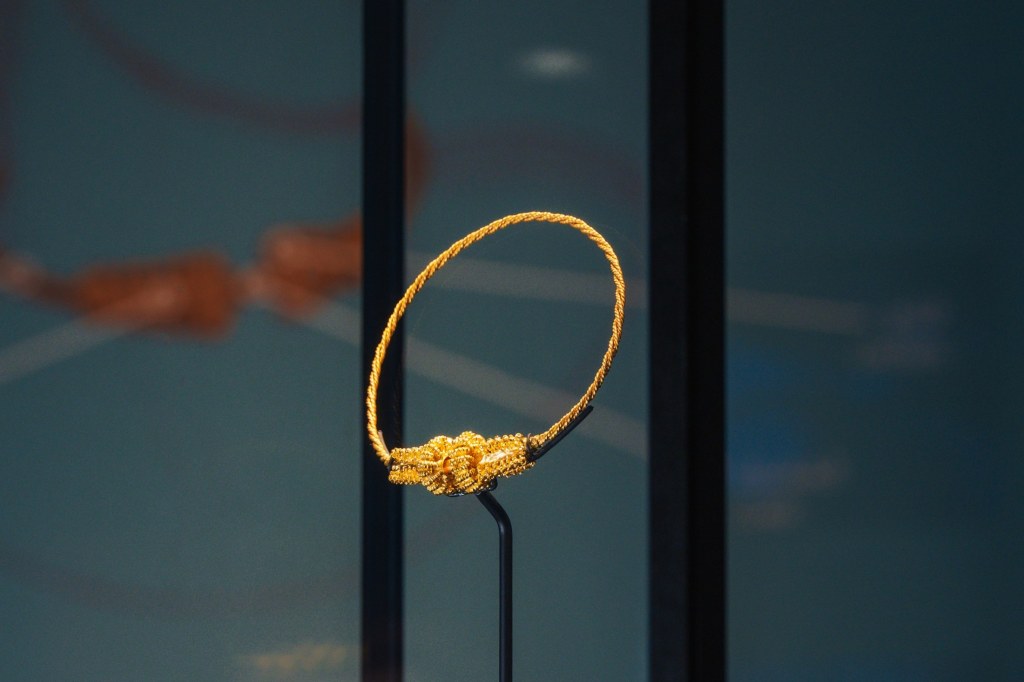
A reconstruction of an Iron Age gold collar has revealed the ingenuity of its makers. At L’ÉCOLE in Dubai, the results of the experiment are exhibited alongside the tools and trials that made it possible.
In 1958, a gold necklace that had been discovered in a field in southern France more than a century earlier resurfaced in New York. It was recognised by the National Museum in Copenhagen, which alerted its French counterparts. By January 1959 the jewel had been acquired by the Musée d’Archéologie nationale in Saint-Germain-en-Laye, where it remains. The curious history of its disappearance and rediscovery is recorded in a 2026 account published by the CNRS, the French national research organisation.
The Montans torque, named after the village in the Tarn where it was found in 1843, has since presented archaeologists with another mystery. Its densely ornamented ends appear almost solid, yet the collar weighs only around a hundred grams. How had its maker achieved such volume with so little metal? The attempt to answer that question is the subject of Recreating Gesture: Crafting a Gold Necklace from the Iron Age, an exhibition at L’ÉCOLE, School of Jewelry Arts, in Dubai.
Recreating Gesture: Crafting a Gold Necklace from the Iron Age
5 November 2026 – 24 April 2027
L’ÉCOLE, School of Jewelry Arts, Dubai Design District (d3), Building 10, ground floor, Dubai, United Arab Emirates.
Tuesday to Saturday, 10 am – 7 pm. Free admission; advance reservation.
Exhibition information and reservations
A hollow construction
The torque belongs to the European Second Iron Age, the period associated with La Tène culture, conventionally dated in Gaul from the mid-fifth century BCE to the later first century BCE. Gold ornaments of this period survive in rich burials, deposits and isolated finds. As the Franco-German research programme Celtic Gold has established in its research framework, their manufacture offers a means of studying the movement of materials, skills and designs across Iron Age Europe. The particular circumstances in which the Montans collar was originally worn and deposited remain uncertain.
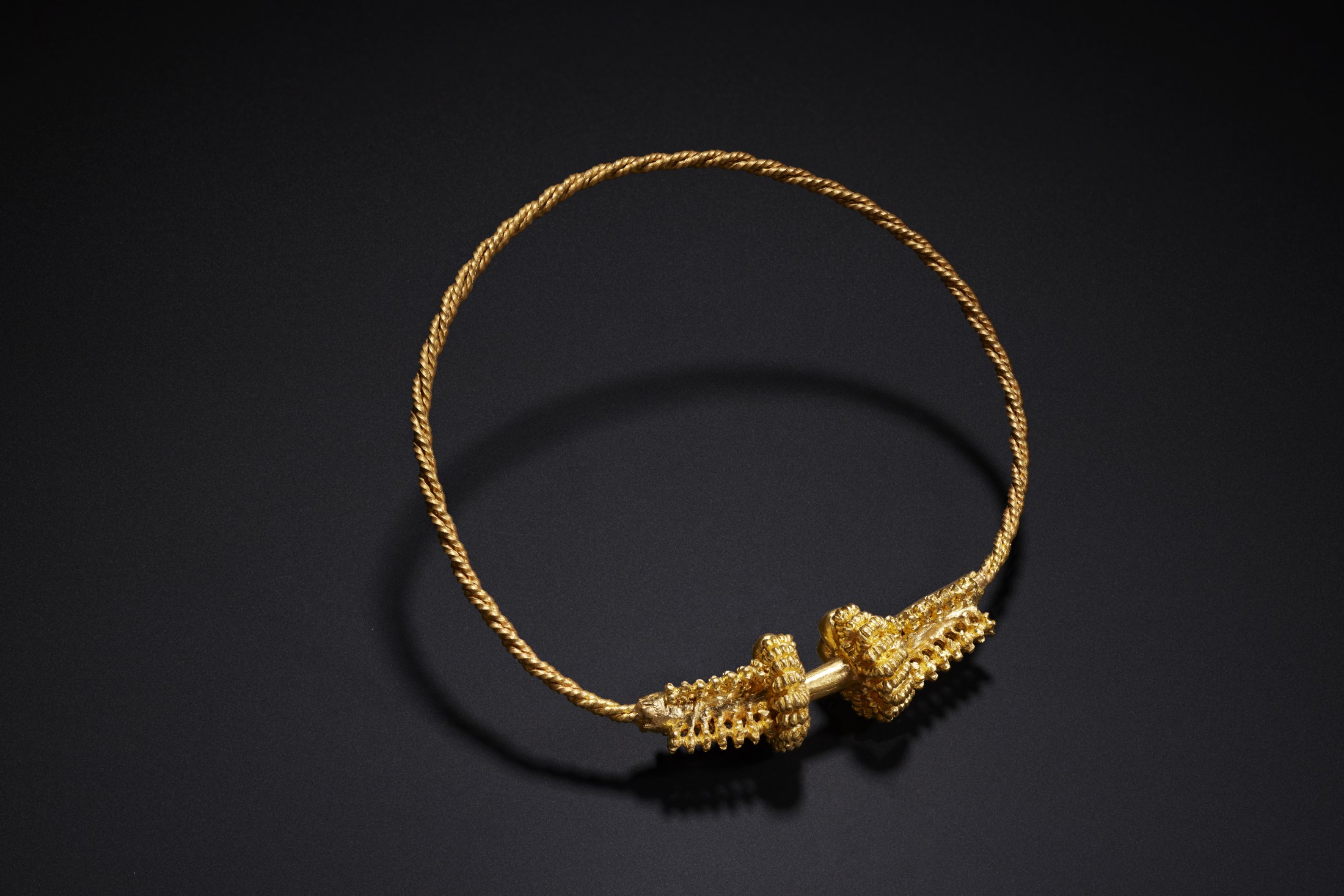
The replica photographs show a relatively slender twisted hoop terminating in elaborate floral forms. The profusion of rounded projections and overlapping contours gives the ends a sculptural presence disproportionate to the rest of the collar. The eye follows a continuous succession of small curves; it is difficult to discern where one piece of metal ends and another begins.
When the archaeologist and trained goldsmith Barbara Armbruster was asked to investigate the possibility of making a replica for Montans, she insisted upon examining the original. With the assistance of the museum’s curator Laurent Olivier, it was taken to the archaeological materials research institute in Orléans. In a French-language interview published by Gaillac-Graulhet in 2025, Armbruster describes how microscopic examination disclosed a construction in thin, worked gold sheet, unlike the cast ornaments she had previously examined.
Elemental analysis indicated a gold content of about 98 per cent. The examination also revealed seams and hollow elements. The challenge was to find a workable way of producing the relief ornament without a permanent internal support.
The goldsmith’s experiment
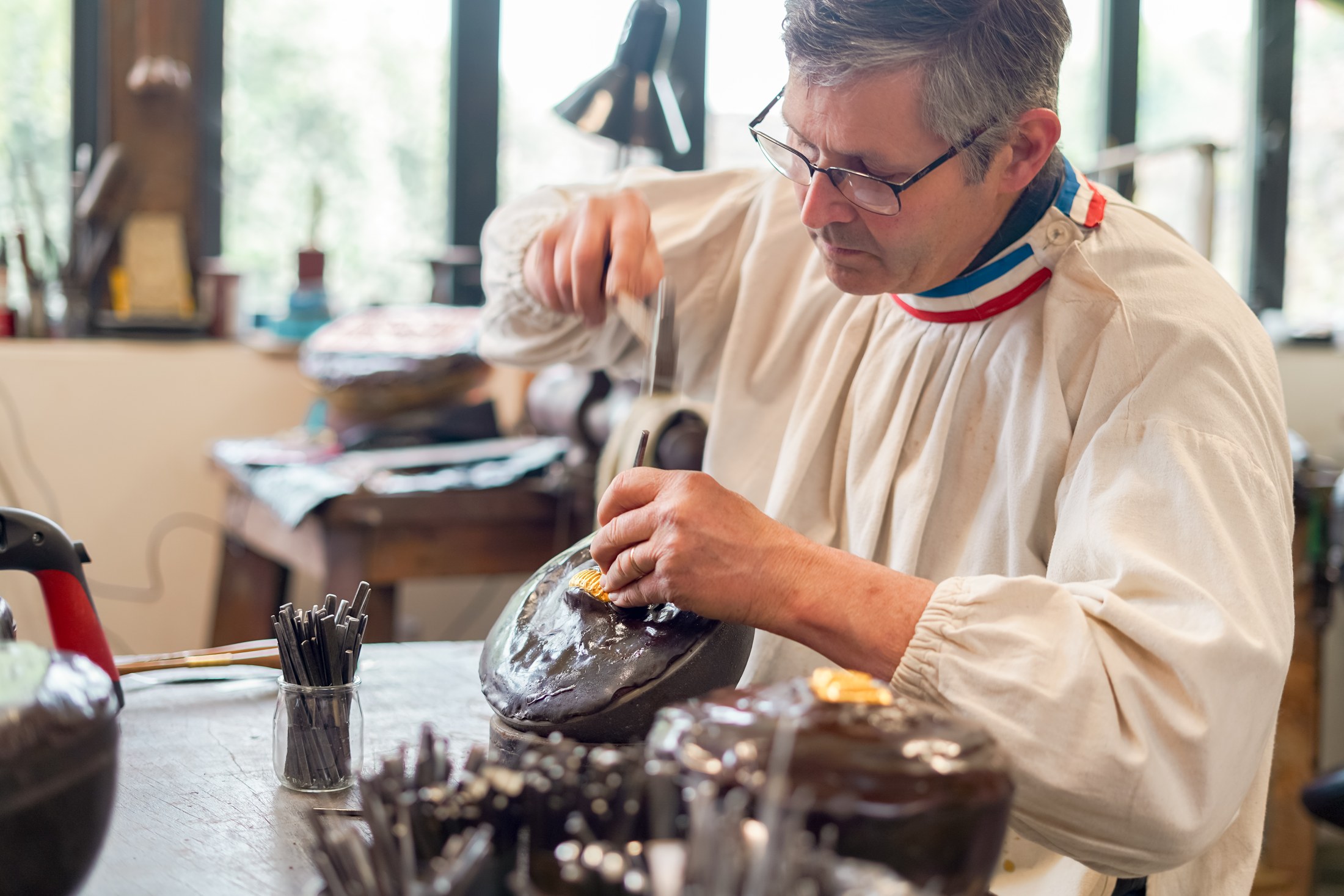
The Centre archéologique de Montans enlisted the services of Antoine Legouy, a specialist in chasing and a recipient of the French Meilleur Ouvrier de France distinction. The collaboration with Armbruster was particularly productive because her own training in jewellery making allowed her to consider the evidence from the perspective of a practitioner. Legouy, in turn, brought decades of experience in manipulating sheet metal.
Chasing involves working the surface of metal with small tools and a hammer. In repoussé work, the relief is raised from the reverse, with further shaping and refinement possible from the front. A thin sheet needs a support that holds it securely yet yields as the metal is displaced. Legouy used chaser’s pitch, a material familiar from his everyday practice, to support the gold while forming the ornament. It could be removed once the work was complete.
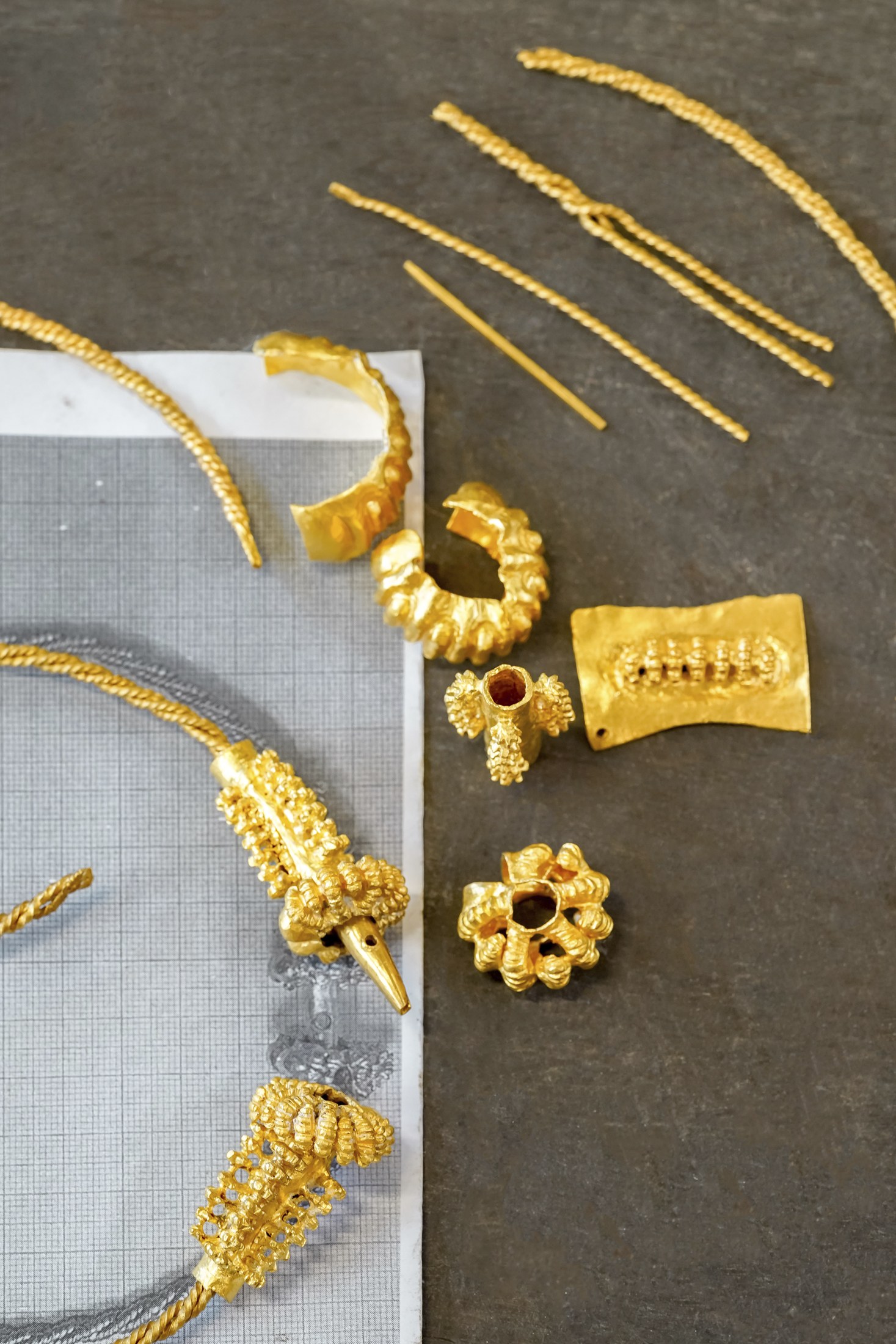
Among the most revealing images of the project are those of the unfinished pieces. Small sections of gold and experimental components are laid out against a photograph of the original printed at actual size. The photograph serves as a reference for proportion and curvature; the separate elements reveal a construction that is scarcely apparent in the completed necklace. Trials in silver and experiments with different tools allowed the team to investigate how the decorative shapes might be obtained before committing to the finished pieces.
Some of the tools tested were made from materials available in antiquity. Legouy also used his own steel tools where appropriate. Experimental archaeology necessarily requires such decisions to be recorded: reproducing an object successfully demonstrates the feasibility of a method, but does not establish that every tool or movement employed by its original maker was identical. Nor is the pitch used in the modern workshop evidence of the precise composition of an ancient workshop material.
There is a further distinction between discovering a viable technique and becoming sufficiently practised to execute it efficiently. Legouy discusses the importance of coordination between eye and hand in an interview about the project. According to the CNRS account, each of his two replicas required six to eight weeks of work. A specialist working routinely on related ornaments in antiquity might have been considerably quicker, though the original production time cannot be established.
From Montans to Dubai
One replica was made for the Centre archéologique de Montans, where the exhibition L’Or et le Geste opened in September 2025. The second was made for L’ÉCOLE, which supported the project. The Dubai exhibition follows earlier presentations in Paris, Lyon, Seoul and Shanghai and was developed with the Montans centre and the Musée d’Archéologie nationale. Grégory Weinstock, Van Cleef & Arpels’ Director of High Jewelry Métiers, also participated in the collaboration.
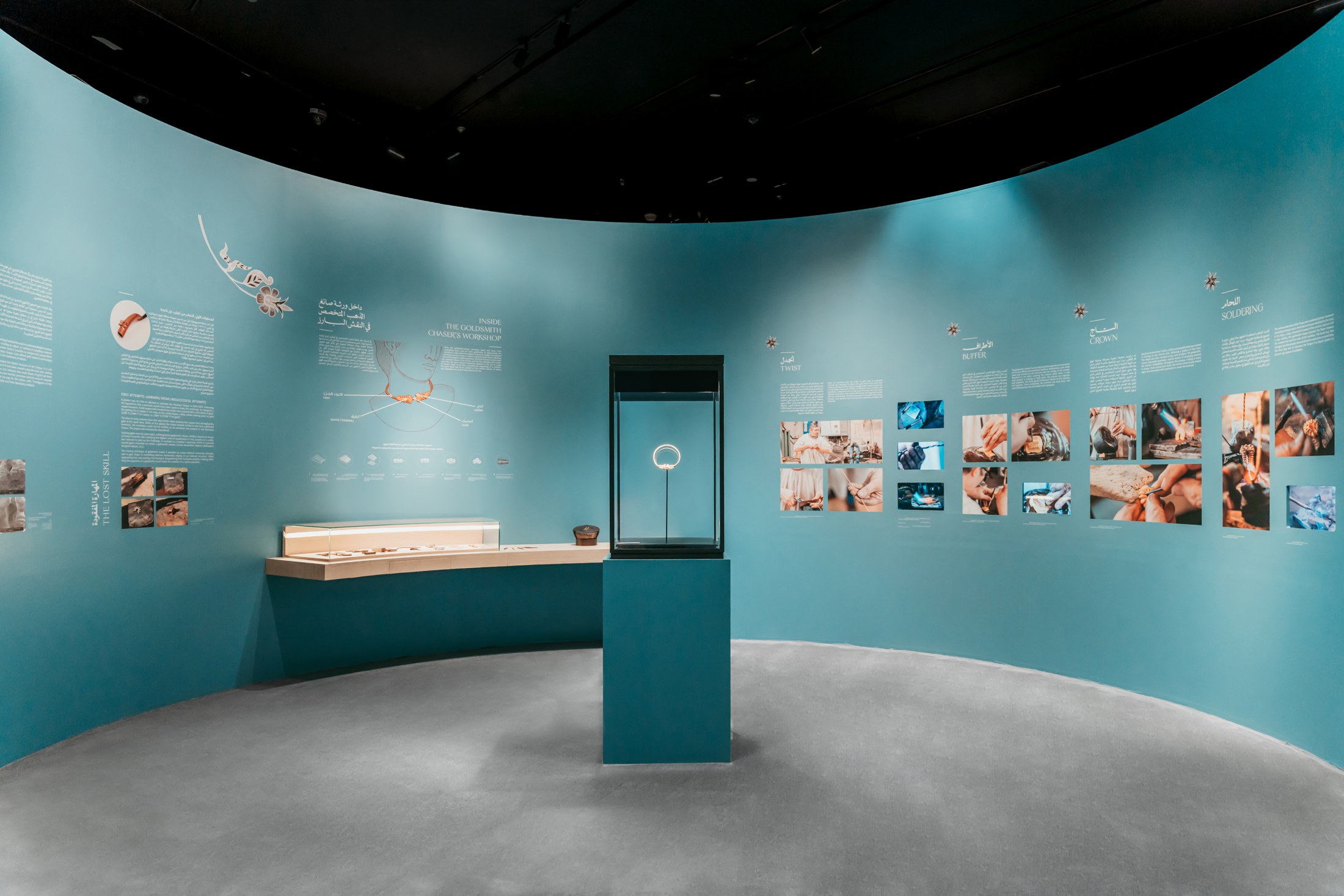
The installation photographs from Dubai show the collar isolated within a glass case in a circular space, surrounded by displays devoted to its production. Tools, working materials and a documentary offer an opportunity to follow the investigation from the finished object back to the bench. The sequence of trials has a place in the exhibition in its own right.
There is an important regional dimension to the Dubai presentation. Archaeological work at Saruq al-Hadid, in the desert south of the city, has recovered gold wire, strips and finished ornaments, including beads and rings. A 2017 archaeological study describes pieces formed from gold-alloy sheet over silver-alloy cores, evidence of a different solution to the problem of working precious metals. The site’s principal Iron Age phase, around 1100–600 BCE, considerably predates La Tène culture. A comparison is therefore useful for examining the technical choices available to goldsmiths in distinct societies, without implying a historical connection between them.
The accompanying Jewels & Journeys programme includes visits to archaeological collections and sites in Dubai, Al Ain, Mleiha and Sharjah, extending the enquiry into the material history of the Arabian Peninsula.
The two replicas now allow an object whose modern history was once interrupted by its disappearance to be studied in more than one place. Their greater contribution, however, lies in the evidence produced in the course of making them. The original collar preserves the results of decisions taken in an Iron Age workshop; the trials, tools and observations give us a means of investigating those decisions. For a craft in which so much is learnt through practice, the involvement of a working goldsmith has made it possible to ask questions of the surviving metal that its outward appearance alone could never have answered.
Cover image: The gold replica of the Montans torque on display at L’ÉCOLE in Dubai. Courtesy of L’ÉCOLE, School of Jewelry Arts.
Related reading: Around the World in Jewellery — The Cultural History of Human Adornment.
