Studio KO’s conversion of a 1912 industrial complex brings contemporary art into contact with Uzbek craft knowledge and an artistic history that long predates the opening.
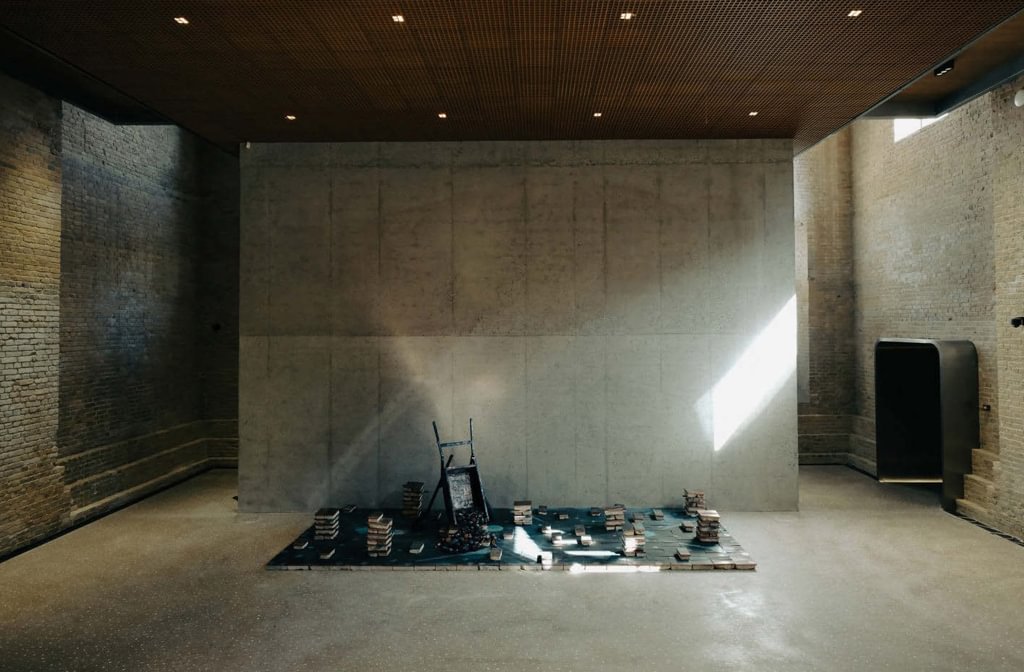
Russian-era bricks, patinated copper and bread stamps make an unusually concise introduction to Tashkent’s new contemporary art centre. They are the materials of Nari Ward’s Tashkent Groundin (2026), an installation incorporating the stamps traditionally used to pattern Uzbek flatbreads. The copper-covered bricks recall the industrial history of the building, while the bread stamps introduce the labour of food preparation. At the Centre for Contemporary Arts Tashkent, where the installation occupies the space beneath a suspended auditorium, the relationship is particularly immediate. The former power station was once part of the infrastructure that kept the city functioning.
The centre opened on 6 September 2026 in a complex designed in 1912 by Wilhelm Heinzelmann, Tashkent’s chief architect during the Russian imperial period. Originally associated with the city’s tramway and electrical infrastructure, the buildings continued to serve industrial purposes under Soviet administration. In 2019, the site was entrusted to the Uzbekistan Art and Culture Development Foundation, which has overseen its conversion into the country’s first permanent institution dedicated to contemporary art. Its new purpose adds another chapter to a building that has already witnessed considerable political and urban change.
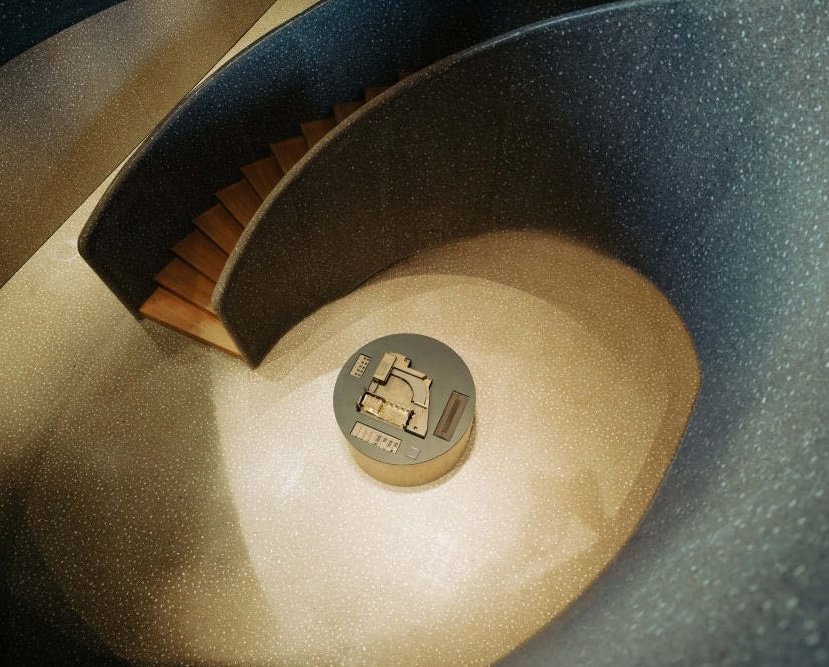
Studio KO, the Paris-based practice founded by Karl Fournier and Olivier Marty, has preserved the pale-yellow brickwork and much of the industrial character of the original structures. Visitors descend a terrazzo staircase to the lower exhibition level, passing through a steel-lined underground passage before entering the former diesel station. Here, a large timber-clad auditorium is suspended within the existing volume. A broad wooden stair doubles as seating for screenings, allowing the space to accommodate public events without subdividing the original hall into conventional rooms.
The conversion is particularly interesting in what it chooses to remove. Marty has described the considerable elimination of later additions, while original openings and architectural proportions were retained. The building now presented to the public is therefore a selective account of its past. Studio KO’s contemporary interventions are deliberately distinguishable from the surviving industrial structure, making the architects’ decisions relatively easy to read.
Local craftsmanship has contributed directly to the construction. A concrete mixture was developed using materials sourced in Uzbekistan, while bespoke tiles were commissioned from the Rakhimov family’s ceramics studio in Tashkent. This is an important aspect of the project, given the tendency for international architectural commissions to be discussed almost exclusively in terms of their designers. The material and technical contributions of local workshops deserve equal recognition.
The inaugural exhibition, Hikmah, curated by the centre’s chief curator, Dr Sara Raza, develops this interest in material knowledge. The title refers to wisdom, a concept with substantial philosophical and spiritual histories across Central Asia and the wider Islamic world. Raza approaches it through what she calls “material intelligence”, suggesting that artistic understanding may be expressed through processes of making as well as abstract thought. The exhibition is most persuasive when its individual works reveal the complexity behind that proposition.
Tashkent-born Shokhrukh Rakhimov, a seventh-generation ceramicist from the family whose workshop contributed to the architecture, presents The Colour of Silence, In Search of Truth (2026). Seven large ceramic spheres, made using locally sourced minerals and pigments, occupy the courtyard. Their colours refer to the teachings of Najm al-Din Kubra, the twelfth- and thirteenth-century Sufi master from Khwarazm who explored the spiritual significance of light and colour.
Rakhimov translates this intellectual tradition into physical form. The apparent simplicity of a sphere places particular demands on ceramic technique: achieving a consistent volume, controlling the surface and anticipating the behaviour of clay during firing. At this scale, those decisions become central to the sculpture. The work draws upon a regional philosophical history while remaining grounded in the technical knowledge of the workshop.
His practice also demonstrates how inherited expertise develops through exchange. Through a Homo Faber Fellowship, Rakhimov worked with Greek ceramicist Giannis Zois in Athens, producing a modular sculptural totem subsequently exhibited during London Craft Week in 2024. Since 2021, he has also taught ceramics to children with developmental disabilities in Tashkent. Both activities extend the family’s ceramic knowledge into different educational and artistic settings.
In Kimsooja’s Archive of Mind, originally developed in 2016 and adapted for Tashkent using local clay, visitors roll small spheres by hand and leave them on a large table. As the exhibition progresses, the accumulated forms register the actions of different participants. The resemblance to Rakhimov’s spheres creates an interesting comparison, although the two works approach making from distinct positions. Rakhimov’s sculpture depends on years of accumulated technical judgement; Kimsooja reduces the process to a gesture that almost anyone can perform. The difference matters. Participation makes Kimsooja’s installation accessible, while Rakhimov’s work demonstrates what prolonged engagement with a material can achieve.
The exhibition also draws on the collections of the I. V. Savitsky State Museum of Arts in Nukus, in the autonomous Republic of Karakalpakstan. Among the historical loans are a carved wooden column made by Daribay Saipov in 1978–79 and a door dating from 1983–84, alongside sculptures by Vladimir Pan and Bakhtiyar Saipov. These works introduce artistic developments from Karakalpakstan that are sometimes overlooked in broader accounts of Uzbek art. The Savitsky Museum’s holdings are particularly important in this respect, encompassing regional applied arts, twentieth-century painting and the Russian and Turkestan avant-gardes.
Tashkent also possesses an important history of conceptual experimentation. Vyacheslav Akhunov, active within the Soviet underground from the 1970s, developed a practice concerned with ideology, repetition and the manipulation of images. In his Mantras (1974), handwritten text accumulates over reproductions taken from Soviet magazines, newspapers and books. As the inscriptions multiply, the original pictures become increasingly difficult to decipher. Repetition, a familiar technique of political communication, becomes a means of interfering with its visual language. The work’s force lies in how little Akhunov needs to alter the printed material before its original authority begins to dissolve.
Akhunov’s career is especially relevant to the ambitions of the new centre. His exhibition Instruments of the Mind, presented by CCA Tashkent at Palazzo Franchetti as an official collateral event of the 2026 Venice Biennale, includes projects conceived during the 1970s but realised for the first time decades later. Some had existed only as drawings for more than fifty years. The distance between conception and execution reveals how artistic production can be shaped by institutional possibilities and limitations. It also establishes a history of experimental art in Uzbekistan that long precedes the opening of its new contemporary art centre.
That history is relevant to the centre’s activities beyond exhibitions. Its research library, freely accessible by advance booking, brings together publications on art, visual culture, textiles and craftsmanship, with an expanding archive documenting local artists’ practices. The September opening programme included workshops for children, film screenings and readings introducing younger audiences to Uzbek poetry.
Akhunov has also announced plans to donate his personal library, which includes material on art history, world literature and Oriental studies. For an artist whose practice developed largely outside the official Soviet exhibition system, making such a collection available for research is a significant development. His drawings and unrealised projects are now entering public circulation alongside the books and intellectual sources that informed them.
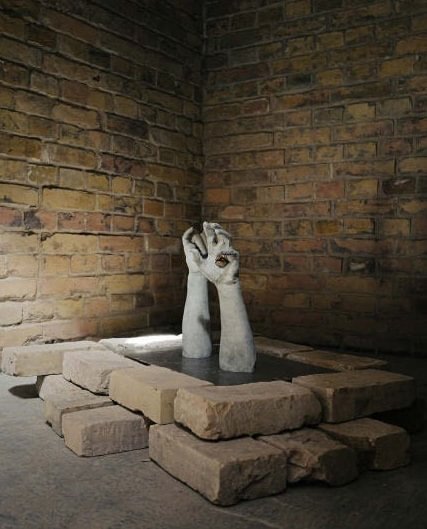
Hikmah is on view at the Centre for Contemporary Arts Tashkent until 31 January 2027. Admission is free, with advance registration required. Visitor information.
Photography © Amir Hazim / Courtesy of The Uzbekistan Arts and Culture Development Foundation (ACDF)

