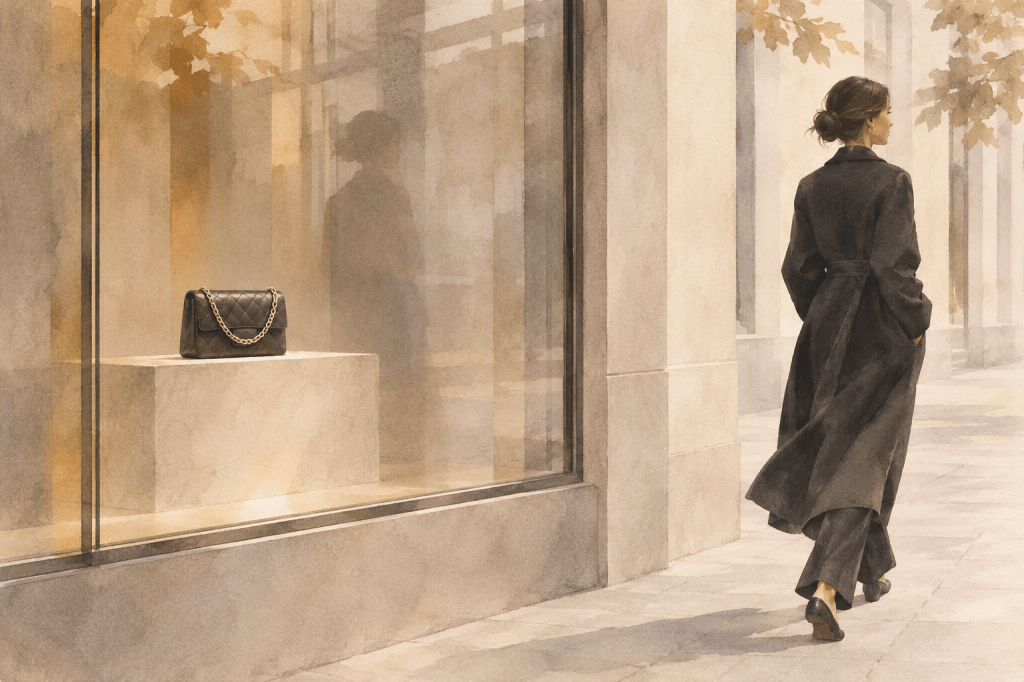
Luxury has always depended on people who wanted what they could not afford. But what happens when the wealthy cease to be admired, the performance of perfect lives becomes tiresome, and the people who once aspired to luxury begin to question the value of the aspiration itself?
The black lambskin Chanel Classic 11.12 currently costs €10,500 in France. It is 25.5 centimetres wide, with diamond-quilted leather, a double-C turn-lock and a chain threaded with leather. Introduced by Karl Lagerfeld in 1983 as a reinterpretation of Gabrielle Chanel’s 1955 flap bag, it has survived more than four decades of changing fashion. According to Chanel, its construction involves over 180 separate operations, including the retourné technique, in which the bag is assembled inside out before being turned.
It is an accomplished piece of design, and there are good reasons why it remains desirable. For some women, owning one has represented a long-standing ambition, something to be saved for over several years, perhaps to celebrate a professional achievement or a significant birthday.
But consider the woman who has finally accumulated enough money to buy one. She is older now, perhaps in her fifties. She has spent years developing her own taste, acquiring things she loves and occasionally regretting expensive purchases. She still recognises the workmanship of the Chanel bag. She simply finds herself less interested in owning one.
Her decision would be difficult to detect in the industry’s financial reports. A customer who can no longer afford luxury and one who no longer wants it produce the same result at the till. Yet they present very different problems for the companies that once counted on their custom.
According to the Bain-Altagamma Luxury Goods Worldwide Market Study, the global luxury customer base fell from approximately 400 million people in 2022 to 340 million in 2025. The personal luxury goods market remained enormous, with sales estimated at €358 billion in 2025, but fewer people were participating. Bain found that the proportion of active shoppers within the industry’s potential customer base had declined from around 60 per cent in 2022 to between 40 and 45 per cent.
Successive price increases have undoubtedly contributed to the contraction. Research by McKinsey and The Business of Fashion found that price increases accounted for more than 80 per cent of luxury-sector growth between 2019 and 2023. The industry was generating extraordinary revenues without selling proportionately more goods. By 2026, Boston Consulting Group and Altagamma found that 70 per cent of luxury consumers surveyed had abandoned a purchase because they considered the price unjustified.
BCG’s description of what a healthier luxury market might look like is revealing. Its projections envisage aspirational consumers accounting for approximately half of revenues, compared with around 70 per cent a decade earlier, while the proportion of one-time buyers falls as houses concentrate on retaining their wealthiest clientele.
The calculation makes sense if the principal objective is to generate revenue from a smaller number of exceptionally wealthy customers. But luxury has always depended on a much larger audience than the people who actually buy its products. The woman who studies Chanel’s collections without ever purchasing anything, who recognises a particular bag in a photograph or admires a friend’s new acquisition, contributes something to the brand’s cultural standing. Her admiration helps establish the desirability of an object she may never own.
For decades, luxury houses have cultivated this audience through advertising, fashion photography and the careful presentation of their own histories. Millions of people have been encouraged to learn the codes of brands whose products remain financially inaccessible to them.
The difficulty with concentrating on the richest customers is that an expensive object does not acquire social distinction through its owners alone. Other people must recognise what it signifies.
The American economist Thorstein Veblen understood this more than a century ago. In The Theory of the Leisure Class, published in 1899, he examined how expensive possessions functioned as demonstrations of wealth, establishing social distinctions that depended upon other people’s recognition. Conspicuous consumption allowed the prosperous to display their financial position, while their spending habits established standards that others were encouraged to imitate.
The price of an object becomes part of its attraction because people know that most others cannot afford it. The handbag is recognisable, and so is the expense.
What happens, though, when the people who recognise that expense cease to regard it as admirable?
Luxury companies have traditionally sold an ideal of exceptional living alongside their products. Beautiful people inhabit beautiful houses, travel to beautiful places and appear to spend their lives moving between pleasurable experiences. Money removes the ordinary inconveniences of existence. Advertising has long presented wealth in this manner, but social media has brought the performance into everyday life. The audience can now follow the holidays, wardrobes, meals and carefully arranged domestic routines of people who seem to possess everything.
There is a peculiar exhaustion in being exposed to so much perfection. A handbag becomes part of an outfit assembled for a photograph. A holiday becomes a succession of coordinated clothes and carefully framed breakfasts. Even apparently spontaneous moments require meticulous preparation. The effect is frequently so artificial that the performance itself becomes more conspicuous than the things being displayed.
In July 2026, The Guardian interviewed Shabaz Ali, a former chemistry teacher whose online following grew through his mockery of extravagant lifestyles. One of the videos that first inspired his commentary showed an affluent influencer making what she called designer ice cubes. Ali’s amused disbelief at such displays has attracted millions of followers, many of whom appear to share his irritation with the endless exhibition of wealth.
The designer ice cubes are funny because the audience is being asked to admire something absurd. An ordinary domestic activity has been transformed into evidence of exceptional privilege, apparently on the assumption that more money must produce a more interesting life.
The wider economic circumstances make the spectacle increasingly uncomfortable. In October 2026, Pew Research Center reported that 44 per cent of American adults had experienced difficulty affording at least one of four basic necessities during the previous year. One in five reported obtaining food from a food bank or pantry.
These findings do not tell us how potential Chanel customers feel about wealthy influencers. Nor do they establish that public irritation with extravagant lifestyles is responsible for declining luxury sales. But they describe a society in which the contrast between ordinary financial difficulties and conspicuous abundance has become difficult to overlook.
The social function of luxury becomes more complicated when wealth itself attracts less admiration. An extravagantly expensive handbag can still demonstrate purchasing power. It may no longer communicate the taste, achievement or sophistication that its owner intends.
The industry’s ownership structures make the question of wealth particularly relevant.
Chanel remains privately owned by the billionaire Wertheimer family. In May 2026, Bloomberg reported that the family’s holding company was set to receive $5.8 billion in dividends relating to 2025, bringing cumulative payouts since 2017 to at least $21 billion. Brothers Alain and Gérard Wertheimer had a combined estimated fortune of approximately $85 billion at the time.
Chanel’s contribution to craftsmanship is substantial. Its workshops preserve specialist skills in leatherwork, embroidery, featherwork and millinery, and its 2025 financial statements recorded more than $700 million invested in acquiring long-established suppliers. The company’s operating profit that year was approximately $4.7 billion on revenues of $19.3 billion across its businesses.
The preservation of specialist craftsmanship requires considerable investment, and historic fashion houses have resources that smaller designers rarely possess. Chanel’s cultural achievements deserve to be judged independently of the wealth accumulated by its owners.
Yet fine craftsmanship cannot establish that every retail price is justified. A customer considering a five-figure handbag may reasonably wonder how much of its price reflects the design and work involved, how much supports an extensive international business and how much ultimately contributes to the fortunes of its proprietors.
There has always been a financial dimension to owning a luxury object. What may be changing is the customer’s willingness to overlook it.
In September 2026, Gallup reported that 43 per cent of Americans viewed socialism positively, the highest proportion recorded in its polling series since 2010. Capitalism still received a more favourable overall rating, at 55 per cent. Among adults aged 18 to 34, however, 57 per cent held a positive view of socialism, compared with 43 per cent for capitalism. Across American adults, only 35 per cent viewed big business positively, while small businesses enjoyed approval of 95 per cent.
These figures should not be mistaken for evidence of a worldwide conversion to socialism. The terms mean different things to different respondents, and American political attitudes cannot explain the behaviour of luxury customers in Europe, Asia or elsewhere. But the distinction between attitudes towards large corporations and small enterprises is worth considering. People can remain enthusiastic about design, craftsmanship and private businesses while becoming increasingly critical of concentrated wealth and corporate power.
That creates an uncomfortable possibility for an industry whose commercial success has made its owners exceptionally rich. The consumer may still want beautifully designed things while feeling considerably less enthusiastic about helping to enlarge a billionaire’s fortune.
There is another demographic development worth considering. The world’s population is getting older, and the social expectations that shape consumption do not necessarily retain the same influence throughout a person’s life.
A 2024 AARP study, drawing on surveys involving more than 20,000 women, found that 75 per cent of women over 50 measured their beauty primarily according to their own standards rather than through comparison with others. Among women aged 18 to 49, the figure was 65 per cent. Older women were also more likely to say they felt free to dress as they wished.
The research concerns beauty and self-perception rather than luxury purchasing. It would be a mistake to conclude that older women are immune to status or that younger women are inherently gullible. The luxury industry has many wealthy, loyal customers over 50, and maturity is no guarantee of good judgement.
Nevertheless, experience can change the importance attached to other people’s approval. A woman who has spent decades working, earning and buying things has had considerable opportunity to discover which purchases genuinely please her. She may know that an expensive object can be beautifully made without improving her life in any lasting way. The desire to demonstrate success through possessions may simply have become less urgent.
In a 2026 YouGov survey, British women over 50 identified quality and value for money as leading considerations when buying fashion and beauty products. Many also felt poorly understood by the companies addressing them, particularly through advertising that failed to represent women of their age.
It is an interesting predicament for luxury houses that depend heavily on mature customers with substantial purchasing power. The woman who can finally afford an expensive handbag may be far less interested in the social promise attached to it than she was when she first wanted one.
Younger consumers may be arriving at a similar position through a different set of experiences. For people facing expensive housing, insecure employment and uncertain prospects, the promise that sustained work will eventually provide access to the lifestyles displayed online may appear increasingly implausible. Their scepticism need not reflect a lack of interest in beautiful things. It may reflect a diminished faith in what the possession of those things is supposed to signify.
These are different attitudes, and there is no evidence that they account for a measurable proportion of luxury’s departing customers. But both suggest limits to a business model that relies on people accepting someone else’s definition of success.
The alternatives available to consumers also make the question of value more difficult for established houses.
The Spanish company Hereu currently offers its Fiblo shoulder bag in black lambskin for €490. It is a medium-sized design with seam detailing, a zip fastening and an adjustable shoulder strap. According to the company, it is made in Spain by specialist artisans. Its construction, history and design differ from those of the Chanel 11.12, so the price difference cannot establish equivalent quality. It does demonstrate that a customer interested in a well-designed leather bag has options far below the price of the established luxury icon.
At the French company Bleu de Chauffe, leather bags are made in a workshop in Aveyron, with each piece dated and signed by the artisan responsible for its construction. The company emphasises a connection between its designs and traditional workwear, and offers information about the workshop and production methods.
Ghanaian designer Akosua Afriyie-Kumi takes a different approach through AAKS, working with women artisans whose raffia-weaving techniques have developed over generations. Her handbags are woven by hand and finished with fabric linings and leather. According to the company, an individual bag can take approximately ten days to complete. The work has its own materials, techniques and design language, with little reason to imitate the products of European fashion houses.
Smaller businesses are not inherently more ethical than larger ones, and independent production offers no automatic guarantee of fair wages or responsible sourcing. Nor can every historical craft be maintained without the substantial resources of established companies. But these examples suggest that good design can be sought outside the small circle of brands whose prices have come to define conventional luxury.
The choice is particularly interesting for consumers who have become confident in their own taste. They may prefer an object because of its materials, construction or design, without needing the authority of a famous name to validate their judgement. The person who once wanted a recognisable handbag might now take greater pleasure in something unfamiliar to most of her acquaintances.
There is also the second-hand market. A customer who admires an older Chanel design can buy a vintage example, selecting the leather, hardware and period of production she prefers. Her interest in the object need not translate into a new purchase from the company. She can remain attached to the work of a particular designer without participating in the house’s current commercial strategy.
None of this means the established luxury houses are approaching extinction. Chanel’s revenue returned to growth in 2025, and the work of its creative director Matthieu Blazy has attracted renewed interest. Wealthy customers continue to spend substantial sums, and exceptional design can still generate enthusiasm. The industry may remain highly profitable while serving fewer people.
The question is what happens to its cultural influence as the relationship between wealth and admiration changes.
For decades, an expensive handbag could operate as evidence of having achieved something. The person who carried it enjoyed the recognition of those who understood its cost, while the people who could not afford it were encouraged to imagine eventual ownership. The arrangement gave both groups a reason to participate, even when only one was making a purchase.
That arrangement may be becoming less reliable. The wealthy will continue to buy expensive things, and many people will continue to admire them. But the public has no obligation to regard conspicuous consumption as impressive, especially when the disparity between extraordinary wealth and ordinary economic life is so visible.
The woman who once saved for a Chanel bag may still admire its design. She might recognise the quality of its leather, understand its place in fashion history and appreciate the work of the artisans who make it. By the time she has €10,500 to spend, however, she may have developed quite different ideas about what deserves her money.
A luxury house can increase its prices, restrict supply and cultivate an increasingly wealthy clientele. It has far less control over whether the people outside its boutiques continue to care.
Cover image © Birgitte / My World of Interiors

