
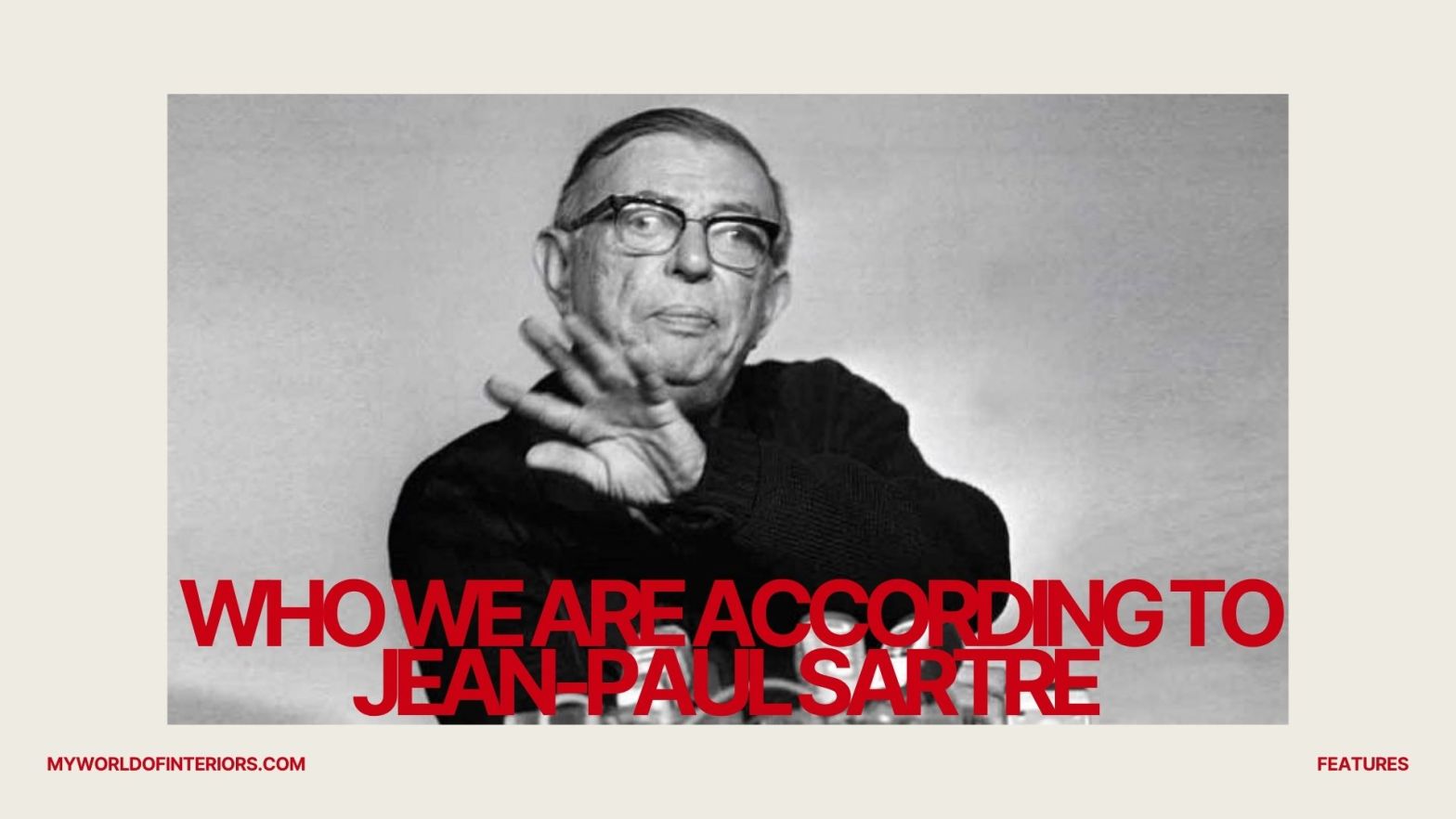
Every philosopher in this series has made demands. Kierkegaard demanded genuine decision. Beauvoir demanded resistance to structural power. Nietzsche demanded value-creation in the void. Heidegger demanded ownership of one’s own being. Sartre takes all of these demands, strips away every remaining support, and arrives at the most terrifying and the most liberating position in the history of philosophy: you are nothing but what you make of yourself, you cannot not choose, and there is nobody to blame.
By Bergotte
In the autumn of 1945, Jean-Paul Sartre delivered a public lecture in Paris titled “Existentialism Is a Humanism” to an audience so large and so pressing that women fainted and chairs were broken in the crowd. Paris had been liberated the previous year. The occupation was over. The world was in the process of confronting what had happened to it and asking, with an urgency that had never been more literal, what human beings were and what they were capable of and on what basis they could be held responsible for anything. Into this moment Sartre walked, small and cross-eyed and almost entirely without vanity about his appearance, and delivered a lecture that answered the question with a clarity so unsparing that the audience simultaneously recognised it as true and flinched from what recognising it required.
The lecture’s central claim — which he had developed at length in Being and Nothingness (1943), written during the occupation, in cafés and apartments and the specific atmosphere of a city that was simultaneously continuing and catastrophically interrupted — was this: existence precedes essence. The human being is not born with a nature that her life then expresses. She is not made for a purpose that gives her existence its meaning. She is not the expression of a divine intention, the product of a rational plan, the carrier of a historical destiny, or the representative of a species-being. She simply is — thrown, as Heidegger said, into existence without a predetermined nature — and everything she is, she has made herself, through her choices, in her situation, with no guarantee that the making is heading anywhere in particular.
This is the most radical statement of the position that the series has been approaching from the beginning. Kierkegaard said the self is a task. Beauvoir said the task is always situated. Nietzsche said the values that organise the task must be created. Heidegger said the task must be owned in the face of death. Sartre says: there is no self beneath the task. There is only the choosing — the endless, unavoidable, responsibility-generating activity of making yourself through the choices that your situation presents and that you cannot not make, because not choosing is itself a choice, and the refusal of responsibility is itself an exercise of the freedom you are trying to escape.
You are condemned to be free.
Being-in-Itself and Being-for-Itself: The Ontology of the Hole
Sartre’s ontology — his account of the fundamental structure of what exists — begins with a distinction that is, once grasped, one of those distinctions that cannot be ungrasped: the distinction between being-in-itself and being-for-itself.
Being-in-itself — en-soi — is the mode of being of things: the table, the stone, the hammer, the body considered as a physical object. Being-in-itself is what it is. It is solid, complete, identical with itself, without any gap between what it is and what it is. It does not project into the future, does not carry its past as a burden, does not relate to its own being. It simply is, with the full, opaque, self-identical weight of the thing.
Being-for-itself — pour-soi — is the mode of being of consciousness, of the human being considered as the being that is aware of itself. And here Sartre makes his most fundamental and most strange ontological claim: being-for-itself is nothing. Not nothing in the sense of not existing — it exists, obviously. But nothing in the sense of not being a thing, not having the solid, self-identical, complete being of the en-soi. Consciousness is a hole in being — a nothingness that has erupted in the midst of being, a kind of emptiness that can be filled only by its own activity of intending objects, projecting possibilities, relating to its own past and future, making itself in the movement of its own existence.
This is what Sartre means when he says that existence precedes essence. The thing has its essence first — the concept of the table precedes the table, the purpose of the hammer precedes the hammer. But the human being has existence first and essence never — or rather, has essence only as something projected and achieved and always provisional, never complete, always capable of being otherwise. The human being is always ahead of itself — always projecting into possibilities, always making itself in the direction of a future that has not yet arrived — and this being-ahead-of-itself, this permanent incompleteness, this inability to coincide with itself in the way that the stone coincides with itself, is not a deficiency. It is freedom. It is what freedom is.
The nausea that gives its title to Sartre’s first novel — Nausea (1938), the work in which these ideas first find their full expression, in the diary of a historian named Antoine Roquentin who is losing his ability to take the world for granted — is the emotional register of the confrontation with the en-soi, with the sheer, absurd, groundless contingency of existing things. Roquentin looks at the root of a chestnut tree in a park and is overwhelmed: the root simply is, massively, without reason or justification, excessively present, superfluous. “The essential thing is contingency,” he writes. “I mean that one cannot define existence as necessity. To exist is simply to be there; those who exist let themselves be encountered, but you can never deduce anything from them.” The nausea is the recognition that existence has no ground — that things exist without reason, that the self exists without reason, that the categories of meaning and purpose and necessity that we apply to existence are not found in existence but imposed on it by the consciousness that cannot tolerate its own groundlessness.
Condemned to Be Free: The Weight of Having No Excuse
The claim that human beings are condemned to be free is the most challenging claim in this series, and it requires careful unpacking because its implications are more extreme than they initially appear.
Sartre is not saying that human beings can do whatever they want — that there are no constraints on action, no facticity of the situation, no limits imposed by the body and the history and the social world within which freedom operates. He acknowledges all of these constraints, as Beauvoir had pressed him to acknowledge them. What he is saying is that no constraint eliminates the freedom to take a stance toward the constraint — to interpret it, to respond to it, to choose from within the situation it produces rather than being simply determined by it.
The waiter who performs his waiterness with excessive precision — who moves with the slightly too-mechanical gait of a person who has decided to be a waiter rather than simply being one, who brings the coffee with the slightly too-deliberate efficiency of someone performing the role — is in bad faith. He is pretending that the role determines him, that being a waiter is a mode of being-in-itself, that the facticity of his situation has removed the freedom that is in fact constitutive of his being. He is not a waiter in the way that the table is a table. He is a consciousness that has chosen, and goes on choosing, to perform waiterness — and the performance, however convincing, cannot eliminate the choosing that underlies it.
This is Sartre’s account of bad faith — which is more precise and more psychologically rich than Heidegger’s account of inauthenticity, because it focuses not on the general loss of self to das Man but on the specific mechanisms by which the individual consciousness evades its own freedom. Bad faith is always self-deception — the attempt to convince oneself that one is what one is not, that one is determined when one is free, that the situation has removed the choice that the situation has not and cannot remove.
The bad faith takes two forms that mirror each other across the distinction between en-soi and pour-soi. The first is the bad faith of the person who pretends to be a thing — who denies her own transcendence, her own capacity to be otherwise, her own projection into possibilities, by identifying completely with a role or a situation or a past. I am a waiter. I am a coward. I am what my past has made me. These identifications are false because the consciousness that makes them is always already more than what it identifies with — always already ahead of itself, always already capable of being otherwise than it has been.
The second form of bad faith is the denial of facticity — the pretence that one is pure freedom, pure transcendence, unencumbered by the situation, the body, the past, the social world, the gaze of others. The person who claims to be entirely self-made, who disavows the specific conditions of her freedom, who treats her situation as though it imposed no constraints on the choices available to her, is in bad faith in the opposite direction: pretending to be pure pour-soi, pure nothingness, when she is in fact always already a situated consciousness, always already in a specific body in a specific world with a specific history.
The authentic existence — if Sartre’s account allows for authenticity, which it does, though with less elaboration than Heidegger provides — is the existence that holds both terms simultaneously: that acknowledges its facticity without denying its transcendence, that owns its freedom without pretending to be unconstrained by its situation. This is, again, not a comfortable position, and it is not a position that the culture makes available readily, because the culture — the social world, the institutions, the roles, the identities — is largely organised around the provision of the bad faith that covers the discomfort of genuine freedom.
Hell Is Other People: The Look and Its Violence
“L’enfer, c’est les Autres.” Hell is other people. The line from No Exit (1944) — the play in which three people who hate each other are locked in a room together for eternity and gradually discover that their own self-understanding depends, in ways they cannot escape, on the judgments of the others — is the most quoted and the most misunderstood sentence in Sartre’s work.
It does not mean that other people are unpleasant, or that solitude is preferable to company, or that one should avoid the social world. It means something more specific and more philosophically precise: that the existence of other consciousnesses introduces into my world a dimension of being that I cannot control and cannot assimilate, a perspective on me that I cannot adopt or escape, a mode of my being that exceeds my own self-understanding in ways that are permanently destabilising.
The look — le regard — is the experience of being seen by another consciousness. When another person looks at me, I am suddenly the object of a perspective that is not mine — I am seen from outside, defined, fixed, given a character and a nature that the other’s gaze imposes on me independently of my own self-understanding. Under the other’s look, I am no longer the subject of my own experience but the object of someone else’s. The freedom of my own consciousness is temporarily replaced by the objectification of the other’s gaze: I am what they see me as.
The famous example is shame. If I am caught performing an action I consider shameful — looking through a keyhole, say — the sound of a footstep behind me produces an immediate and involuntary experience: I become, for myself, the person who was caught looking through a keyhole. The other’s potential gaze has objectified me — has given me a nature, a character, a being-in-itself — that I experience as my own even though it is the other’s imposition. Shame is the sudden awareness of oneself as an object in another’s world.
This produces what Sartre describes as the fundamental structure of human relations: a conflict between consciousnesses, each of which experiences the other’s freedom as a threat to its own. I want to be the subject; the other’s look makes me an object. I try to recover my subjectivity by making the other an object — by turning the look back, by reducing the other’s consciousness to the character I assign it. But the other’s consciousness resists this, as mine resists the other’s, and the result is the permanent oscillation between the attempt to possess the other and the attempt to escape the other’s possession: love, hatred, sadism, masochism, indifference — all the modalities of human relation, for Sartre, are specific forms of this fundamental conflict between consciousnesses that cannot coexist in peace because each threatens the freedom of the other simply by existing.
This is, on the face of it, a bleak account of human relations — bleaker than anything in the series so far, bleaker even than Heidegger’s account of das Man. But it is also, in certain respects, a deeply honest account of something that everyone who has been genuinely in the presence of another consciousness has felt: the specific vulnerability of being seen, the specific violence of being defined, the specific terror and the specific comfort of another person’s recognition. Hell is other people — and heaven is other people, which Sartre says less often but which the same analysis implies, because the recognition that the other provides is not only a threat but the only source of the confirmation of one’s own existence that consciousness, in its nothingness, perpetually seeks.
Engagement: The Intellectual’s Responsibility
The existentialism that Sartre outlined in the war years generated, in his own work and in the broader culture that took it up, a specific demand: the demand for engagement. If existence precedes essence, if the human being is what she makes of herself through her choices, if she is radically responsible for everything she is — then the intellectual who retreats into pure contemplation, who maintains the detachment of the observer, who produces work with no relation to the political conditions in which it is produced, is in bad faith. She is pretending that the choice of detachment is not a choice, that the political non-engagement of her work is a neutral position rather than a specific position with specific consequences.
Sartre’s own career was organised around the refusal of this detachment with a thoroughness — and an inconsistency — that is among the most instructive records of what it means to attempt to live an engaged intellectual life in conditions that make engagement genuinely costly. He signed manifestos, led protests, wrote prefaces to revolutionary texts, edited journals, gave interviews, accepted and refused prizes — most famously refusing the Nobel Prize for Literature in 1964, on the grounds that the Nobel represented the institutional establishment and that accepting it would compromise his independence. He went to Cuba, to Algeria, to the Soviet Union. He visited the leaders of liberation movements and wrote about the violence of colonial oppression with a directness that cost him readers and friends and, on at least two occasions, required the intervention of the French government to prevent his prosecution.
His political positions were not always right. His relationship with Stalinism — his extended reluctance to condemn the Soviet labour camps, his philosophical contortions to maintain the possibility of a Marxist politics even as the evidence of what Soviet Marxism had produced accumulated — is the most serious intellectual failure in his public career, and it is a serious one. He eventually broke with the Soviet apologists, but later than he should have and with less clarity about the reasons than the clarity of his own philosophical method should have allowed.
The failure is illuminating in the same way that Heidegger’s failure is illuminating: it demonstrates the distance between the philosophical demand for authenticity and its practical achievement, between the clear analysis of bad faith and the ability to avoid it in one’s own most consequential positions. Sartre understood, better than almost anyone, the mechanisms of self-deception by which the intellectual evades the implications of her own thinking. He was not immune to those mechanisms. The understanding of a pathology does not confer immunity to it.
Sartre and Beauvoir: The Relationship as Philosophical Problem
The relationship between Sartre and Simone de Beauvoir is one of the most examined and most contested intellectual partnerships in the history of philosophy, and it must be addressed here both because it bears on the question of Sartre’s own authenticity and because it illuminates the relationship between his philosophy and Beauvoir’s in ways that the series requires.
They met at the École Normale Supérieure in 1929 and formed immediately a bond of intellectual intensity that neither of them formed with anyone else to the same degree. The philosophical dialogue between them was genuine and was mutual — Beauvoir read and commented on Sartre’s work in manuscript, and Sartre read and commented on Beauvoir’s, and the influence ran in both directions, though the culture has been consistently more willing to acknowledge Sartre’s influence on Beauvoir than Beauvoir’s on Sartre.
What Beauvoir contributed to the philosophical partnership — the insistence that freedom is always situated, that the conditions of freedom are not equally distributed, that the body and the social world in which the body exists are not mere facticity to be transcended but the very medium of freedom — is the correction that Sartre’s account of radical freedom most needed and that The Second Sex most fully provided. Sartre’s account of freedom, in its earlier formulations, is insufficiently attentive to the specific conditions under which freedom operates — tends to treat the situation as merely the material on which freedom works rather than as the constitutive condition of the specific form of freedom available to any particular consciousness. Beauvoir’s correction is not a rejection of the existentialist framework but its deepening, and Sartre’s own later work — particularly the Critique of Dialectical Reason (1960), in which he attempts to think the relationship between individual freedom and collective historical conditions — moves substantially in the direction that Beauvoir had already mapped.
The personal relationship is more complicated and requires the same critical pressure that the essay applied to Heidegger’s relationship to his own philosophy. Sartre and Beauvoir maintained what they called an “open relationship” — a partnership of necessary love alongside contingent loves with others — and the framework was, as with many such frameworks, considerably more convenient for one party than the other. Sartre’s contingent loves were numerous, intense, and emotionally costly to Beauvoir in ways that the philosophical framework of freedom and authenticity did not fully account for. She was devastated by his relationship with Olga Kosakiewicz and then by his subsequent relationships with other women; she drank too much during certain periods; she was capable, in the manipulation of the women in Sartre’s life, of behaviours that her own philosophy of genuine recognition of the other’s freedom would have condemned.
The relationship does not invalidate either philosophy. It demonstrates, again, the permanent distance between the theoretical account and the lived practice — the gap that the series has been documenting with increasing specificity and that no philosopher in the series has been immune to. What it adds to the Sartrean record is a specific irony: the philosopher who most completely developed the concept of bad faith, who most precisely anatomised the mechanisms by which consciousness deceives itself about its own freedom and its own responsibility, was capable of sustaining for decades a domestic arrangement in which the specific conditions of Beauvoir’s situation — the costs that the openness of the relationship imposed on her rather than on him — were not faced with the honesty that his own philosophy demanded.
Responsibility Without Excuse
The most demanding and the most practically important consequence of Sartre’s account of radical freedom is the account of responsibility that follows from it. If existence precedes essence, if the human being is nothing but what she makes of herself, if every situation presents choices and every choice is genuinely mine — then I am responsible, in a way that admits of no final excuse, for everything I am.
“Man is nothing else but what he makes of himself” — the sentence from the 1945 lecture that has been quoted most often, usually as a stirring affirmation, is also, read with full seriousness, a statement of terrifying responsibility. It means: I am not what my childhood made me, in the final sense. I am not what my society made me, in the final sense. I am not what my genes or my class or my gender or my history made me, in the final sense. All of these are facticity — real constraints, real materials, the specific situation within which my freedom operates. But they are not me. I am what I do with them — what I choose, from within the situation they produce, to make of what they have given me.
This is simultaneously the most liberating and the most oppressive claim in modern philosophy, and the two qualities are inseparable. The liberation: I am not fixed. I am not determined. I am not the person my past has produced, irrevocably and without remainder. I can always choose otherwise — always project myself toward a different possibility, always take a different stance toward the situation I am in. The oppression: I cannot not choose. I cannot escape the responsibility for what I am by attributing it to causes outside myself. I cannot, in bad faith, point to my history or my class or my psychology as the explanation for what I do and what I am. The freedom is the responsibility, and the responsibility is total.
Sartre takes this further than any previous philosopher in the series. When I choose, he argues, I choose for all of humanity — not in the sense that my choices bind others, but in the sense that in choosing I am affirming a vision of what the human being should be, creating an image of humanity that my choice expresses. “In choosing myself, I choose man.” This is not a statement about the political consequences of individual action. It is a statement about the inherent universality of moral choice — the fact that genuine choosing is always implicitly the assertion of a value that transcends the individual situation, always implicitly the answer to the question of what human beings are for.
The weight of this is considerable. It means that there is no moral shelter — no position from which the human being can observe the world and make choices without those choices being already a moral statement, already an expression of a vision of what human life should be. Neutrality is a choice. Indifference is a choice. The person who does nothing in the face of injustice has chosen — has affirmed, by her inaction, the world as it is. There is no outside from which to observe without being implicated in what is observed.
The Nausea and the Project: Living With Radical Freedom
Nausea is the most honest of Sartre’s works precisely because it does not resolve the condition it describes. Roquentin, confronting the groundlessness of existence, does not arrive at a programme. He arrives, tentatively and with considerable doubt, at something like a possibility: the jazz record playing in the café, the voice of the singer, the specific beauty of the music — these are things that exist with a different quality from the mute, superfluous existence of the chestnut root. They have been made, they have form, they have necessity within their own internal logic. Perhaps — the ending of the novel is genuinely tentative — perhaps the making of something is a way of living with the nausea that the groundlessness of existence produces. Not eliminating it. Living with it.
This is not a triumphant conclusion. It is the best available conclusion within the framework that Sartre has constructed — a framework that has removed every support, stripped away every essence, rejected every ground, and left the human being with nothing but her own choosing in a situation she did not choose. The project — the sustained commitment to a set of possibilities, the organisation of freedom into something with continuity and direction — is the existentialist equivalent of the meaning that the older frameworks used to provide. It is not guaranteed, not underwritten by anything beyond itself, always capable of being abandoned or revised or discovered to have been a form of bad faith all along. But it is what is available. It is what freedom, honestly faced, produces when it is lived rather than evaded.
The comparison with the series is clarifying. Kierkegaard gave the individual a relation to the absolute — a God who, however silent and demanding, was there. Beauvoir gave the individual a political world to resist — a structure of power that, however oppressive, provided the material for genuine engagement. Nietzsche gave the individual the creative act — the making of values that, however groundless, expressed the will to power in its highest form. Heidegger gave the individual death — the horizon that made genuine existence possible by making it finite. Sartre gives the individual nothing but the choosing — pure freedom, pure responsibility, pure project, without any of the supports that the previous philosophers, in their different ways, had offered.
And then, after Sartre, comes Camus. Who looks at this situation — the groundlessness, the nausea, the radical freedom without ground — and asks the only question that remains: given all of this, is life worth living? And who answers yes. Not with argument. Not with a system. With the clear-eyed, defiant, life-affirming no to despair that is the most human thing in the series and the one that the series has been moving toward all along.
But first: who are we, according to Sartre?
We are nothingness that makes itself into something — consciousness that has no nature and therefore must be its own project, freedom that cannot not choose and therefore cannot not be responsible, beings for whom existence is always ahead of itself and never complete, always projecting into possibilities and never arriving at the solid, self-identical being of the thing. We are the beings for whom bad faith is always tempting and authenticity always demanding, for whom other people are simultaneously the threat and the confirmation of our existence, for whom the political world is not a distraction from the philosophical life but its most urgent theatre. We are the beings who are, in the fullest and most terrible sense, free — condemned to it, unable to escape it, responsible for everything we make of it.
“We are left alone,” Sartre said in the 1945 lecture, “without excuse.” The without excuse is the key. Not without support — the situation provides material to work with, others provide recognition and conflict and the texture of shared existence. But without excuse: without the final alibi of nature or God or history or psychology that would allow the human being to point outside herself for the explanation of what she is. She is what she has made herself. The making is ongoing. The responsibility is total. And the freedom — which is also the condemnation — is absolute.
Being and Nothingness (1943) is available in the Hazel Barnes translation (Washington Square Press) and the more recent Sarah Richmond translation (Routledge), which is more accurate. Existentialism Is a Humanism (1945) is translated by Carol Macomber (Yale University Press). Nausea (1938) is translated by Lloyd Alexander (New Directions). No Exit and Three Other Plays is translated by Stuart Gilbert (Vintage). For biography, Annie Cohen-Solal’s Sartre: A Life is published by Pantheon. For the Sartre-Beauvoir relationship, Hazel Rowley’s Tête-à-Tête is published by HarperCollins and is the most balanced account. Ronald Aronson’s Camus and Sartre: The Story of a Friendship and the Quarrel That Ended It (University of Chicago Press) is essential reading for understanding the transition to the final essay in this series.
Condemned to Be Free: Who We Are According to Jean-Paul Sartre
Every philosopher in this series has made demands. Kierkegaard demanded genuine decision. Beauvoir demanded resistance to structural power. Nietzsche demanded value-creation in the void. Heidegger demanded ownership of one’s own being. Sartre takes all of these demands, strips away every remaining support, and arrives at the most terrifying and the most liberating position in the history of philosophy: you are nothing but what you make of yourself, you cannot not choose, and there is nobody to blame.
By a Staff Writer
In the autumn of 1945, Jean-Paul Sartre delivered a public lecture in Paris titled “Existentialism Is a Humanism” to an audience so large and so pressing that women fainted and chairs were broken in the crowd. Paris had been liberated the previous year. The occupation was over. The world was in the process of confronting what had happened to it and asking, with an urgency that had never been more literal, what human beings were and what they were capable of and on what basis they could be held responsible for anything. Into this moment Sartre walked, small and cross-eyed and almost entirely without vanity about his appearance, and delivered a lecture that answered the question with a clarity so unsparing that the audience simultaneously recognised it as true and flinched from what recognising it required.
The lecture’s central claim — which he had developed at length in Being and Nothingness (1943), written during the occupation, in cafés and apartments and the specific atmosphere of a city that was simultaneously continuing and catastrophically interrupted — was this: existence precedes essence. The human being is not born with a nature that her life then expresses. She is not made for a purpose that gives her existence its meaning. She is not the expression of a divine intention, the product of a rational plan, the carrier of a historical destiny, or the representative of a species-being. She simply is — thrown, as Heidegger said, into existence without a predetermined nature — and everything she is, she has made herself, through her choices, in her situation, with no guarantee that the making is heading anywhere in particular.
This is the most radical statement of the position that the series has been approaching from the beginning. Kierkegaard said the self is a task. Beauvoir said the task is always situated. Nietzsche said the values that organise the task must be created. Heidegger said the task must be owned in the face of death. Sartre says: there is no self beneath the task. There is only the choosing — the endless, unavoidable, responsibility-generating activity of making yourself through the choices that your situation presents and that you cannot not make, because not choosing is itself a choice, and the refusal of responsibility is itself an exercise of the freedom you are trying to escape.
You are condemned to be free.
Being-in-Itself and Being-for-Itself: The Ontology of the Hole
Sartre’s ontology — his account of the fundamental structure of what exists — begins with a distinction that is, once grasped, one of those distinctions that cannot be ungrasped: the distinction between being-in-itself and being-for-itself.
Being-in-itself — en-soi — is the mode of being of things: the table, the stone, the hammer, the body considered as a physical object. Being-in-itself is what it is. It is solid, complete, identical with itself, without any gap between what it is and what it is. It does not project into the future, does not carry its past as a burden, does not relate to its own being. It simply is, with the full, opaque, self-identical weight of the thing.
Being-for-itself — pour-soi — is the mode of being of consciousness, of the human being considered as the being that is aware of itself. And here Sartre makes his most fundamental and most strange ontological claim: being-for-itself is nothing. Not nothing in the sense of not existing — it exists, obviously. But nothing in the sense of not being a thing, not having the solid, self-identical, complete being of the en-soi. Consciousness is a hole in being — a nothingness that has erupted in the midst of being, a kind of emptiness that can be filled only by its own activity of intending objects, projecting possibilities, relating to its own past and future, making itself in the movement of its own existence.
This is what Sartre means when he says that existence precedes essence. The thing has its essence first — the concept of the table precedes the table, the purpose of the hammer precedes the hammer. But the human being has existence first and essence never — or rather, has essence only as something projected and achieved and always provisional, never complete, always capable of being otherwise. The human being is always ahead of itself — always projecting into possibilities, always making itself in the direction of a future that has not yet arrived — and this being-ahead-of-itself, this permanent incompleteness, this inability to coincide with itself in the way that the stone coincides with itself, is not a deficiency. It is freedom. It is what freedom is.
The nausea that gives its title to Sartre’s first novel — Nausea (1938), the work in which these ideas first find their full expression, in the diary of a historian named Antoine Roquentin who is losing his ability to take the world for granted — is the emotional register of the confrontation with the en-soi, with the sheer, absurd, groundless contingency of existing things. Roquentin looks at the root of a chestnut tree in a park and is overwhelmed: the root simply is, massively, without reason or justification, excessively present, superfluous. “The essential thing is contingency,” he writes. “I mean that one cannot define existence as necessity. To exist is simply to be there; those who exist let themselves be encountered, but you can never deduce anything from them.” The nausea is the recognition that existence has no ground — that things exist without reason, that the self exists without reason, that the categories of meaning and purpose and necessity that we apply to existence are not found in existence but imposed on it by the consciousness that cannot tolerate its own groundlessness.
Condemned to Be Free: The Weight of Having No Excuse
The claim that human beings are condemned to be free is the most challenging claim in this series, and it requires careful unpacking because its implications are more extreme than they initially appear.
Sartre is not saying that human beings can do whatever they want — that there are no constraints on action, no facticity of the situation, no limits imposed by the body and the history and the social world within which freedom operates. He acknowledges all of these constraints, as Beauvoir had pressed him to acknowledge them. What he is saying is that no constraint eliminates the freedom to take a stance toward the constraint — to interpret it, to respond to it, to choose from within the situation it produces rather than being simply determined by it.
The waiter who performs his waiterness with excessive precision — who moves with the slightly too-mechanical gait of a person who has decided to be a waiter rather than simply being one, who brings the coffee with the slightly too-deliberate efficiency of someone performing the role — is in bad faith. He is pretending that the role determines him, that being a waiter is a mode of being-in-itself, that the facticity of his situation has removed the freedom that is in fact constitutive of his being. He is not a waiter in the way that the table is a table. He is a consciousness that has chosen, and goes on choosing, to perform waiterness — and the performance, however convincing, cannot eliminate the choosing that underlies it.
This is Sartre’s account of bad faith — which is more precise and more psychologically rich than Heidegger’s account of inauthenticity, because it focuses not on the general loss of self to das Man but on the specific mechanisms by which the individual consciousness evades its own freedom. Bad faith is always self-deception — the attempt to convince oneself that one is what one is not, that one is determined when one is free, that the situation has removed the choice that the situation has not and cannot remove.
The bad faith takes two forms that mirror each other across the distinction between en-soi and pour-soi. The first is the bad faith of the person who pretends to be a thing — who denies her own transcendence, her own capacity to be otherwise, her own projection into possibilities, by identifying completely with a role or a situation or a past. I am a waiter. I am a coward. I am what my past has made me. These identifications are false because the consciousness that makes them is always already more than what it identifies with — always already ahead of itself, always already capable of being otherwise than it has been.
The second form of bad faith is the denial of facticity — the pretence that one is pure freedom, pure transcendence, unencumbered by the situation, the body, the past, the social world, the gaze of others. The person who claims to be entirely self-made, who disavows the specific conditions of her freedom, who treats her situation as though it imposed no constraints on the choices available to her, is in bad faith in the opposite direction: pretending to be pure pour-soi, pure nothingness, when she is in fact always already a situated consciousness, always already in a specific body in a specific world with a specific history.
The authentic existence — if Sartre’s account allows for authenticity, which it does, though with less elaboration than Heidegger provides — is the existence that holds both terms simultaneously: that acknowledges its facticity without denying its transcendence, that owns its freedom without pretending to be unconstrained by its situation. This is, again, not a comfortable position, and it is not a position that the culture makes available readily, because the culture — the social world, the institutions, the roles, the identities — is largely organised around the provision of the bad faith that covers the discomfort of genuine freedom.
Hell Is Other People: The Look and Its Violence
“L’enfer, c’est les Autres.” Hell is other people. The line from No Exit (1944) — the play in which three people who hate each other are locked in a room together for eternity and gradually discover that their own self-understanding depends, in ways they cannot escape, on the judgments of the others — is the most quoted and the most misunderstood sentence in Sartre’s work.
It does not mean that other people are unpleasant, or that solitude is preferable to company, or that one should avoid the social world. It means something more specific and more philosophically precise: that the existence of other consciousnesses introduces into my world a dimension of being that I cannot control and cannot assimilate, a perspective on me that I cannot adopt or escape, a mode of my being that exceeds my own self-understanding in ways that are permanently destabilising.
The look — le regard — is the experience of being seen by another consciousness. When another person looks at me, I am suddenly the object of a perspective that is not mine — I am seen from outside, defined, fixed, given a character and a nature that the other’s gaze imposes on me independently of my own self-understanding. Under the other’s look, I am no longer the subject of my own experience but the object of someone else’s. The freedom of my own consciousness is temporarily replaced by the objectification of the other’s gaze: I am what they see me as.
The famous example is shame. If I am caught performing an action I consider shameful — looking through a keyhole, say — the sound of a footstep behind me produces an immediate and involuntary experience: I become, for myself, the person who was caught looking through a keyhole. The other’s potential gaze has objectified me — has given me a nature, a character, a being-in-itself — that I experience as my own even though it is the other’s imposition. Shame is the sudden awareness of oneself as an object in another’s world.
This produces what Sartre describes as the fundamental structure of human relations: a conflict between consciousnesses, each of which experiences the other’s freedom as a threat to its own. I want to be the subject; the other’s look makes me an object. I try to recover my subjectivity by making the other an object — by turning the look back, by reducing the other’s consciousness to the character I assign it. But the other’s consciousness resists this, as mine resists the other’s, and the result is the permanent oscillation between the attempt to possess the other and the attempt to escape the other’s possession: love, hatred, sadism, masochism, indifference — all the modalities of human relation, for Sartre, are specific forms of this fundamental conflict between consciousnesses that cannot coexist in peace because each threatens the freedom of the other simply by existing.
This is, on the face of it, a bleak account of human relations — bleaker than anything in the series so far, bleaker even than Heidegger’s account of das Man. But it is also, in certain respects, a deeply honest account of something that everyone who has been genuinely in the presence of another consciousness has felt: the specific vulnerability of being seen, the specific violence of being defined, the specific terror and the specific comfort of another person’s recognition. Hell is other people — and heaven is other people, which Sartre says less often but which the same analysis implies, because the recognition that the other provides is not only a threat but the only source of the confirmation of one’s own existence that consciousness, in its nothingness, perpetually seeks.
Engagement: The Intellectual’s Responsibility
The existentialism that Sartre outlined in the war years generated, in his own work and in the broader culture that took it up, a specific demand: the demand for engagement. If existence precedes essence, if the human being is what she makes of herself through her choices, if she is radically responsible for everything she is — then the intellectual who retreats into pure contemplation, who maintains the detachment of the observer, who produces work with no relation to the political conditions in which it is produced, is in bad faith. She is pretending that the choice of detachment is not a choice, that the political non-engagement of her work is a neutral position rather than a specific position with specific consequences.
Sartre’s own career was organised around the refusal of this detachment with a thoroughness — and an inconsistency — that is among the most instructive records of what it means to attempt to live an engaged intellectual life in conditions that make engagement genuinely costly. He signed manifestos, led protests, wrote prefaces to revolutionary texts, edited journals, gave interviews, accepted and refused prizes — most famously refusing the Nobel Prize for Literature in 1964, on the grounds that the Nobel represented the institutional establishment and that accepting it would compromise his independence. He went to Cuba, to Algeria, to the Soviet Union. He visited the leaders of liberation movements and wrote about the violence of colonial oppression with a directness that cost him readers and friends and, on at least two occasions, required the intervention of the French government to prevent his prosecution.
His political positions were not always right. His relationship with Stalinism — his extended reluctance to condemn the Soviet labour camps, his philosophical contortions to maintain the possibility of a Marxist politics even as the evidence of what Soviet Marxism had produced accumulated — is the most serious intellectual failure in his public career, and it is a serious one. He eventually broke with the Soviet apologists, but later than he should have and with less clarity about the reasons than the clarity of his own philosophical method should have allowed.
The failure is illuminating in the same way that Heidegger’s failure is illuminating: it demonstrates the distance between the philosophical demand for authenticity and its practical achievement, between the clear analysis of bad faith and the ability to avoid it in one’s own most consequential positions. Sartre understood, better than almost anyone, the mechanisms of self-deception by which the intellectual evades the implications of her own thinking. He was not immune to those mechanisms. The understanding of a pathology does not confer immunity to it.
Sartre and Beauvoir: The Relationship as Philosophical Problem
The relationship between Sartre and Simone de Beauvoir is one of the most examined and most contested intellectual partnerships in the history of philosophy, and it must be addressed here both because it bears on the question of Sartre’s own authenticity and because it illuminates the relationship between his philosophy and Beauvoir’s in ways that the series requires.
They met at the École Normale Supérieure in 1929 and formed immediately a bond of intellectual intensity that neither of them formed with anyone else to the same degree. The philosophical dialogue between them was genuine and was mutual — Beauvoir read and commented on Sartre’s work in manuscript, and Sartre read and commented on Beauvoir’s, and the influence ran in both directions, though the culture has been consistently more willing to acknowledge Sartre’s influence on Beauvoir than Beauvoir’s on Sartre.
What Beauvoir contributed to the philosophical partnership — the insistence that freedom is always situated, that the conditions of freedom are not equally distributed, that the body and the social world in which the body exists are not mere facticity to be transcended but the very medium of freedom — is the correction that Sartre’s account of radical freedom most needed and that The Second Sex most fully provided. Sartre’s account of freedom, in its earlier formulations, is insufficiently attentive to the specific conditions under which freedom operates — tends to treat the situation as merely the material on which freedom works rather than as the constitutive condition of the specific form of freedom available to any particular consciousness. Beauvoir’s correction is not a rejection of the existentialist framework but its deepening, and Sartre’s own later work — particularly the Critique of Dialectical Reason (1960), in which he attempts to think the relationship between individual freedom and collective historical conditions — moves substantially in the direction that Beauvoir had already mapped.
The personal relationship is more complicated and requires the same critical pressure that the essay applied to Heidegger’s relationship to his own philosophy. Sartre and Beauvoir maintained what they called an “open relationship” — a partnership of necessary love alongside contingent loves with others — and the framework was, as with many such frameworks, considerably more convenient for one party than the other. Sartre’s contingent loves were numerous, intense, and emotionally costly to Beauvoir in ways that the philosophical framework of freedom and authenticity did not fully account for. She was devastated by his relationship with Olga Kosakiewicz and then by his subsequent relationships with other women; she drank too much during certain periods; she was capable, in the manipulation of the women in Sartre’s life, of behaviours that her own philosophy of genuine recognition of the other’s freedom would have condemned.
The relationship does not invalidate either philosophy. It demonstrates, again, the permanent distance between the theoretical account and the lived practice — the gap that the series has been documenting with increasing specificity and that no philosopher in the series has been immune to. What it adds to the Sartrean record is a specific irony: the philosopher who most completely developed the concept of bad faith, who most precisely anatomised the mechanisms by which consciousness deceives itself about its own freedom and its own responsibility, was capable of sustaining for decades a domestic arrangement in which the specific conditions of Beauvoir’s situation — the costs that the openness of the relationship imposed on her rather than on him — were not faced with the honesty that his own philosophy demanded.
Responsibility Without Excuse
The most demanding and the most practically important consequence of Sartre’s account of radical freedom is the account of responsibility that follows from it. If existence precedes essence, if the human being is nothing but what she makes of herself, if every situation presents choices and every choice is genuinely mine — then I am responsible, in a way that admits of no final excuse, for everything I am.
“Man is nothing else but what he makes of himself” — the sentence from the 1945 lecture that has been quoted most often, usually as a stirring affirmation, is also, read with full seriousness, a statement of terrifying responsibility. It means: I am not what my childhood made me, in the final sense. I am not what my society made me, in the final sense. I am not what my genes or my class or my gender or my history made me, in the final sense. All of these are facticity — real constraints, real materials, the specific situation within which my freedom operates. But they are not me. I am what I do with them — what I choose, from within the situation they produce, to make of what they have given me.
This is simultaneously the most liberating and the most oppressive claim in modern philosophy, and the two qualities are inseparable. The liberation: I am not fixed. I am not determined. I am not the person my past has produced, irrevocably and without remainder. I can always choose otherwise — always project myself toward a different possibility, always take a different stance toward the situation I am in. The oppression: I cannot not choose. I cannot escape the responsibility for what I am by attributing it to causes outside myself. I cannot, in bad faith, point to my history or my class or my psychology as the explanation for what I do and what I am. The freedom is the responsibility, and the responsibility is total.
Sartre takes this further than any previous philosopher in the series. When I choose, he argues, I choose for all of humanity — not in the sense that my choices bind others, but in the sense that in choosing I am affirming a vision of what the human being should be, creating an image of humanity that my choice expresses. “In choosing myself, I choose man.” This is not a statement about the political consequences of individual action. It is a statement about the inherent universality of moral choice — the fact that genuine choosing is always implicitly the assertion of a value that transcends the individual situation, always implicitly the answer to the question of what human beings are for.
The weight of this is considerable. It means that there is no moral shelter — no position from which the human being can observe the world and make choices without those choices being already a moral statement, already an expression of a vision of what human life should be. Neutrality is a choice. Indifference is a choice. The person who does nothing in the face of injustice has chosen — has affirmed, by her inaction, the world as it is. There is no outside from which to observe without being implicated in what is observed.
The Nausea and the Project: Living With Radical Freedom
Nausea is the most honest of Sartre’s works precisely because it does not resolve the condition it describes. Roquentin, confronting the groundlessness of existence, does not arrive at a programme. He arrives, tentatively and with considerable doubt, at something like a possibility: the jazz record playing in the café, the voice of the singer, the specific beauty of the music — these are things that exist with a different quality from the mute, superfluous existence of the chestnut root. They have been made, they have form, they have necessity within their own internal logic. Perhaps — the ending of the novel is genuinely tentative — perhaps the making of something is a way of living with the nausea that the groundlessness of existence produces. Not eliminating it. Living with it.
This is not a triumphant conclusion. It is the best available conclusion within the framework that Sartre has constructed — a framework that has removed every support, stripped away every essence, rejected every ground, and left the human being with nothing but her own choosing in a situation she did not choose. The project — the sustained commitment to a set of possibilities, the organisation of freedom into something with continuity and direction — is the existentialist equivalent of the meaning that the older frameworks used to provide. It is not guaranteed, not underwritten by anything beyond itself, always capable of being abandoned or revised or discovered to have been a form of bad faith all along. But it is what is available. It is what freedom, honestly faced, produces when it is lived rather than evaded.
The comparison with the series is clarifying. Kierkegaard gave the individual a relation to the absolute — a God who, however silent and demanding, was there. Beauvoir gave the individual a political world to resist — a structure of power that, however oppressive, provided the material for genuine engagement. Nietzsche gave the individual the creative act — the making of values that, however groundless, expressed the will to power in its highest form. Heidegger gave the individual death — the horizon that made genuine existence possible by making it finite. Sartre gives the individual nothing but the choosing — pure freedom, pure responsibility, pure project, without any of the supports that the previous philosophers, in their different ways, had offered.
And then, after Sartre, comes Camus. Who looks at this situation — the groundlessness, the nausea, the radical freedom without ground — and asks the only question that remains: given all of this, is life worth living? And who answers yes. Not with argument. Not with a system. With the clear-eyed, defiant, life-affirming no to despair that is the most human thing in the series and the one that the series has been moving toward all along.
But first: who are we, according to Sartre?
We are nothingness that makes itself into something — consciousness that has no nature and therefore must be its own project, freedom that cannot not choose and therefore cannot not be responsible, beings for whom existence is always ahead of itself and never complete, always projecting into possibilities and never arriving at the solid, self-identical being of the thing. We are the beings for whom bad faith is always tempting and authenticity always demanding, for whom other people are simultaneously the threat and the confirmation of our existence, for whom the political world is not a distraction from the philosophical life but its most urgent theatre. We are the beings who are, in the fullest and most terrible sense, free — condemned to it, unable to escape it, responsible for everything we make of it.
“We are left alone,” Sartre said in the 1945 lecture, “without excuse.” The without excuse is the key. Not without support — the situation provides material to work with, others provide recognition and conflict and the texture of shared existence. But without excuse: without the final alibi of nature or God or history or psychology that would allow the human being to point outside herself for the explanation of what she is. She is what she has made herself. The making is ongoing. The responsibility is total. And the freedom — which is also the condemnation — is absolute.
Being and Nothingness (1943) is available in the Hazel Barnes translation (Washington Square Press) and the more recent Sarah Richmond translation (Routledge), which is more accurate. Existentialism Is a Humanism (1945) is translated by Carol Macomber (Yale University Press). Nausea (1938) is translated by Lloyd Alexander (New Directions). No Exit and Three Other Plays is translated by Stuart Gilbert (Vintage). For biography, Annie Cohen-Solal’s Sartre: A Life is published by Pantheon. For the Sartre-Beauvoir relationship, Hazel Rowley’s Tête-à-Tête is published by HarperCollins and is the most balanced account. Ronald Aronson’s Camus and Sartre: The Story of a Friendship and the Quarrel That Ended It (University of Chicago Press) is essential reading for understanding the transition to the final essay in this series.
Discover more from My World of Interiors
Subscribe to get the latest posts sent to your email.

