
Encounters · No. 7
The Vandal with a Vision
Asger Jorn bought other people’s paintings at flea markets and painted over them. He helped invent two of the twentieth century’s most radical movements and then walked away from both. He believed that art was not a product but a way of being alive. He was difficult, funny, and completely serious.
By Bergotte
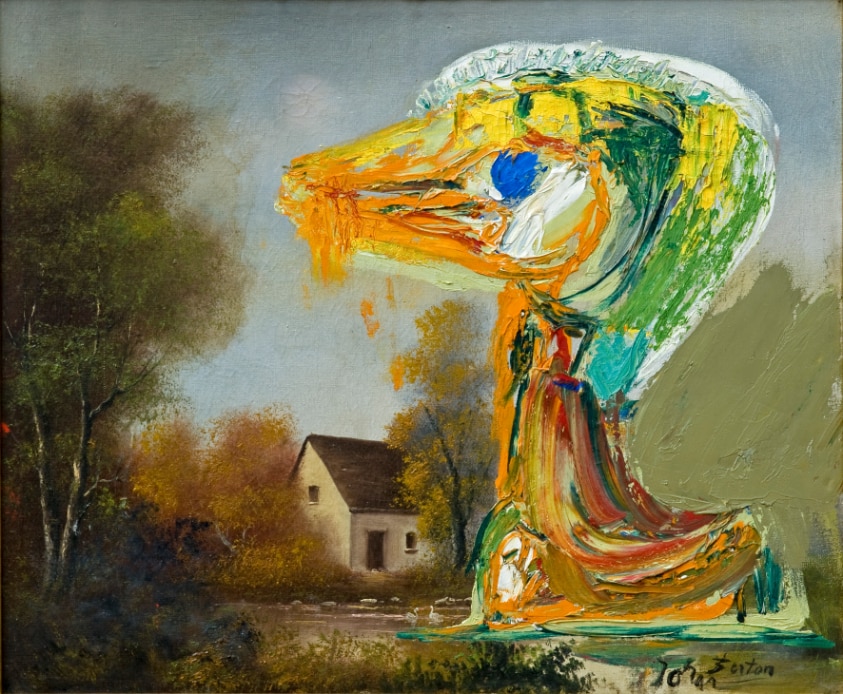
In the late 1950s, Asger Jorn developed a practice he called modifications or, in his more sardonic moods, détournement de peinture. He would visit the flea markets of Paris and Copenhagen and pick up cheap oil paintings — the kind of competent, anonymous work that fills the back rooms of brocantes and the walls of provincial hotels, landscapes and portraits and hunting scenes in ornate frames, made by people whose names nobody now remembers. He would take them home and paint over them. Not efface them — incorporate them. A bucolic scene of cows in a meadow would acquire, in Jorn’s hands, a snarling, googly-eyed creature looming from the middle distance, rendered in viscous paint, grinning with what can only be described as philosophical menace. A stiff bourgeois portrait would find itself sharing canvas with a swirling, lurid presence that appeared to be eating the original painting from the inside.
Jorn called the series Nouvelles Défigurations — New Disfigurations — and showed them with a straight face in Paris galleries. The critics were unsure whether to laugh or be offended, which was, of course, precisely the right response. The works were funny, genuinely funny, with the particular comedy of incongruity pushed past the point of comfort. They were also, beneath the comedy, making a serious argument: that the anonymous labour of forgotten painters deserved not to be discarded but to be engaged with, argued with, metabolised into something new. That tradition was not a museum but a conversation, and that conversation required, occasionally, someone willing to be rude.
Tradition was not a museum but a conversation — and that conversation required, occasionally, someone willing to be rude.
The Boy from Vejrum
Asger Oluf Jørgensen was born in 1914 in Vejrum, a small village in the Jutland peninsula of Denmark, the third of six children in a family of modest means and serious religious conviction. His father was a schoolteacher and lay preacher; the household was orderly, Lutheran, and not especially interested in art. Jorn — he adopted the name in 1945, partly for practical reasons during the German occupation, partly because reinvention was a mode of thought as well as a biographical fact — showed an early aptitude for drawing and an early impatience with the life that Vejrum had on offer. He read widely and hungrily: Marx, Nietzsche, the Norse sagas, whatever he could find. He was forming, long before he had the means to act on it, a view of culture as something you were entitled to take seriously regardless of where you came from.
At twenty, he travelled to Paris to study with Fernand Léger, arriving in 1936 with very little money and an ambition that seems, at this distance, almost comically large for someone from a Danish village who had never exhibited anything. Léger’s studio gave him access to the intellectual and artistic life of Paris at one of its most fertile and turbulent moments — the Popular Front, the Spanish Civil War, Surrealism at its height, the Communist Party drawing in artists from across the left. Jorn absorbed it all and committed to none of it, which was itself a kind of intellectual position: the refusal to be recruited, the insistence on remaining mobile.
CoBrA
In November 1948, in the café Notre-Dame in Paris, Jorn and a group of artists from Copenhagen, Brussels and Amsterdam signed a manifesto and founded a movement. They named it from their cities: Copenhagen, Brussels, Amsterdam — CoBrA. The founding members included the Dutch painter Karel Appel, the Belgian poet Christian Dotremont, and the Danish artist Carl-Henning Pedersen. What they shared was a conviction that European art had become over-intellectualised, over-theorised, too far from the sources of vitality that they located in children’s drawings, in folk art, in the automatic writing of the Surrealists but pushed further — toward rawness, toward a kind of controlled derangement, toward paint applied with a speed and physicality that left the mark of the making on the surface.
CoBrA paintings are loud. They are full of creatures — half-human, half-beast, half-something-else — rendered in unmixed colours with a brushwork that does not apologise for being brushwork. They have the quality of images made by someone who has decided that the most important thing is to get the thing out before the thinking catches up with it. This sounds, described abstractly, like primitivism, and CoBrA has sometimes been accused of exactly that — of romanticising an irrationality it should have interrogated more carefully. The accusation has some force. It does not account for the intelligence, in Jorn’s case particularly, that organised and drove the irrationality — the theoretical frameworks he was reading and writing alongside the painting, the letters and essays and philosophical tracts he produced in enormous quantities throughout his career, the evidence that the rawness was chosen rather than defaulted into.
CoBrA lasted three years. Jorn dissolved his involvement in it in 1951, when he contracted tuberculosis and spent two years in a Danish sanatorium, working obsessively — drawing, painting on whatever was available, covering the walls of his room — and thinking about what he wanted to do next. He was thirty-seven when he emerged. He had, by this point, already been a founder of one significant movement. He was about to become a founding member of another, stranger, more consequential one.
The Situationists
In 1957, at a conference in the small Italian town of Cosio d’Arroscia, Jorn co-founded the Situationist International with Guy Debord, the French theorist and filmmaker who would go on to write The Society of the Spectacle, one of the defining texts of twentieth-century radical thought. The SI was not, primarily, an art movement. It was a political and philosophical project: an analysis of how advanced capitalism had transformed lived experience into a spectacle — a system of representations that substituted images of life for life itself — and a programme for resisting that transformation through what it called the construction of situations: moments of genuine, unmediated experience wrested from the logic of the commodity.
Jorn brought to the SI his painter’s intelligence — his instinct for the concrete, his distrust of abstraction that could not be cashed out in practice — and his resources. He was, by the late 1950s, selling paintings at serious prices, and he funded the early publications and activities of the SI from his own income, a fact Debord acknowledged with characteristic ambivalence. The theoretical framework was largely Debord’s; the energy and the visual intelligence and a substantial portion of the money were Jorn’s.
The collaboration produced, among other things, two remarkable artist’s books: Fin de Copenhague (1957) and Mémoires (1959), both made in close partnership with Debord, both composed from cut-up texts and images, both held together not by argument but by the logic of collage — the unexpected conjunction, the productive violence of things placed alongside each other that were not meant to be together. Mémoires was bound in sandpaper, so that it would damage any book shelved next to it. This was not a joke. It was a statement about the relationship between the work and its context, and about what a serious object ought to be willing to do.
Mémoires was bound in sandpaper, so that it would damage any book shelved next to it. This was not a joke. It was a statement about what a serious object ought to be willing to do.
Jorn resigned from the SI in 1961. He said he was resigning in order to paint, which was true but also insufficient as an explanation. The deeper tension was between his belief that art — actual making, actual objects, the physical encounter between a body and a material — remained the site of genuine experience, and Debord’s increasing conviction that art, under the conditions of the spectacle, was irredeemably compromised and that the only honest response was its abolition. Jorn would not abolish art. He had been making it since he was a child in Vejrum, and no amount of theory, however brilliant, was going to persuade him that the act of painting was not worth doing.
Silkeborg
In 1953, Jorn donated a substantial collection of his own work and works he had collected by other artists to the town of Silkeborg in Jutland — the region of Denmark he had grown up in — to form the basis of a public museum. The Silkeborg Museum of Art, which he continued to support and donate to until his death, now holds the largest collection of his work in the world, as well as important holdings of CoBrA and related artists. It is a municipal museum in a medium-sized Danish town, and its existence is one of the more quietly radical acts of Jorn’s career: the insistence that serious contemporary art belonged not only in Paris or New York or the great metropolitan centres of the art world, but in the places where people actually lived.
This was consistent with everything else he believed. Jorn was not interested in art as a luxury, as a commodity, as the property of the wealthy and the sophisticated. He was interested in it as a necessity — as something human beings do because they must, because the making of images and objects is inseparable from the making of meaning, and the making of meaning is what distinguishes a life from a mere existence. He had grown up without access to great art and had not been diminished by this, but he had also not accepted it as natural or inevitable. He had gone to Paris at twenty and taught himself, by force of will and intelligence, everything he needed to know. He then spent the rest of his career making the argument that this kind of access should not require the force of will of an exceptional individual — that it should simply be available, as water is available, as a public good.
He was interested in art as a necessity — something human beings do because they must, because the making of images and objects is inseparable from the making of meaning.
The Paintings Themselves
It is possible to spend so much time on Jorn’s theoretical positions and his institutional activities and his foundational role in movements that changed the course of twentieth-century culture that you forget to look at the paintings, which would be a serious mistake. The paintings are extraordinary. They are full of figures that resist being named — creatures that are almost faces, almost animals, almost landscapes, hovering in that uncomfortable zone between recognition and strangeness where the most interesting images tend to live. The colour is violent and precise simultaneously: acid greens against deep ochres, reds that have no business being next to the blues they are next to and yet are irrefutably right. The surfaces are built up in layers, scraped back, built up again, carrying the record of their own revision in a way that makes the finished image feel less like a conclusion than like a process that has temporarily paused.
He died in Aarhus in 1973, of lung cancer, at fifty-nine. He had spent the last years of his life between Paris, Albisola in Italy — where he had worked in ceramics alongside Lucio Fontana and Wilfredo Lam, covering enormous plates and architectural surfaces with figures drawn from Norse myth and personal obsession — and his house in Albisola Mare, which he had decorated, inside and out, with the same compulsive generosity he brought to everything.
What Jorn left behind is not easy to summarise, which would have pleased him. He was against summaries. He was against the reduction of experience to information, of art to product, of a life to a career. He was for mess, for argument, for the productive interference of things that do not belong together, for the painting that attacks the wall next to it, for the creature that grins out of the bucolic landscape and refuses to explain itself. He spent his life making things that would not sit still, and they have not sat still since. They are still grinning. They are still, in whatever room they are in, slightly too much for it.
Works referenced: Fin de Copenhague (with Guy Debord, 1957); Mémoires (with Guy Debord, 1959); Nouvelles Défigurations (1962–ongoing series); ceramics at Albisola (1954–72). Guy Debord, The Society of the Spectacle (1967). See also Graham Birtwistle, Living Art: Asger Jorn’s Comprehensive Theory of Art (1986). This essay is part of an ongoing series, Encounters, on artists whose practice cannot be easily categorised.
Discover more from My World of Interiors
Subscribe to get the latest posts sent to your email.

