
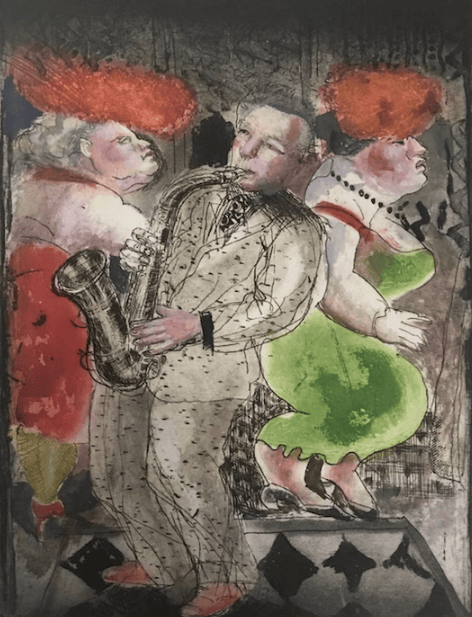
The British painter and Royal Academician, whose mysterious, richly coloured pictures transformed ordinary human life into scenes of dream, myth and private theatre, has died.
Mick Rooney, the British painter whose strange, densely imagined figurative pictures occupied a distinctive place in British art for more than half a century, has died. Born in 1944, Rooney was a Royal Academician, a former Head of Painting at the Royal Academy Schools and one of the most persistent defenders of narrative painting in a period when narrative itself repeatedly fell in and out of artistic fashion. The Royal Academy announced his death in September 2026. His final years had remained creatively active, and his work was being shown at Rye Art Gallery almost at the moment of his death, turning an exhibition planned with friends into an unintended memorial.
Rooney belonged to an increasingly rare species of British artist: a painter for whom the painted image remained capable of containing almost everything. Memory, literature, mythology, sex, anxiety, humour, travel, religion, dreams, domestic life and the peculiar comedy of human behaviour all found their way into his pictures. His people inhabit rooms, streets, gardens and landscapes that initially appear recognisable but never remain entirely stable. Something has happened, or is about to happen. A glance passes between two figures. A strange animal appears. A person seems simultaneously participant and spectator. The everyday slips almost imperceptibly into allegory.
For Rooney, this was not Surrealism in the orthodox sense, although the adjective surreal is frequently applied to his work. His imagination was less interested in the unconscious as an autonomous realm than in the strange material human beings already carry around with them: memories, folktales, superstitions, half-remembered paintings, songs, books, dreams and private embarrassments. His pictures suggest that ordinary consciousness is already fantastical enough. The task of the painter is simply to notice what is accumulating inside it.
He was born in Epsom, Surrey, in 1944 and grew up in Sutton and London. His formal education moved through Sutton School of Art from 1959 to 1962, Wimbledon School of Art from 1962 to 1964 and the Royal College of Art between 1964 and 1967. At the RCA he was awarded the Austin Abbey Major Scholarship, which took him to the British School at Rome in 1967–68. Rome mattered. Rooney’s later work retained something of the compositional density of early Italian painting: figures arranged within shallow spaces, gestures carrying narrative weight, the picture behaving not as an instantaneous snapshot but as a field across which a story could unfold.
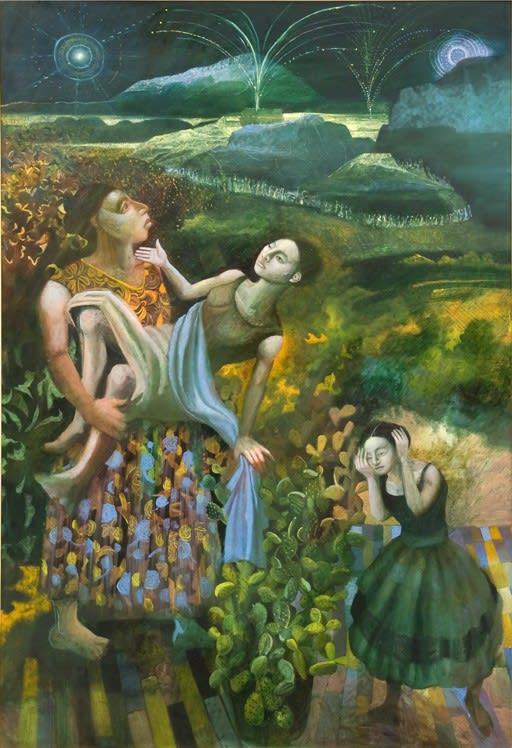
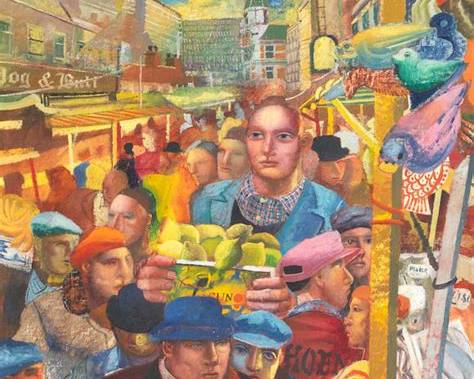
During this period he was commissioned by the Franciscan Order to produce a wall mosaic for a new basilica in Nazareth. It was an appropriate early undertaking for an artist who would remain fascinated by the border between painting, storytelling and the icon. Rooney later described himself quite explicitly as a narrative painter and preferred the idea of “illumination” to illustration. The distinction was important. Illustration, within the old hierarchy of fine art, was presumed to serve a pre-existing story. Illumination suggested something more mysterious: an image capable of clarifying a story while simultaneously enlarging it.
That idea became central to his mature work. Rooney painted stories without necessarily providing their plots. His figures seem to possess histories that we have entered too late to hear in full. Lovers, musicians, travellers, children, animals and solitary men and women recur, yet they are rarely straightforward characters. They belong to a theatrical company permanently moving between memory and invention.
His travels expanded that theatre. Rooney lived for periods in Italy and Spain and travelled through Holland, Morocco, Mexico, the Seychelles, Antigua and Romania. Mexico became especially important. He travelled in Oaxaca and Chiapas, spending time in Indigenous communities, and its visual culture entered deeply into his imagination: brilliant colour, ritual, crowded composition, masks, death, celebration and the proximity of the sacred to ordinary life. His 2024 book Touching Mexico brought together decades of this fascination, recording a country that had become less a source of picturesque motifs than part of his internal visual vocabulary.
Yet Rooney was never simply an exoticist collecting images from elsewhere. Travel interested him because it destabilised the familiar. A market, a wedding, a musician, a street or a procession could become a way of looking again at the perennial subjects underneath: desire, loneliness, performance, mortality, companionship. His pictures repeatedly return to what galleries representing him have aptly called the “human condition,” though Rooney’s treatment of it was far less portentous than the phrase suggests. There is melancholy in his work, but also mischief. Human beings are tragic, certainly, but they are also peculiar.
This humour separated Rooney from much expressionist figurative painting. His subjects could be psychologically charged without becoming solemn. A goldfish might acquire the gravity of a confidant; musicians appear both heroic and faintly ridiculous; lovers occupy rooms whose emotional temperature seems more important than their architecture. He had a particular sympathy for people caught in states of waiting, watching, remembering and wondering — the apparently uneventful moments in which private narratives proliferate.
The technique was equally important. Rooney worked across oil, gouache, tempera, drawing and printmaking, building surfaces through revision, glazing, covering and rediscovery. He spoke of the “under spirits” created when an earlier image was obliterated or painted over. The phrase is revealing. A Rooney painting often appears inhabited not merely by what is visible but by what has been suppressed beneath it. Paint itself becomes a form of memory.
That insistence on craft placed him within a long figurative tradition at precisely the moment when British art was repeatedly announcing painting’s exhaustion. Rooney’s career extended through Conceptualism, Minimalism, Neo-Expressionism and the spectacular ascent of the Young British Artists, yet none caused him to abandon the premise that a brush, pigment and a human figure remained intellectually sufficient materials. This was not conservatism so much as confidence in painting’s enormous elasticity. His pictures could absorb Kafka, popular music, medieval icons, Mexican folk culture, domestic anecdote and contemporary neurosis without requiring painting to cease being painting.
There was also a specifically British lineage behind him. The crowded psychological spaces of Stanley Spencer, the narrative eccentricity of Carel Weight and the broader postwar tradition of figurative painting provided an environment in which Rooney’s imagination could develop. As a schoolboy he and his lifelong friend, the artist Gus Cummins, even encountered an elderly Spencer during a visit to Cookham. In retrospect the meeting seems almost too symbolically neat: one eccentric English narrative painter glimpsing, at the beginning of his life in art, another nearing the end of his.
Rooney nevertheless refused to become merely a continuation of that tradition. His visual culture was too geographically restless and his imagination too promiscuous. Islamic and Jewish imagery, Christian iconography, European painting, literature, poetry, folktale and travel coexist without settling into a single doctrine. The pictures often resemble secular altarpieces for people uncertain what they believe.
His professional career gathered momentum through the 1970s and 1980s. Early exhibitions took place in London, Amsterdam and The Hague, while regular shows at London’s Mercury Gallery began in 1984. In 1983 he was artist in residence at the Towner Art Gallery in Eastbourne. A substantial retrospective covering the decade from 1978 to 1988 toured Folkestone, Eastbourne and Bath in 1989. By then he had accumulated an unusual number of prizes, including the John Player Portrait Award at the National Portrait Gallery in 1985, the Daler/Rowney Prize at the Royal Academy in 1986, the House & Garden Magazine Award in 1988 and the Korn/Ferry International Premier Award at the Royal Academy in 1989.
He was elected an Associate of the Royal Academy in 1990 and a full Royal Academician the following year. In 2001 he became a member of the Royal Society of Painter-Printmakers. Rooney subsequently served as Head of Painting at the Royal Academy Schools, making his importance to British painting institutional as well as personal. Teaching mattered within his career because he belonged to a generation for whom painting was understood partly as accumulated knowledge: how colour behaves, how bodies occupy space, how the history of pictures can be learned and then disobeyed.
His commissions demonstrated the unusual reach of his visual language. He created a painting for the centenary of the Financial Times in 1988, produced a poster for London Underground in 1990 and designed imagery translated into tapestry. His work entered the Government Art Collection and the Royal Collection as well as numerous institutional and private collections; collectors included Queen Elizabeth II and Paul McCartney.
Yet official recognition never quite explains Rooney’s appeal. His work inspires the particular loyalty reserved for artists whose pictures feel like worlds rather than styles. Once one recognises a Rooney, one begins to recognise them almost immediately: the compact figures, unexpected shifts of scale, glowing colour, compressed space, atmosphere of dream and the impression that every object has been assigned a role in a story nobody has completely explained.
Late in life, that imaginative energy showed little sign of becoming tidy. His 2019 exhibition From Genesis to Nemesis returned characteristically to enormous subjects — creation, destruction, humanity’s relationship with nature — without surrendering the humour and visual eccentricity that prevented the pictures from becoming sermons. His more recent works continued to combine animals, humans, landscape and mythology as though civilisation itself were one long, peculiar procession.
The circumstances surrounding his final exhibition are especially poignant. In September 2026, Rye Art Gallery opened September Song, an exhibition centred on Rooney’s friend Louis Turpin that also featured Rooney’s paintings. Rooney died only days before the opening. Turpin recalled not only decades of exhibiting together but evenings playing guitars at home and at parties. Rooney’s family attended the opening, and what had been conceived as another gathering of artists and friends became a celebration of a career that had just ended.
There is something appropriate in this. Rooney’s paintings were always populated. Even their loneliness is social. People arrive, depart, watch one another, play music, dream, disguise themselves and carry obscure burdens. His was not an art of the isolated heroic individual but of human beings entangled in stories — family stories, cultural stories, religious stories and stories they barely understand themselves.
In the history of recent British art, Rooney may ultimately matter precisely because he declined to accept one of modernism’s most persistent assumptions: that sophistication requires the abandonment of storytelling. He understood that narrative could be psychologically complicated, formally ambitious and deeply painterly. A picture did not have to choose between being an object and telling a story. It could do both.
Mick Rooney spent more than half a century painting the peculiar theatre that exists between what happens to us and what we imagine has happened. His figures remain suspended there, amid animals, lovers, musicians, myths and memories, inhabiting worlds that are recognisably ours but never entirely explicable. He understood that human beings do not live by facts alone. We live among stories, and Rooney painted the strange, comic and sometimes melancholy things those stories make of us.
Sources / Read More
Royal Academy of Arts, announcement of Mick Rooney’s death and artist records, September 2026; reported by ArtDog Istanbul.
Rye News, “Great Dixter through the seasons,” including tributes to Rooney following his death and the opening of September Song, September 2026.
Rye Art Gallery, Mick Rooney RA biography, exhibitions, awards and commissions.
Government Art Collection, Mick Rooney artist biography and collection record.
Fosse Gallery, Mick Rooney RA — biography and account of his narrative, poetic and humanistic approach to painting.
Portal Painters, Mick Rooney RA — artist statement, career chronology and reflections on narrative painting.
Unicorn Publishing, Touching Mexico by Mick Rooney, biographical and publication information.
Discover more from My World of Interiors
Subscribe to get the latest posts sent to your email.

