
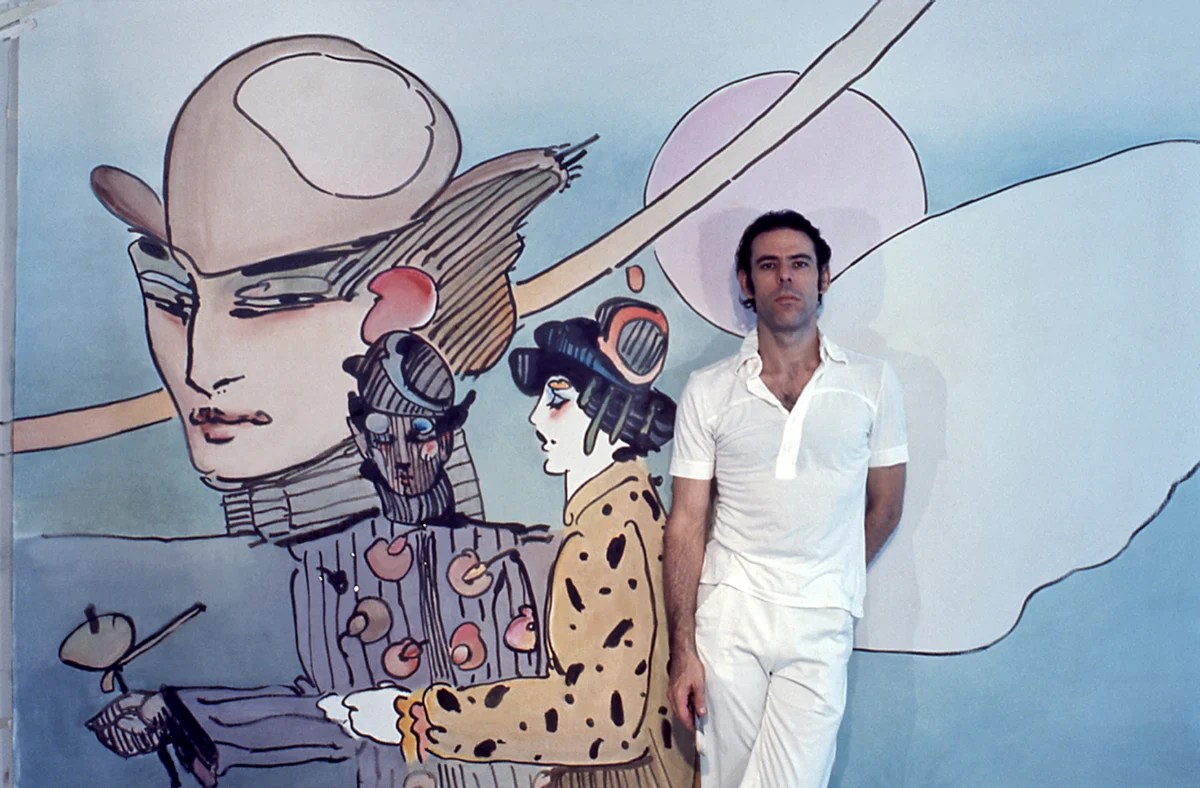
The German-born American artist, whose ecstatic suns, rainbows, cosmic figures and Day-Glo colours became part of the visual language of the 1960s, has died aged 88.
Peter Max, the artist whose brilliant colours, cosmic landscapes and buoyant psychedelic imagery became almost inseparable from the visual culture of the American 1960s, died on 14 September 2026 at a hospital in Manhattan. He was 88. His death was announced by his son, Adam Max. In his later years, Max had lived with advanced dementia and had largely withdrawn from public life.
Few artists have been so completely absorbed into the visual memory of an era. Max’s suns had faces; his skies turned orange, purple and electric blue; figures floated through expanses of stars, flowers, planets and clouds. His world was recognisable before one had encountered his name. At the height of his fame, his designs appeared not only in galleries but on posters, record sleeves, clothes, clocks, bedspreads, mugs and magazines. The distinction between an artwork and an image circulating through popular culture was one he cheerfully complicated long before such boundaries became a routine subject of contemporary art.
For that reason, Max occupies a curious position in twentieth-century American art. He was extraordinarily famous without ever fitting comfortably into the official hierarchy of Pop Art. Andy Warhol entered the museum canon by exposing the mechanisms of celebrity and consumer culture; Roy Lichtenstein appropriated the visual grammar of advertising and comics with an ironic coolness. Max approached mass culture without much irony at all. He believed in colour, pleasure, accessibility and visual abundance. If Warhol’s America was simultaneously alluring and faintly sinister, Max’s America appeared to be perpetually approaching sunrise.
The optimism was all the more remarkable given the circumstances of his early childhood. Peter Max Finkelstein was born into a Jewish family in Berlin on 19 October 1937. His parents fled Nazi Germany while he was still a baby and settled in Shanghai, where he spent much of his childhood before the family lived in Israel and, briefly, Paris. They eventually arrived in New York in 1953, when Max was sixteen. By then he had already developed interests that would remain central to his imagination: drawing, astronomy and the dazzling imagery of American popular culture.
In New York he received a surprisingly traditional artistic education. He studied at the Art Students League under the realist painter Frank J. Reilly and later continued his artistic training in the city. His early discipline therefore lay in figure drawing, anatomy, composition and realism rather than psychedelic experimentation. In the early 1960s he established a graphic-design studio with Tom Daly, producing book jackets and commercial illustrations before developing the visual vocabulary that would make him famous.
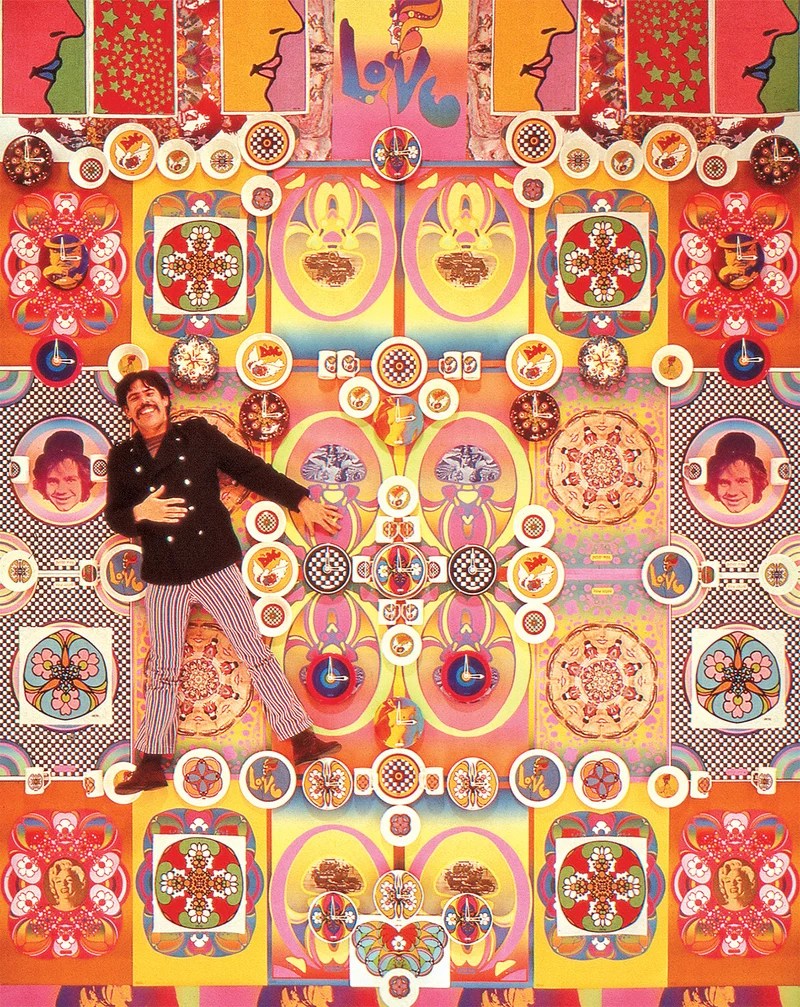
It arrived at precisely the right historical moment. By the later 1960s, American visual culture was being transformed by the space race, rock music, Eastern spirituality, anti-war politics, experimental typography and the rapidly expanding youth market. Max absorbed all of it. Astronomy gave him planets, stars and cosmic depth; Art Nouveau contributed sinuous line; Fauvism provided permission for colour to become almost independent of natural appearance. The expanding counterculture supplied peace signs, flowers, mysticism and the dream of consciousness transformed.
The resulting images were not records of psychedelic experience so much as advertisements for possibility. Figures drifted weightlessly through enormous skies. Colours existed at a pitch rarely encountered in respectable painting. Faces appeared in profile beneath stars and radiant suns. There was something childlike in the imagery without its being entirely innocent: Max had grasped that one of the great cultural commodities of the later 1960s was not rebellion alone but transcendence. His pictures offered a world in which the ordinary constraints of grey postwar life seemed temporarily suspended.
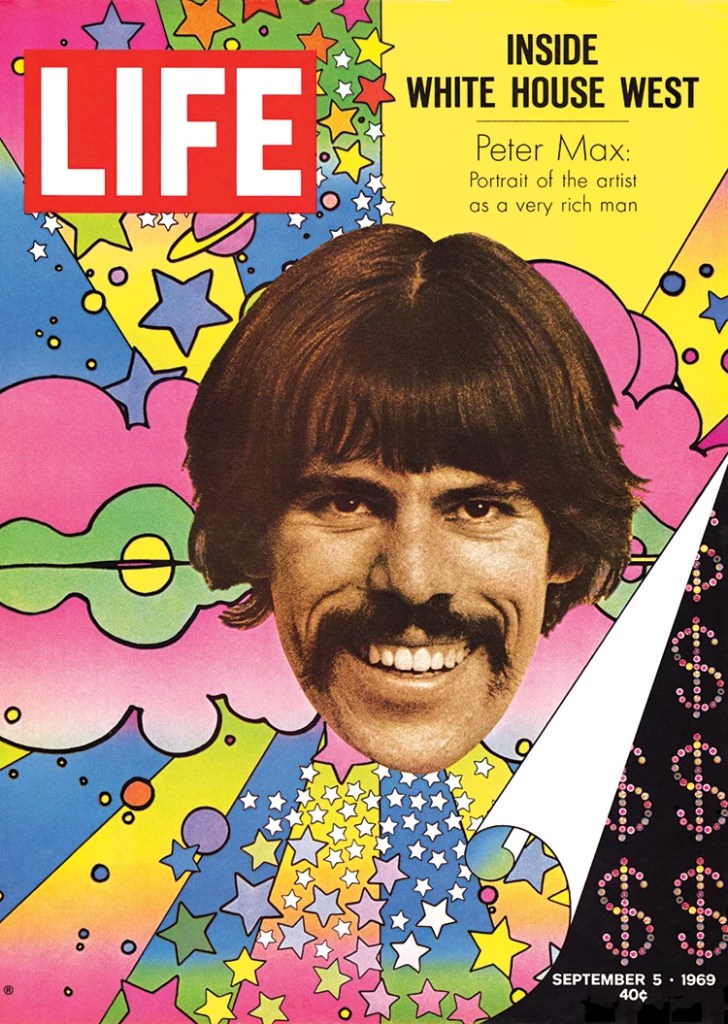
By 1969 he was famous enough to appear on the cover of Life. His images had meanwhile escaped the conventional confines of art almost completely. Companies licensed Max designs across scores of product lines, and his pictures entered bedrooms, kitchens, boutiques and college dormitories. The scale of the enterprise eventually troubled even him. Commercial success had grown so rapidly that he felt himself drifting away from painting, and in the early 1970s he pulled back from the business for a period in an attempt to return to the studio.
This tension between art and merchandising followed him throughout his career. To some critics, the ubiquity of the Max image diminished it. Repetition converted a once-radical psychedelic vocabulary into decoration, while the sheer volume of licensed objects made him easy to dismiss as a businessman with a paintbrush. Max rejected the assumption that commercial success invalidated artistic seriousness. His argument was essentially democratic: reproduction allowed people who would never own an expensive painting to live with art. In this respect his career anticipated a contemporary culture in which artists routinely move between museum exhibitions, fashion collaborations, mass editions, branding and public commissions.
His significance therefore cannot be measured solely by conventional art-world prestige. Max understood images as things capable of moving through society, and he possessed an instinctive understanding of visual branding before the term acquired its present meaning. His palette, motifs and graphic rhythms formed a coherent identity that could survive almost any change of scale, from a postage stamp to the side of an aircraft. The artist himself became inseparable from that identity: moustached, cosmopolitan, spiritual, prolific and seemingly permanently surrounded by paint.
After withdrawing temporarily from public life, Max returned to painting and gradually developed a more gestural manner. Among his most persistent subjects was the Statue of Liberty, which he first painted extensively around the American Bicentennial. During the following decade he became closely associated with efforts surrounding restoration of the monument. Liberty would remain one of his principal motifs, repeatedly transformed through saturated reds, blues, yellows and greens.
Public commissions proliferated. He became an official artist for major sporting events including Super Bowls, the World Cup and the Olympics; his work eventually appeared across an extraordinary range of surfaces, including aircraft, cruise ships and race cars. Portraits of musicians, public figures and celebrities expanded another branch of his practice. His New York studio eventually became a substantial commercial operation, producing and selling large numbers of works and editions.
One persistent piece of Max mythology also deserves correction. His aesthetic became so identified with the psychedelic 1960s that he has often been credited with the imagery of the Beatles’ Yellow Submarine. The film’s distinctive visual design was principally the work of Heinz Edelmann, not Max. The confusion is itself revealing. Max’s imagery became so culturally pervasive that an entire period of psychedelic graphic design could retrospectively look as though it belonged to him.
His philosophy of colour was connected to a wider spiritual curiosity. Max practised yoga and maintained a longstanding interest in Eastern spirituality. Yet his paintings seldom became doctrinal. Their spirituality remained visual and atmospheric: suns, stars, hovering figures, ecstatic colour and an insistence upon the universe as a place of extraordinary abundance. His work depended upon the idea that colour could do more than decorate an image; it could alter mood, perception and, for a moment at least, one’s sense of what the world might contain.
There were less luminous chapters. In 1997 Max pleaded guilty to tax evasion after federal authorities accused him of concealing more than $1 million in art income. He later served time in a work-release arrangement, paid back taxes and a fine, and performed community service. In later life, as his health deteriorated, bitter disputes involving relatives, guardians and business associates raised questions about his finances and whether an increasingly vulnerable artist was being exploited. The claims made during those disputes were often contested, making the final chapter of his life considerably darker and more complicated than the public optimism of his pictures.
Max is survived by his children, Adam and Libra. Their recollections of him emphasised his kindness, curiosity and persistent ability to see beauty and possibility in the world around him. That language is striking because joy, so frequently regarded with suspicion in serious art, was not incidental to Max’s work. It was its organising principle.
The critical question surrounding Peter Max has always been whether his enormous popularity should be understood as evidence against his seriousness or as the central fact of his achievement. Half a century after his breakthrough, the latter possibility looks increasingly interesting. The modern history of art cannot be confined to objects hanging quietly in museums. It also belongs to advertising, album covers, magazines, clothes, film, graphic design and the images with which people furnish their private lives. Max moved almost frictionlessly among these worlds.
He also captured something genuine about the particular optimism of the late 1960s, before psychedelia hardened into nostalgia and the visual language of counterculture became a commercial style. His universe suggested that colour itself might constitute a form of liberation, that consciousness might be expanded, that peace might be imaginable and that the future, however improbable the proposition may now seem, could be brighter than the present. The imagery could be naïve, repetitive and relentlessly affirmative, but those qualities were integral to its historical meaning.
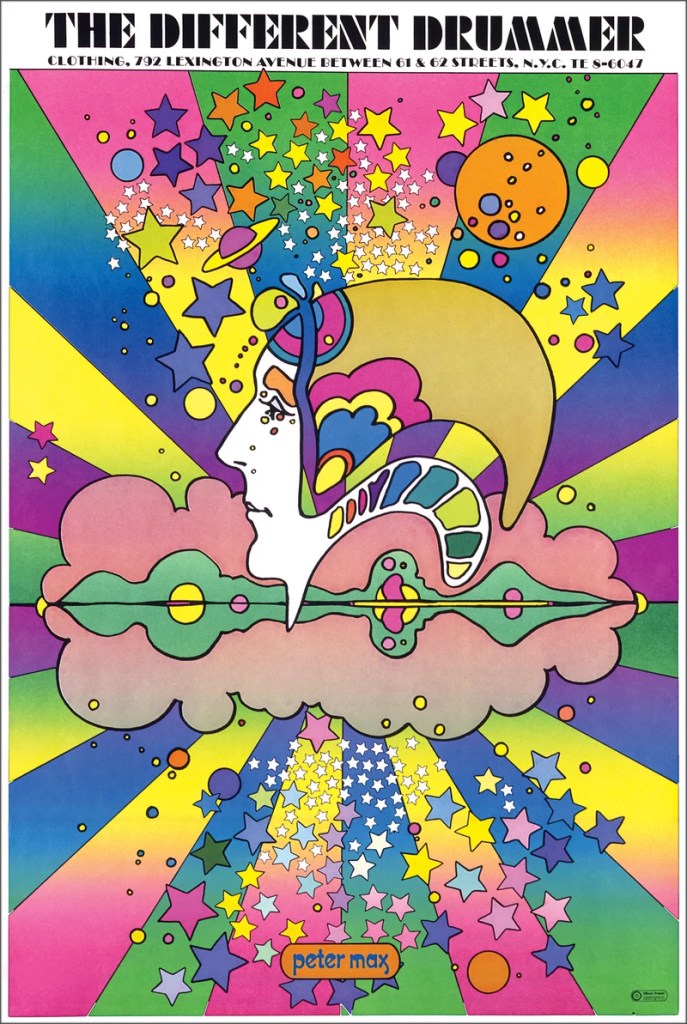
Peter Max did not merely illustrate the counterculture. He helped make its fantasies visible. His stars, rainbows, profiles, planets and impossible skies entered the collective imagination so thoroughly that they eventually ceased to look like the inventions of an individual artist and began instead to look like the 1960s themselves. That may be the peculiar measure of his achievement: he created a visual language so widely reproduced that it became difficult to remember there had once been a moment before we knew how to see the world in Peter Max colours.
Sources / Read More
Associated Press, obituary of Peter Max, 16 September 2026.
Reuters, “Peter Max, known for groovy art that came to symbolize the 60s, dies at 88,” 17 September 2026.
Peter Max Studio, official biography and archive.
Artnet News, “Peter Max, Whose Psychedelic Paintings Defined the 1960s, Dies at 88.”
Discover more from My World of Interiors
Subscribe to get the latest posts sent to your email.

